

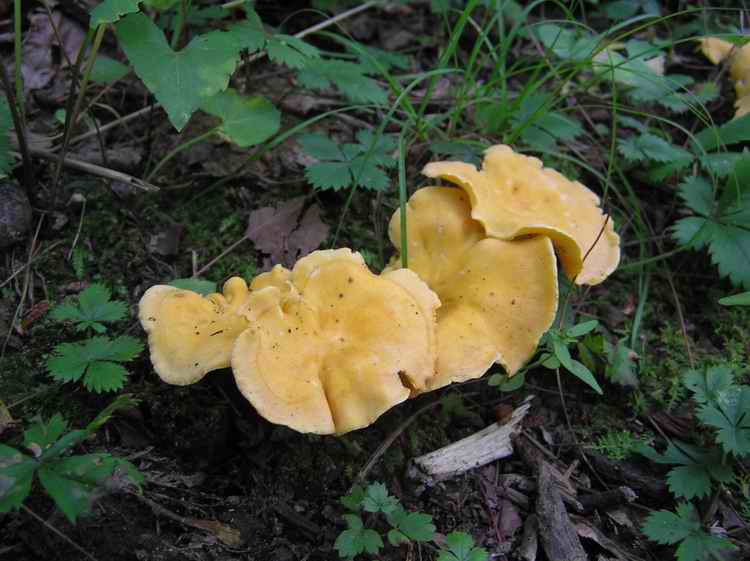
Common Name: Chanterelle, Golden chanterelle, Smooth chanterelle– Of French origin from Latin cantharis, a drinking vessel. Derived from Greek kantharos, more specific as “a deep cup of ancient Greece with a high stem … continuing the curve of the bottom of the body and rising above the rim” [1] This describes the shape of the mushroom with its cup-shaped cap and decurrent ridges that extend down the stem. Perhaps not inconsequently, chanterelle is also a French word for the highest string of a piano. The verb chanter meaning to sing, an apt metaphor for the many positive qualities of chanterelles.
Scientific Name: Cantharellus cibarius – The genus name is from cup as above. The species name is from the Latin meaning “relating to food.” It is thought to be derived from the Greek dialectal kibba, an animal’s fodder bag, emphasizing the historical tradition of chanterelles as choice edible mushrooms. C. cibarius was once treated as a single species. Due to DNA revelations and consequent renaissance of biology, the golden chanterelle is now considered to be a complex of related but different species, following the trend of many mushrooms that must comply with the hard-wired reality of genetics.
Potpourri: Chanterelles are likely the most well-known of edible fungi across the globe, notably in North America and Europe but almost equally in Asia and Africa. This is due to four factors. The most significant is that they are relatively easy to find. The bright yellow orange of the cap stands out against the green undergrowth of forest understory where they thrive. Of equal importance is that chanterelles are distinctive enough to allow for positive identification even among neophyte mushroom hunters. The erstwhile doppelgänger Jack-O-Lantern is only a minor impediment to confident identification, a necessity for mushroom consumption. The third factor is that they frequently fruit in extensive flushes that can blanket the ground, providing a veritable cornucopia for the gatherer. And last but not least, they are consistently delectable, choice even, and can be eaten as a side dish or added to soups, salads, or just about anything else.
The most distinctive feature of mushrooms in the Chanterelle Family Cantharellaceae is that they have ridges instead of gills, like most agarics, or tubes extending inward from the visible pores, like boletes and bracket fungi. The ridges of the chanterelles are similar in form and function to the surfaces of coral and tooth fungi in that they support the hymenium, the name for the all-important spore bearing or fertile layer of a fungus. The sole function of the mushroom, the fruiting body of the fungus, is to produce reproductive spores. Since living things must reproduce to perpetuate their genes, fungi in general evolved to produce as many spores as possible. Gills and pores are configured to maximize the surface area of the hymenium, which covers both sides of the gill or the entire circumference of the tube. A spore on a vertical gill or circumferential tube surface cannot simply be released as it would get stuck to the surface. The evolved mechanism to shoot the spore away from the hymenium involves a drop of water condensed from atmospheric moisture under the cap (which is one reason why rain is important for mushrooms). Called a surface tension catapult, the drop’s adherence to the surface of the spore propels it at a speed of about 10 miles per hour with an acceleration of some 25,000 times the force of gravity called G-Force or simply G’s (see HNB article on Parasol Mushrooms for more details). [2]

Chanterelles and other fungi with the hymenium extending across a relatively flat (albeit ridged) surface followed a different evolutionary path. It is generally accepted that this surface spore dispersion physiology is more primitive than that of the gilled and pored fungi. This would follow the logical path of progression from producing a limited number of spores on a flat surface to the much more efficient and prolific spore production of gills and pores. The spore production dichotomy is also reflected in the relative growth and maturity of chanterelle family fruiting bodies. Whereas most mushrooms come up overnight and open almost immediately to release a torrent of spores, deliquescing to muck in about a week, chanterelles grow slowly, about one inch per month, and persist for up to three months. Chanterelles thus produce mature spores slowly over a much longer time frame and in significantly smaller numbers. [3] This raises (at least) two questions: (1) Since the fruiting bodies of chanterelles persist for so long, how do they keep from getting eaten by animals, notably insects; and (2) Since they produce a relatively limited number of spores, how can chanterelles compete successfully in an environment shared with the multitudes of spores created by all of the other fungi that specialize in spore saturation?
To answer the first question, field observation confirms that chanterelles are rarely subject to significant predation. They are almost always found intact with none of the obvious scars and torn edges that are indicative of incision by insects. In contrast, most of the other mushrooms encountered on woodland byways have pieces missing, notably the gilled mushrooms of the Russula genus and the mushrooms with pores collectively called boletes. When collected chanterelles are sorted, the older ones are excluded from the cookpot due only to general degradation in the form of dryness and chalking and not due to embedded bugs. A study conducted in Finland where chanterelles proliferate found that only one percent of chanterelles had insect larvae compared to over fifty percent for other mushrooms. The only reasonable explanation for this observation is that chanterelles have evolved some form of chemical compound that acts as a deterrent to consumption by animals. This is hard to reconcile with the appeal of chanterelles to human animals. The delicate fruity smell of chanterelles, usually compared to apricots, is retained on cooking to impart a similar taste when eaten. [4] It is hard to imagine how an apricot aroma would deter animals, humans excepted. It is an as yet unresolved conundrum.
The second question concerns the ability of spore-sparse chanterelles to compete with spore-sporting fungi. It is related to the degree and extent of the association between trees of the forest and fungal mycelia. The mycelium is the corpus of the fungus from which the mushroom fruiting bodies sprout to sporulate. Mycelia consist of bundles of the root-like tendrils called hyphae that emerge from spores when they germinate. Since fungi are heterotrophic, they must locate and metabolize nutrients from external sources. Only plants are autotrophic. Many if not most fungi that produce mushrooms form a mutualistic relationship with trees called mycorrhizal, literally “fungus root” in Greek. Fungal hyphae surround the roots of trees in a sheath, a configuration called ectomycorrhizal. At the molecular level, the fungus provides minerals, notably phosphorous, and water to the tree in return for the hydrocarbons produced by photosynthesis. Chanterelles compete well with other forest mycorrhizal mushrooms in spite of slow growth and fewer spores. This is in part because they are masters of mycorrhizal matchups. Tolerant of soil variance that can range from limestone to weathered granite, they form partnerships with many different tree types. The golden chanterelle, C. cibarius, has been found to associate with 14 different tree genera ranging from pines to oaks. [5] This relationship is long term − chanterelles can be found in the same areas because they have been nourished by the same forest for decades.
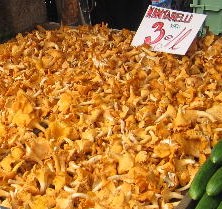
The global renown of chanterelles is due to their reputation among gourmands as exceptional ingredients to any cuisine. This is in no part diminished by the fact that they are not cultivated and must therefore be hand-picked by foragers who know where to find them. It has even been suggested that one way to gain the gratitude of gourmet chefs is to arrive at their restaurant with a basket of harvested chanterelles to be prepared for a meal, leaving the excess for the use of the chef in other dishes. [6] The mycorrhizal relationship between chanterelles and trees is complex. and, although there has been some modest success in promoting chanterelle growth in dedicated plantations inoculated with spawn, it has been largely experimental and not scalable. This is contrary to the common wisdom that they are “easy to transplant within congenial habitats by mycelium or spores.” [7] Recipes for chanterelles abound, ranging from sauteed in oil and seasoned with salt and pepper to Venetian “Chanterelles Risi e Bisi” (rice and peas) and Mid-Atlantic “Chanterelle Sea Food Stew.” [8]
The demand for chanterelles often exceeds the local supply resulting in national and even international trade to reduce deficits. Germany is the epicenter of both chanterelle consumption and depletion. While most of German imports come from Lithuania, Poland. and Belarus, five million pounds, come from the Pacific Northwest of the United States. [9] This is a small fraction of the annual international trade in chanterelles, estimated at over 400 million pounds. Where trade is reduced or restricted, local demand can result in depletion, threatening local populations. For example, in Saarbrucken, Germany, seven tons of chanterelles were sold annually in the mid 1950’s. By 1970, the local harvest had plummeted to half a ton. While the decline in chanterelles is to some extent a result of overconsumption, there a general decline of mycorrhizal fungal globally due to habitat loss as forests are cleared for agriculture or urban expansion. A survey conducted in the Netherlands found that between 1972 and 1989 the average number of mushrooms in a 1000 square meter plot fell from 4720 to 370. [10] This has in part been compensated by the surge in production of cultivated mushrooms like button mushrooms and shitakes. Uncultivated chanterelles are in a category of their own in being totally dependent on nature vice nurture.
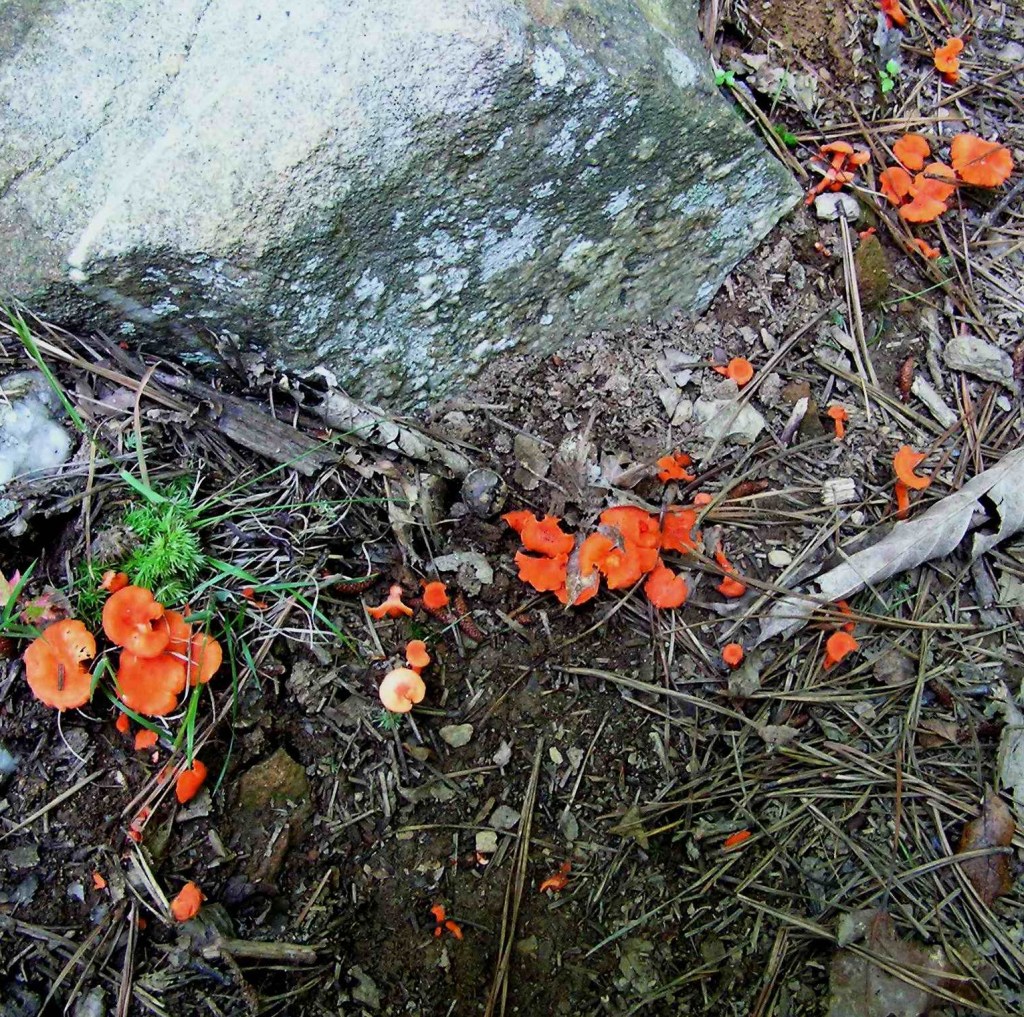
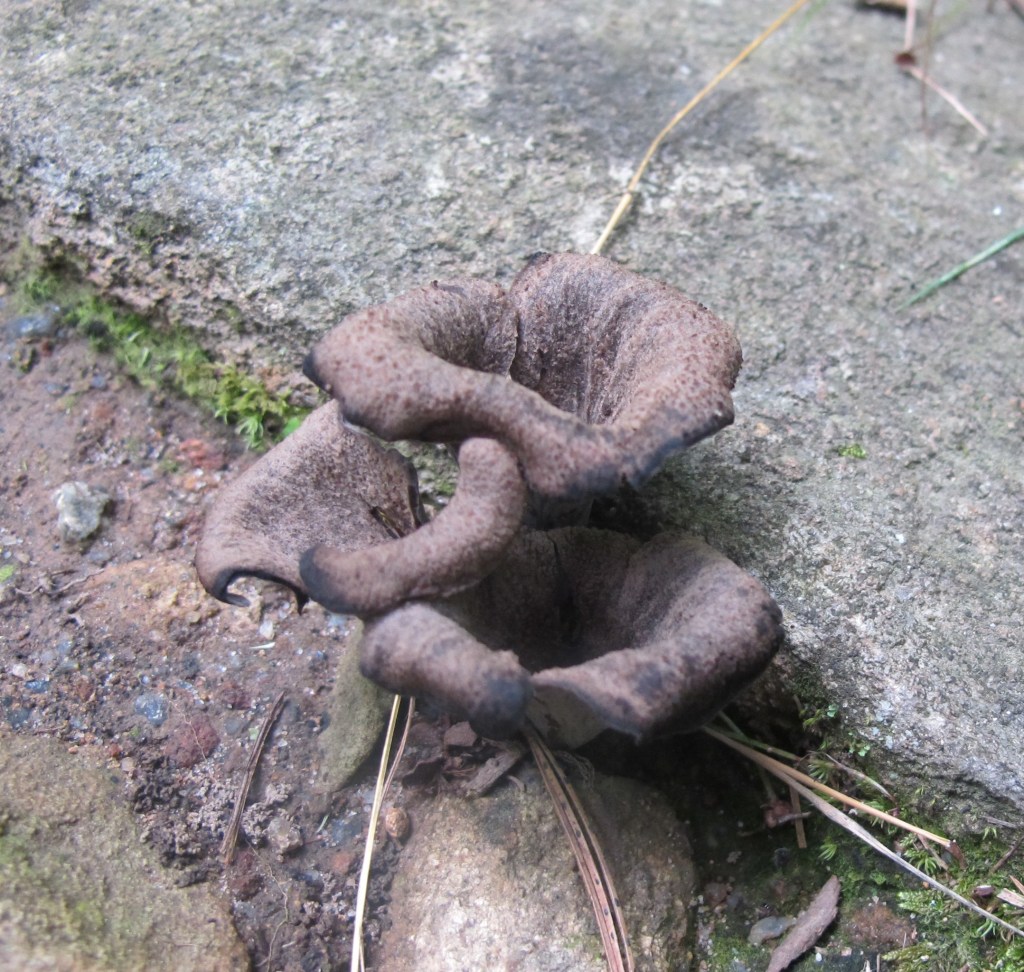
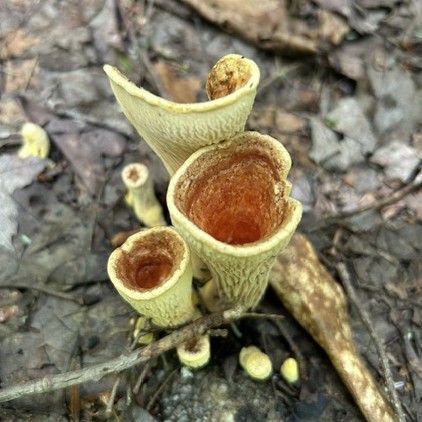
The chanterelle family Cantharellaceae is comprised of genetically related mushrooms that evolved with ridges instead of gills as the reproductive spore bearing surface. While the golden chanterelle (C. cibarius) is the most common, the Cinnabar-red Chanterelle (C. cinnararinus) is a close second and is also edible. Found in expansive tracts in open oak woods, it is rarely harvested due to its diminutive size with a cap diameter that rarely exceeds one centimeter. The Black Trumpet (Craterellus fallax) which shares the highest gastronomic encomium as “choice” like the golden chanterelle, is less common and difficult to spot due to its monochromatic blackness. However, its fruity smell is pungent, providing a second sensory vector for localization. Not all chanterelles are edible. The Scaly Vase Chanterelle (Gomphus floccosus) looks like a chanterelle that never opened, frozen in position without the namesake cup shape. It contains indigestible acids that convey a sour taste making it unpalatable. [11]
Because of the global reach of chanterelles among diverse human populations for millennia, local traditions have led to an array of descriptive common names. Language traditions predate the establishment of modern nation states resulting in substantial variance in one area or language. In German, the names include pfifferling, pepper mushroom, dotterpilz, egg yolk mushroom, and hasenöhrlein, little hare ear. The French don’t call it chanterelle, in spite of its Latin etymology. It has many other names instead, ranging from chevrette, small goat, and crete du coq, cock’s crest, to girolle, twisted mushroom. From the Netherlands north into Scandinavia, it is typically referred to as simply kantarell, a Germanic derivative of chanterelle. China has a long cultural history that involves fungi that probably reaches into the Neolithic Age. Chanterelles were not only consumed, as jiyou-jun, chicken fat mushroom, or xingjun, apricot mushroom, but also used to treat dry skin and prevent night blindness. [12] Suffice it to say that chanterelles are a remarkably global species.
Chanterelles are not only nutritious but contain several important medicinal compounds. A commonly referenced quote from a 19th century European source asserts that “Not only this same fungus [the chanterelle] never did any harm (sic), but it might even restore the dead.” [13] This is evidence of a global consensus that chanterelles and ambrosia are synonymous. Like most mushrooms, chanterelles have high levels of protein (about 10 percent by dry weight), potassium (5 percent) and nitrogen (3 percent) in addition to the fiber-rich chitin that is the structural building block of fungal cells (as cellulose is for plants). Chanterelles have levels of vitamin D comparable to the inimitable cod liver oil, and vitamin A, a result of the beta-carotenes responsible for the yellow and red hues − an antidote for vision problems like night blindness. [14] It is no small wonder then that evocative joy emanates from mushroom foragers on discovering a chanterelle expanse along a forest corridor. They may even break into song.
References:
1. Webster’s Third New International Dictionary of the English Language, Unabridged. G. C. Merriam-Webster Co. New York, 1966.
2. Kendrick, B. The Fifth Kingdom, Focus Publishing, Newburyport, Massachusetts, 2000, pp 80-98.
3. Pilz, D. et al “Ecology and Management of Commercially Harvested Chanterelle Mushrooms” USDA General Technical Report, PNW-GTR 576. March 2003 https://research.fs.usda.gov/download/treesearch/5298.pdf
4. Schaechter, E. In the Company of Mushrooms, Harvard University Press, Cambridge, Massachusetts, 1997, pp 132-133.
5. Pilz, D. et al op. cit.
6. Russell, B. Field Guide to Wild Mushrooms of Pennsylvania and the Mid-Atlantic, Keystone Books, Pennsylvania State University Press, University Park, Pennsylvania, 2006.pp 100-101.
7.McIlvane, C and Macadam, R. One Thousand American Fungi, Dover Publications, New York, 1973, pp 214-220.
8. Casciero, A. “A Chanterelle Extravaganza” Fungi Magazine, Volume 10 Number 2, Summer 2017. Pp 39-42
9 Arora, D. Mushrooms Demystified, 2nd Ed., Ten Speed Press, Berkely, California, 1986, p. 658.
10. Carlile, M., Watkinson, S., and Gooday, G. The Fungi, Elsevier Academic Press, London, 2001, pp354-355.
11. Lincoff, G. National Audubon Society Field Guide to North American Mushrooms, Alfred A. Knopf, New York, 2002, pp 387-398.
12. Pilz, D. et al op. cit.
13. Trattinick, L. 1764-1849 Die essbaren schwmme des Oesterreichischen Kaiserstaates (which translates literally as Edible Sponges of the Austrian States – probably dialect for mushrooms) https://archive.org/details/dieessbarenschwm00trat/page/n35/mode/2up (often quoted in numerous sources)
14. Pilz, D. er al op. cit.

