


Common Name: Bobcat, Bay Lynx, Wildcat, Barred bobcat, Pallid bobcat, Red lynx – The bobcat is named for its diminutive tail; bob in the sense of a knob, knot or twist of yarn or hair is of Celtic origin – in Gaelic a baban is a tassel or tuft.
Scientific Name: Lynx rufus – In Latin, the medium-sized, bob-tailed wild cat was also called a lynx. The etymology of the Latin name is not certain, though it is likely from the Greek leukos, which means white or bright, which may refer to the light coloring of the Eurasian Lynx (Lynx lynx). Alternative explanations are the luminescence of the cats’ eyes in the darkness of deep woods and its keenness of vision. [1] Rufus means red or ruddy in Latin and refers to the reddish-brown coloring of the bobcat; the alternative common name “Bay Lynx” also reflects this association – a bay is a reddish-brown horse (or any other animal).
Potpourri: Bobcats are members of the Cat Family, or Felidae, from which the adjective feline is derived. Modern cats first appeared in the geological record in Asia about 11 million years ago during the Miocene Epoch when most mammals evolved. The iconic saber-toothed tiger of the genus Smilodon is an ancient cat and is not a direct ancestor of the felines. [2] The members of the cat family across the globe are remarkably similar in general appearance and characteristics. The bobcat, which looks much like a large domestic cat, is the only feline that ranges from coast to coast. The other major cat family species of North America are Canada lynx which ranges to the north and the mountain lion that extends primarily in west from British Columbia in Canada to Patagonia in Chile. All felines have lithe bodies, slashing claws, keen eyesight and remarkable agility, the epitome of the meat-eating predator. Over the course of millions of years with attendant and inexorable climate changes, the herbivores necessarily modified their diets or changed habitats due to new ecosystems. The meat-eating cats did not need to change – their hunting acumen is largely independent of the specific prey sought. [3] The evolutionary pressure of the cat’s carnivorous diet necessitated its essential characteristics as a matter of survival, their speed, strength, and intelligence are necessary and sufficient.
Deciphering the complex evolution of the global cat family has been a long-term challenge for biologists. One factor is the similarity of feline skeletal remains which makes confirmed identification at the species level difficult. Further, the small sample size commensurate with widely dispersed populations inherent to apex predators offers few fossils for scrutiny. However, recent DNA testing of the 37 living cat species according to their mitochondrial gene segments (22,789 base pairs) has augmented the archaeological evidence to clarify their taxonomy, dividing the cats into eight lineages: lynx, panther, ocelot, puma, caracal, bay cat, leopard cat, and domestic cat. The complicated evolution of cats involved 10 intercontinental migrations, starting with the “big cats” of the panther genus that originated in Asia about 10 million years ago and evolved as the lion of Africa, the tiger of South Asia, the jaguar of the South and Central America and the leopard of Asia and Africa. [4] The Panthera generic name became panther in the vernacular as an alternative name for leopards, jaguars, and pumas (even though not in the Panthera genus). It is mostly used for these animals when they have a black, or melanistic coat, the most common of which is the black leopard. In all cases the black cats are widely known as black panthers.
About 8 million years ago, an ancestor to the lynxes, ocelots, pumas and domestic cats crossed over to North America on the Beringian land bridge, which was exposed about 11 million years ago when glaciation of one of the recurrent ice ages lowered the level of the world’s oceans. Rising temperatures and melting ice submerged the Bering Straight (as it is now) about 6 million years ago. The isolated American continents thus became the genetic caldron for the larger part of Felidae, the cat family. The first extant bobcat (Lynx rufus) fossils are about 2.5 million years old, having descended from the earliest lynx species, the extinct Issoire lynx, L. issiodorensis. The Canada lynx (L. canadensis) coevolved to the north with a larger body, thicker coat, longer legs and broader, furry paws necessary for mobility in snow-covered habitats.[5] The ocelot lineage evolved into the ocelot and related felines of South America. The puma lineage evolved into the present-day puma, cougar or mountain lion (the name varies according to regional preferences – it is the same species) as well as the cheetah. About 2 million years ago, colder temperatures again prevailed and glaciation with its concomitant sea level reduction restored the land bridge. This allowed for the cheetah (Acinonyx jubatus – now a native of Africa), the lynx and the ancestors of the domestic cat (Felis catus) to migrate to Eurasia, thus establishing a nexus between the world’s feline populations. The global ranging and speciation of the felines over a 10-million-year period is a consequence of their evolutionary success as independent and opportunistic hunters – they were able to follow their prey into new habitats and there evolved according to the exigencies of their new environment.
Bobcats have thus evolved to survive as solitary, skillful hunters. They are crepuscular, active for several hours early in the morning and in the evening from late afternoon until about midnight; their superior night vision gives them a marked advantage after dark. They are opportunistic hunters and will eat mammals ranging in size from a mouse to a deer, favoring lagomorphs (rabbits and hares). However, they will also eat fish, amphibians, reptiles, birds, insects and, as a last resort, carrion. Bobcats hunt smaller animals by stalking until within about twenty feet and then bounding in for the kill. Deer predation is rare, relegated mostly to the winter months – the stalked prey is generally attacked while immobile and killed by crushing the throat with powerful jaws. The deer is eaten over the course of several visits; the carcass temporarily covered with leaves to afford some concealment from other animals. Bobcats travel about 5 miles a day over a home range that can vary considerably in size according to a number of factors including the availability of game, local geography, and gender; the average is about 10 square kilometers. In general, home ranges are larger in the winter than in the summer to account for a decrease in the availability of prey. Male ranges are somewhat larger than those of females and they may therefore encompass more than one female range. Male bobcats are surprisingly tolerant of range overlap. [6] The relationship between male and female bobcats is far from monogamous. Males may mate with several different females and the females may mate with several different males. Breeding generally takes place late in the winter and the litter of two to four kittens is born about two months later in the early spring. There is no involvement on the part of the male. The kittens are trained by the mother, and, by the end of the first summer, they are ready to begin hunting by themselves. However, they are subject to predation by many animals including foxes, coyotes, owls, and, in times of prey shortages, by adult male bobcats. [7]
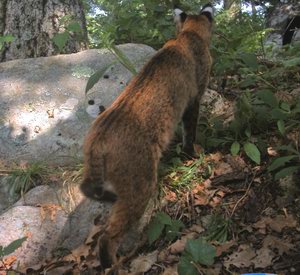
Bobcats have a variable coloration; their coat or pelage ranges from gray-brown to reddish brown. Darker coats prevail in the northern latitudes and the winter coat of an individual bobcat is darker than the summer coat. Their ears are marked by white bands and their tail is tipped with white fur. The maculated fur of the bobcat affords a measure of camouflage, the darker spots on the light background convey the appearance of scattered sunlight filtering through the forest canopy. [8] According to Shawnee Indian lore, the bobcat got his spots due to an encounter with a rabbit that he had chased into a tree. The wily rabbit suggested that the bobcat build a fire in order to be ready to start cooking – once the fire was going, the rabbit jumped in its center and sent sparks flying so that embers landed on the bobcat. The rabbit escaped as the bobcat ran to the river to extinguish his coat, which the embers had left with telltale burned spots. [9}
References:
1. Webster’s Third New International Dictionary of the English Language, Unabridged,. G. & C. Merriam Company, Manilla, Philippines, 1971 p 1351
2. Barnett, R. et al (2005). “Evolution of the extinct sabretooths and the American cheetah-like cat”. Current Biology. 9 August 2005 Volume 15 Number 15 pp 589 – 590.
3. Whitaker, J. National Audubon Society Field Guide to North American Mammals, Alfred A. Knopf, New York, New York, 1996, pp 788-804
4. Johnson, W. et al. “The Late Miocene radiation of modern Felidae: A genetic assessment”. 6 January 2006 Science. Volume 311 Number 5757 pp 73–77.
5. San Diego Zoo Wildlife Alliance, https://animals.sandiegozoo.org/animals/lynx-and-bobcat
6. Smithsonian National Zoological Park Bobcat Fact Sheet. https://web.archive.org/web/20120401110239/http://nationalzoo.si.edu/Animals/NorthAmerica/Facts/bobcatfacts.cfm
7. Chiamulera, J.; Krueger, E. and Yarbrough, C. “Bobcat Lynx rufus” https://web.archive.org/web/20110608214022/http://www.uwsp.edu/wildlife/carnivore/Bobcat%20Natural%20History_files/Bobcat%20Natural%20History.htm
8. National Geographic http://animals.nationalgeographic.com/animals/mammals/bobcat
9. Jacksonville Zoo and Gardens. “Florida Bobcat Bio Facts”. 2005 https://web.archive.org/web/20060225003145/http://www.jaxzoo.org/things/biofacts/FloridaBobcat.asp
 Hiker's Notebook