

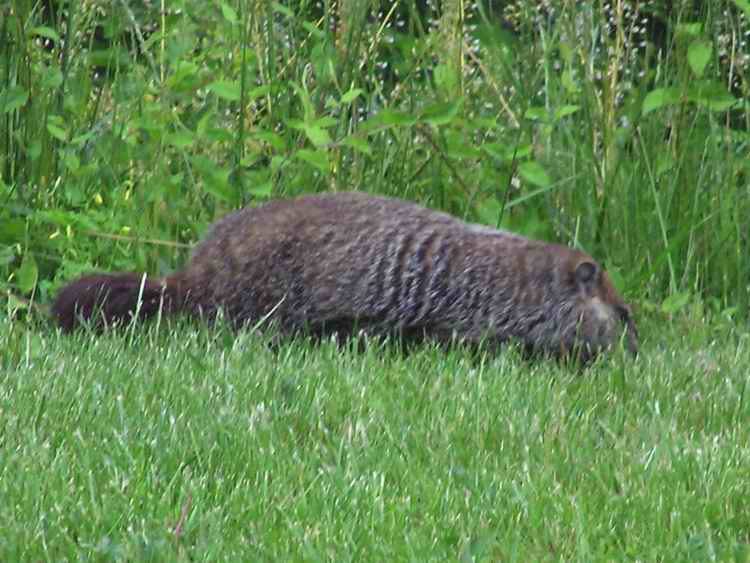
Common Name: Groundhog, woodchuck, forest marmot, whistle pig, marmotte commune (French), waldmurmeltier (German), Marmota canadiense (Spanish) – Groundhog is thought to derive from a translation of the Afrikaans aardvark; aarde means “earth” and vark means “pig”. This may have come to North America with the Dutch settlers of New Amsterdam. Earth pig and ground hog are synonymous.
Scientific Name: Marmota monax – The generic name comes from the French marmotte which is a shortened form of the Old French marmontaine which is from the Latin mures monti, which means “mountain mouse,” which is metaphorically similar to ground hog. The specific name is from the Greek monos, which means single or alone, referring to characteristic solitary and asocial behavior.
Potpourri: The groundhog is also known colloquially as woodchuck from a disparate Native American etymology. The various tribes of the Northeast were familiar with the indigenous mammal, as it ventures abroad openly yet furtively in search of food during daylight hours. On being startled by a relatively large, and surprisingly fast woodchuck inadvertently encountered alongside a hiking trail, “big – brown – fluffy” was the descriptive name blurted out by one hiker. Perhaps due to similar and more frequent run-ins with different members of different tribes with different languages, a variety of names were adapted over thousands of years of encounters: ockqutchaun in Narragansett; otchig in Ojibwa; otcheck or wuchak in Cree. [1] It is not clear that this was the name given to the groundhog, as one translation of the Cree name is “he who fishes” which was given to any of various fishing animals and groundhogs are not noted for catching or eating aquatic animals. Regardless of the precise etymology, which is rarely a matter of certainty, the name wuchak was adopted by colonists. Many plants and animals of the New World had no European equivalents and were similarly christened. When words are taken from one language and used in another, modifications to suit familiarity are the norm. Thus, wu became “wood” to account for the animal’s habitat and chak became “chuck” perhaps as an onomatopoeia for the clucking noises that it made. The calque word woodchuck was the result. The palindrome that results from the reversal of the words led to the language exercise (tongue twister) phrase” how much wood could a wood chuck chuck if a woodchuck could chuck wood.” It was never clear what chuck wood was supposed to mean, but it suggests gnawing.
Groundhogs/woodchucks are in the Order Rodentia in the Family Sciuridae and are therefore closely related to squirrels and chipmunks, collectively the sciurids. The rodents are the largest group of mammals, comprising roughly 50 percent of all species, closer to 70 percent if based on the number of individual animals due to their geometric population growth and proliferation. Like all rodents, groundhog incisors grow at a rate of several millimeters a week throughout their lives (less during hibernation), which promotes and necessitates gnawing hard objects frequently. [2] While woodchucks may not chuck wood the way beavers do, it is not unlikely that they do. If there is nothing available to grind the teeth, malocclusion can proceed with potentially fatal result. Woodchucks are herbivores as are all rodents; foraging for food is the primary daily activity. While they favor grasses and herbs, they also regularly eat the leaves and twigs of dogwood, black cherry, and sassafras trees. Groundhogs are synanthropes, thriving in habitats planted and maintained in support of human enterprise. They are notorious for damaging consumption of farm crops such as corn, vegetables and fruit trees, eating over a pound a day on average to maintain a body weight of 10 pounds. [3]
Groundhogs have strong, clawed forelimbs to dig elaborate dens that consist of an underground tunnel system with over 45 feet of tunnels extending to a depth of 5 feet underground. The amount of effort necessary to excavate a maze of interconnected tunnels is near herculean, transporting about 100 cubic feet of soil weighing more than three tons. The tunnelling process would almost always include cutting through plant and tree roots, providing the tooth grinding necessary for survival. The den is accessed by a number of entrances, one of which is a plunge hole that extends vertically to the main tunnel for rapid ingress to escape predation. Occupied dens have a characteristic pile of fresh dirt at the entrances as a result of frequent cleaning. The den is arranged with a special chamber for excrement and a chamber for sleeping/hibernation that is a cozy 15 inch diameter padded nest. The dens are both a boon and a bane as far ashumans are concerned. Their aeration and fecal fertilization of the subsoil transforms it into topsoil, estimated by the state of New York to amount to 1.6 million tons per year. On the other hand, the burrows can damage building foundations and are a hazard to horses, who have been known to break a leg on penetrating a hidden tunnel. [4]
Groundhogs have been traditionally characterized as solitary, agonistic animals, meeting only for the conjugal act necessary for survival of the species. Mating occurs soon after emergence from hibernation in early spring, the males on occasion fighting for the rights to reproductive activities with local females where geographic ranges overlap. The pugilistic ritual brings out the range of noises that make up the vocabulary of the animal which consists of barking, squealing, chattering, and whistling; the name whistle pig is attributable to the cacophony. Female woodchucks have about three to five young called kits, that they raise for the most part on their own. The kits are naked, blind, and helpless and don’t even open their eyes until the fourth week. At six weeks, they are expelled from the den and forced to disperse. Not too many survive the first summer. The widely held belief that groundhogs are loners has been challenged by field studies. Recent research with modern radio tracking equipment has established that some if not most groundhogs belong to small groups consisting of one male and two or more kin groups of females consisting of an adult and a juvenile from the previous mating. “Interactions within the kin group and with the adult male were relatively frequent and generally amicable.” [5] Or maybe groundhogs are evolving so that the genetic traits that foster cooperation in raising kits results in increased survival of those who practice it.
Groundhogs are true hibernators in that they enter a state of torpor over extended periods during the colder months of winter. Hibernation is an evolutionary trait necessary and sufficient for survival (of the fitter) during periods when there is limited food available. It was most likely an adaptative genetic mutation that occurred soon after animals emerged from the oceans, where food is floating or swimming around at all times, to the challenges of seasonal terrestrial food availability. According to this theory, hibernation emerged during the transition from amphibians to reptiles and was retained in the mammalian diaspora during the Eocene Epoch. Human mammals would then have retained its genes, making the study of groundhog hibernation relevant to human treatments involving methods to slow metabolism During sleep torpor, groundhog body temperature drops almost fifty degrees from 95 °F to 46 °F and heart rate slows form 100 to 15 beats per minute. In the mid-Atlantic groundhog hibernation begins in October and does not end until March or early April, lasting about 100 days. Research over the last twenty years has revealed that groundhogs do not stay in the lower metabolic, energy preserving state continuously, but rather reheat periodically to arouse and move about. It is hypothesized that arousal cycles may be needed to limit the physiological harm caused by long term shutdowns and contribute to readiness for spring mating. Arousals occur throughout winter becoming more extensive toward spring, which may then include short forays above ground, where they can be spotted by superstitious humans and named Punxsutawney Phil.[6]
Groundhog Day (February 2) is based on sound practical science even if its modern interpretation is fraught with the holiday hype of the social media age. When growing food became the norm during the Neolithic Age, knowing when to plant in spring for the fall harvest was a matter of life and death. The decision is essentially the same as that made by a hibernating animal that must decide based on environmental clues that it is safe to wake up and expend energy in search of food (and a mate).So looking for a hibernating animal out and about would provide a reliable prediction of the last frost and signal the start of preparatory measures to plow the fallow fields to sew the seeds of spring. Where and how this started is not known, but Romans purportedly celebrated hedgehog day in a similar manner, the indigenous hedgehog providing the shadowy omen. This practice spread across and was retained in medieval Europe. Since there are no hedgehogs in the New World, the majority of colonists who followed the Old World predictive prescription eventually settled on groundhogs. While there are other animals that hibernate, including bears, skunks and snakes, the groundhog was common, easy to spot, and benign.
February 2 has a celestial significance that was important to early humans governed by the seasons as measured by the movement of the sun, the moon, and the visible stars. The Celtic tradition, which was incorporated into cultures that succeeded it in Britain and Ireland, is notable. The winter and summer solstices when the sun stood still and the spring and fall equinoxes with equal night and day were evident by careful observation. To provide for some transition between the four “quarter points,” the day that was midway between the two was known as a “cross-quarter” day. February 2, Groundhog Day, is the quarter point between the winter solstice and the spring equinox. According to the Celtic tradition, it was called Imbolc, meaning lamb’s milk. A cloudy day was considered a harbinger of warm spring rains to prepare the ground for planting. Imbolc was symbolized by Brigantia, the goddess of light. When the Christian faith penetrated the Celtic lands, the holiday became Candlemas, when the candles of the church were blessed in celebration of the presentation of the Christ Child at the temple in Jerusalem. The other three cross quarter points are May 1, Beltane, generally the rite of spring now May Day, August 1, Lammas, from “loaf mass” to celebrate the wheat harvest, and October 31, Samhain meaning “summer’s end” and the end of the old year, a time of the spirits of the dead. This became All Hallow’s Eve, now Halloween, returning to religiosity on All Saint’s Day on November 1. [7]
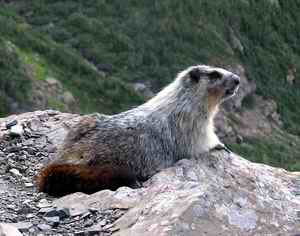
The groundhog is the most solitary of the marmots, which are large ground squirrels that live in burrows and subsist on vegetative matter that can include grasses, berries, lichens, mosses, roots and flowers. The marmot appellation is more commonly applied to the species that live in mountainous areas, such as the Hoary Marmot (M. caligata) of the North American northwest and Siberia (right). The Yellow-bellied Marmot (M. flaviventris) is also indigenous to the northwest and is noted for being the host for the tick that carries Rocky Mountain spotted fever. The Alpine Marmot (M. marmota) of Europe is thought by some historians to be the primary carrier of the Bubonic Plague, otherwise attributed to rats, which are also rodents. [8] It is not all bad. Groundhogs are the best non-human models for studying Hepatitis B since they suffer from a similar ailment and are also useful in studies of obesity, metabolism, and endocrinology. [9]
References:
1. Bento, H, publisher, Webster’s Third New International Dictionary of the English Language Unabridged, Encyclopedia Brittanica, Inc. Chicago, Illinois. 1971, p 2630
2. Wood, A. “Rodentia” Encyclopedia Brittanica, Macropedia William and Helen Benton Publishers, University of Chicago. 1974, Volume 15 pp 969-980.
3. Light, J. University of Michigan Museum of Zoology Animal Diversity Web. https://animaldiversity.org/accounts/Marmota_monax/
4. Kerwin, K. and Maslo, B. Ecology and Management of the Groundhog (Marmota monax) Rutgers School of Environmental and Biological Sciences https://njaes.rutgers.edu/e361/
5. Meier, P. “Social organization of woodchucks (Marmota monax)”. Behavioral Ecology and Sociobiology Volume. 31 Number 6, December 1, 1992, pp 393–400
6. Zervanos, S, “Professor sheds light on groundhog’s shadowy behavior” Penn State University Newsletter, January 2014
https://berks.psu.edu/story/2398/2014/01/23/professor-sheds-light-groundhogs-shadowy-behavior
7. Rothovius, A. “Ancient Celtic Calendar: Quarter Days and Cross-Quarter Days” https://www.almanac.com/quarter-days-and-cross-quarter-days
8. Whitaker, J. National Audubon Society Field Guide to North American Mammals, Alfred A. Knopf, New York, 1996, pp 438-445.
9. Kerwin and Maslo, op. cit.
 Hiker's Notebook