

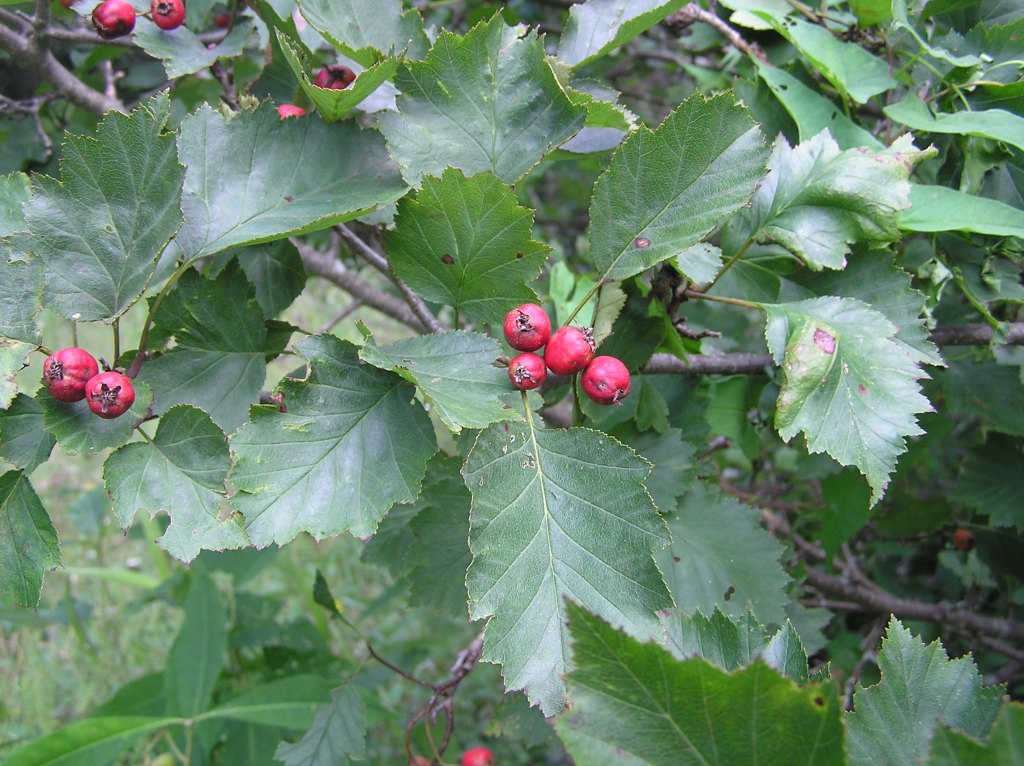
Common Name: Hawthorn, Haw, Mayhaw, Thorn Apple, Red Haw, Hog-apple, Thornbush, May. Mayflower, Hagthorn, Cockspur Thorn, Shan Zsa (Asia) – Haw is derived from the Old English word haga meaning “hedge.” The pervasive use of the thorny shrub for hedges as a demarcation for arable plots gave rise to the combination of haw and thorn as hawthorn.
Scientific Name: Crataegus spp – The genus name is a Latin form of the Greek word krataigos which is the adjective form of kratos, meaning “strength.” [1] This refers to the notably hard wood of the hawthorn making it ideal for tool handles. Spp is an abbreviation for species and is used in cases where there are so many species that none stands out as representative.
Potpourri: Hawthorn trees or shrubs are as American as apple pie but also quintessentially British where apple pie originated. They range across the Northern hemisphere spanning both the Atlantic and Pacific oceans in an evolutionary tour de force. They are in all likelihood the most adaptable of all woody plants, hybridizing readily and often as circumstances dictate. Hawthorns grow in a wide variety of soils and habits, ranging from heavy clay to the calcium carbonate of limestone, and, especially important in the modern era, they are tolerant of atmospheric pollution. [2] One of the perennial debates among botanists concerns hawthorn taxonomy. Some argue that there are upwards of one thousand different species but even at the low end, hundreds have specific descriptions. The genetic diversity can only be attributed to a robust reproductive complexity that operates on a generational basis. That they are in the Rose Order (Rosales) is not surprising, it is comprised of survivors that frequently employ thorns to deter predation and fruits to promote propagation.
One hundred years ago, a prominent botanist from Harvard’s Arnold Arboretum observed that, among hawthorns “There appears to be considerable variability even within the species in such particulars as the size of the flowers, the number of corymbs, and the compactness or laxity of the latter. The shape of the leaves is even less stable and dependable; many types even being found on the same branch.” This was attributed, at least in part. to the fact that “ … many North American species were named for specimens cultivated in European gardens.” [3] Fifty years later, a prominent field guide for Maryland flora characterizes Crataegus as “a large, difficult genus, many species being closely similar to each other” attributed to the observation that “some individuals are thought to be hybrids that possess characters of each parent.” This is accompanied by a dichotomous key with a mere twenty species described as “difficult until experience is acquired.” [4] Common names are equally equivocal, ranging from Barberry hawthorn to Beautiful hawthorn and including, Red, Yellow, One flower, and Three flower hawthorns. [5] Life is admittedly complicated, but botanical “splitters” seem on occasion to lose sight of the forest because of all the trees.
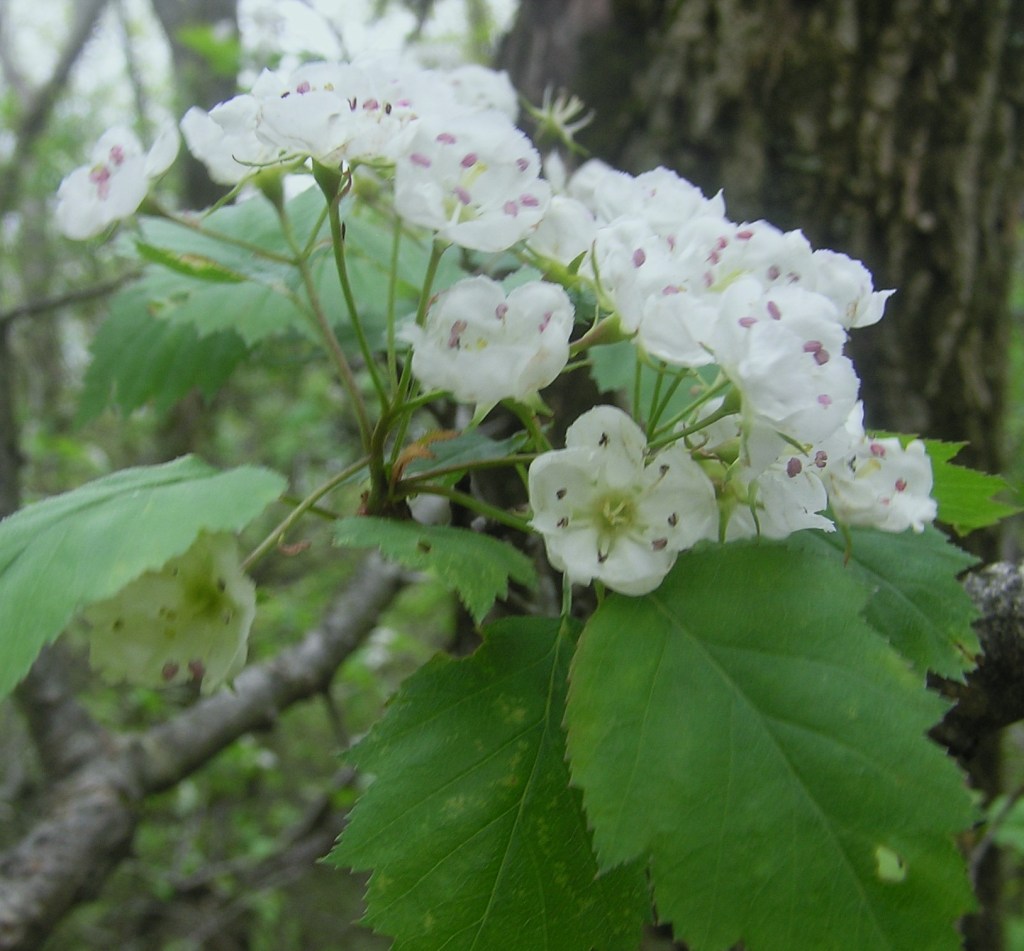
The Rose Family (Rosaceae) that comprises the bulk of the order Rosales is noted for polyploidy, the replication of chromosomes in multiples of doubled, trebled and even quadrupled. While this is not all that unusual for plants, is a font of the genetic diversity of hawthorns. Hawthorns have a base number of 17 chromosomes, with variants of 34, 51, and 68 chromosomes Hypothetically, two sexual species each with a multiple set of chromosomes can hybridize to produce sterile offspring that spread out in a geographic area through asexual reproduction called apomixis. To complicate matters, fertility may become reestablished through polyploidy. The end result is a multitude of species arbitrarily assigned within a taxonomic classification rather than a rigorous scientific expression of evolutionary relationships. “If each variant is considered a species of some rank, the number of kinds becomes almost infinite, and such a classification system serves no useful purpose.” [6] The Rose Family has some 100 genera and 3,000 species worldwide which is not that large for the Plant Kingdom. However, it it consists of some of the most important fruits, including apples, pears, plums, cherries, peaches, apricots, blackberries, strawberries, and raspberries. [7] As a result of the hybridization penchant of the rose fruits, all apples, pears, plums, and peaches are produced by grafting of clones onto root stock rather than from seed. [8]
Hawthorns played a prominent role in British folklore and consequently as a cultural export to the colonies of North America. Widely known as the May Tree, the hawthorn was central to the important country festival May Day as the harbinger of Spring. This was because hawthorns bloomed on or about the first of May until 1752 when the calendar was revised as Britain adopted the Gregorian Calendar to correct the two-week error accumulated over the centuries using the (slightly) erroneous Julian Calendar (the real issue was the drift of Easter from the celestial vernal equinox). Although the bloom date changed to mid-April, the original May moniker was retained. The fame of the hawthorn was accentuated by the legend that it was the source of the crown of thorns that was mockingly placed on the head of Jesus by Roman soldiers enroute to Calvary (or Golgotha). This association with salvation has been attributed to the christening of the ship Mayflower that carried the Pilgrims (a protestant sect known at the time as Brownists) to Plymouth of the nascent Massachusetts colony in 1620. In keeping with the fervency of Catholic hagiography, Joseph of Arimathea (who donated his tomb to inter Jesus, if only temporarily) came to Britan bearing a cup of Christ’s blood to found a Christian Church. As he struck his staff on the ground while resting wearily, a flowering hawthorn arose, marking the spot where he Glastonbury Abbey was built. Legend does not require veracity. [9]
The hawthorns of the Americas were thus suffused with cultural relevance even as the immigrants first disembarked into the wilderness of the New World. Over the course of the colonial period, three exceptional hawthorn species were sent to Carolinas Linnaeus to be included in the 1753 version of Species Plantarum, the foundation of taxonomy. The Scarlet Hawthorne (C. coccinea) and the Green Hawthorne (C. viridis) were named for the bright red berries and shiny green leaves respectively and the Cockspur Hawthorne (C. crus-galli) was named for its exceptional spines, comparable to the large spurs protruding from roosters as weapons to establish barnyard mating supremacy and expropriated for cock fighting contests. [10] Cockspurs became popular in Britian for their thorny efficacy in forming impenetrable hedges. Scarlet Hawthornes were noted for their relatively sweet taste compared to the astringent fruit of Britains’s native hawthorns, as noted by an early colonist named Jon Josselyn in Two Voyages to New England in 1663. [11] They were widely gathered by Native Americans and eaten immediately or mixed with animal fat to make pemmican for winter consumption or trail rations. Gatheirng hawthorn fruits was adopted by colonists, adding jams, jellies, and marmalades to frontier menus. [12]
In consideration of the robustness of hawthorns, it should come as no surprise that they produce a number of chemical compounds to shield them from harm and that these compounds have been coopted for human medicinal purpose. Historically, extracts from hawthorn fruits and flowers have been used in herbal folk medicine by Asians, Europeans, and Native Americans as a heart tonic. Research based on over ten clinical studies has found that hawthorn extracts act to dilate coronary blood vessels and thus reduce blood pressure and improve circulation. [13] Further, extensive in vivo and in vitro studies have revealed the potential of hawthorn extract to have an ameliorative effect on inflammation, gastric problems, microbial infection in addition to the widespread use in the treatment of heart maladies. However, as with just about every herbal remedy, the jury is still out on effectiveness, citing a lack of safety testing and the need for more definitive data. [14] The bane of a capitalist drug market is evident. No one will foot the bill for additional testing unless there is a profit and hawthorn is free for the taking.
References:
1. Webster’s Third New International Dictionary, Unabridged, Merriam-Webster Co. Chicago, Illinois, 1971, pp 531, 1040-1041.
2. Plants for a Future https://pfaf.org/user/cmspage.aspx?pageid=59
3. Palmer, E. “Synopsis of North American Crataegi” Journal of the Arnold Arboretum, Volume 6, Issue 1, 1925, pp 5 -128.
4. Brown, R. and Brown, M. Woody Plants of Maryland, University of Maryland, Port City Press, Baltimore, Maryland, 1972, pp 142-157.
5. Little, E. Audubon Field Guide to North American Trees, Alfred A. Knopf, New York, 1983, pp 458-489
6. Cowan, R. S. Smithsonian Museum of Natural History, “Rosales” Encyclopedia Brittanica Macropedia, Volume 15 pp 1150-1154, W. Benton Publisher, University of Chicago,
7. Niering, W. and Olmstead, N. Audubon Field Guide to North American Wildflowers, Alfred A. Knopf, New York, 1998, pp 746-762
8. Mckenna, M. “The Mystery Tree” Scientific American October 2026, p 66
9. Wells, D. Lives of the Trees, Algonquin Books of Chapel Hill, Workman Publishing, Chapel Hill, North Carolina, 2010, pp 154-156.
10. Little op cit.
11. Wells op. cit.
12. Angier, B. Edible Wild Plants 2nd Edition, Stackpole Books, Mechanicsburg, Pennsylvania, 2008, pp 90-91.
13. Foster, S. and Duke, J. Medicinal Plants and Herbs, 2nd Edition, Houghton Mifflin Company, Boston, 2000. pp 266-267
14. Memorial Sloan Kettering Cancer Center. https://www.mskcc.org/cancer-care/integrative-medicine/herbs/hawthorn#SideEffects

