

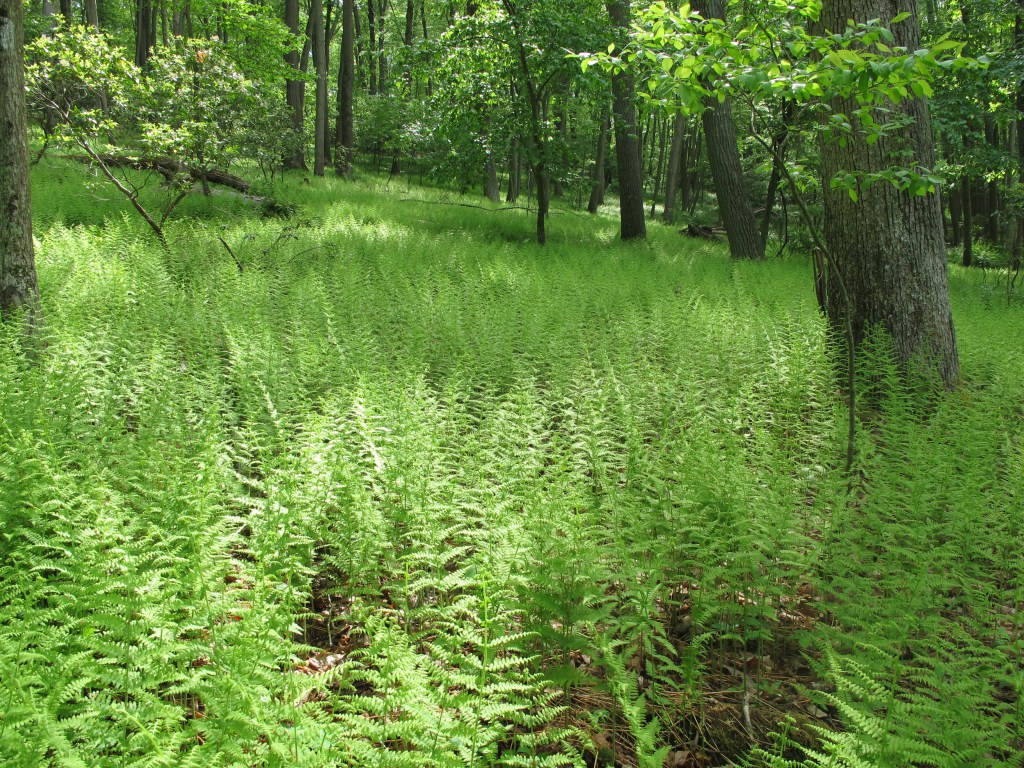
Common Name: Hay-scented Fern, Boulder fern – The pungent smell of fresh cut hay is produced when the fern frond is crushed. A reasonable hypothesis is that the chemical that smells like hay according to human sensory perception acts as a deterrent against insect and herbivore predation. It is noteworthy as the only local fern named for its smell.
Scientific Name: Dennstaedtia punctiloba – The genus recognizes August Wilhelm Dennstaedt, a prominent German botanist who did not study ferns. The eponym is an honorific, common practice according to the rules of increasingly arcane Linnean taxonomy. The species name translates literally to “spotted lobes” for reasons that are unclear, but which may possibly refer to the clusters of spores called sori that appear as tiny dots on the fern’s fertile fronds.[1]
Potpourri: The hay-scented fern is among the most prolific of Eastern North American ferns. Covering the forest floor as far as the eye can see. It can seem as invasive as Japanese stilt grass even though it is in reality a weedy native. It is easily recognizable due not only to the expanse of its habitat, but also to its feathery appearance. Most ferns have similar structures, with a stem extending upward with side branches, the green leaves of photosynthesis symmetrically deployed. The two standard forms are a single leaf directly from the main stem or a branch extending from the stem with multiple leaflets. Hay-scented ferns have a tertiary arrangement whereby terminal leaflets have multiple recesses. The overall effect is a gentle blend of light greens with no sharp edges to define individual ferns, the epitome of a tranquil, verdant forest.
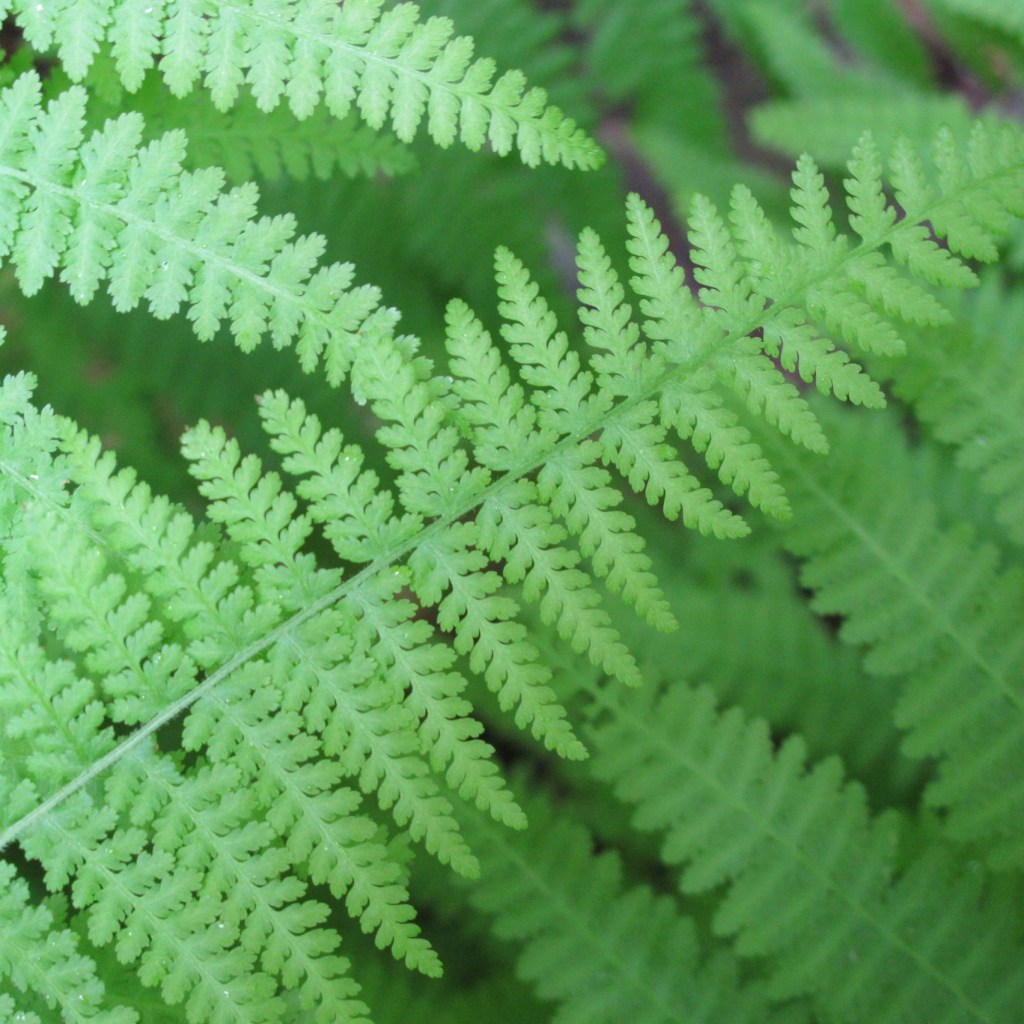
Hay-scented ferns are sometimes referred to as three-cut or thrice-divided. [2] In the unique lexicon that pteridology (the study of ferns) adopted, this means that the entire above ground part of the fern called the frond has three separate divisions. The first division consists of branches called pinnae (Latin for feather) that extend from the main stem, which is called the axis. The second division consists of subsequent breaks off of each pinna, which are called pinnules, small pinna. The third division, in which the pinnules are also split into segments, may be referred to pinnatifid if the cut is partial, or pinnulated if the cut is complete; the final leaflet becoming the pinnulet. Bracken ferns, similar to Hay-scented ferns in habitat dominance are fully three-cut with pinnulets. Hay-scented ferns are pinnatifid. Leaf divisions provide a useful means for field identification. [3]
Ferns are among the most primitive of land plants, emerging during the Devonian Period some 400 million years ago. Ferns and their equally primitive fern allies (clubmosses and horsetails) dominated terrestrial habitats for millions of years. The Carboniferous Period that followed the Devonian 50 million years later is frequently called the Age of Ferns. As the period name suggests, it is also the age of carbon, as vast coal deposits resulted from the buildup and decomposition of mostly fern forests.[4] The proliferation of hay-scented ferns in the present is vestigial of their former dominance. As the seed-bearing angiosperms and cone-bearing gymnosperms evolved during subsequent millennia, they rose in height to form the canopies of the great forests of the present accompanied by an understory of smaller trees, shrubs, and wildflowers. It is tempting to conclude that ferns are an anachronism, struggling to survive in narrow niche habitats surrounded by the competition. Fern genetics tells a different story.
While it has long been suspected that ferns are “chromosome hoarders,” this was recently confirmed by DNA sequencing. A fern species native to several of Pacific islands was found to have a 160 billions of base pairs of DNA. By comparison, humans have 3 billion base pairs which is fairly large compared to other genomes. The smallest known genome codes for one species of mammalian intestinal parasite with only 2 million. The geometric range of DNA base pair populations can have little to do with physiological complexity; humans are vastly more complex than ferns.[5] DNA diversity does have a lot to do with evolution. The genus Homo sapiens has been around for at most 200 thousand years. Ferns are a thousand times older. It is widely accepted that long term survival requires genetic mutations as environmental parameters change over time and that these gradually accumulate. While hay-scented fern DNA has not yet been sequenced, it is sure to be substantial.
The evolution of the fern genome has been consequential to the diversity and geographic distribution of ferns in the modern era. Even though angiosperms dominate with about 300,000 species compared to about 10,000 ferns, it is not called the age of flowers. Fossil and molecular data of fern forebearers indicates that, while ferns did decline at the onset of seed plant expansion, they diversified and expanded, taking advantage of the forested habitats that ensued. The fern order Polypodiales, which makes up about 80 percent of the global fern population, evolved toward the end of the Mesozoic Era about 100 million years ago. [6] One factor that is considered key to the successful transition of ferns from terrestrial dominance to their current diminished populations is the emergence of a chemical receptor that enhanced photosynthesis across a broad spectrum of light wavelengths. Survival in the dimly lit corners of the forest became their evolved habitat. [7] The hay-scented fern came later.
Climate changes associated with geologic factors like moving plates and periodic meteor impacts have had a significant impact on life in general and ferns in particular. The hay-scented fern is the only fern of its genus in North America; its cohorts are in Asia. The supercontinent Pangaea broke into its constituent parts roughly 65 million years ago marking the onset of the current geological Tertiary Period. The subsequent glacial movement of tectonic plates and the complex interaction of sunlight and atmospheric gases resulted in the warmest period of Earth’s geological history between 54 and 28 million years ago. A circumboreal band of tropic and temperate forests extended across the northern hemisphere through Eurasia and North America across land bridges now submerged by the resurgent oceans. When the subsequent Ice Ages followed, plants migrated south to survive. In Europe, the east-west Pyrenees, Alp, and Carpathian mountain ranges prevented movement and the temperate species like ferns perished. In North America and east Asia with north-south mountain ranges, migration to a new sustainable latitude prevailed, leading to the similarity in floral species. There are two species of the hay-scented fern genus Dennstaedtia in Asia and none in Europe. [8]
The evolutionary diaspora of plants across the terrestrial landscape is beholden to the sexualized spores of ferns. As amphibians gave rise to reptiles in the journey of animals from sea to shore; ferns gave rise to flowers; frogs and ferns both need water to procreate. Spores are key to the origin story, germinating to produce both male sex organs called archegonia and female sex organs called antheridia on the same embryonic body called a prothallus. Fern sperm cells must swim to reach and fertilize eggs to create a gamete, initiating the miracle of reproductive life. Once fertilization is complete, the gametophyte’s sexual role is consummated, and the familiar frond sporophyte rises from the soggy soil bearing the spores that complete the life cycle. [9] Recent DNA analysis of the similarities between flowering plants and ferns has shown that gene groupings that govern plant behaviors such as seed germination and flowering time originated with ferns some 200 million years earlier. [10] It may be reasonably concluded that ferns occupy a critical role in plant evolution and are not antiquated relics of the past as much as the spore-seeds of progression.
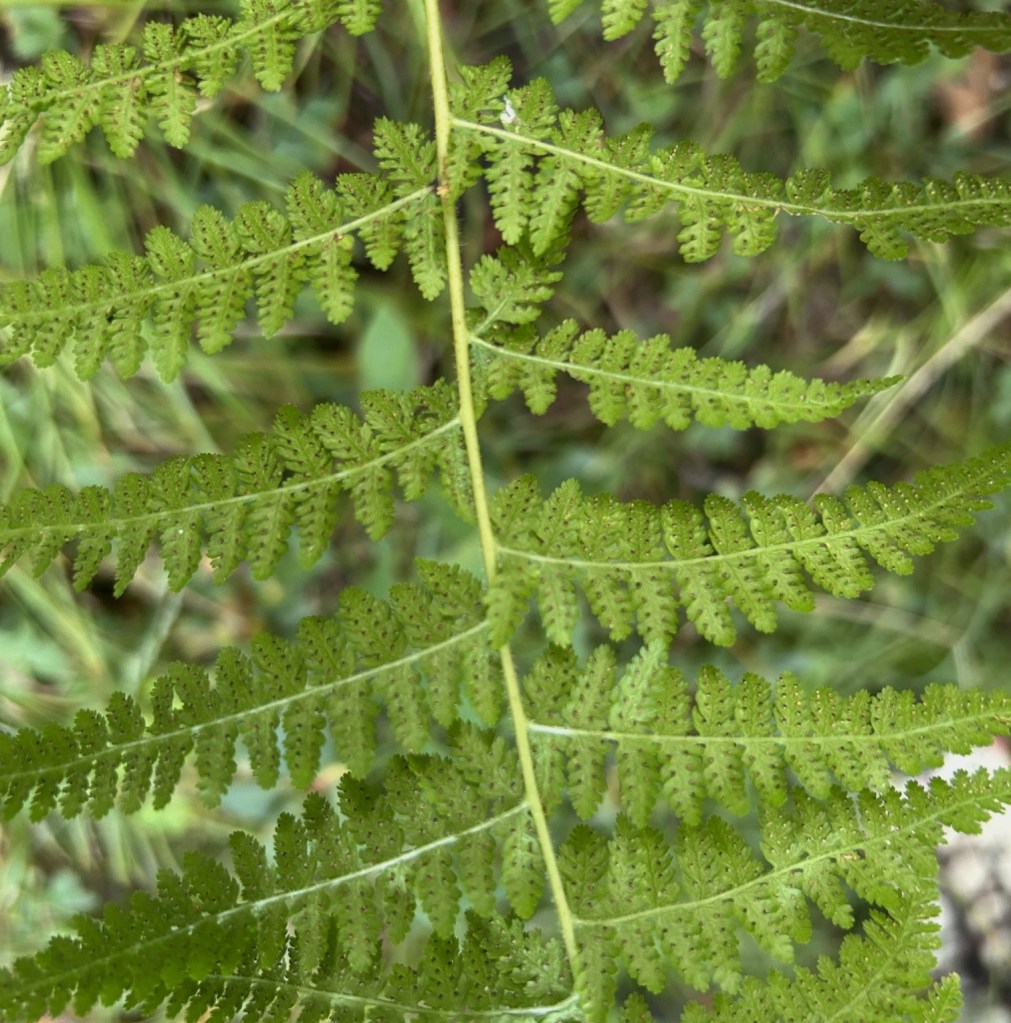
Successful spore production and distribution is the most important of all fern evolutionary adaptations. Some ferns like cinnamon ferns have a separate spore bearing structure called a fertile frond. The more common arrangement is a dense cluster of spores called a sorus covered with a protective shield, the indusium. Hay-scented ferns produce fertile fronds with sori (plural) on the underside of each pinnule cum sporophyll. Sterile fronds with no spores are randomly interspersed among the fertile fronds, photosynthesizing for vegetative growth. Sometimes called “fruit dots,” sori produce thousands of miniscule spores that are invisible to the naked eye. Before Van Leeuwenhoek’s invention so the microscope in the 17th century, it was widely believed that fern seeds must be invisible and therefore had magical properties. In Shakespeare’s Henry IV Act 2 Falstaff’s partner Gadshill announces “the receipt of fern seed, we walk invisible” in planning a robbery. [11]
Spores are not activated until they are expelled from the sorus, float through the air, and come to rest in a suitable moist habitat. Since this is the essential step in species propagation, evolution has acted to promote its likelihood. Ferns (and fungi) produce seas of spores to improve the chances of at least one achieving the improbability of successful germination. The first necessary step is the ejection of each spore from the sorus. The dispersal mechanism is called a cavitation-triggered catapult, using the medieval siege weapon as analogy. As with the similar fungal spore ejection mechanism called a surface-tension catapult, fern sori use the properties of water evaporation and condensation as motive force. A group of cells on one side of the sorus lose water due to evaporation, contracting and bending the spore-bearing enclosure. When it reaches the breaking point, evaporation in adjacent cells (which is cavitation) causes a rapid (10 microseconds) pulse that ejects the spores with a speed of 10 meters per second with an acceleration 105 times that of gravitation (called the G-Force or just G’s). [12] Water as the essence of life that started in Earth’s oceans is critical at every juncture, even as plants and animals ventured onto land, became fruitful, and multiplied.
Returning finally to the matter of fern survival in an environment of leaf-eating animals. Early fern populations were subject to the onslaught of rapidly advancing insect populations with voracious larvae. As an evolutionary matter, random mutations in fern genome generated new or modified proteins one or several of which evidently diminished consumption. This would be a classic example of survival of the fittest, as bitter (or perhaps even hay-scented) fern mutants would persist as others perished to predation. The pesticide properties of ferns have long been recognized but not studied by biologists until recently. In the last decade, research has accelerated in this area as older genetic pest deterrents have been compromised by increasingly tolerant insects. Preliminary tests in India, Australia, and Europe have shown significant reduction in crop insect damage when selected fern genes have been incorporated into seed crops. [13] Using ferns to protect agricultural mainstays would fulfil one of Barry Commoner’s four laws of ecology: Nature knows best. Hay-scented ferns, which cover acres of open forest frequented by many insects without even the occasional nibble, must have potent deterrents that await discovery.
References:
1. North Carolina State University https://plants.ces.ncsu.edu/plants/dennstaedtia-punctilobula/
2. . https://gobotany.nativeplanttrust.org/species/dennstaedtia/punctilobula/
3. Hallowell, A. and Hallowell, G. Fern Finder, Nature Study Guild Publishers, Rochester, New York, 2001. pp 1-7, 32, 50.
4. Wilson, C. and Loomis, W. Botany, 4th edition, Holt Rinehart and Winston, New York, 1967 pp 499-514.
5. Stimson, A. “This unassuming fern has the largest known genome—and no one knows why” Science 31 May 2024.
6. Ehrenberg, R. “Faced With Flowers, Ferns Flourished” Science, 31 March 2004
7. Cobb, B, Farnsworth, E, and Lowe, C, Ferns of Northeastern and Central North America 2nd edition, Houghton-Mifflin, Boston, 2005. Pp 3-13, 115-117.
8. Horan, R. A Natural History of Ferns, Timber Press, Portland, Oregon, 2004, pp 186-204.
9. Wilson, C. and Loomis, W. op cit. pp 268-272, 506-507.
10. Pennesi, E. “Genes for seeds arose early in plant evolution, ferns reveal” Science, 22 September 2022.
11. https://shakespeare.mit.edu/1henryiv/full.html
12. Noblin, X. et al “The Fern Sporangium: A Unique Catapult” Science, Volume 335, Issue 6074, 16 March 2012. p. 1322.
13. Pennisi, E. “Fern proteins fight crop pests, could usher in potent new insecticides” Science Volume 382, Issue 6673 November 17, 2023.

