


Common Name: Horsenettle, Bull nettle, Carolina horse nettle, Apple of Sodom, Devil’s potato, Thorn apple, Wild tomato, Poisonous potato – A nettle is a plant of the genus Urtica noted for stinging hairs. The name has been widely applied to other plants that have prickles like the horsenettle. The horse association is likely due to the fact that horsenettle plants are commonly found in pastures, like those fenced off for horses.
Scientific Name: Solanum carolinense – Solanum is Latin for nightshade. The genus name is attributed to Pliny the Elder (Gaius Plinius Secundus), a Roman military commander and naturalist in the first century AD. The origins of Solanum are unclear, but sol is Latin for sun; there is a sunberry flower in the nightshade family. The similarity in spelling to the Latin word solamen which means comfort is another possible etymology. [1] Plants of the Solanum genus have historically been widely used as medicine for a variety of ailments and conditions. The species name is reference to the North American colony Carolina where it was first noted, probably before its division between north and south.
Potpourri: The horsenettle is a weed according to the standard definition as it grows where humans don’t want it to grow and crowds out preferred plants. If weediness is a matter of garden aesthetics, however, an argument can be made that the five-petalled white star with five yellow elongated stamens projecting from the center has some appeal. If weediness is detrimental to food crops like soybeans and wheat awaiting harvest from farm fields, then eradication with herbicides may be justified. Horsenettle is also poisonous to the extent that it is included in edible wild plant field guides as a cautionary measure to prevent gathering the wrong things when edible plants are sought. [2] But it is also medicinal, having been used by Native Americans and subsequently by colonizing Europeans for centuries. This, too, is not unusual, as horsenettle is a member of the Nightshade family, a rogue’s gallery of deadly plants that also includes potatoes, tomatoes, peppers, and eggplants, mainstay edibles of western cuisines. Horsenettle is bad weed, good medicine, and has ugly prickles.
Another thing that can be said about weeds like horsenettle is that they are successful plants, able to flourish in marginal soils and spread outward in profusion. That is what all living things aspire to do, perpetuating their own kind following the recipe for survival by being fittest. Darwin came to recognize that competition among plants was equal to if not more than that among animals, even as Galapagos finch beaks became his focus. As a backyard scientist with inimitable curiosity, he conducted an field test in his backyard by clearing six square feet down to bare soil to observe the emergence of native weeds. He noted that “out of 357 no less than 295 were destroyed, chiefly by slugs and insects,” the detail testimony to thoroughness. As confirmation, he repeated the experiment on a second area of established turf, noting that “out of twenty species … nine species perished” because the “more vigorous plants gradually kill the less vigorous.” [3] It is evident that becoming a successful weed is an evolutionary feat rather than a routine event. It is also apparent that the weeds that persist and become human problems are the cream of the weed crop, exceptionally evolved with propagative efficiency.
Horsenettles are poisonous because they produce an alkaloid chemical named solanine, the name derived from Solanaceae, the Nightshade family of almost 4,000 plant species in nearly 100 genera. Alkaloids are complex organic chemical compounds that can in many cases have physiological effects on animals ranging from medicinal like morphine, hallucinogenic like mescaline, and stimulants like nicotine (the “ine” suffix is prescribed). The root alkali is derived from the Arabic word for the calcined ashes of the saltwort plant, and refers to molecules that are basic (pH > 7), the opposite of acidic. Alkaloids are mostly bitter, which is undoubtedly the reason why bitter is one of the five tastebud types also including sweet for sugars, salt for minerals, sour for ripeness, and savory for proteins. Bitterness warns of poison and most animals avoid bitter plants like horsenettle. The genetic code for bitterness taste sensors was retained by the survivors; individuals that lacked sensitivity learned about bitter poisons the hard way. Up until the nineteenth century, plant compounds were only known through trial and error. The alkaloid associated with the poison hemlock (coniine) was the first to be synthesized in 1886. [4]
The taxonomy of plants is based on familial similarities. The production of a specific alkaloid is typically a shared characteristic. This is true of the nightshades (Solanaceae) just as it is of buttercups (Ranunculaceae), poppies (Papaveraceae) and barberries (Berberidaceae). Alkaloid concentrations vary among the different species of a plant from plentiful to nearly nonexistent. The nightshades range from almost no alkaloid in tomatoes, potatoes, and eggplant to substantial amounts in horsenettle and tobacco. Why plants produce alkaloids is uncertain. Experiments have shown that tomatoes grafted onto tobacco stems produce no solanine. Conversely, tobacco grafted onto tomato stocks does. This would indicate that solanine isn’t involved in growth or metabolism. However, that is not to say that there is not a purpose for a plant to make a complex chemical compound, which takes energy and raw materials. There is more to life than growth and there is more to genetics than the here and now. Alkaloids may be vestigial remnants that once had a purpose in the evolutionary past, but which is no longer relevant.
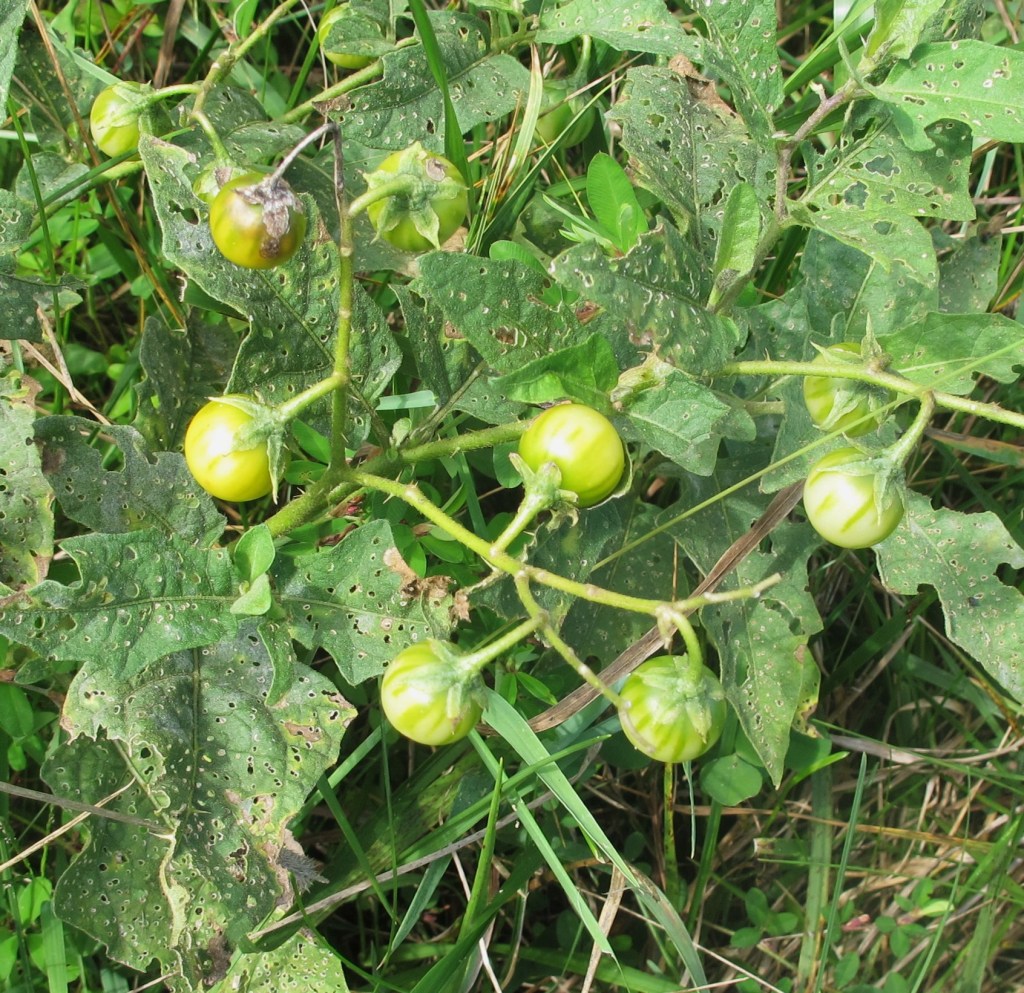
Alkaloids may also have a role in reproduction, as some plants produce high levels during seed and fruit formation which become depleted when the seed is ripe. Horsenettle fruits look like miniature tomatoes. Whether they are toxic or not is an open question. One source says “the berries are the most toxic when they are mature” [5] and another says “all parts of the plants, except the mature fruit, are capable of poisoning livestock” [6] Since poisoning experiments on humans and livestock are not ethically acceptable, almost all reports of poisoning are anecdotal. It is probable that immature fruits are poisonous and mature, ripe fruits are not. This makes sense, as plants produce fruit to be eaten by animals so that the seeds are distributed in a dollop of fertilizing manure. For example, all parts of the mayapple are poisonous except the ripe fruit. Experiments with livestock that consumed ripe horsenettle fruits have shown that the seeds pass through the gut unharmed, exactly as would be intended and predicted. [7]
The relationships between animals and plants are complex. This is particularly true when it comes to alkaloids. Ostensibly, plants produce the bitter compounds through random genetic mutation and eventually a formulation occurs that keeps animal predation in check. However, in the niche-centric ecology of survival, the opposite must also occur. That is, animals that evolve some form of immunity to certain alkaloids in certain plants gain the advantage of abundant food avoided by competitive herbivores. The example of the monarch butterfly caterpillars eating milkweed that is poisonous to nearly all other animals is well known. Experimentation has shown that this is more the rule than the exception. When the Panama Canal was built in the early twentieth century, the flooding of Gatun lake created Barro Colorado Island where a Smithsonian Field Station was opened in 1924 to conduct long term experiments of evolution in an isolated biosphere. A recent study of the 174 caterpillars found on the island found that they were “picky eaters” is choosing which types of over 200 toxic compounds they would consume. This “encourages diversification, as new species with new, temporarily insect-proof toxin profiles emerge.” [8] It is not therefore surprising that a fair number of insects, and some animals, eat horsenettle leaves, stems, and fruit.
The vast majority of twenty first century humans have plenty to eat―in many cases too much. There is no cornucopia in the wild where life is “nasty, brutish, and short” according to Thomas Hobbes. Many insects and a few animals consume not only the horsenettle fruit, but also the bitter, normally poisonous leaves and stems as well. A study conducted in Virginia over a period of six years (1996-2002) revealed that 31 insects from six different orders ate horsenettle voraciously. In fact, a detailed survey of 960 horsenettle plants found that the plants were severely damaged. And it wasn’t just bugs, as meadow voles also consumed horsenettle with no apparent ill effects. The most damaging insect species were those that also fed on other Nightshade family plants including the eggplant flea beetle and the false potato beetle in keeping with the evolutionary pathway of alkaloid tolerance. Fruits were assessed separately due to their importance in propagation as the seed bearing component of the plant. The three species accounted for 75 percent of fruit damage were false potato beetles, pepper maggots, and meadow voles. [9] This also provides some validity to the overall scheme of life with plants producing sweet, tasty fruit to attract animals for seed dissemination.
As is the case with many plants that are listed as poisonous to animals in general and humans in particular, horsenettle has historically been used for medicinal purpose. In the eons that preceded the Renaissance in the arts and sciences, treatment of human and livestock ailments was a matter of local lore and tradition using naturally occurring substances, mostly plants. Essentially, the chemicals created by a plant for its own use and protection provided similar benefits when consumed by an animal. In the case of horsenettle, the Cherokee who were indigenous to Virginia and the Carolinas where it originated were its most inventive purveyors. The leaves were used internally to dispel worms (apparently worms don’t like it either) and externally to treat poison ivy (although one would think that Cherokee had figured out the “leaves of three let it be” rule). Fruits were boiled in grease to treat dogs with mange and the seeds of the fruit were made into a sore throat gargle. [10] The Native American uses of native plants were in many cases adopted by early colonists so that these “natural remedies” appeared in the early listings of drugs. Horsenettle was listed in the United States Pharmacopeia from 1916 to 1936 as a treatment for epilepsy, and, in keeping with the “snake oil” practices of unregulated past, both an aphrodisiac and a diuretic. It has long since disappeared from the apothecaries shelves, and is now mostly known for its toxicity. A modern medicinal plant guide concludes with “fatalities reported in children from eating berries.” [11]
References:
1. Simpson, D. Cassell’s Latin Dictionary, Wiley Publishing New York, 1968, pp 560, 772.
2. Elias T. and Dykeman, P. Edible Wild Plants, Sterling Publication Co. New York, 1990, p 265.
3. Darwin, C. On the Origin of Species, Easton Press, Norwalk, Connecticut, 1976, p.50.
4. Manske, R, “Alkaloids” Encyclopedia Britannica, Micropedia, William Benton Publisher University of Chicago, 1974, Volume 1 pp 595-608.
5. North Carolina State University Agricultural Extension https://plants.ces.ncsu.edu/plants/solanum-carolinense/
6. Bradley, K. and Hagood, E. “ Identification and Control of Horsenettle (Solanum carolinense) in Virginia” http://www.ppws.vt.edu/scott/weed_id/horsenettle.PDF
7. https://www.illinoiswildflowers.info/prairie/plantx/hrs_nettlex.htm
8. “One hundred years of plenitude” The Economist, Science and Technology, 6 July 2024. p 64.
9. Wise, M. “The Herbivores of Solanum carolinense (Horsenettle) in Northern Virginia: Natural History and Damage Assessment” Southeastern Naturalist, 1 September 2007, Volume 6, Number 3, pp 505-522.
10. Native American Ethnobotany Data Base http://naeb.brit.org/
11. Duke, J. and Foster, F. Medicinal Plants and Herbs, Peterson Field Guide Series 2nd edition, Houghton Mifflin Company, Boston, 2000, p 206.
 Hiker's Notebook