

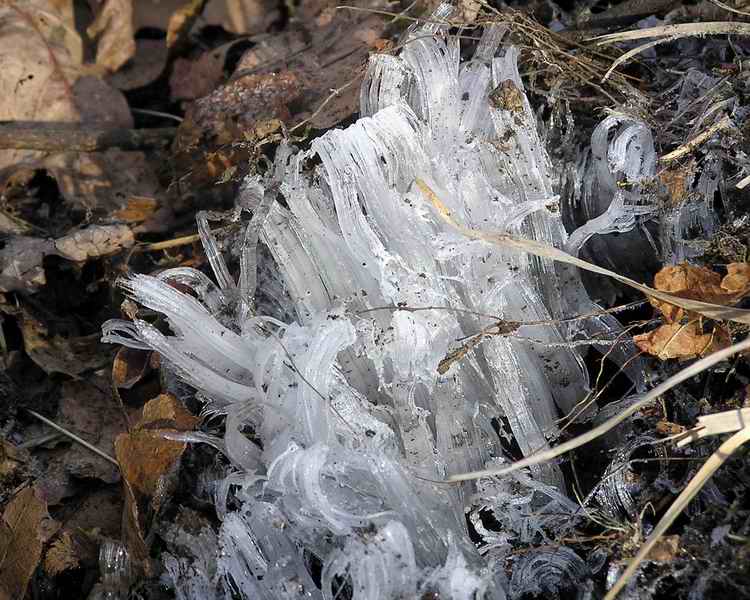
Common Name: Needle Ice, Ice flowers, Frost flowers, Ice fringes, Ice filaments, Rabbit ice, Ice castles, Ice leaf – The various descriptive terms are applied to an ice formation depending on the configuration of its components that can range from narrow needles to blocky castles.
Scientific Name: Segregated Periglacial Ice – Characterized by an area that is subject to intense freeze-thaw conditions (periglacial) that extends (segregates) from a frozen substrate, which may be ground soil or a plant stem. The name Crystallofolia has been proposed as a Latinized version of ice flower.
Potpourri: Hiking in winter is a challenge as air temperature often drops below the freezing point of water. Water is wet and sometimes slick but ice is slipperier and potentially dangerous. Mountainous regions are particularly susceptible to icy conditions for two reasons. The first is that ground water accumulates in the high volume terrain much more than level areas. It is drawn by gravity downslope, forming rivulets in ravines that combine to become the headwaters of rivers flowing eventually to the sea. Freezing is also a matter of height since temperature decreases between 3 and 5 degrees Fahrenheit (depending on how dry the air is) with every 1000 feet of elevation gain (6-10 degrees Celsius per kilometer). Sometimes physics is not intuitive. Lower temperatures occur when hiking upward in elevation because there is less atmosphere above and therefore less pressure, making the molecules of air (mostly nitrogen and oxygen) move further apart. Temperature is a measure of molecular movement which is therefore lower when going higher. More elevation, more ice. Because of this effect, a gently meandering downward trail can turn into an icy toboggan run without a sled. Ice can be beautiful just as it is oftentimes treacherous. Under certain conditions, it forms ice sculptures with variety of shapes and sizes. The most common form is needle ice.
The formation of needle ice structures is a well-recognized phenomenon in areas with the necessary and sufficient environmental conditions; it is called kammeis in Germany, pipkrake in Sweden and shimobashira in Japan. The German name kammeis translates to “comb ice” as the structure suggests the teeth of a hair comb. It occurs on sloped regions to the extent that a special name, kammeissolifluktion, is given to the process of movement of soil down the face of a slope due to comb ice. The Swedish name pipkrake is used largely in reference to sub-arctic needle ice. Pipkrake formation results in frost creep, one of the primary geomorphologic processes associated with the shift of temperature across the freezing point of water. Frost creep occurs in permafrost regions due to the action of the individual pipkraken (needles) that rise beneath individual sediment particles. The net movement of soil due to needle ice/pipkrake is up to one meter per year; laboratory demonstrations have shown that pipkrake can lift ten pound rocks. The Japanese word for needle ice, shimobashira, translates as “columns of frost.”
Needle ice can be defined as “the accumulation of ice crystal growths in the direction of heat loss at, or directly beneath, the ground surface.” There are some complexities in this definition that relate to thermodynamics, the branch of physics that deals with the relationship between heat and energy. [1] However, the mechanism of extending ice can be understood from observing the conditions under which it occurs. The fundamental requirement is a diurnal freeze-thaw cycle, which is nothing more than a 24 hour period during which freezing occurs at night followed by thawing with the radiant heat of the sun starting a dawn’s early light. In mountains, the area where this will occur depends on the height above ground due to the effect of elevation on temperature and the degree to which the sun is shaded by adjacent slopes. [2] Soil composition is also important in channeling the extending ice crystals in parallel columns. Soil is classified according to the relative amounts of three basic forms/sizes that arise depending on the degree of the erosion of weathered rocks. The largest particles are sand ranging in diameter from 0.05 mm to 2 mm. Silt is smaller, starting at 0.01mm. Clay particles are one order of magnitude lower, in the micron range, imparting a slippery feel to soil. A soil that has an even mix of sand, silt, and clay is called loam. Needle ice is most prevalent in soils that are made up of small sand particles with about 10 percent silt or clay. [3] It may be concluded that needle ice forms in columns separated by soil particles as water is pushed upward into the frozen air.
The thermodynamics of water is the essence of meteorology and oceanography (and therefore weather and climate) at the macro scale just as it is of needle ice at the micro scale. Radiant heat from the sun in the form of photons is the font of all energy. Plants use sunlight energy to produce hydrocarbons and exhale oxygen. Oxidation of hydrocarbons in the mitochondria of all cells is the energy of growth and movement. With a higher intensity along equatorial latitudes, the sun’s radiant photons interact with either solid ground, causing concrete hot spots in cities, or water, mostly ocean, causing evaporation. Water molecules thus vaporized rise from the oceans and cool as they travel skywards to condense as clouds. The energy of evaporation, called the latent heat of evaporation, is returned when water vapor becomes liquid, falling as rain, snow, and sleet. This returned energy is what powers the weather, manifest in the extremes with thunderbolts of lightning and tornado whirlwinds. The rotation of the earth swirls the rising tropical vaporous clouds as they move away from the equator toward the poles to create weather. At the other end of the temperature spectrum is the latent heat of fusion, that amount of energy needed to melt solid ice to yield liquid water. Since it takes energy to melt ice, then energy must be released when ice forms. This is what is meant by the definitive statement that needle ice grows in the direction of heat loss. Energy from liquid water freezing is what forms the vertical needle column and moves it upward. [4]

The growth of needle ice is also affected by an increase in volume that occurs when liquid water solidifies. Solid water ice is 9 percent larger in volume that the liquid water from which it arose. This very unusual behavior for a substance occurs due to the nature of the bonding between the two hydrogen atoms and one oxygen atom that make up the water molecule, the familiar H2O. The water molecular attractive bond called a hydrogen bond acts between two molecules that results from polarity, the familiar positive (+) or negative (-) of electric battery terminals. Hydrogen bond sites occur due to the way water molecules are put together. Chemical compounds between atoms occur by sharing electrons so as to achieve a stable number of electrons that is the same as those in the inert gases at the far right side of the periodic table, which don’t react with anything (inert is the adjective form of inertia, to remain at rest). Oxygen needs two extra electrons which it shares with two hydrogens each with a single electron. Oxygen bonded to hydrogen in water is like the inert gas neon in stability. The result of the covalent water bonds is the creation of a positive charge on region on the hydrogen atom side of the water molecule and a negative charge on the oxygen atom side. These are called dipoles due to having two poles, one positive and one negative. The hydrogen or dipole to dipole bond occurs because opposite charges attract each other with an electrostatic force. Each water molecule is hydrogen bonded to four adjacent water molecules. [5]
The weak electrostatic attraction of hydrogen bonds is what makes water fluid. It is also what makes liquid water more dense than frozen water. The freedom of liquid hydrogen bonds to attach to alternative and closer molecules draws them more tightly together. When crystallized as ice, molecules are rigidly set in space further apart, which is why ice occupies a larger volume than the liquid it formed from. Since ice is less dense than water, icebergs float and ponds freeze from the top down and not the bottom up. This fact is enormously important to life on earth. If ice sank, the oceans would fill with ice and only a thin surface layer would be melted by the sun. Earth would essentially be an ice-covered ball. Further, since life (apparently) arose in aqueous (watery) saline (salty) conditions that we call oceans, there would almost certainly be no life on a frozen earth. When organisms eventually ventured out of the oceans onto dry land, they could continue to operate only by taking the ocean with them. Which is why humans and all other mammals are about 60 percent salt water. The hydrogen bond of water molecules in an aqueous environment is what makes life work. “The structures of the molecules on which life is based, proteins, nucleic acids, lipid membranes, and complex carbohydrates result directly from their interactions with their aqueous environment The combination of solvent properties responsible for the intramolecular and intermolecular associations of these substances is peculiar to water (italics in original).” [6] Something to think about when you look down at the needle ice on the trail.

Aside from aesthetics, needle ice formation is of scientific interest due to plant damage that is often its result. In order to establish the key variables in the formation and growth of needle ice, a montane area near Vancouver, British Columbia was instrumented and monitored in the late 1960’s. Weather conditions consisted of a prolonged anticyclonic period with clear, cold, and dry air. An anticyclone is the clockwise (CW) circulation (in the northern hemisphere) of air around an area of high (H) pressure noted for cloudless blue brilliance. Cyclones are the opposite, turning counter-clockwise (CCW) around low (L) pressure areas which, under extreme conditions, result in hurricanes. Over the course of eleven sequential 24-hour noon to noon periods, parametric data were collected to evaluate the effects of temperature and time on needle formation and mean values calculated from the eleven data sets. Starting with the nucleation of ice at the bottom of the needle that started 9.9 hours after noon (about 2200), the nominal ice needle grew for 7.3 hours with an elongation of 9 millimeters (about 1 centimeter or 1/3 inch). As the sun rose the next day, the maximum surface temperature reached 12.8 °C (55 °F) at about 1330, resulting in some melting, and, more importantly, evaporation of the soil water into the desiccated air. Depending on the balance between freezing at night and melting during the day, needle ice formation is either homogenous (top photo), with continuous upward growth, or heterogeneous (right photo), with repetitive cycles of soil upheaval and subsidence, the latter resulting in greater damage. [7]

The formation of ice structures that resemble flowers or ribbons is due to a freezing phenomenon that is closely related to that which causes needle ice. The fundamental difference is that ice flowers exude from the stems of certain plants whereas needle ice exudes from ground water without any botanical conduit. The geometry of certain plants and rotting wood is such that a passage for supercooled water is created. When the temperature drops, longitudinal cracks form along the axis of the stem and allow the liquid to ooze out into sub-zero air to be almost instantaneously frozen into a ribbon-like crispation. The overpressure that pushes the extruded ribbon out is thought to be the result of the gradual freezing of the water in the stem.[8] Ice flower formation is often erroneously attributed to frozen sap, which may contribute to the cracking of the stem wall. However, there is not enough sap in the plant to create the “remarkable accumulations of voluminous friable masses of semi-pellucid ice around the footstalks of the Pluchea (fleabane) which grow along the road-side ditches” as described by Dr LeConte of the University of Georgia in 1850. The plants that exhibit ice flower formation have been identified by observation, as the relevant dimensions of the plants’ structures that result in the phenomenon have not yet been determined. The list, largely anecdotal includes: dittany (Cunila origanoides), frostweed (Helianthemum canadense), yellow ironweed (Verbesina alternifolia) and white crownbeard (Verbesina virginica). [9]

Spring is for flowers, summer is for fauna, fall is for fruit and fungi. Winter is for ice. Solid water frozen into structures sculpted by the physical properties of soil and air are quest-worthy. While ice needles may be admired for incongruous symmetry and ice flowers marveled for their mobius strip curvature, wind and water in frigid air works equal wonder. The trinity of water as vapor, liquid, and ice is as profound and deeply rooted in relevance to humans as the spiritual trinity that guides the lives of many. Cathedral portals through the iced boughs and branches offer solitude and purpose just as those of churches. Here one may find the animist gods of the aborigine, the lares and penates of the wooded home, and the solitude of the soul, reduced to the raw elements that are ultimately its origin.
References:
1. Grab, S. “Needle-Ice”. In Goudie, Andrew (ed.). Encyclopedia of Geomorphology. Routledge. p. 709.
2. Pidwirny, M.: Fundamentals of Physical Geography, 2nd ed., section 10(ag), Periglacial Processes and Landforms
3. Nardi, J. Life in the Soil, University of Chicago Press, Chicago, 2007, pp 1-6.
4. Petrucci, R. General Chemistry, 4th Edition, Macmillan Publishing Company, New York, 1985, pp 140-151, 285-298.
5. Ibid. pp 305-307.
6. Voet, D. and Voet, J. Biochemistry, John Wiley and Sons, New York, 1990, pp 29-34.
7. Outcalt, S. “A Study of Time Dependence During Serial Needle Ice Events” Department of Environmental Sciences University of Virginia, Charlottesville, Virginia, U. S. A. 23 April 1970. Water Resources Journal , Volume 7, pp 394-400.
8. Carter, J. “Flowers and Ribbons of Ice” American Scientist. Sep-Oct 2013, Volume 101, Number 5. p. 360.
9. Carter, J. “Needle Ice” Geography-Geology Department Illinois State University, Normal IL https://www.jrcarter.net/ice/needle/
 Hiker's Notebook