
Rock Tripe

Rock Tripe Lichen attached to a rock at 2,000 feet in Shenandoah National Park

Common Name:  Rock Tripe, Navel lichen –   The common name is a direct translation of tripe-de-roche, the French name for the lichen. Tripe is the name for the wall of the stomach of a ruminant animal when consumed as a food. It has taken on a number of secondary meanings that generally convey a notion of being worthless or of inferior quality. Thus the common name conveys that it is a poor quality food, like tripe, that is found on rocks.

Scientific NameUmbilicaria mammulata – The genus is derived from the Latin umbilicus meaning navel (the umbilical cord attachment point); the whorled shape of the lichen with its single attachment point is similar in appearance to a navel – note that  the common name navel lichen (used by the USDA) is based on this association.  The species name is from the Latin word mammula meaning small breast. This is in reference to the presence of  papillae on the lower, black surface of the lichen; a papilla is a small, rounded bump, like goose flesh. The term mammular means covered with papillae. The net result is a lichen that looks like a navel and is covered with small bumps.

Alexander von Humboldt is credited with the observation that biology varies equally by elevation or latitude which he noted in the ascent of Mount Chimborazo in the Andes at the dawn of the nineteenth century. [1] For species that are distributed mostly or wholly in Nordic regions, in part because the air is more pristine, this equivalence allows for access by  ascent. The Appalachian Mountains rise from the eastern side of the North American (tectonic) plate in a literal blue ridge of billion-year old granitic rock overlooking the Piedmont “foot of the mountain” to the east like a brooding parent. This is the realm of rock tripe, with large, rounded structures that comprise the main body called the  thallus that appear to be the peeling chips of a badly botched paint job. Inky black on the bottom, they are held in place by a single attachment point near the center. The lighter colored top surface faces the sun’s photons that provide the energy processed by algae of the genus Trebouxia.  Rock tripe is of course a type of lichen; a dual organism that consists of both a fungus and an alga (some also have cyanobacteria) that live in mutualism, a type of symbiosis in which both constituents share the benefits of the association. A lichen has been called a fungus that has discovered agriculture; the fungus constitutes the bulk of the extant vegetative body or thallus. The algal partner or photobiont having been incorporated as a source of photosynthetic energy.  The close mutual relationship allows lichens to occupy extremely adverse environmental habitats that range from isolated rock outcrops in the frigid rarefied atmosphere at elevations over 6,000 meters; there are over 3,600 species of lichen in North America alone. Rock tripe are among the hardiest of the lichens, they can survive extreme drought for over 62 weeks. The survival of lichens in axenic environments lends credence to the notion that the first aquatic plants to make landfall in the Silurian Period some 400 million years ago were some form of algae that brought along their fungal partners for structure and support, the mycorrhizal associations of most of our Holocene Epoch plants are perhaps vestigial.
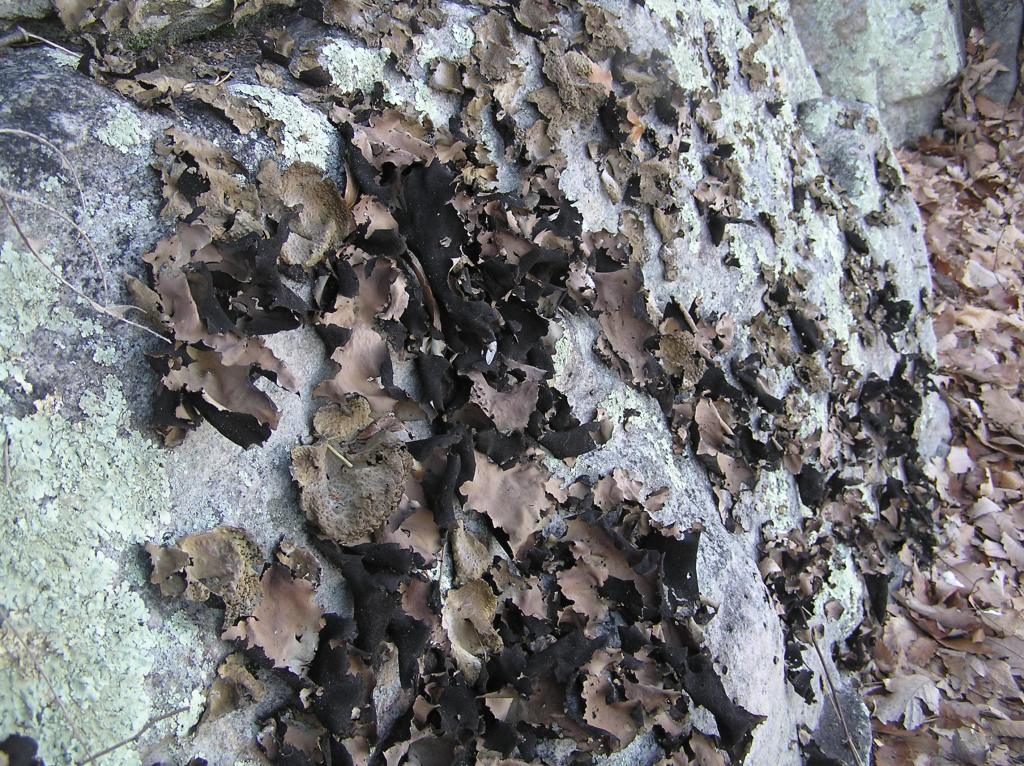
Rock Tripe covering an outcrop of Silurian sandstone on Massanutten Mountain

The “rock” part of rock tripe is clear, as a mineral substrate is both necessary and sufficient for its domicile. What about tripe?  Tripe is defined as either the portion of a ruminant animal’s stomach consumed as food or it can mean anything worthless or offensive. In the minds of all vegetarians and many others, the two meanings are synonymous. As a vegetarian in practice and an omnivore in spirit, some expatiation is warranted. Tripe is an exemplar of British cuisine, which is noted for meat and potato delicacies like bangers and mash; a Tripe Marketing Board persists in homage to its former glory. [2] Offal is the general term for the internal organs of animals; the more popular connotation is refuse or garbage with a synonymy even more pronounced. Two mitigating factors are germane to any discussion of the consumption of animal parts; one historical and the other philosophical. Historically, paleolithic hunters cherished the perishable internal organs for their own consumption in the field, dragging the meat back to their encampments for others. Stomachs were especially prized and may well have been consumed along with their contents. In medieval times, abattoirs were gruesome affairs, butchers standing knee deep in animal parts covered with their blood. Every part was put to use: the intestines for sausages; heads for head cheese; and random scraps for scrapple among many others.  [3] The antiseptic package of hamburger and the guarantee of adequate food whenever hungry was preceded by eons of everything edible being eaten. Philosophically, the total consumption of anything that is killed for its life-giving meat is justifiable according to food chain ecology. Cows can eat grass and humans can’t; as long as the former are afforded a reasonable life ended by a swift and painless death, the latter are surely legitimate in making a meal of them. On the other hand, fewer cows means less of the greenhouse gas methane from their belching, which is another issue altogether. Not eating them in the first place is something to consider … most edible fungi have significant amounts of protein and all eight essential amino acids. As omnivores, we get to choose. Regardless,  humans will eat  just about anything (including each other) to stay alive – which is where rock tripe comes in.

Since the lichens called rock tripe thrive in the harshest arctic climates and maintain their viability through the winter, they have long served as a source of emergency food by Native Americans. The French name tripe-de-roche precedes the translation into the English rock tripe; the provenance of the term is Canadian.  The Inuit peoples of the Canadian arctic regions considered rock tripe to be a food of last resort, to be eaten only in times of starvation, its continuous use thought to be pathological.  Other Native Americans found it more palatable, incorporating it into their routine regimen of food gathering and preparation. For example the Cree, which constitute the largest group of First Nations (Native Canadians, or in Quebecois, Autochthones), used it as an additive to fish broth to make a thick soup that was not only eaten for nutrition but was considered to be somewhat medicinal, affording nourishment to the sick. [4]

The early explorers of the North America became aware of the use of rock tripe as a survival food from the indigenous peoples, and used it on occasion of isolation to stave off starvation. Most notable was the first expedition of Sir John Franklin to map out the Northwest Passage from Europe to Asia from 1819 to 1822. In the second year of the exploration, the party of 20 was forced to return on foot when their two birch bark canoes became damaged. Franklin’s journal recorded the epic journey which has become one of the epitomes of deprivation: “Previous to setting out, the whole party ate the remains of their old shoes, and whatever scraps of leather they had, to strengthen their stomachs for the fatigue of the day’s journey …. The tripe-de-roche, even where we got enough, only serving to allay the pangs of hunger for a short time.”  Nine of the party succumbed to the ordeal. [5] Franklin survived only to perish with 134 officers and sailors on the HMS Erebus and HMS Terror on his fourth quest for the Northwest Passage; they were last seen in July of 1845. It is hypothesized from Inuit sources and the remains of the stranded mariners that they must have escaped the ships and set out over the ice in desperation. Some of the skeletal bones showed signs of knife marks suggesting that cannibalism may have been a last resort. That is what can happen when you can’t find any rock tripe. The two ships were located lying about 100 miles apart off King William Island in northern Canada using side-scan sonar about five years ago as the area has become largely ice-free due to global warming. The Northwest Passage is now very nearly a reality, but for all the wrong reasons. [6]

Cooked Rock Tripe is both nutritious with good fungal taste and texture

The different species of the genus are global in scope with different local names according to custom, including shi er meaning “rock ear” in Chinese, ‘stone mushroom’ soegi posot meaning “stone mushroom” in Korean and iwatake meaning “crag mushroom” in Japanese. Ironically, U. esculenta, a rock tripe species indigenous to Asia,  is considered a delicacy. It is so sought after that harvesters repel down steep slopes to collect it, favoring wet weather to reduce the risk of crumbling of the delicate lichen. [7] The nutritional and medicinal value of rock tripe fungi has been investigated experimentally to evaluate its viability as a survival food. A lichen supplementation was given to female mice for three weeks to measure its effects on growth, metabolism and immune function in comparison to a control group fed a standard diet.  The lichen-fed mice had a higher growth rate and ate more than the control group. Testing of the vital organs, including the heart, liver, kidneys and spleen revealed the lichen diet had no deleterious effects. The study concluded that rock tripe was not only a good source of nutrition in survival situations but that it acted to stimulate the immune system, as manifest in an increase in the production spleen B-lymphocytes. A second evaluation of several varieties of rock tripe found that they manifested substantive anti-bacterial activity against most of the bacteria tested. [8] Rock tripe is certainly worth a try, if only to survive the winter, but those are, alas, becoming shorter and warmer. It is plentiful, readily harvested, easy to cook, and has a texture that promotes palatability. Simply pluck from the side of  a rock, take it home, wash it, and boil it for about ten minutes for an excellent additive to soups or salads.

1. Rahbek, C. et al “Humboldt’s enigma: What causes global patterns of mountain diversity?” Science, 13 September 2019, Volume 365, Issue 6458, pp. 1108-1113.

2. https://tripemarketingboard.co.uk/

3. Tannahill, R., Food in History, Three Rivers Press, New York, 1988, pp 12-18, 291-292.

4. Brodo, I., Sharnoff, Sylvia and Sharnoff, Stephen, Lichens of North America, Yale University Press, New Haven, 2001 pp 78-83. The essential lichen reference

5. Davis, R. Sir John Franklin’s Journals and Correspondence First Arctic Land Expedition (1819-1821) Champlain Society, 1995.

6. Vaidyanathan, G. “Mysterious lost ships, HMS Terror and Erebus, reveal new layer of clues in Arctic” Washington Post, 27 November 2016

7. Riedel, T. “Eating Iwatake, A Rock Tripe from Japan”, Fungi, Volume 7, Number 2-3 Summer 2014. Pp 63-65.

8. Ng, I. and Kälman, S. “The lichen rock tripe (Lasallia pustulata) as survival food: effects on growth, metabolism and immune function in Balb/c mice.” Natural Toxins 1999, Volume 9 Number 6, pp 321-329.

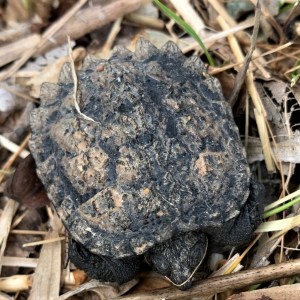
Snapping Turtle

Snapping Turtle West Virginia 200716
Female Snapping Turtle just after crossing a road to find a good place to lay eggs in a location remote from predation and near water where hatchlings might survive. 

Common Name: Snapping Turtle, Common Snapping Turtle – The name refers to the prominent toothless beak that has a powerful, snapping bite for capturing prey and for defense. The term “common” is sometimes added to distinguish this species from the larger and more fearsome alligator snapping turtles that inhabit the Gulf Coast northward along the Mississippi River and its tributaries.

Scientific Name: Chelydra serpentina – The genus is from Chelydros, the Greek word for an amphibious serpent or a tortoise. Serpens is the Latin word for a creeping animal, usually taken to mean a snake (serpent). The leitmotif of snake may be due to the snapping turtle’s unusually long tail.

Potpourri:  Snapping turtles have an unsavory reputation as aquatic aggressors, lurking in the depths of freshwater ponds to lop off the extremities of innocent waders.  The resultant chelonaphobia, a form of zoophobia … the unreasonable fear of animals … applies to those who see turtles as terrible, preventing those afflicted from getting into the water in the first place. Turtle phobia can only apply to snapping turtles … box turtles hide form intruders in their armored sanctuaries and painted turtles slip into the water when approached. There is at least a modicum of  rational apprehension of water immersion due to the possible presence of large, aggressive marine predators like some sharks that (rarely) attack humans with nightmarish consequences exaggerated by cinematic jaws. But in spite of the University of Maryland motto, there is no reason to “fear the turtle.” There is no record of anyone ever being killed by a snapping turtle and the incidence of injury of any kind is vanishingly small, mostly on land due to improper handling. While snapping turtles do bite with a bone crushing finality, it is no more or less that many other animals which are larger and more mobile. Nothing to fear but fear itself.

Snapping turtles are in a separate family (Chelydridae) in the turtle order (Testudines) of the reptile  class (Reptilia) with kindred crocodiles, snakes, and lizards. They are among the oldest of all animal groups, having evolved from the earliest reptiles about 200 million years ago, long before the age of the related and now extinct dinosaurs. That they survived the Cretaceous-Paleogene (K-Pg) extinction 66 million years ago with their avian cousins as the thunder lizards perished en masse along with three fourths of all living things is testimony to the resilient “intelligent design” of natural evolution.  Testudinal structure is a case study in  the random course of genetic mutation  that has no plan, but which rarely but inexorably succeeds by repetitive trial and error. Turtles are unlike any other reptile in having a carapace exoskeleton, a horny toothless beak, and the bones and ligaments of locomotion located inside the rib cage. [1] Their abrupt appearance in the fossil record absent a gradual transition through stages of partial shell hybrid variants has been a perennial issue with paleobiologists. Specifically, how could the ribs that had always been the vertebrate organ cage become body armor?

A turtle shell seems to be a relatively simple structure with an arched top comprised of polygonal scales called scutes with a flattened bottom plastron as foundation. However, complexity is biology’s handmaiden ― there are about sixty separate bones growing in synchrony to form the whole. The rib bones in turtles grow straight through the muscle in which they would become embedded in most vertebrates until they reach the dorsal (back) tissue that is known as the carapacial ridge. Here they release bone morphogenic proteins (BMPs) and hedgehog proteins that convert the nearby tissue cells into bone, filling in the spaces around the fifty-odd segments like mortar in the brick wall of the carapace. The nine bones of the plastron follow a different path ―no ribs and no tissue ossification. Here the bone cells expand independently, fusing together like those that form the brain-encasing skull except they encase the body. [2] It is feasible that the mutation in the bone forming cells occurred randomly, imparting an almost immediate enhancement survival benefit in the form of a fortress palladium. The turtle as battle tank succeeded and the mutation was passed on as a  cladistical advantage.  While we should not fear the turtle, the whole body shield renders the turtle fearless, like their teenage ninja mutant namesakes. The snapping turtle especially so.

Snapping turtles are apex predators of North American freshwater habitats with almost nothing to fear until humans came along. They are seldom seen as they spend the majority of their time hidden in the mud and ooze at the bottom of a pond or lazy river where quiescence prevails. There they lurk as a cryptic mud-colored mound until a proximate  potential meal appears. Alligator snapping turtles (Macroclemys temmincki) take this one step further with a worm-like appendage that is anchored to the bottom of their maw as lure to passing fish. The coup de grace is administered by the snapping beak deployed at the business end of the long, flexible neck that can extend outward some thirty centimeters, about two-thirds of the length of the shell. As observations of snapping turtle predation are limited by the black of their lagoon habitat, dietary preference research requires capture and dissection. Not surprisingly, slow bottom dwellers like crayfish, catfish and diving beetles are among the more likely menu alternatives, but toads, tree frogs, muskrats, and even waterfowl are occasional entrées. Snapping turtle predation of pond ducks and migrating geese is one of the bones of contention concerning their presence in water habitats, particularly those that qualify as private property. A study conducted in 1943 found that less than one percent of the stomach contents of 470 snapping turtles consisted of bird remains. While other studies have asserted avian losses exceeding ten percent, the general vilification of snapping turtles contributes to some exaggeration of decimation. [3]

The lore of snapping turtles as malevolent monsters of the deep is a matter of American acculturation. Comics and cartoons frequently depict barefoot boys jumping out of ponds with a turtle snapped onto a toe. The perception of snapping turtles as hurtful is due primarily  to their pugnacity when encountered on land, the only time that they are readily observable.  Any animal will trend toward wariness and become aggressively defensive when away from its natural habitat home, water in this case. An inquisitive human intruder only makes things worse. However, they only lunge and snap when cornered, and will only bite when proffered something that is bite-sized, like a twig (or a finger perhaps).  A second fear factor is the ominous appearance of the nutcracker beak,  a formidable weapon designed to do real damage. This is an evolutionary trade-off that favored powerful jaws for bone-crunching carnivores … turtles that feed mostly on plants and invertebrates get by with much less. [4]  Association with the alligator snapping turtle with the size and strength to  sever a finger renders all of their kith and kin suspect. Rumors abound of a human finger being found inside one caught by trappers for alligator snapper stew, a popular dish in bayou country. One confirmed case of finger loss involved a group of intoxicated bar patrons and a bet as to whether anyone could stick their finger into an alligator snapping turtle’s mouth and pull it out before it snapped shut. [5] No prestidigitation there. In their natural aquatic environment, snapping turtles are docile, noted mostly for their curiosity which can result in a slight bump as they investigate swimmers or boats snout first. When approached in the wild in their home waters, they do not even bite, much less snap.

Snapping turtles are well suited to riparian wetlands and boggy marshes. A prime location has an average water depth of about two feet so that the occupant can sit on the bottom and poke its head above the surface for an occasional gulp of air. These are reserved for the larger males that predominate ― might makes right is more than an aphorism in the wild. They have been observed in the same location for stretches of up to ten years, when they eventually are displaced by a younger, stronger, or larger rival.  Life consists of  walking along the bottom with deliberation eating the aquatic plants that typically comprise over fifty percent of their diet. One study found that over 90 percent of the contents of the stomachs of 278 individuals was plant material. [6] Snapping turtles have superior vision both above and below water with an optical range that extends to directly overhead. The larger males are mostly sedentary, ensconced in the mud waiting for their unwitting faunal prey … the more spry, younger turtles are more likely to hunt for food. Smaller males and females occupy less desirable and more marginal waterways that contribute to a density that can be as many as 30 adult turtles  in a single acre. The bucolic regimen of lounging in the water with plenty of food comes to an end in winter when hibernation in a frozen pond is the only option and spring when the hormones of procreation mandate their expiation in the sexual union of new life.

The tilt of the Earth’s axis creates the seasons in succession consequent to the annual orbit of the sun. In the temperate latitudes, winter’s dark and cold shadows are an existential risk for turtles that live in water that freezes. One of the attributes of the perfect pond is having a depth that is below the freeze line with adequate vegetation to provide oxygenated (aerobic) water for survival.  These goldilocks spots become the hibernacula not only for the resident, staked-claim dominant males but also for guest turtles that can congregate  in a small area sometimes stacked vertically. There they live in suspended animation for up to six months at the northern reaches of their range  with no food and no air with body temperatures just above freezing.  Hibernation is one of the most compelling cases for evolution, the shutdown of all but essential activity a matter of physiological adaptation. Dissolved oxygen that still persists early in winter is absorbed through the skin and the membranes of the mouth to sustain the metabolism of the slowly pulsating heart. When the oxygen runs out, sugar and fat breakdown continues for a time causing an increase in acidity that eventually becomes  life threatening. In one laboratory experiment in a water tank held at near freezing with bubbling nitrogen to maintain anaerobic conditions, turtles survived for four months, their blood PH dropping for a neutral 8.0 to a near lethal 7.1. Southern populations of turtles not accustomed to hibernation only survived for one month in the same experiment. [7] Practice, even among turtles, makes perfect. When spring comes to the hibernaculum pond and the ice melts, the dominant male chases everyone else out of the water and they all set off looking for someone to mate with … like spring break at the beach.

Snapping Turtle Hatchling Columbia 200523
Snapping Turtle Hatchling making its way to water and safety.

Male snapping turtles are aggressive and sex does not appear to be consensual since females attempt to flee when pursued. This is an anthropocentric perception as it would be at best difficult to determine what constitutes normal behavior for a male or female snapping turtle; they are all perpetually gruff by human standards. Females are much more peripatetic than males, travelling several miles in search of a location that will provide some survivability benefit to the 22 to 62 eggs that will be laid. Prime nesting sites are mostly upstream of home ponds on sandy banks adjacent to water into which the vulnerable hatchling turtles can rapidly move. It is along these watercourse causeways  that the males wait in ambush.  Since females can store sperm for several years, neither copulation nor nest building to lay eggs is necessarily an annual event. In any given year, 72 percent of females deposit their eggs at a nesting site that is almost always the same site used previously. This is not a particularly good strategy, as up to 90 percent of the nests are destroyed on the first night by egg-eating foxes, racoons, skunks, opossums, and coyotes. [8] But it works well enough, as snapping turtle populations are, at least for now, stable.

The journey of snapping turtles, particularly females, over long distances through sometimes dense forested areas to the same location every other year or so raises questions about navigation. This conundrum pertains to animals in general … migratory birds travelling thousands of miles over continental spans to return to nesting grounds and salmon seeking their birth stream after years foraging in the open ocean, among others. There are several candidates that could plausibly be involved in geographic positioning. Transits made above ground could use the positions of the sun, moon, and stars augmented in some cases by landmarks where available and perhaps by wind direction, temperature, and air  composition. Waterborne transits could use marine parameters like salinity, suspended solids, acidity, and currents  for orientation. Much more likely, however, is the one parameter that is universal and does not depend on temperature, elevation, or cloud cover ― magnetism. Lines of magnetic flux vary on the macroscopic scale of the north and south poles and on the local scale by the presence of magnetite.  The ability to use the magnetic field as a sensor is called spontaneous magnetic alignment (SMA) and appears to use two types of magnetoreception mechanisms. The first is a magnetite-based (MBM) and is thought to be the basis for a geographical map (where am I?) of different field strengths and inclinations. The second type is more esoteric in that it involves complementary light inputs. Known as the radical-pair mechanism (RPM), it involves a linkage between photopigments and magnetism that hypothetically provides directional inputs (where do I go?).   Snapping turtles have been experimentally shown to respond to variations in radiofrequency (RF) signals that emulate magnetism. [9] At this point, there is more theory than fact, but one thing is certain. Turtles and other animals can find their way back against insuperable odds to the same place and it can’t be luck or magic.

Even though snapping turtles are ubiquitous and listed as being of “least concern” in species data bases, there is reason to consider conservation measures now before it is too late.  This is especially true in Canada, where many of the  empowered First Nations peoples refer to  North America “Turtle Nation” and believed that a turtle allowed the earth to be created on its back. This is not as implausible as it sounds. Western lore includes the notion that the flat earth rested on the back of a turtle swimming in an endless sea. This is not all that far removed from the “modern” scientific ever expanding universe that began with a big bang containing dark matter and dark energy that have not yet been defined. It surely can have nothing to do with turtles, though, unless they are dark matter. The life cycle of turtles is stressed. Snapping turtles become sexually mature only after a decade or so, live for a long time, and rely on frequent reproductive events that result in high mortality rates for embryos and hatchlings to maintain the population. It has been estimated that the probability of an embryo surviving to reproduce in adulthood is 0.1 percent (1 out of every 1,000). The concern is that with this population dynamic, the loss of an adult can result in serious and possibly irreparable harm. People are the problem.  The human horde encroachments include habitat destruction for more houses, road kills along the paved accesses to the new houses, and increases in predator populations like racoons that share human habitats. Adding insult to injury are more direct assaults including fishing bycatch, the killing of snapping turtles by people who kill snakes for the same reason, and legal and illegal “harvesting.” As an example, between 1996 and 2006, the US Fish and Wildlife Service recorded over one million snapping turtles shipped overseas in the illegal wildlife trade. Yes, Virginia, the enemy is us and Santa Claus has nothing to do with it.


References:

  1. Behler, J. and King, F. National Audubon Society Field Guide to Amphibians and Reptiles, Alfred A. Knopf, New York, 1979, pp 425-437.
  2. Pennisi, E. “Neural Beginnings for the Turtle’s Shell” Science, 13 February 2004, Volume 303, Issue 5660, pp 951.
  3. http://www.virginiaherpetologicalsociety.com/reptiles/turtles/eastern-snapping-turtle/eastern_snapping_turtle.php
  4. Herrel, A. et al. “Evolution of bite performance in turtles”. Journal of Evolutionary Biology. 25 October 2002, Volume 15 Issue 6 pp 1083–1094. https://onlinelibrary.wiley.com/doi/full/10.1046/j.1420-9101.2002.00459.x
  5. Gibbons, J. W. “Can a Snapping Turtle bite off a finger?”24 June 2018 Savannah River Ecology Laboratory, University of Georgia http://archive-srel.uga.edu/outreach/ecoviews/ecoview180624.htm
  6. Cameron, M. Committee on the status of Endangered Wildlife in Canada (COSEWIC) Assessment and Status Report, “Snapping Turtle, Chelydra serpentina” 2008 at http://publications.gc.ca/collections/collection_2009/ec/CW69-14-565-2009E.pdf
  7. Heinrich, B. Winter World, Harper Collins, 2003, pp 145-156
  8. Kynast, S. “Snapping Turtles” Tortoise Trust Web Site at http://www.tortoisetrust.org/articles/snappers.htm
  9. Landler, L. et al “Spontaneous Magnetic Alignment by Yearling Snapping Turtles: Rapid Association of Radio Frequency Dependent Pattern of Magnetic Input with Novel Surroundings”. PLoS ONE 10(5). 15 May 2015. https://www.ncbi.nlm.nih.gov/pmc/articles/PMC4433231/
  10. Management Plan for the Snapping Turtle (Chelydra serpentina) in Canada [Proposed]. Environment and Climate Change Canada (2016).  Species at Risk Act Management Plan Series. Ottawa: Ottawa, Environment and Climate Change Canada  https://www.registrelep-sararegistry.gc.ca/virtual_sara/files/plans/mp_snapping%20turtle_e_proposed.pdf