

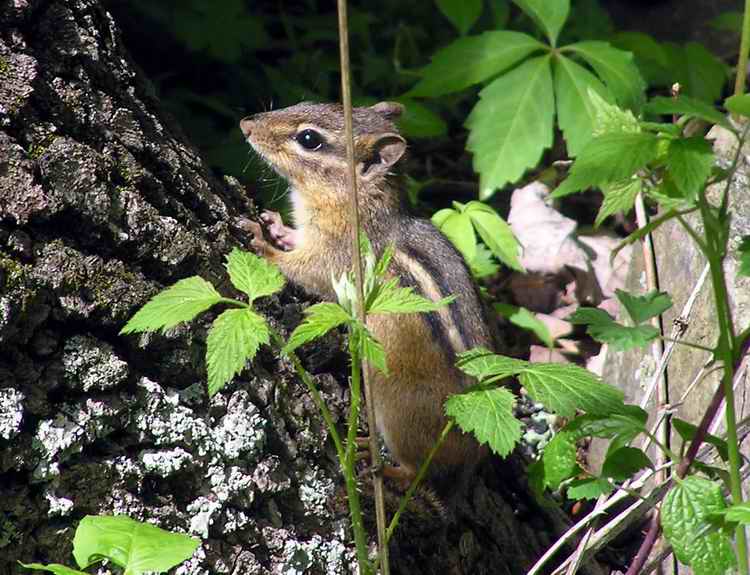
Common Name: Chipmunk, Ground squirrel, Grinny, Hackle, Chippee, Rock squirrel – Chipmunk is an Anglicized version of the name given to the animal by Native Americans. Originally ajidamoo in the Ojibwa dialect of the Algonquian language group meaning red squirrel and traced to an earlier dialect as acitamo, which literally meant “upside down to eat.” With the removal of the two “a” sounds it became jidmoo or citmo which evolved to chipmunk probably due to the similarities to existing English words chip and mink. It first appeared in print in Huron Chief, a poetry collection by Adam Kidd published in 1830. [1]
Scientific Name: Tamias striatus – The generic name is Greek meaning “steward” or “dispenser” for the food hoarding behavior of chipmunks. They are stewards of their cache, keeping it replenished over summer and fall, dispensing when necessary in winter and spring. Striated means striped, derived from the Latin word striatus, emphasizing the most notable feature of the chipmunk―a striped ground squirrel.
Potpourri: Chipmunks encountered along hiking trails offer only a streak of striped fur crossing a fallen log to a hidden den. While they are fervid foragers, packing their ample cheek pouches with seeds and nuts, they are fearful of looming, large animals. Rodents are an important source of food for a whole range of carnivorous animals and birds of prey. The brief encounter is sometimes accompanied by a series of sharp sounds that consist of either a high pitched chirping or a staccato chipping or both. While it is contended by some and believed by many that this is the reason they are called chipmunks [2], linguists trace the name to an Algonquian word acitamo (as per etymology above). There are no chipmunks in Europe, so the immigrant colonists had never seen one and coopted the existing Native American name.
Chipmunks are in the Order Rodentia in the Family Sciuridae and are therefore closely related to squirrels and marmots. The rodents are the largest group of mammals, comprising roughly 50 percent of all species, closer to 70 percent if the number of individual animals on account of their geometric proliferation. Like all rodents, chipmunk incisors grow at a rate of several millimeters a week throughout there lives (less during hibernation), which promotes and necessitates gnawing hard objects frequently. [3] Phylogenic research over the last several decades has revealed that rodents are closely related to primates in the tongue-twisting superorder Euarchontoglires. Euarchonta is a grand order of mammals consisting of primates, and, surprisingly, tree shrews and small flying mammals called colugos from South Asia. Glire is a genetically related group or clade consisting of rabbits and rodents. In spite of our anthropocentric world view (Euarchonta means true rulers), humans share a common ancestor with rodents like chipmunks dating from the late Cretaceous Period at the end of the Mesozoic Era dominated by dinosaurs. [4] The behavioral characteristics of the chipmunks therefore offer some insight into the evolutionary foundations of all Euarchontoglires. A 130 million year old fossil rodent skull was recently found in Wyoming and nicknamed the mutant ninja chipmunk for its pronounced front teeth and saw-edged rear teeth, a “the terror of the underbrush.” Evolution is relentlessly creative. [5]
Chipmunks are hermit hoarders with masterful survival skills. They live alone in underground tunnels about two inches in diameter and up to thirty feet in length. The tunnels are dug with sharply clawed front feet, excess dirt pushed to the surface and carried away to conceal the openings. Multiple exits afford escape from predators that dig like dogs or slither like snakes. Tunnel depth ranges from two to three feet according to the prevailing winter temperatures. The tunnels are fashioned with several sleeping areas lined with soft leaves and with several food storage areas, normally at the lowest point in the tunnel to keep it cool and fresh.
Chipmunks are omnivorous. Their primary diet of nuts, seeds and berries is occasionally augmented by the consumption of fungi, slugs, insects and even small birds and snakes. As the colder and shorter days of fall herald the coming of the winter, chipmunks become consummate foragers, storing nonperishable foodstuffs in their tunneled lairs for midwinter nourishment. The cheek pouches of the chipmunk are capacious, confirmed by field measurements of 31 corn kernels, 70 sunflower seeds, or 32 beech nuts. Experiments with chipmunk foraging revealed that a chipmunk can deliver about 4600 kilojoules (about 1,000 kilocalories which is the same as 1,000 calories in the vernacular) of food energy to the larder every day. The resulting cache can contain over 5,000 nuts. Chipmunk populations rise and fall with the availability of nuts and seeds. Accordingly, when oak and hickory trees produce an abundant crop of nuts every three to five years, a phenomenon known as masting, chipmunks thrive. [6]
Chipmunks do not hibernate per se in the winter. They enter a torpid state called superficial or shallow hibernation. True hibernation occurs when body temperature is lowered near to that of the environment with concomitant physiological changes like a reduction in breathing to about three irregular breaths per minute. Only three orders of mammals display true hibernation: Insectivora like the hedgehog, Chiroptera, the bats, and some Rodentia, like the marmot and the ground squirrel. Shallow hibernation is a compromise between full activity and true hibernation, the latter being a more precarious mode of survival from which a significant number of animals expire. The chipmunk retires to its tunnel nest in the late fall and enters a deep sleep during which time its body temperature is lowered and metabolism slowed. About every two weeks, it awakens and snacks on cached food in a somnambulate state and then resumes its long sleep. The average 163 kJ energy consumption of an active chipmunk is reduced to 25kJ in the winter torpor. [7]
The only time chipmunks associate with each other except in confrontation over territory is during the spring mating season, when female pheromones attract males who aggressively compete against each other for paternity rights using loud chipping noises, chasing reversals, and even biting. After mating with multiple males during the 6-7-hour period of estrus, females return to their own burrow to give birth to about five blind and completely helpless young (which could be but are not called chipmunkies) that are nurtured absent any male parental care or provision. After about 40 days, they are weaned and abandoned, their mother establishing a new burrow elsewhere to sometimes produce a second litter. One in five survive the first year, resulting in a stable population of about three adult chipmunks per acre in suitable habitats.

For a small and relatively insignificant rodent, chipmunk evolution and classification has aroused serious scientific inquiry for more than a century. A USDA survey in 1930 noted that “these animals, so attractive to every lover of nature” had been analyzed using “modern methods.” A total of 14,554 chipmunk specimens were evaluated to conclude that there were 65 species and sub-species in three genera: Eutamias in the eastern regions of Asia; Neotamias in western North America (the prefixes eu and neo both mean new); and Tamias in the east. [8] The most notable physiological difference was that chipmunks from humid areas were richly colored compared to pallid hues in dry regions. [9] However, there is not universal consensus concerning chipmunk taxonomy and many references include all 23 species of chipmunk in the single genus Tamias. One respected field guide addresses the similarity in the appearance of the western variants “with the shape of the penis (or baculum) and the call often serving as the basis for identification.” These species are generally confined to small, isolated areas along the west coast and probably evolved by interbreeding after separation. [10]

The chipmunk is prominent in the legends of Native Americans. One well-known Iroquois story called “Chipmunk and Bear” anthropomorphizes the former as devil-may-care and the latter as unbearably arrogant. Bear proclaimed he could do anything, so Chipmunk challenged him to stop the sun from rising. Bear took the challenge and proclaimed that the sun would not rise the next morning. When the sun rose, Bear was upset, and Chipmunk laughed so hard that he collapsed from weakness. Bear pinned Chipmunk to the ground with one big paw, proclaiming “your time to walk the Sky Road has come.” Chipmunk asked for one last prayer, beseeching Bear to lift his paw just enough for him to breathe. Bear complied and Chipmunk pulled free, the tips of Bear’s claws scraping his back in the process leaving three stripes. Chipmunk retains the stripes to this day as a reminder that one animal never makes fun of another. [11] Chipmunks also feature prominently in modern culture, epitomized by Alvin, Theodore, and Simon singing Christmas Carols in the 1960’s to Chip ‘n’ Dale, Disney cartoons with their own comic books and a television series.
Why do chipmunks have stripes? This may seem like an innocuous question, as many other animals are striped in whole or in part. However, rodents rely on a combination of stealth, speed, and dexterity to survive in a dangerous world of predators. Almost every other rodent has fur that ranges from gray to brown, blending into the background with no contrasting colors. Stripes are noticeable and would only provide camouflage in stripe-like grassy areas like the savannahs of African zebras or the reeds of Indian tigers. Chipmunks live in temperate deciduous forests of the Northern Hemisphere with brown tree trunks and tan leaf litter. Research on the African striped mouse, one of the only other striped rodents, revealed that the striping was caused by a gene that interrupts the development of pigment cells that was repurposed from a gene associated with cranial development, a phenomenon called co-option. Chipmunks have the same gene. The hypothesis is that both species independently evolved striping through a mutation that was random but survived in some Darwinian way. [12] Since it is unlikely that the stripes improved survival from predation (or squirrels would have them), then there can be but one reason: female chipmunks prefer striped males. Bear claws can have nothing to do with it.
References:
1.Oxford English Dictionary https://www.oed.com/dictionary/chipmunk_n?tl=true
2. New Hampshire Public Television https://www.nhptv.org/natureworks/chipmunk.htm
3. Wood, A. “Rodentia” Encyclopedia Brittanica, Macropedia William and Helen Benton Publishers, University of Chicago. 1974, Volume 15 pp 969-980.
4. Drew. L. I, Mammal, Bloomsbury Publishing, London, England, 2017 pp 193-224.
5. Holden, C. “The Rise of the Ninja Chipmunk” Science, 18 May 1990, Volume 248 Issue 4957, p. 810
6. Saunders, D. “Eastern Chipmunk”. Adirondack Mammals. Adirondack Ecological Center. 1988. https://www.esf.edu//aec/adks/mammals/chipmunk.php
7. 10. Pennsylvania Game Commission https://www.pgc.pa.gov/Education/WildlifeNotesIndex/Pages/Chipmunk.aspx#
8. Patterson, B. and Norris, R, . “Towards a uniform nomenclature for ground squirrels: the status of the Holarctic chipmunks” . Mammalia. 1 May 2016 Volume 80 Number 3 pp 241–251.
9. Cockerell, T. “Book Review of Revision of the American Chipmunks by Arthur Howell, USDA Publication 52, November 1929” 28 March 1930 Science Volume 71 Issue 1839, pp 342-343.
10. Whitaker, J. National Audubon Society Field Guide to North American Mammals, Alfred A. Knopf, New York,1996, pp 408-438
11. https://www.native-languages.org/legends-chipmunk.htm#google_vignette
12. . Reuell, P. “Science of Stripes” Harvard Gazette, 17 November 2016 https://news.harvard.edu/gazette/story/2016/11/science-of-stripes/
 Hiker's Notebook