Northern Water Snake

Northern Water Snake2 White Oak Canyon 160824
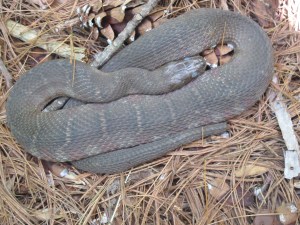
White Oak Canyon Trail in Shenandoah National Park adjacent to boggy, wet area. The banding and colors of this snake are either a northern water snake or a copperhead, a fully grown adult about 3-4 feet long (maximum size for either species). 

Common Name: Northern Water Snake, common water snake, banded water snake, dryland moccasin, water moccasin, water adder, water viper – Among the various snakes that are primarily aquatic, this species is the most common in the northeastern and mid-Atlantic states.

Scientific Name: Nerodia sipedon – Several references attribute the genus name to the Greek word for flowing, neros. This cannot be correct since the Greek word for flowing is ρεύση pronounced “refsi.”  The more likely etymology is the Greek god of the sea Nereus from which neritic, an adjective for shallow water, is derived. It is a shallow water snake. The species name is also obscure. Some references again cite the Greek sepedon, a “snake whose bite causes mortification,” which would be an adder or a viper but water snakes are not poisonous. The Latin word for snake, serpens, is more likely. Natrix is the original generic name occasionally in use.

Potpourri: The undulating black stripes that separate the alternating patches of tan and brown of the northern water snake appear distorted as if viewed in refraction beneath the rippled pond surface of its habitat. The chiaroscuro effect is camouflage, allowing a stealthy approach to unwitting prey and protection from witting predators. Intraspecies color variability is substantial with red tones ranging to roan and different shades of gray. Brightness and clarity are accentuated in new skin emerging after a molt which gradually fades until only nuances of earth tones remain as the skin ages. Older snakes are dark brown to nearly black. It is called water snake for a reason―it is a reptilian hunter of smaller aquatic species including fish and amphibians in small ponds and along streams where its quarry abound. The combination of inconsistency in color and frequent terrestrial excursions to and from aquatic hunting grounds results in frequent misidentification as a water moccasin (Agkistrodon piscivorus), which, as the species name indicates, is also a fish (piscis) eater (vorare).

Fear of snakes or ophidiophobia is one of the most common forms of zoophobia. This is almost certainly a result of evolutionary behavior buried deep in the amygdala of every primate for whom snakes comprise a real and present danger … a propensity retained in Homo sapiens. Genesis makes it clear from the Bible’s outset that the serpent of Eden is the fount of all evil. The sight of a snake evokes both fright and flight in the sympathetic nervous system which overrides rational pre-frontal cortex thinking―water snake becoming water viper.  The water moccasin is one of the three pit vipers in the Mid-Atlantic region that is poisonous and necessarily avoided; the other two are the copperhead (A. contortrix) and the timber rattlesnake (Crotalus horridus). All three have circumferential bands of a variety of brownish hues similar to those of the northern water snake. [1] Cursory inspection would reveal that water moccasins have larger, block-shaped heads with a narrower neck and thick bodies, where other water snakes are thin and narrow on both counts.[2] However, when faced with a snake near water, it takes a great deal of poise to make a rational determination … and snakes are not patient. The only fully reliable identification is the white mouth lining from which the name cottonmouth derives, but by then it might be too late.  Keeping at a safe distance from any snake encountered in the wild is the best policy, as many, including the northern water snake, are quite aggressive if cornered and they all can and will bite.

While northern water snakes are killed relatively frequently due to either mistaken identity or general ophidiophobia, they are not endangered. They are an exceptionally successful species that is, if anything, too prolific. There are a number of reasons for this, but surely one of the most important is their domination of the freshwater habitat, where food is abundant and competition, at least for snakes, is limited. The ancestors of the 3400 living snakes that comprise the suborder Serpentes first appear in the fossil record in the early Cretaceous Period about 100 million years ago (mya) as terrestrial vertebrate predators. It is postulated that they were primarily nocturnal hunters that sought out small animals with soft bodies in vegetative habitats, the proverbial snake in the grass. Like the mammals, snakes were ideally positioned to radiate outward across all continents after the Cretaceous-Paleogene extinction of 66 mya wiped out the dominant dinosaurs.  Competition led to evolutionary pressures to kill more effectively with constriction or poison, for articulated jaws to increase portion size, and to seek new habitats for exploitation while maintaining the basic streamlined body shape.[3] Riparian water snakes and saltwater sea snakes took up swimming and diving in the three dimensional aquatic environment for subsistence.

Northern Water Snake 2 Big Run 130810R
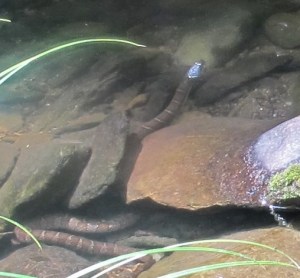
The Northern Watersnake hunts for prey with its head just above water.

The ponds and streams of farm country and the water hazards of golf courses offer a smorgasbord for the night-stalking northern water snake. They are easy to spot in the dusky twilight as they course about with their heads above water like “Nessie” in search of likely prey.  An absolute affirmation of food choices was established by a somewhat controversial yet incontrovertible field study conducted in the George Washington National Forest in 1939. Thirty northern water snakes were dissected to determine that their diet consisted of 48% non-game fish, 19% frogs, 13% game fish, 13% salamanders and 3% toads with the balance indeterminate or minimal. [4] And, surprisingly, they do this without a great deal of effort. Fifty snakes were outfitted with radio tracking devices and monitored over a three year period to determine that they spent between 1.43% and 2.38% of their time foraging, which works out to about thirty minutes a day. [5] That they are terrestrial animals that go fishing is also evident in the manner of consumption. The fish is typically dragged out of the water and subdued on land where the tables are turned. [6] Since water snakes don’t spend much time hunting, there is a lot of time for other activities, among them procreation.

Squamate reptiles, which includes snakes, lizards, and a smaller group called amphisbaenians or worm lizards, have two penises called hemipenes.  There is also some evidence of a duality in the female organs of some species called hemiclitores. [7] The evolution of sexuality of one form or another in most living things is testimony to the efficacy of random genomic mixing in perpetuating a species. Environmental variations of the geologic time frame of moving tectonic plates, orogenic mountains, and subducting seas are the forcing functions of survival of the fittest. A means to implant sperm directly into a protected repository for fertilization of the egg only became necessary when animals came ashore … fish do not have penises since semen mobility is not diminished in aquatic environs. The current consensus is that what began as a genital bud about 300 mya adapted according to usage and effectiveness. Placental mammals, turtles, and crocodiles have a single penis while almost all birds, ducks being one exception, have none. As evidence of the random mutation nature of sexuality, female marsupial mammals have two wombs and three vaginas and males have branched, two-headed penises. [8] Whatever works.

Snake sex is accomplished one penis at a time, each connected to a separate and independent testicle―a double-barreled shotgun. This almost certainly is related to the role of mate choice, the behaviors that lead to successful sex to create the progeny that set the genetic heritage of the species.  Both sexes have a role to play in this the most important of biological functions. Female snakes can store sperm for up to five years, releasing it for impregnation only when they choose to do so based on criteria that are at best obscure, but which must surely have something to do with viability of offspring (or why bother?). Male snakes advance their genetic potential by having sex with as many females as possible (nothing new here). The dual phallus arrangement allows for some flexibility in intercourse so that a fully charged testicle is always at the ready. Testing has been done with lizards who share the hemipenes anatomical feature to confirm that penis use is alternated and that a second use of the same organ results in a diminution of sperm quality and quantity (determined experimentally by taping one side shut). [9] The importance of sexual selection to speciation has motivated extensive theoretical research, mostly speculative. Four basic theories have emerged with the alliterative titles sexy sons, good genes, sperm competition and sexual conflict. The first two are related and imply a preference for “maleness” in appearance or behavior and sperm competition speaks for itself, a race to the finish. In the snake world, it is more likely sexual conflict that dominates so that two penises are better than one for the male and multiple choice is better for the female. [10] However, this matter is far from settled. Male northern water snakes are smaller than females (sexual dimorphism) but their size does not correlate to mating success, suggesting that sperm competition is the key factor. [11], [12] One thing is certain. Sex is a strong instinctual drive that operates outside cognition.

Northern Water Snake Molting Hazel River 180526
The opaque eyes and dull skin are indicative of imminent molting.

Regardless of the how’s and why’s of snake sex, the consequence is the birth of about thirty live, wriggling snakelets usually on land near water. While they are left to their own devices with no parental guidance, they forego the more typical reptilian egg stage and are thus not subject to being eaten while sessile and incubated. The young of any species are subject to predation according to size … juvenile northern water snakes are eaten by many predators, notably king snakes and raccoons on land and large-mouth bass and snapping turtles in the water. Those that survive for a few weeks grow out of their skin and need to molt, shedding the skin from the tip of the nose to the tail in one continuous unbroken sheath. During the first year, rapid growth necessitates molting every other month which segues to annually for adults. The molting process occurs from the inside out, with a new layer of skin growing underneath the old. This includes the eyes, which become opaque and nearly sightless for several days as the new layer forms. The essentially incapacitated snake holes up in a secluded and quiescent lair to await clairvoyance. [13] With a glowing new coat, the rejuvenated adult snake sets out on its natural duty to find a mate. Field experimentation has shown that female northern water snakes are five times more likely to be located by a male after shedding. [14] And thus another thirty snakes start anew in a geometrical progression.

Northern water snakes are quite common and can become a nuisance species when introduced to non-native environments. The serpentine combination of crypsis and lethality is well-suited to finding prey in a new area while avoiding the retribution of local predators. The brown tree snake was accidentally transported from its home range in the South Pacific to the island of Guam where it extirpated most of the local bird population; Hawaii has been on guarded alert for over fifty years to prevent its intrusion there. Closer to home, pet Burmese pythons escaped into the Florida Everglades … the furry mammal population, including pet dogs and cats, are now at risk. While water snakes do not eat birds or beasts, they are consummate aquatic hunters. The wetlands of California’s Central Valley are gradually becoming infested with northern water snakes that have been accidentally introduced there, probably as escaped pets. A recent field survey of a two hectare watershed near Roseville, California estimated the density of the invasive watersnake at 56.2 per hectare (more than 20 per acre). [15] Sometimes a snake in the water can be worse than a snake in the grass.

References:

  1. Behler, J. National Audubon Society Field Guide to Reptiles and Amphibians, Alfred A. Knopf, New York, 1979, pp 637-639, 682-689.
  2. Johnson, S. University of Florida Department of Wildlife Ecology and Conservation at https://ufwildlife.ifas.ufl.edu/water_moccasin_watersnake_comparison.shtml
  3. Hsiang, A. et al “The origin of snakes: Revealing the ecology, behavior, and evolutionary history of early snakes using genomics, phenomics, and the fossil record”. BMC Evolutionary Biology. 20 May 2015 Volume 15. https://bmcevolbiol.biomedcentral.com/articles/10.1186/s12862-015-0358-5
  4. Linzey, D. and Clifford, M. Snakes of Virginia, University Press of Virginia, Charlottesville, Virginia, 1981. pp 44-48, 123-138.
  5. Cundall, D. et al. “Foraging Time Investment in an Urban Population of Watersnakes (Nerodia sipedon)” Journal of Herpetology, 1 June 2011. Volume 45(2) pp 174-177.
  6. Sutton, W. et al. Nerodia sipedon (northern water snake) feeding behavior. Herpetological Review 2013 Volume 44 (2) p 333.
  7. Gredler, M.et al. “Development of the Cloaca, Hemipenes, and Hemiclitores in the Green Anole, Anolis carolinensis”. Sexual Development January 2015 Volume 9 (1) pp 21–33.
  8. Drew, L. I, Mammal, Bloomsbury Sigma Publishing, London, 2017, pp 84-87, 99-104.
  9. http://snakesarelong.blogspot.com/2014/03/why-do-snakes-have-two-penises.html?
  10. Hosken, D. and Stockley, P. “Sexual selection and genital evolution” (PDF). Trends in Ecology and Evolution. 2 February 2004. Volume19 (2) pp 87–93. Available at:11. Weatherhead, P. et al. “Sex ratios, mating behavior and sexual size dimorphism of the common water snake, Nerodia sipedon “. Behavioral Ecology and Sociobiology. May 1995 36 (5) pp 301–311
  11. Schulte-Hostedde A. et al. “Intraspecific variation in ejaculate traits of the northern watersnake (Nerodia sipedon)”. Journal of Zoology. 24 May 2006 Volume 270 (1): 147–152.
  12. http://www.virginiaherpetologicalsociety.com/reptiles/snakes/northern-watersnake/northern_watersnake.php
  13. Jellen, B. and Aldridge, R. “It takes two to tango: Female movement facilitates male mate location in wild common water snakes (Nerodia sipedon)”. Behaviour. 1 January 2014 Volume 151 (4) pp 421–434.
  14. Rose, J. et al. “Trapping Efficiency, Demography, and Density of an Introduced population of Northern Watersnakes, Nerodia sipedon, in California” Journal of Herpetology. Volume 47 (3) pp 421–427.

St. Johnswort

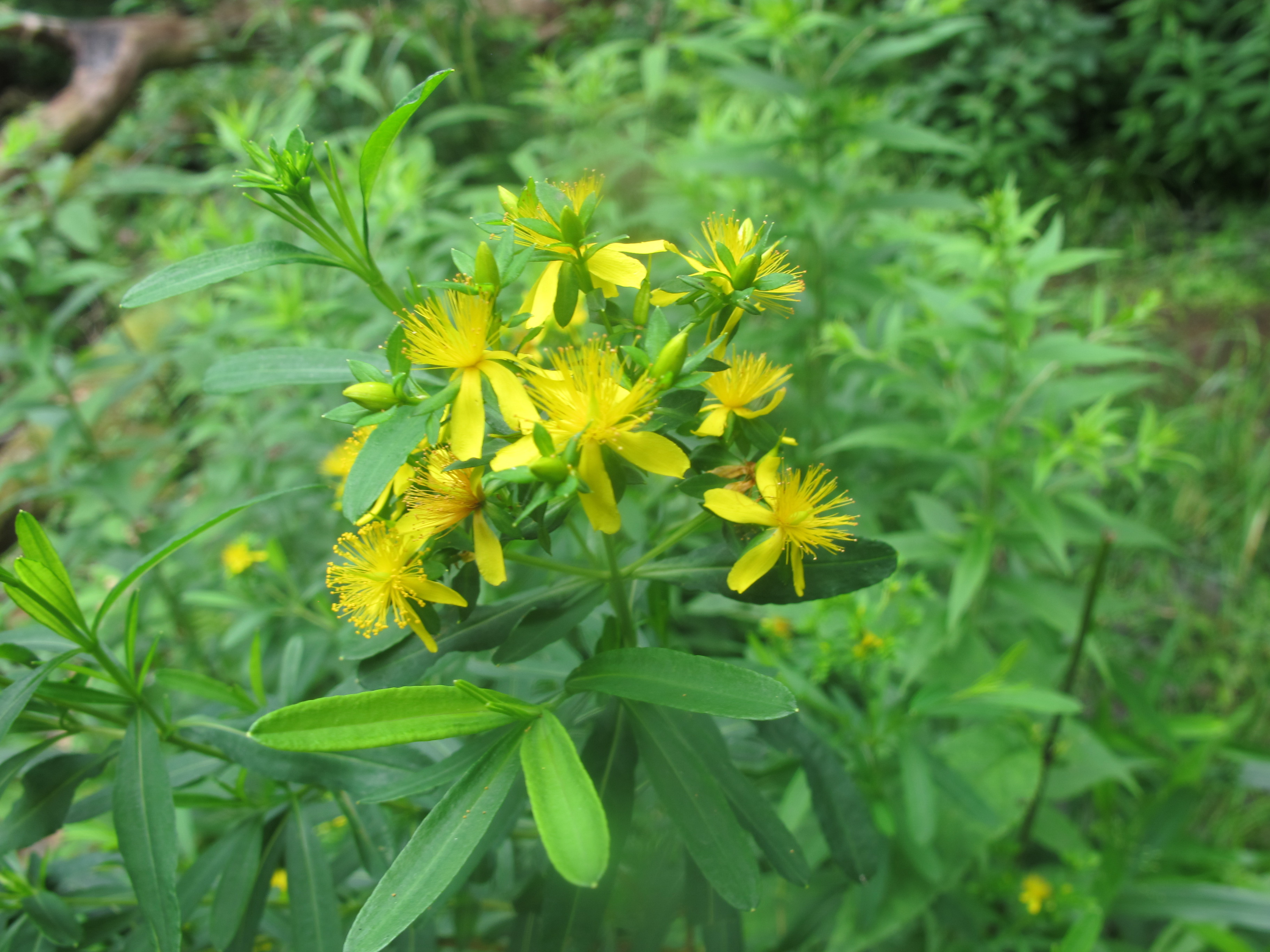
Saint Johnswort Common_Dolly Sods 160716

Common Name: St. Johnswort, Common St. Johnswort, Klamath weed, Goatweed, Perforate St. Johnswort – Saint John refers to Saint John the Baptist. The predominant etymology is that the flower blooms on or about 24 June, the Feast Day of Saint John in Catholic hagiography. There are several other theories that are described in detail below. Wort is from wyrt, Old English for herb.

Scientific Name: Hypericum perforatum – The generic name is probably a combination of hypo meaning below and erice, the Latin word for heath to describe its rocky, shrubby preferred habitat. Alternative explanations have been suggested as discussed below. The leaves have small translucent dots that look like little holes – perforare is Latin for “to bore through.”

Potpourri:  St. Johnswort is good and bad … but not ugly. Numerous anther bearing male stamens project from the base of the ovary like a shock of spiky blond hair in a unique display of floral beauty. It is good as one of the most renowned medicinal plants with a tradition of healing that dates to antiquity. It is bad in part for the same reason. Plants produce chemicals to protect themselves from herbaceous insects. The unintentional consumption of large quantities of that same chemical by plodding herbivores can be pernicious. St. Johnswort is also good as a garden cynosure and several cultivars are grown horticulturally for that purpose. But this is also bad, as they can escape into the wild where reproductive success can overwhelm the delicate balance of an ecosystem. Nature is gray as a balance between the opposites of black and white … what is good for some is relative to that which is bad for others.

The Feast Day of Saint John the Baptist was perhaps the third most important holy day (whence holiday) in the medieval Christian calendar with the birth of Jesus on 25 December second and his Easter Sunday resurrection first. It is celebrated on 24 June, which is six months prior to Christmas in accordance with Luke’s Gospel (1:36) wherein the angel Gabriel informed Mary on the night of her immaculate conception that “your kinswoman Elizabeth in her old age has also conceived a son; and this is the sixth month with her who was called barren.” Just as Christmas conveniently falls near the winter solstice to coincide with the folk festivals that preceded it, Saint John’s day is close to its summer solstice counterpart with Earth at the solar antipode. Both holidays took advantage of extant customs and social gatherings and repurposed them from pagan saturnalia to deistic ritual. Saint John’s festival was replete with local customs that varied according to the time and the tradition. Among the more ecumenical of midsummer celebrations was the gathering of flowers, St. Johnswort among them. It was in many cases it was hung over the door to ward off evil spirits giving rise to a dubious alternate explanation of the genus name Hypericum as Greek for above (hyper) the door (eikon). [1]

The naming of one flower among many for a day given to the celebration of John the Baptist seems unlikely. An alternative etiology is that St. Johnswort was one of the most notable medicinal herbs in the Levant in an age when violent, bloody rampage and rape were rife. The Crusades were the culmination of the spread of Christianity north from Rome and Constantinople to the various Germanic and Slavic tribes that succeeded Pax Romana. Led by the Franks, the crusaders set out with religious fervor stoked by Pope Urban II in 1095 to free Jerusalem from the perceived Moslem yoke, eventually establishing a presence in the eastern Mediterranean that lasted until the fall of Acre in 1291. The Knights Hospitaller or Knights of Hospital of St. John the Baptist were formed to succor the Christians in the Holy Land in 1120, becoming “one of the noblest charitable bodies in the Christian world.” They certainly used a common herb for the treatment of their charges, which, due to their success as healers and fame as protectors, became identified with them as St. Johnswort. After the fall of Acre, the Hospitallers eventually resettled to Malta where they became the Knights of Malta until they disbanded five centuries later in 1799. [2] The legacy of their symbolic healing was retained eponymously with the wort they used.

 It is not then surprising that St. Johnswort was gathered to celebrate the midsummer holiday. This was not just because it happens to bloom at about that time in northern temperate climates but because it was always good to have a store on hand for medical exigency. John Gerard was one of the more notable herbalists of sixteenth century England as the superintendent of gardens of one of Queen Elizabeth I’s primary advisors. He is credited with establishing the first comprehensive survey of medicinal plants even though his work is mostly plagiarized from an earlier work by the Dutch botanist Rembert Dodoen. [3] Gerard’s prescription for St. Johnswort was to steep the leaves, flowers, and seeds in olive oil and strain them to produce an “oile of the colour of blood” that could then be used as a “most precious remedie for deep wounds … or any wound made with a venomed weapon … because I know that in the world there is not a better.” [4] The reputation of St. Johnswort was further enhanced by divine provenance with the invocation of the doctrine of signatures by the botanist William Coles. The “signatures” idea started in central Europe with the assertion that God had made “herbs for the use of men” with “particular signatures, whereby a man may read, even in legible characters, the use of them.” Therefore, since the leaves of St. Johnswort are perforated with holes “like the pores of a man’s skin,” it was a “sovereign remedy for any cut in the skin.” [5]

With the benefit of modern laboratory assay, it is now known that St. Johnswort is a chemical cornucopia. The flowers, buds, leaves, and roots collectively contain at least ten classes of biologically active compounds ranging from amino acids to xanthones including thirty separate constituents.[6] While some of these are necessary for the operations necessary to be a plant like photosynthesis, some are the result of ecological factors with which the plant must have contended in the past up to and including the present. This adjunct group, known generally as secondary metabolites, consists of molecular combinations randomly produced in response to things like sucking insects and pervasive bacteria. The war of the worlds that determines survival sub rosa is what makes plants (and fungi) excellent sources for potential human medicinals, as we seek to repel the same invaders. When the epidermal shield is breached by accident or assault, the body is wide open for exploitation. The chemicals of St. Johnswort have proven to be effective in stemming the tide of infection. One recent study tested oil extracts of Hypericum perforatum in incision models finding that they “possess remarkable wound healing and anti-inflammatory activities supporting the folkloric assertion.” [7]

The use of St; Johnswort has long since been extended well past basic first aid for cuts and bruises to a panacea for anything that ails the body either physically, or, in a thoroughly modern twist, mentally. Brewed as one ot the many herbal tea concoctions either in whole or in part, it has been promoted as a treatment for bladder problems, intestinal worms, diarrhea, and dysentery, among others. While there have been no clinical trials to prove efficacy, it is not beyond reason that the complex chemistry of St. Johnswort could have some ameliorative affect at least for some … and then there is the placebo effect; it works because you think it will. The known biologically active compounds of St. Johnswort include choline, pectin, rutin, sitosterol, hyperforin, hypericin, and pseudohypericin. The latter two compounds are notable as having anti-retroviral properties that are a key attribute of AIDS medications. [8] However, it is in mental health applications, notably depression, that St. Johnswort has been subject to rigorous trial and assessment. The results are mixed.

Treatment for mental disorders is not an exact science. There are no objective guidelines based on independent physical parameters on which to base diagnosis and treatment … no blood samples and no lungs to listen to. The Diagnostic and Statistical Manual of Mental Disorders (DSM) has eighteen broad categories ranging from anxiety disorder to sexual dysfunction. Diagnosis relies on verbal feedback from a patient concerning subjective assessments of moods, aspirations, and other quality of life measures. Treatment is largely trial and error prescription with a mix of psychopharmaceutic drugs and dose rates until there is patient-reported improvement. Mixing St. Johnswort with other drugs is the main reason for controversy concerning its use. Many studies have been undertaken to determine that it works if taken as a singular medication for depression. For example, a metanalysis of 66 studies involving over fifteen thousand mental health patients found that “hypericum extracts were found to be significantly superior to placebo, with estimated odds ratios between 1.69 and 2.03.” Further, there were fewer adverse effects with St. Johnswort than with other tested drugs so that patients were able to stick to the medication program. [9] The National Institutes of Health (NIH) is the gold standard for the health efficacy of medications. While it does not rule out St. Johnswort as a treatment for depression, it is emphatically stated that “combining St. John’s wort and certain antidepressants can lead to a potentially life-threatening increase in your body’s levels of serotonin, a chemical produced by nerve cells.” [10]

St. Johnswort is not a single plant. It is a family formally named Hypericaceae that consists of eight genera and over four hundred species that extends geographically across both temperate and tropical regions. The characteristic features of its constituents are shrubby plants having clustered flowers with five separate petals and five separate sepals and numerous stamens that are mostly yellow to orange. [11] Common St. Johnswort earned its moniker by being the most expansive species in the family. It is more than common, however. According to the USDA, it is an official weed in seven states, listed with the caveat “Caution: This plant may become invasive.” While it only invades disturbed areas generally leaving established habitats intact, it forms dense colonies that will crowd out native species nearby. [12] H. perforatum is native to Europe and was either accidentally introduced to North America with packing materials or purposely transplanted as a medicinal herb or ornamental garden flower … it was first noted in Pennsylvania in 1793. One century later it had migrated to the western United States and by 1940 it had reached Canada. It has since become a serious invasive problem in Mexico, Argentina, Chile, South Africa, Reunion, Japan, Australia, New Zealand and Hawaii. [1]

Common St. Johnswort is a problem because it is an extraordinarily successful plant. Each individual shrub produces an average of 33,000 seeds in a single season and each seed remains viable for at least three years―about half are still potent after fifteen years. The many seeds are small and therefore light enough to be dispersed by wind for distances as far as thirty meters, germinating even in marginal soils in shady locations. Once established, seed growth is supplemented by vegetative growth as rhizomes extend outward from the parent plant to produce a copse that then predominates. The seeds are also sticky to adhere to the coats of any passing animals for further dissemination. Aside from invasive weediness, a second problem arises incident to consumption of Common St. Johnswort by grazing animals.   One of the unintended consequences of its complex chemical cocktail is that it causes photosensitization. This self-descriptive term means that exposed areas become sensitive to the photons of the sun’s energy field, particularly those in the ultraviolet range. For animals including humans, light-colored areas absorb more energy and are damaged … something like severe sunburn. This can wreak havoc with white (but not black) sheep and any other animal with white patches like horses and cattle. [1]

The alternative name Klamath weed is a case in point. The Klamath River basin of California was an important livestock grazing area that had succumbed to a gradual infestation of Common St. Johnswort in the early twentieth century. Starting in 1922, Dr. Harry Smith of California’s Department of Food and Agriculture sought a biological control agent, identifying several beetles that might be compatible. However, local resistance to introduced phytophagous species in a dense agricultural area stymied trials―a common issue due to fears of potential damage to cash crop staples. However, by 1944 over two million acres of rangeland had been essentially rendered useless by the “Klamath weed” and land prices plummeted as ranchers were unable to raise cattle due to the debilitating effects of photosensitization. Three candidate beetles were approved for introduction from Australia where they had already been successfully deployed from their native Europe to control St. Johnswort. In spite of the acclimatization issues due to seasonal reversal, one of the three (Chrysolina quadrigemina) survived and thrived. Five thousand were released in 1946 to establish a population of three million by 1950 which were then distributed throughout the western states.  After ten years, St. Johnswort had been reduced by over ninety percent as land values rose by a factor of four saving over three million dollars a year. [13]

St. Johnswort is one of the most notable examples of ethnobotany―the complex interplay between plants and people. Within the constraints of its indigenous fons et origio, it evolved chemicals to deter herbivores from its destruction and an industrial scale reproductive capacity to advance its quest for survival and dominance. Resourceful hunter gatherers learned of its potency through random trial and error, making it a key ingredient of the herbal healer’s medicine chest. It spread with the advances of civilization whose pioneers brought it with them wherever they went to treat the wounds incurred as rite of passage. Unchecked by local predators in these new places, St. Johnswort proliferated unabated. Reestablishing nature’s balance to control its epidemic proliferation mandated the importation of its native beetle predators to its new habitat. After centuries of relocation and decades of remediation, St. Johnswort is once again living in harmony with its environment. The only difference is that what once was used for physical wounds has been repurposed to treat the depressed mental wounds that seem quid pro quo to the frenetic pace of human endeavor.  One can only wonder what John the Baptist might have thought of this.


References:

  1. https://www.cabi.org/isc/datasheet/28268 The Commonwealth Agricultural Bureau International is the primary agency for tracking invasive species and its impact on the food supply. This is a comprehensive fact sheet that also includes history, lore, and usage.
  2. Durant, W. The Story of Civilization, Volume 4, The Age of Faith, Simon and Schuster, New York, 1950 pp. 585-613.
  3. http://exhibits.hsl.virginia.edu/herbs/herball/
  4. Gerard, John, Generall Historie of Plantes, John Norton Publisher, London, England, 1597, pp. 123-124.
  5. Coles William, The Art of Simpling, Angell in Cornhill, England, 1656 p. 87 reprinted by Provoker Press, St. Catherines, Ontario, Canada, 1968
  6. Greeson, J. et al. “St. John’s wort (Hypericum perforatum): a review of the current pharmacological, toxicological, and clinical literature”. Psychopharmacology 5 January 2001 Volume 153 (4): pp. 402–414.
  7. Süntar, I. et al “Investigations on the in vivo wound healing potential of Hypericum perforatum L”. Journal of Ethnopharmacology 3 February 2010 Volume 127: pp. 468–77
  8. Foster, S. and Duke, J. Medicinal Plants and Herbs, Houghton Mifflin Company, Boston, 2000, pp.128-129.
  9. Linde K. et al (February 2015). “Efficacy and acceptability of pharmacological treatments for depressive disorders in primary care: systematic review and network meta-analysis”. Annals of Family Medicine. 13 January 2015 Volume 13 (1): pp. 69–79. https://www.ncbi.nlm.nih.gov/pmc/articles/PMC4291268/
  10. “St. John’s Wort”. National Center for Complementary and Integrative Health, US National Institutes of Health. September 2016. https://www.nccih.nih.gov/health/st-johns-wort
  11. Niering, W. and Olmstead, N. National Audubon Field Guide to North American Wildflowers, Alfred A. Knopf, New York, 1998, pp. 557-561.
  12. https://plants.sc.egov.usda.gov/factsheet/pdf/fs_hype.pdf
  13. https://faculty.ucr.edu/~legneref/biotact/ch-66.htm (University of California, Riverside).