Masting Behavior of Trees

Acorn mast from white oak trees occurs about every 5 years, evidence of variability

Common Name: Masting – The production of copious quantities of deciduous tree nuts in a single year followed by several years of minimal nut production. The phenomenon involves all nut trees, regardless of species, within a well-defined geographical region.

 Scientific Name:  Seed masting or Mast Seeding – A slightly more technical term to emphasize that the purpose of masting is to accentuate seed propagation to promote new tree growth.

Potpourri: Mast is a noun of Anglo-Saxon origin (mæst in the original Old English form using the ligature æ) that refers to the accumulation of various kinds of nuts on the forest floor that served as food for farm animals, particularly domesticated hogs. Pannage is a mostly arcane term for the pasturing of animals in the forest to take advantage of the mast, a practice that played a major role in the sociological development of rural life in Europe. As the swine population grew in concert with the human population, the pannage season had to be restricted, traditionally from the feast of Saint Michael (September 29) to the last day of November.  Pigs were brought to the New World with the earliest expeditions, notably that of Hernando De Soto in the southeast from 1539 to 1542, the progenitors of the razorback. Hogs became central to the salt pork and fatback cultures of the Appalachian and Ozark Mountains, the oak-chestnut forests providing the mast for their sustenance. [1]

The process by which trees produce mast is called masting. The curious thing about masting is that it is not a continuous process but rather is cyclic. Every three to five years a tree will produce prodigious quantities of nuts; in between the “masts,” it will produce almost none. The span of time between masts varies according to tree species and a host of other ecological and climate factors and can be as long as ten years. It is a matter of common experience that many kinds of trees exhibit this behavior at the same time over a large geographic area. This poses two conundrums: (1) Why do the trees regulate their nut production in a boom or bust manner?; and (2) How do they manage to coordinate the same cycle with other trees over a large area? Individual tree masting is called variability and the coordination among masting trees is called synchrony. [2]

Variability has had two hypothetical explanations: resource responsiveness and economy of scale.  The basic precept of resource responsiveness is that an individual tree will respond to the resources at its disposal. In a good year with plenty of rain and sunlight, a tree would have more resources with which to manufacture more nuts, which would subsequently be more likely to propagate in a moist, nutrient rich environment.  The primary resources of interest (rain and an adequacy of sunlight) are determined by prevailing weather conditions. Since weather patterns extend over an extended geographic area, resource tracking could also explain synchrony, as all the trees would be subject to the same cycle of resources.

Nature is not that simple, however. The fact is that variations in weather do not correlate with masting; moist and sunny weather does not produce a mast crop any more than dry and overcast weather prevents one. Weather is not cyclic; a wet year is not necessarily followed by a dry year. Masting is much more consistent in periodicity and result, cycles of high nut production occurring on a regular, periodic basis. However, there is one aspect of resource utilization by masting trees that does track with mast cycles, the resources expended by the tree. A significant resource investment (estimated to be about 10 percent of its total nutrients) must be made by a tree to produce the flowers that, when fertilized, produce the seed nuts. What this means is that trees grow slowly during mast years and more rapidly in non-mast years as the resources are shifted from reproduction to growth.   This suggests that masting is part of a complex evolutionary behavior pattern that must derive from an ecological stimulus – economy of scale variability.

The term economy of scale refers to the general precept that benefits will be magnified by the scale of the population size. Buying in bulk lots distinguishes wholesale from retail with the former gaining the economy of scale reduced costs of larger quantities.  There are two corollaries associated with the economy of scale theory for masting variability – predator satiation and pollination efficiency. In predator satiation, masting is stimulated by a tree’s adaptive strategy for survival in a world of nut-eating predators (notably squirrels). By producing a super-sized nut crop, the predators become satiated so that an adequate number of nuts will survive to succeed for propagation of the tree species.

The seven white oaks in my backyard so overwhelm the squirrel population with acorns in a mast year that they scamper about in confusion with too many nuts to eat or bury. A rough calculation based on extrapolation yields a total over 200,000 acorns. When squirrels cross from the back yard to the front past the side of the house, they are confronted with an equally overwhelming mass of hickory nuts from the hickory trees there, which, of course, mast in synchrony with the oak trees. The predator population is held in check during the non-mast years, when the parsimony of production is reflected in declining populations. In the economy of scale paradigm, each nut in a mast year has a greater probability of escaping predation.

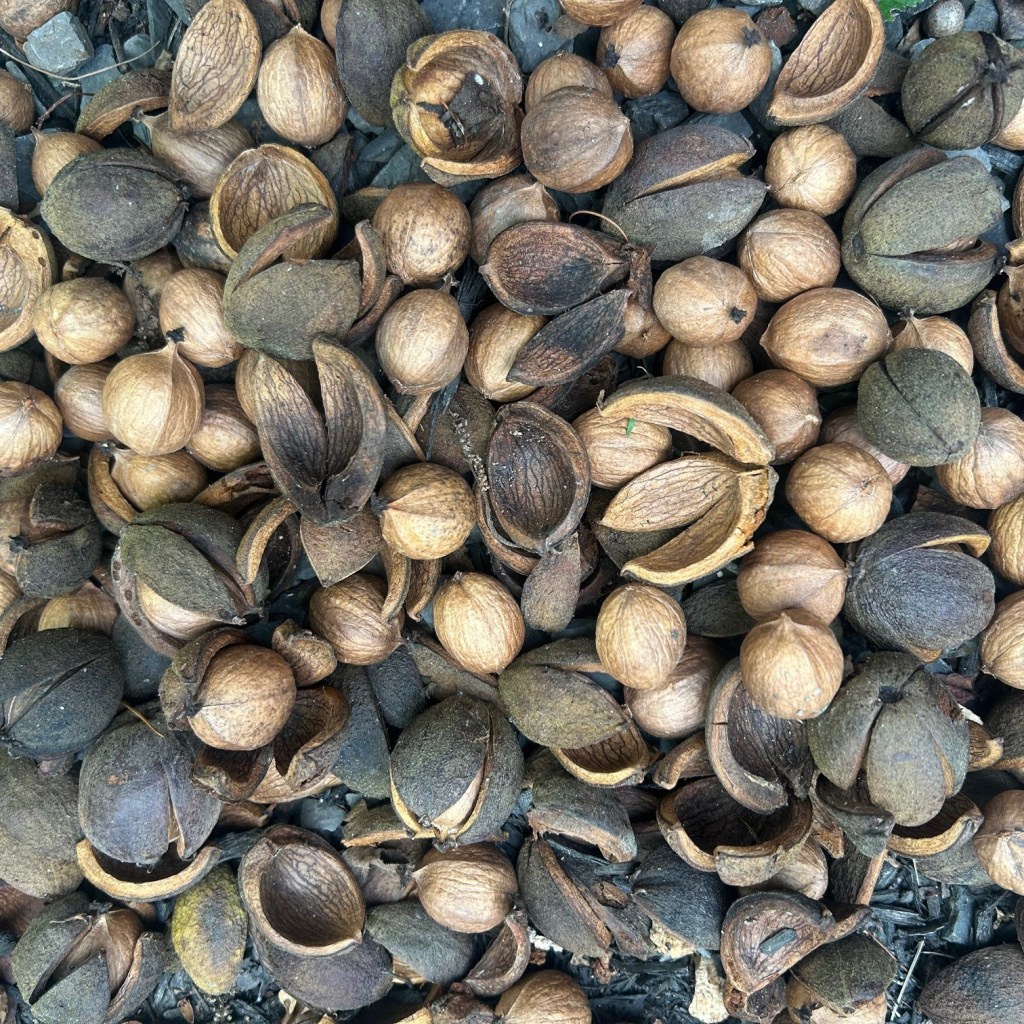
Hickory nut mast 10 meters away from acorn mast above, evidence of synchrony

Pollination efficiency is based on the notion that it is more efficient from the resource standpoint for a plant to successfully propagate if there are a large number of sites for germination. This is not true for all plants. Flowering (Angiosperm) plants employ insect pollination, meting out nectar advertised by their attractive flowers to take advantage of male pollen transport to the female ovary of another plant. Chicory is a good example, as only a few flowers open each day and each expires at day’s end. Oak and hickory trees are monecious (male and female flowers are on the same tree) and their pollen is transported from staminate to pistillate flowers by the wind.  From the standpoint of reproductive success, it is advantageous for oaks to fill the air with pollen from many trees at the same time, saving up energy during off-years. Fungi are also mostly wind-pollinated and accordingly produce spores in prodigal proportions; a giant puffball is estimated to contain about 7 trillion spores.

Field testing for experimental evidence of predator satiation and pollination efficiency as causative factors for the masting behavior of trees is difficult and the results tenuous. For example, a study of masting trees in a 6-hectare study area estimated pollination efficiency by counting the total number male flowers and the number of nuts produced from1988 to 1993. Testing for predator satiation is even more difficult; one must not only show that predators were satiated but also that the interval between masting events was sufficient to result in a decrease in predator population. The same study utilized the number of nuts that had evidence of insect predation relative to those that were undamaged as a measure of satiation. The year-to-year variance in nuts with evidence of insect predation was used to determine the mast interval. The study concluded that both effects were observable, pollination efficiency having a greater impact than predator satiation. [3]

But the real conundrum is not why trees mast as individuals (variability), but how they coordinate their activities over large areas and across different species (synchrony). It is a matter of direct observation and scientific study that they do. A survey of acorn production was initiated in 1994 to quantify acorn production of blue oaks at 10 different sites at separated by up to 700 kilometers in California. The conclusion, after eleven years of study was that “acorn production extends to pretty much every blue oak, a population of 100 to 200 million individuals.” A more comprehensive literature survey of relevant references on nut production by various trees was organized by W.D. Koenig, a professor at UC Berkeley. A review of 72 sites and 5,000 data points revealed that synchronization of seed production was statistically significant in populations separated by 2500 kilometers. [4] One may conclude that synchrony occurs over long distances and involves almost every tree. So how do they do it?

Three mechanisms are germane to any discussion of synchronization of activities among plants or animals: chemical, reproductive, and environmental. The use of chemicals to transmit signals among individuals is common. However, it is not likely that this is pertinent to the case of masting as chemicals act over much shorter ranges than is observed in masting tree populations. Reproductive synchronization in arboreal terms is called pollen coupling. The concept is that if a tree depends on the pollen from a second tree to produce the fruit nut, then it must be synchronized with it. Implicit in this is that the tree that is providing the pollen must be at some relevant distance away. The effective distance over which pollen is effective in achieving fertilization is of value in forest management; recently completed studies have revealed that pollen is only effective within a range of about 60 meters, hardly on the order of the observed ranges of masting behavior. [5] A second reason that this mechanism is irrelevant here is that both oak and hickory trees are monecious, so the pollen doesn’t need to travel more than a few meters. Since it is not likely that chemical or reproductive effects result in the long-distance synchrony of masting, one must conclude that the only other reasonable choice would be environmental.

The notion that resource responsiveness to the environment causes the masting behavior of individual trees, i.e. variability, was ruled out above based on field observation. The question is how environmental resources that could not cause masting variability would nonetheless be the cause for masting synchrony.  It is the difference between weather and climate, the former term referring to the short-term manifestation of the latter. The idea that the environment can cause synchronous fluctuation in population size is not new. It is called the Moran effect after the Australian statistician who showed that the correlation of two populations at different locations was equal to the correlation in their common environmental influence (if they were subject to the same basic parameters).  It has been demonstrated empirically in many organisms, from viruses in the body to caribou in Greenland. [6]

It is therefore possible that geographically wide-ranging climate conditions cause trees to mast in synchrony. It is not known at present what aspect of the climate is predominate, if, in fact, it is that simple. There is some evidence that temperature may be a key parameter. The study of the California oaks was correlated with the mean temperature in April over the course of the eleven years of data. April was chosen as the most important month for masting, as it is when the trees produce the male and female flowers that result in nuts that ultimately fall as mast. The spatial synchronization of April temperatures was found to be even more strongly correlated than the masting of the oaks. The rationale is clear: the periodic fluctuations of temperatures (perhaps caused by the cyclic El Nino phenomenon) operate in synchronization with masting over the same geographic area. [7]

Or maybe it is something else altogether. The recent demonstration of the communion of all of the trees in the forest in concert with their mutualistic fungal partners may offer an alternative hypothesis. It is demonstrably true that the stronger trees in a forest send nutrients to the weaker trees in the forest and the trees in the sun send nutrients to the understory trees in the shade in order to keep the forest ecosystem in balance [8], then why wouldn’t these same signal paths send the signal to make more nuts? As the nutrient levels build up in the tree roots and fungal mycelia during high growth years, a crescendo point is reached and each and every tree gets a boost of energy to make it a mast year. This would certainly explain synchrony, and, given the vast dimensions of the “wood-wide web” it would also explain regional geographic expanse. All of the trees in the forest would benefit from an increased likelihood of the growth of saplings that would eventually succeed their parent trees so that the forest as “mega-organism” survived.

A similar and probably related observation is that many fungi will gather their resources for years only to erupt in a single year that results essentially in what might be considered a mast of mushrooms. There are many similarities as fungal spores, like the pollen of trees, benefit from a large cohort; each germinating spore creates a hypha that must find a mate. The fact that oaks have an especially large number of fungi with which they form mycorrhizal associations is quite likely why they are so successful as climax forest tree species in part due to the benefits of masting to longevity in a healthy forest. [9]

Another point to ponder at this juncture is why the masting phenomenon is restricted only to nut trees like oaks. What about the seed-bearing cones of conifers? It is not uncommon to traverse a pine forest, noting the soft tread of pine needles and a profusion of cones. The pine needles are indicative of a little noted characteristic of evergreens. They lose their needles just as deciduous trees shed their leaves. They just don’t do it all at once but take about four years to recycle all needles (longer for firs and spruces).  Cone masting is more of a challenge, however, because it takes three years to produce a cone. Year one requires moisture and sunlight to prime the cone by accumulating resources, year two must be dry to enhance pollination, and year three must be wet and sunny for cone growth. While cone trees “mast” based on field observation experience, there does not appear to be any synchrony between conifers masting cones and deciduous trees masting nuts. This has led to the hypothesis that cone bearing trees produce copious seeds when environmental conditions favor germination as opposed to the more social sharing behavior of nut trees.  [10]

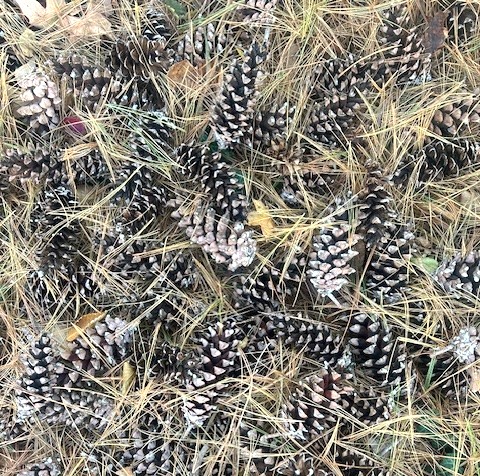
Pine trees also produce many cones with their embedded pine nuts on a periodic basis like oak and hickory trees

Over the last twenty-five years, research to better understand tree masting and its effects of forest health has continued, expanding across the globe from its mostly North America and Europe roots and to involve specialists from fields other than botany. Of note is confirmation of the wide geographic range of masting synchrony that has been shown to be of intercontinental scale, extending to over thousands of kilometers. This suggests that fluctuating weather patterns driven by some environmental factor (the 11-year sunspot cycle has been proposed) must be key to synchrony as nothing else could be so widespread.  One of the more influential studies concluded that masting was the fundamental driver of animal behavior: “variable acorn crop size drives a chain reaction linking deer populations, ticks, and Lyme disease along with mouse populations, ground-nesting birds, and gypsy moths”.

The fundamental debate is now focused on the relative importance of resource matching (that masting depends on some limited resource), and economy of scale (that masting depends on genetic evolutionary trends of the tree species). A resource budget model has been proposed that unites the two with advantages of evolving to produce mountains of acorns weighed against the resources needed for synchronous reproduction. [11] The bottom line is that there is not (yet) an accepted comprehensive explanation for masting, despite its importance to the health of forests and the animals and fungi that live in them. It may well be that we are just at the threshold of understanding the real, complex nature of forests.

References:

1. DeVoto, B. The Course of Empire, The Easton Press, Norwalk, Connecticut, 1988. pp 23-31.

2. http://uslancaster.sc.edu/faculty/scarlett/acrnsmry.htm  

3. Shibata, M. et al “Causes and Consequences of Mast Seed Production of Four Co-occurring Carpinus species in Japan” Ecology, January 1998, pp 9 – 12 This paper documents a thorough field test of masting hypotheses.

4. Koenig, D. and Knops, J. “The Mystery of Masting in Trees” American Scientist Volume 93 July-August 2005. Pp 340-349.

5. Knapp, E. et al “Pollen-limited reproduction in blue oak: Implications for wind pollination for fragmented applications” Oecologia 128 March 2001 pp 48-55.

6. Moran, P. A. P. “The statistical analysis of the Canadian lynx cycle. II. Synchronization and meteorology” Australian Journal of Zoology, June 1953 pp. 291–298.

7. Koenig, D. and Knops, J. Op. cit.

8. Klein, T. et al “Belowground carbon trade among tall trees in a temperate forest.” Science 15 April 2016, Vol. 352, Issue 6283, pp. 342-344.

9. Binion, D. et al Macrofungi Associated with Oaks of Eastern North America, West Virginia University Press, Morgantown, WV, 2008.

10. Lauder, J.  “The Science of Masting: Why are there so many acorns (or cones)?” Sierra Streams Institute. 15 October 2024 https://sierrastreamsinstitute.org/2024/10/15/the-science-of-masting-why-are-there-so-many-acorns-or-cones/    

11. Koenig D. A Brief History of Masting Research Philosophical Transactions of the Royal Society, 26 March 2021 Volume 376

Hydropower

The Conowingo Hydroelectric Dam on The Susquehanna River is a two mile hike north of Susquehanna State Park along the railroad right of way that was installed to transport building materials for the dam, which opened in 1928.

Hydroelectricity is one of the three sources of renewable energy capable of providing electricity on a global scale. All three ultimately derive their energy from the sun. Photovoltaic or PV panels collect and transmit sun photon energy directly. Wind turbines collect the energy of pressure differences caused by temperature differences from the sun heating the earth’s surface. Hydro energy is more nuanced. The sun evaporates water from the oceans. As water vapor rises and moves with winds swirled by the Coriolis effect, clouds form and the vapor condenses to water falling as rain or snow. Water falling on land finds its way back to the ocean by forming rivers that flow from  higher to lower elevation. The potential energy of the water at higher elevation is converted to kinetic energy as it moves downhill. Turbines placed in the flow connected to electrical generators is hydroelectric power. Dams regulate the flow so that the power is constant and continuous rather than being subject to the whims of weather in floods and drought. Hydro has recently taken on a new role. Since wind and sun are intermittent but hydro is constant, the use for water has gained in importance linking the former to the latter. Power supplied  by wind and solar in excess of demand runs pumps to move water uphill to an elevated reservoir. The energy thus stored is reclaimed when the upper reservoir flows back downhill now directed through a hydroelectric generator. Pumped storage hydropower (PSH), as this arrangement is called,  thus provides energy storage, a mandatory capacity for a future global electrical system dominated by renewables.   

Hydropower is a broad and underutilized word that applies to any means by which water in its liquid state is used as a source of energy for human endeavor.  It is useful as an inclusive term that applies throughout the course of human history. Water for mills and the machinery of early, mainly textile factories, was generally called water power. Starting in the late 19th century, water became one of the main sources of generating electricity, mostly with the construction of dams, giving rise to the term hydroelectric power. Hydropower does not refer to the use of hydrogen gas as a source of energy (power is the rate of using energy), although this may one day become a neologism if hydrogen power proliferates. The similarity and possible confusion arises from the fact that Antoine Lavoisier, the father of chemistry, concocted the word hydrogen from Greek words meaning “I beget water” for the seminal work of Chemistry, published in English as Elements of Chemistry in 1790. The rationale for the name was that oxygen, meaning “I beget acid,” had been previously named based on the observation that sulfur, phosphorus and carbon produced acidic solutions when burned. Hydrogen mixed with oxygen “begot” water (2H2 + O2 = 2H2O), which was at the center of scientific inquiry from its inception.  Thales, a Greek philosopher of the 6th century BCE, held that water was the primary substance from which all other matter was formed. [1] While water is crucial to the evolution of life, the erosion of uplifted land back to the sea, and to the swirling chaos of weather, it falls short of being the elemental element. But it could be considered the elemental compound.

The use of water to do work dates from the dawn of prehistory as agriculture radiated outward from Mesopotamia and the first cities became food production and distribution centers. More mouths to feed with larger harvests gave rise to a better and more efficient way to make flour from threshed seeds in the Neolithic, literally New Stone Age.  The first written account of water turning a millstone to grind grain appears in the writings of Antipater of Thessalonica in the 1st century BCE: “Demeter (Greek goddess of agriculture) has reassigned to the water nymphs the chores your hands performed.” A horizonal wheel in a flowing stream was connected with an axle to a large circular shaped stone that rotated against a second stationary stone with the force otherwise provided by man or perhaps donkey power. The much more efficient vertical wheel that could use both the weight and the velocity of water required gearing to convert rotary motion to the horizontal stone was first described by the Roman engineer Vitruvius as hydraletae, Latin for water mills, in 27 BCE.  The watermill became the cynosure of the hamlets of England which grew in number from 6,000 according to the Domesday survey in 1086 to 30,000 in 1850. As the American colonies were settled and farmers migrated inland, watermills followed to make flour for daily bread to feed the burgeoning nation. Their remnants, long abandoned, abound.

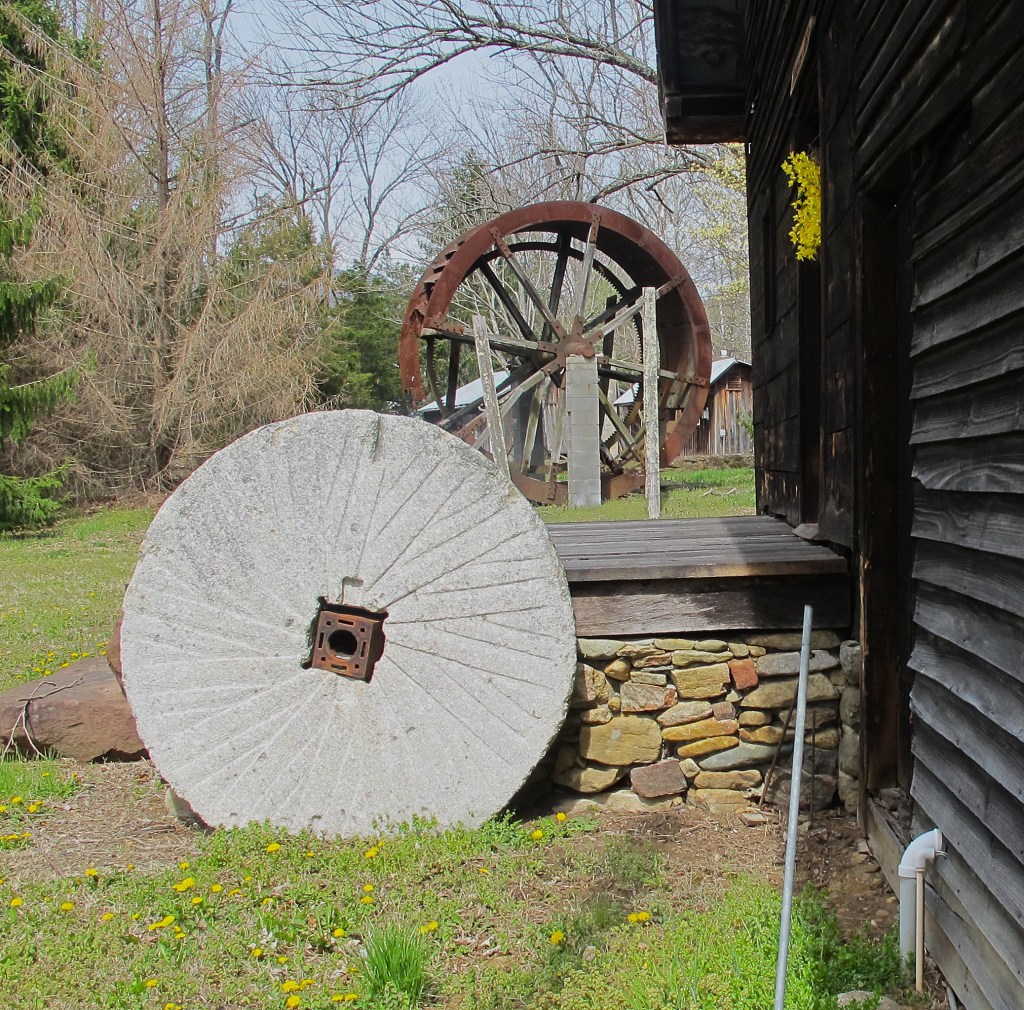
The mill at Nethers, Virginia is just down the road from the Old Rag Trailhead.

The use of water advanced from foundational milling of flour to powering industry as an integral part of the nascent Industrial Revolution in the early 19th century. It was a matter of economics, waterwheels were the most efficient sources of energy available. Two manual laborers could manually grind 15 pounds of flour per hour (200 watts), a mule-driven mill could double that, but a waterwheel produced about 200 pounds with a power of 2.000 watts or 2 KW―enough to feed a village of 3,500 inhabitants. Water power could be scaled up by enlarging the wheel and/or by employing multiple wheels. To supply the 1,400 fountains and waterfalls at  King Louis XIV’s magnificent palace at Versailles, near Paris, France, fourteen 30-foot wheels were installed  on the Seine River between 1680 and 1688 to drive 200 pumps. Glasgow, Scotland became a manufacturing entrepot in the 1830’s in part because of the massive water works on the Clyde River at Greenock with 20 waterwheels that could provide about 2,000 KW or 2 megawatts (MW). The full potential of water as a viable power source to meet the demands of expanding industry was the water turbine, invented by the French engineer Benoit Fourneyron in 1827. A turbine, named from the Greek word for whirling, uses curved blades with radial outward flow, increasing the efficiency of the traditional flat board waterwheel substantially. Water turbines were the primary source of power along the Merrimac River in Massachusetts, supplying 60 MW to hundreds of textile mills in 1875, 80 percent of all power. [2]

Waterwheels powered factories with rotary motion to turn pulleys linked by gears and belt drives to spindles for weaving fabric, to operate saw blades to cut lumber, and many other similar mechanical operations. Hydroelectricity became possible only after the invention of a device that could take the rotary motion imparted by a water turbine to generate current. The dynamo was invented by Michael Faraday in 1831 as a practical application of his discovery of induced electricity, that any conductive material moving through a magnetic field was induced to create a current of  moving electrons. The rotation of an iron rotor through a magnetic stator converted mechanical to electrical energy, giving rise to the induced current generator or dynamo. Any rotational device, such as a steam engine, could provide the motive force. Initial development of the dynamo generator as a practical device was one of the many inventions of the inimitable Thomas Edison at Menlo Park. The impetus was to provide a constant voltage source that was necessary to power the incandescent lights that he was working on as concurrent development with a stated goal of creating a central station for lighting all of New York City. The resultant dynamo, nicknamed “long-wasted Mary Ann” for its unusual two upright columns, was found to not only produce a nearly constant 110 direct current (DC) output but to do so at 90 percent efficiency, twice as much as its variable voltage predecessors. At 3 P.M. on Monday, September 4, 1882, Edison gave the order to start up four boilers to make steam for nine steam engines connected to Edison dynamos at Pearl Street Station in New York City to provide electricity to 400 incandescent lamps. [3]  While momentous as a practical demonstration of the use of electricity, the DC generated by Edison’s dynamos was limited in range to about one mile. The subsequent invention of alternating current (AC) would solve that problem.

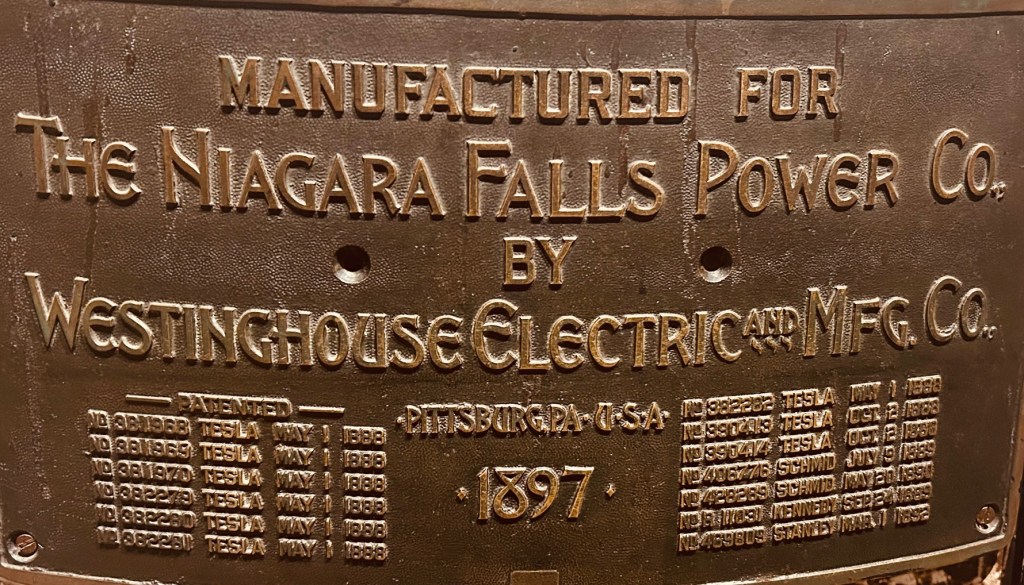
Niagara Falls played a seminal role in the development of electricity as the backbone of modern industry. The prodigious flow of the Niagara River that carries the waters of the Great Lakes to the Atlantic Ocean over a 167 foot cliff has attracted tourists for centuries (Edison spent his honeymoon there) and inevitably those interested in harnessing its water power. A small waterwheel-driven saw mill constructed in 1759 was succeeded 80 years later by a generating station that provided a small amount of electricity supplied by a DC generator for mills in what had by now become a namesake village. The Cataract Construction Company was organized in the 1890’s with the express purpose of building a water tunnel to supply a large scale hydroelectric power plant to sell electricity to customers at a profit. However, unlike New York City with its closely clustered businesses, upstate New York was remotely situated and would require long distance transmission. [4] The technology of electrical generation underwent a sea change when George Westinghouse bought the patents of Nicolas Tesla (who originally worked for Edison at Menlo Park) to design an alternating current (AC) generator. As AC current could be transformed to higher voltages for efficient transmission over long distances, the decision, considered radical and risky at the time, was to install AC generators in the Niagara Falls hydroelectric plant. It  began transmitting power twenty miles to Buffalo, New York, in 1896, making it the first modern industrial mecca. Thereafter, 80 percent of all new generating capacity was AC as the nation’s electrical grid took shape with remote power stations, like hydroelectric dams, feeding a network of long-distance power lines. Niagara Falls was a watershed reservoir for the watershed technology of AC power.[5] It now boasts 60 generators producing 5,000,000 KW, or 5 gigawatts (GW).

The nameplate from the Westinghouse AC generators in stalled at Niagara Falls is on display at the Smithsonian Museum of American History as one of the significant objects relating to power and industry

Construction of hydroelectric dams by the United States government resulted from congressional measures to address the international threat posed by Germany and its allies during the First World War after the sinking of the Lusitania in 1915.  The National Defense Act of 1916 doubled the size of the Regular Army and the National Guard and authorized the construction and operation of a nitrate plant for munitions “at a cost not more than 20 million.” President Woodrow Wilson chose  Muscle Shoals on the Tennessee River in Alabama as the site for a hydroelectric dam to provide power for the nitrate plant. This was at least in part a matter of investing in the impoverished south that had yet to fully recover from the devastation and disruption of the Civil War; Wilson was from Virginia. [6] The eponymous Wilson Dam, still in operation producing 663 MW of electricity, was not completed until 1924 and had no impact on the war, but a tremendous impact on the region. The Roaring Twenties optimism that infused the antebellum nation gave rise to stock speculation culminating in its precipitous plunge on Black Thursday, 24 October 1929. President Herbert Hoover, as an engineer and businessman, held to the belief that cajoling industrial and financial leaders to increase spending would staunch the downward spiral. Hoover vetoed a bill that would have converted the Muscle Shoals nitrate plant hydroelectric dam into a government run operation with the express purpose of providing electricity to the Tennessee region, preferring to have it run by private enterprise. By 1930, the Hoover Administration reluctantly concluded that some economic stimulus was warranted. Half a billion dollars was authorized for public works, including 65 million to construct Boulder Dam (later renamed Hoover Dam) on the Colorado River on the border between Arizona and Nevada. The economy continued to founder. Franklin Delano Roosevelt pledged to restore economic prosperity through federal government action in 1932 and was elected in a landslide with 472 of the 531 electoral college votes. [7]

Roosevelt’s New Deal ushered in the age of massive government programs, instituting a comprehensive plan to put the nation back to work. Building hydroelectric dams to bring power to the people was a core precept. With the Wilson Dam at Muscle Shoals as model, the US Congress passed the Tennessee Valley Authority (TVA) Bill in May 1933. It was one of the most important and far reaching initiatives in the history of the country. It gave the federal government the authority to construct and operate hydroelectric dams in a seven state region encompassing 40,000 square miles to “generate and sell electric power particularly with a view to rural electrification … and to advance the economic and social well-being of the people living in said river basin.” To accomplish this lofty goal, the government erected over 4,000 miles of transmission lines and subsidized rural electrification to quadruple the number of customers connected. The TVA is currently the largest public power provider in the United States and the fourth largest electric power provider with 29 hydroelectric sites employing over 300,000 people. The TVA model of government owned and operated hydroelectric dams to “use the facilities of a controlled river to release the energies of the people” was replicated in the Columbia River region of the Pacific Northwest. Construction of the Grand Coulee Dam in Washington State starting  in 1933 followed by the Bonneville Dam in Oregon in 1934. [8] By 1940, 40 percent of the electricity in the United States was provided by hydroelectric dams. The Depression Era ended with the full employment necessary to build the arsenal of democracy that won World War II. When it was over, nuclear energy of the atomic age replaced hydro as energy of the future.

Hydroelectric power has declined in importance in the United States over time, now providing only 6.2 percent of the electricity overall and 28.7 percent of that which is  renewable. This is the consequence of growing demand for electricity in an increasingly industrialized society relative to  static availability of appropriate locations for dam construction. Almost all of the good spots are taken and the older, larger capacity dams are over 80 years old . The United States is currently home to over 2,200 hydropower units that produce 80 gigawatts of electricity. Between 2010 and 2022, hydropower in the United States grew by only 2.1 GW almost entirely due to upgrades to existing hydroelectric dams (1.4 GW) and to additions of generators at 32 non-powered dams (550 MW). During the same period, 68 hydropower licenses were terminated for a total of 330 MW. By contrast in 2024 alone, the United States added 30 GW of solar power. [9]  Hydropower dams are in decline in the United States for several reasons. One is the droughts that are increasingly dire as global temperatures rise and more water evaporates. When the 2.1 GW Hoover Dam was completed in 1936, Lake Mead  was the largest reservoir in the United States. Due to a series of droughts in the 21st century, it has been reduced to as low as one quarter capacity with the plant’s four intake towers above the water line. [10] The second reason for the declining interest in hydropower is environmental. Dams disrupt the natural flow of sediments and impede the movement of fish upriver. The removal of the dams on the Elwha River on the Olympic Peninsula in Washington State in 2014 was the largest intentional dam removal  in world until the removal of the Klamath River dam in California in 2024.  A total of 1,951 dams were removed in the United Stats between 1912 and 2021. [11] Hydroelectric energy, while on the decline in the United States, is expanding in some areas of the world, notably China.

Unlike the network of hydroelectric facilities in the United States that were erected decades ago, global hydroelectric power was delayed until the broad industrialization that took hold in the  second half of the 20th century. Since the beginning of the 21st century, global hydropower has grown 70 percent, and now provides one sixth of  the world’s electricity. Hydroelectric power trails only coal and gas as third in overall capacity, is larger than all other renewable sources combined, and provides the lion’s share of electricity in 28 emerging and developing countries. Between 2021 and 2030 hydroelectric capacity is projected  to rise by 230 GW, an additional 17 percent. However, that marks a 23 percent reduction from the preceding decade of 2011 to 2020 indicating that the availability of sites with sufficient water flow and favorable geology is now reaching saturation worldwide. China is a case in point.  Between 2001 and 2010, it became the world leader in hydroelectric power with nearly 60 percent of global capacity. [12] The Three Gorges Dam of the Yangtze River, at 22.5 GW  the largest capacity hydroelectric plant in the world, was completed in 2003. During its nine year construction, the overall cost was over $30 billion, some of which was to resettle 1.3 million people displaced by the resultant reservoir. China’s growth has slowed since so that in 2025 it is still in first place, but with only 30 percent of global capacity. In a renewed bid to regain momentum, China recently approved the construction of  an even larger dam on the lower reaches of the Yarlung Tsangpo River that flows from Tibet to become the Brahmaputra in India and Bangladesh, where it empties into the Bay of Bengal. It is expected to be three times the size of the Three Gorges Dam and to cost $100 billion more. Aside from the international protests from the downstream countries, local Tibetans were involved in a protest in February of 2024 at the site of another dam. [13] [14]

Pumped Storage Hydro (PSH) facility encountered on a hike in central Germany.

While new hydroelectric projects are in decline, the use of water for energy storage, known as pumped storage hydro or PSH, is in the throes of a renaissance. There has always been a  need for large scale electricity storage. This is because electricity supply depends on the number and size of generators, which are traditionally either on or off. Electricity demand is variable depending on both diurnal workday activities and seasonal variation. To allow for some flexibility in balancing supply and demand, PSH was pioneered in the Swiss Alps in the early 1900’s. The basic idea is to use the excess supply during periods of low demand to operate pumps to move water from a low point to a higher point. The stored energy is used to augment supply when demand increases by allowing the water to flow back downhill through turbine generators. When the chimera of climate change energized the mandate for renewable energy sources, the storage problem got worse. Wind and solar are as variable on the supply side as the load on the demand side. While large scale rechargeable battery arrays can and have been used, they are not usually economically viable. There are 43 PSH units in the US with a storage capacity of 553 GWh, providing over 90 percent of all large scale electricity backup power. While 14,000 sites have been identified for possible PSH installations, the $2B price tag for a large unit is likely prohibitive. [15] While hydropower is a reliable and proven source of renewable energy with some limited storage capacity as PSH, it will not close the gap necessary to reduce carbon dioxide emissions on its own.

References:

1. Wothers, P. Antimony, Gold, and Jupiter’s Wolf, How the Elements were named. Oxford University Press, Oxford, England, 2019, pp 110 to 118, The fourth chapter of the book is entitled ‘H two O to O two H’ and is devoted to unravelling the chemical nature of water.

2. Smil, V. Energy in Nature and Society, General Energetics of Complex Systems, The MIT Press, Cambridge, Massachusetts, 2008, pp 180-184. Vaclav Smil is one of the world’s most respected authorities on power and energy. The book is encyclopedic.

3. Josephson, M. Edison, The Easton Press, Norwalk, Connecticut, 1986, pp 175-208.

4. https://www.niagarafrontier.com/power.html 

5. Needham, W The Green Nuclear Option, Outskirts Press, Denver, Colorado, 2022, pp 113-115

6. Link, A. Woodrow Wilson and the Progressive Era 1910-1917, Easton Press, Norwalk, Connecticut, 1982, pp 174-196

7. Wecter, D. Age of the Great Depression, The Macmillan Company, New York 1948.pp 44, 70.

8. Morison, S. and Commager, H. The Growth of the American Republic, Volume II, Oxford University Press, New York, 1950, pp 603-606.

9. Uria-Martinez, R. and Johnson, M. US Hydropower Market Report, US Department of Energy, Office of Scientific and Technical Management, Washington, DC. 2023

10. Kolbert, E. “A Vast Experiment, The Climate Crisis from A to Z” The New Yorker, 28 November 2022, p 47

11. Gleick, P. The Three Ages of Water, Public Affairs, Hachette Book Group, New York, 2023, pp 245-247

12. Hydropower Special Market Report to 2030  International Energy Agency 2020 https://iea.blob.core.windows.net/assets/4d2d4365-08c6-4171-9ea2-8549fabd1c8d/HydropowerSpecialMarketReport_corr.pdf     

13. “Dam!” The Economist, 4 January 2025, p 28.

14, Shepherd, C. “China pushes ahead with huge, and controversial, dam in Tibet” Washington Post 27 December 2024.

15. Kunzig, R. “Water Batteries” Science, Volume 383 Issue 6681, 26 January 2024, pp 359-363

Hemlock for a Happy New Year

Hemlocks are among the many pines and fir evergreens that are symbolic of the holiday season. This hemlock is a new generation growing to replace those lost to an invasive species and a devastating hurricane at Limberlost in Shenandoah National Park.

Common Name: Eastern Hemlock, Canada hemlock, Hemlock spruce – Hemlock is the name for the hop plant in both the Germanic (homele) and Finno-Ugric (humala) language groups. The hop plant is the source of “hops” used for centuries across much of northern Europe to impart a bitter flavor to liquors made from malted grain. The small flowers of the hop plant are similar to the flowers of the poison hemlock (Conium maculatum) which shares the same etymology and from which the hemlock tree gets its name (by indirect association). In other words, the poison hemlock looks like and was named for  the hop plant and the hemlock tree shares a number of attributes with poison hemlock. The Carolina hemlock is very similar and difficult to distinguish from its collocated cousin.

Scientific Name: Tsuga canadensis – The generic name is from the Japanese word for the larch tree which, like the hemlock, is a member of the pine family. Most of the other trees in the genus Tsuga are indigenous to east Asia, primarily Japan. The species name is reference to the first classification of the tree in the Linnaean taxonomic system based on a specimen first sighted and identified in Canada. The Carolina hemlock is Tsuga caroliniana first distinguished in the Appalachian uplands further south.

Potpourri: Hemlocks are members of the ubiquitous Pinaceae or pine family which consists of conifer or cone-bearing trees that grow throughout the temperate regions of both the Northern and Southern Hemispheres and in mountainous tropical regions. The Pine family includes pines (Pinus), spruce (Picea), firs (Abies), hemlocks (Tsuga), larches (Larix), and Douglas-firs (Pseudotsuga or false hemlock). [1] Since they are large trees that grow in dense clusters, they are among the  most important trees of the timber industry, providing 75 percent of all lumber, and 90 percent of paper  pulp.  There are over 200 species worldwide of which about 60 are indigenous to North America. Pine family trees are self-pollinating, or monoecious, contributing to their evolutionary success at the expense of genetic diversity. The “naked seeds” that literally define the Gymnosperms (gymno is Greek―gymnasiums were places for naked exercise) are at the base of the female pinecone scales fertilized by male cone pollen wind-blown from the same tree. The pollen that is deposited on the megasporangium of the female cone in the spring ceases growth through the winter, consummating fertilization the following year. [2] In good time, you get a pine.

Hemlocks can most easily be distinguished by their needles, a term referring to the narrow, pointed leaves that, except for the larch, do not fall off over winter giving rise to the more general term evergreen. Hemlocks needles are short, arrayed in two neat rows, one of nature’s better options for higher mountains and boreal forests. However, needles do have a lifespan. Pine trees lose about one fourth of their needles every year resulting in trails coated with a soft cushion of decaying needles that suppresses almost all other plant growth, one of the best treads for foot travel. The “evergreen” needle as a leaf form is an evolutionary result of several factors involving both latitude and geology. The primary determinant is the length of the growing season, which can vary from as short as 65 days in New England to an average of 250 days in the southeast. All things being equal, a plant will trend toward greater leaf area exposed to as much sunlight as possible. Photosynthesis in the chloroplast cells of the leaves converts sun photon energy to the hydrocarbon molecules of biology. Broadleaf trees grow where they can, and evergreen needle trees grow where they can’t.

Hemlock needles (with woolly adelgids)

When the non-growth colder season approaches, broadleaf trees are better off  wintering over with bare branches, having adequate time to replenish their foliage the following spring. In northern latitudes, there is simply not enough time to restock the canopy with sun gatherers, so they persist year-round as narrow needle-like leaves. Temperature is a second factor due primarily to physics; when the freezing point is reached, the uptake of water is squelched and growth is curtailed.  Since average temperature drops about 3 degrees F every 1,000 feet, mountainous terrain has the same effect as latitude on the growing season so evergreens also prevail in higher elevations. Needle trees are also favored in northern latitudes and uplands because they are winterized with wax-coated  needles and resin-infused wood and roots. The conical shape of many conifer trees with their one dimensional needles are also better at survival in heavy snowpack. It should be noted that the pine barrens of New Jersey and the wide expanses of scrub pines across the south are neither mountainous nor northern. Some species of pine thrive in dry sandy soils where periodic wildfires have historically been the norm. Their cones are serotinous, which means that they evolved to burst open after a fire to spread the seeds of restoration, eventually becoming the dominant species. [3]  

That hemlock trees have the same name as the poisonous hemlock plant cannot be a matter of chance etymology. They have some things in common, but not the notorious toxins of the latter. The “drinking of the hemlock” was the standard method of execution in Ancient Greece. One of history’s most enduring dramas is the trial of Socrates by the popular court or dikasterion comprised of 500 Athenian citizens in 399 BCE. He was prosecuted for undermining religious faith in the  “gods that the state recognizes” by introducing new “demonical beings” and for “corrupting the youth” and found guilty by a slight majority. The hemlock execution of Socrates is considered by many historians to mark the end of the Golden Age of Greece. [4] Poison hemlock was thus well known throughout Europe by the Middle Ages both for its toxicity, and, in small doses, for treatment of a variety of ailments. There is evidence of its use for the treatment of cancer, as a narcotic or analgesic, and even as an anti-aphrodisiac (perhaps by killing the object of desire). [5] Because of this, many Europeans were familiar with its shape when growing and its smell when ground into powder. However, since there were no hemlock trees in Europe, it took the discovery and exploration of the Americas to associate the poison hemlock plant with its namesake tree.

The hemlocks of North America were almost certainly first sighted along riparian riverbanks by French explorers who penetrated the mainland by sailing up the St. Lawrence from the North Atlantic in the 16th century. Their knowledge of the smell and branching pattern of the poison hemlock led to applying the familiar name to the unfamiliar evergreen tree due to its similar characteristics. This is corroborated by the British Cyclopedia of 1836 in noting that the hemlock tree was “so called from its branches in tenuity and position resembling the foliage of the common hemlock.”  Conium, the genus of the poison hemlock, was purposely chosen because the plant looked like a miniature cone-bearing tree. In the New World, where there were so many new and strange plants, any means of distinguishing one species from another by using a mnemonic brought some order to the chaos. To differentiate the evergreen version of hemlock from its doppelgänger, the compound name “hemlock spruce” was applied. [6] Spruce trees of the genus Picea prevail in boreal forests across North America and Eurasia. Spruce is an anglicized version of “from Prussia” due to the prevalence of native spruce trees along the Baltic Sea near present day Lithuania. Prussia was  the ancestral home of the medieval Teutonic Knights that grew in prestige and power, uniting the disparate Germanic states to form a unified Germany in the 19th century. The hemlock spruce is called Pruche du Canada in Quebec, further evidence of  Prussian origin. It was later moved from the spruce to the pine family.

Eastern hemlock or hemlock spruce is the most shade tolerant of all tree species and can survive with as little as 5 percent full sunlight. Since the conversion of solar energy to produce hydrocarbon energy is the foundation of life, its lack can only be compensated for by slow growth. Like Treebeard, the ent of Tolkien’s mythical Fangorn Forest, hemlock growth is slow but inexorable. A one-inch diameter (usually reported as dbh―diameter at breast height―to account for irregularities) hemlock can be over 100 years old. Since hemlocks can grow to over six feet dbh with a height of over 150 feet, it follows that longevity is another characteristic trait. The record age for a hemlock is 988 years, older than Noah’s 969-year-old grandfather Methuselah, the epitome of lifetime endurance. Once established, a hemlock canopy blocks sunlight from penetrating to the understory, snuffing out most arboreal competition. The subsequent microclimate of dense shade with a deep duff layer retains moisture and sustains uniformly reduced ambient temperatures. Not surprisingly, the relatively exacting moisture and temperature requirements for hemlock germination are met by the conditions that they create. [7] But there is more to forest soil management than trees. There are also fungi.

Hemlock polypore growing on dead hemlock.

Pine family trees like hemlock are connected through their root systems with fungi that surround them, an arrangement know as ectomycorrhizal, “outside fungus root” in Greek. About 90 percent of all plants form mutualistic partnerships with fungi to gain access to essential soil nutrients like phosphorus and nitrogen, with the plant providing up to ten percent of its hydrocarbon sugar output to root fungi in return. For most plants, the mycorrhizal relationship is an option that results in more robust growth. For trees of the Pine family like hemlock, the mycorrhizal relationship is universal. Many different species of fungi are involved with the roots of any given tree. While there have been no studies for hemlocks, the closely related Douglas firs (Pseudotsuga menziesii) are estimated to have over 2.000 different species of associated fungi. [8] The kingdom Fungi is not uniformly benign, however, as all living things must find their niche in the tangled web of life as a matter of survival. The subsurface soils kept moist by the hulking hemlocks are an ideal habitat for mold, another broad category of fungi. Seven species of fungi attack the seeds of hemlock resting on the moist soil awaiting the magic of germination. One mold species, Aureobasidum pullulans, was found growing on almost three fourths of all hemlock seeds, impeding their full function. Hemlocks, when they eventually keel over, provide yet another form of fungi, the saprophytes that feed on the dead. Were it not for the fungi that consume the cellulose and lignin from which tree trunks are made, the world would be covered with tree trunks and none of their carbon would be returned to the atmosphere. Because hemlocks are so pervasive, one species of fungus aptly named Ganoderma tsugae or hemlock polypore, subsists exclusively on its deadwood.  Also called varnish shelf, it is one of the most recognizable of all fungi and is closely related to one of the most important fungi in Asian medicine (see full article for further details).

Hemlock growing adjacent to fallen old growth hemlock trunk in foreground.

The hemlock is listed on the International Union for Conservation of Nature Red List as near threatened. [9] This surprising state of affairs is not the result of clear cutting and overharvesting, although human impact has surely had deleterious effects. The high point of hemlock harvest was at the turn of the last century when the wood was used primarily for home construction roofs and flooring. As the population surged in the decades that followed and newspapers of the golden age of Hearst and Pulitzer proliferated, hemlocks became one of the primary sources for paper pulp.   The effects are exemplified by Michigan’s growing stock decreasing by over 70 percent between 1935 and 1955, a result of the slow growth of hemlock relative to its removal. However, the real culprit that threatens hemlocks is a sap sucking insect closely related to aphids, the bane of gardeners and food for ladybugs. The woolly adelgid was probably introduced from Japan in the early 1950s somewhere in New England and has now spread to 19 states and two Canadian provinces.[10] The larvae of the adelgid suck the body fluids from hemlock needles at their base, covering themselves with a fluffy white layer (hence woolly) to protect against predation (see full article for further details). A death by a literal thousand cuts ensues that can take decades but is in most cases inevitable. The hemlocks of Limberlost were the only old growth tract in Shenandoah National Park. They had been so weakened by woolly adelgids that they toppled during hurricane Fran in 1996. The hemlocks are just starting to recover almost thirty years later (note fallen hemlock trunk in foreground in photo). 

Unlike its poisonous namesake, hemlock is not only edible but salubrious. It has been attested that the entire Pine family “comprises one of the most vital groups of edibles in the world.” [11] This would mostly apply to northern latitudes where the paucity of winter food could result in starvation absent the resort to eating pine tree inner bark, a thin layer called the cambium.  The nutritious cambium is responsible for the formation of the water transport xylem on the inside and the hydrocarbon food transport phloem on the outside; in other words, it makes the tree trunk. For soft wood pine trees stripping off the outer bark layer to gain access to the cambium can be readily accomplished with primitive scraping tools. The native peoples of North America collected cambium which was cut into strips eaten either raw, cooked, or dried and ground into flour to make bread, a practice adopted by early colonists. The Adirondack Mountains of New York derive from the Mohawk word haterỏntaks, which means “they eat trees.” The healthful benefits of hemlocks and other pines are further enhanced by high concentrations of anti-inflammatory tannins and anti-oxidant ascorbic acid/vitamin C in all parts of the tree. The various Indian tribes had diverse uses, extending from pine tea tea to treat colds to thick pinesap paste applied to wounds as poultice.[12] One early colonist wrote in his diary in the mid 19th century that “I never caught a cold yet. I recommend, from experience, a hemlock-bed, and hemlock-tea, with a dash of whiskey in it merely to assist the flavor, as the best preventive.” [13]

References: 

1. Little, E. The Audubon Field Guide to North American Trees, Eastern Region, Alfred A. Knopf, 1980, pp 276-301.

2. Wilson, C. and Loomis, W. Botany, Holt, Rinehart and Winston, New York,1967, pp 549-570

3. Kricher, J. and Morrison, G. A Field Guide to Eastern Forests of North America, Peterson Field Guide Series, Houghton Mifflin Company, Boston. 1988, pp 9-10.

4. Durant, W. The Life of Greece, Simon and Schuster, New York, 1966, pp 452-456.

5. Foster, S. and Duke, J. Medicinal Plants and Herbs of Eastern and Central North America. Peterson Field Guide Series. Houghton Mifflin Company, Boston, 2000, pp 68-69.

6. Earle, C. Tsuga, The Gymnosperm Database, 2018, at https://www.conifers.org/pi/Tsuga.php      

7. Godman, T. and Lancaster, K. “Pinaceae, Pine Family” U.S. Forest Service Report at https://www.srs.fs.usda.gov/pubs/misc/ag_654/volume_1/tsuga/canadensis.htm   

8. Kendrick, B. The Fifth Kingdom, Focus Publishing, Newburyport, Massachusetts, 2000. Pp 257-278.

9. https://www.iucnredlist.org/species/42431/2979676    

10. https://explorer.natureserve.org/Taxon/ELEMENT_GLOBAL.2.131718/Tsuga_canadensis  

11. Angier, B. and Foster, K. Edible Wild Plants, Stackpole Books, Mechanicsburg, Pennsylvania, 2008, pp 168-169.

12.Ethnobotany Data Base at http://naeb.brit.org/uses/search/?string=tsuga+canadensis   

13. Harris, M. Botanica, North America, Harper Collins, New York, 2003, pp 44-46.