
Porcelain-berry

The multi-colored somewhat translucent berries are reminiscent of porcelain

Common Name: Porcelain-berry, Amur peppervine, Blueberry climber, Porcelain berry vine – Porcelain is a hard and translucent ceramic made from kaolin (a type of clay) mixed with a variety of other minerals such as feldspar and quartz noted for its aesthetic properties. The multi-colored berries of this grape family vine are similarly attractive.

Scientific Name: Ampelopsis brevipedunculataThe genus is derived from ampel, the Greek word for grapevine. The species name means short (brevi in Latin) peduncle, the main stem that holds the flower that becomes the seed-bearing berry when fertilized. Formerly (and more frequently) listed as A. glandulosa and more recently as A. glandulosa var brevipedunculata.

Potpourri: While kudzu may be the vine that ate the South, porcelain-berry is well on its way to becoming the vine that ate New England. Both are invasive plants of the first order, combining supercharged seed reproduction and rapid vegetative growth of up to 15 feet in a single season. They are also both vines, employing the insidious and parasitic characteristic of using stems of other plants for support, the floral equivalent of spineless. Both plants were intentionally introduced to North America in the late 19th century mostly for their appearance. In the age of horticultural innocence that then prevailed, the only consideration for importation of alien plants was as an attractive addition to a garden. All went well for a time, until the mass movement of people from cities to suburbia with lawns and gardens after 1950. Porcelain-berry went with them, now in close proximity to natural fields and forests to which it soon spread unchecked. The exponential growth of invasives in the last twenty years does not augur well for the future of humanities’ continuing diaspora into exurbs and beyond. [1] In that garden plants are selected by horticulturalists for their hardiness and rapid growth, their emergence as invasive species when unintentionally released is no surprise.

The name Amur peppervine is apropos, as the plant is native to the Amur River basin that extends from Mongolia eastward through central China into the Strait of Tartary and ultimately the Pacific Ocean. It is also indigenous to Japan, India and parts of Southeast Asia having spread southward and eastward. [2] On its home turf, where porcelain-berry evolved in concert with a community of native and competing flora and predatory fauna, it is held in check. All that is gone with transplantation an ocean away in an equally fertile and climatically consistent locality like North America. In the absence of any of the constraints that drove its evolutionary characteristics in its homeland, some plants (and animals) can spread unchecked and outcompete native species.

Invasion of porcelain-berry

There are several factors that contribute to the success of porcelain-berry over the native flora of North America. Success may seem an ill-chosen description for a nuisance invasive, but proliferation and dominance are the evolutionary goal of every living thing. In late spring to early summer, an array of small, greenish-white flowers appear in flat-topped clusters called cymes that offer the promise of nectar to visiting pollinators. Porcelain-berry is monoecious, meaning that each plant has both male and female flowers, facilitating fertilization by roving pollinators, mostly bees. In early fall, the now fertilized flowers give rise to the reproductive berries, that start out white and gradually change to yellow, lilac, green, and turquoise. The attractive multi-colored berries that have been compared to miniature bird eggs are what drew the horticulturalists and their gardener clients in the first place, giving rise to the name porcelain-berry as a marketing moniker to evoke the comparable beauty of its namesake ceramic. [3] It is ironic that China is the fons et origo of porcelain, dating from the Han Dynasty of the first century CE. Porcelain was called china without attribution in the United States for many years. It is doubly ironic that Japanese stilt grass, called packing grass for its functional purpose, was the material used to protect the imported porcelain/china during transit whence it escaped into the wild as discarded shipping waste to become invasive, now joined by porcelain-berry.

The rainbow-hued berries afford an appealing visual palette that must be attractive to animals, mostly birds; humans are somewhat more sophisticated animals with similar aesthetic preferences. Since the fruits produced by most plants are nearly universal in having a single hue when ripe, it is relevant to consider not only how color variability is accomplished, but also why. It is well established that the reds and blues of fruits and flowers are due to the chemical anthocyanin, which literally means “blue flower” in Greek. It was named colored cell sap by the German botanist Ludwig Marquart in 1835 when he determined that it formed by the reaction between the sugar produced by the plant and proteins in the sap. [4] Most plants leave it there, the green chlorophyll-colored fruits infused with colored cell sap to turn them mostly red but sometimes blue. The color change indicates ripeness to roving animals to promote fruit consumption that spreads the seeds of propagation for the next generation. Amur peppervine creates a second chemical from the broad category of phytochemicals called flavonols that interact with anthocyanin to produce color variability. [5] This must be by design and not by chance.

Flower and fruit colors are evolutionary elements that result from a random mutation that proved effective in advancing the porcelain-berry genetic code. Accordingly, it is probable that the color-changing flavonol, once initiated, resulted in increased consumption, propagation, and germination of new generations with the multi-colored fruits. Eventually, these became dominant to the extent that all future generations carried the flavonol genetic code. Or, if one were to follow the logic of Michael Pollan in The Botany of Desire, it could be that the driving force was human aesthetics, spreading the seeds in order to fulfill a desire for berries of porcelain beauty. [6] Whatever effects different colors may have on attracting animals, the facility with which porcelain-berry seeds germinate and their multi-year viability also contributes to its spread. And even if there are no seeds, the plant spreads vegetatively and asexually by sprouting from its roots. [7] Taken together, the end result of seed and vegetative growth is a highly invasive plant that “is making a bold attempt to take over the world.” [8]

There is another good reason why the porcelain-berry was imported and widely planted without ecological concern or constraint. One of the key field identification features of porcelain-berry is that it has leaves that frequently look like those of the wild grape, although they can vary considerably, even on the same plant. This is because peppervine belongs to Viticeae, the grape family, cultivated since antiquity for fermentation as wine. When and where viniculture started is a matter of some conjecture, but the inclusion of Dionysus as the god of wine in Greek Mythology suggests a Paleolithic time frame. Recent research using DNA analysis of wine-stained chards from the Transcaucasian region provide evidence that modern wine making dates to at least 3,000 BCE. While 99 percent of modern wine is made from one of the many variants of Vitis vinifera var sylvestris, there are almost 1,000 species globally and it is almost certain that many other varieties were made into wine. [9] Therefore, most members of Homo sapiens that emerged in Africa about 50,000 BCE were familiar with some type of grape. The idiom I heard it through the grapevine has been around for awhile.
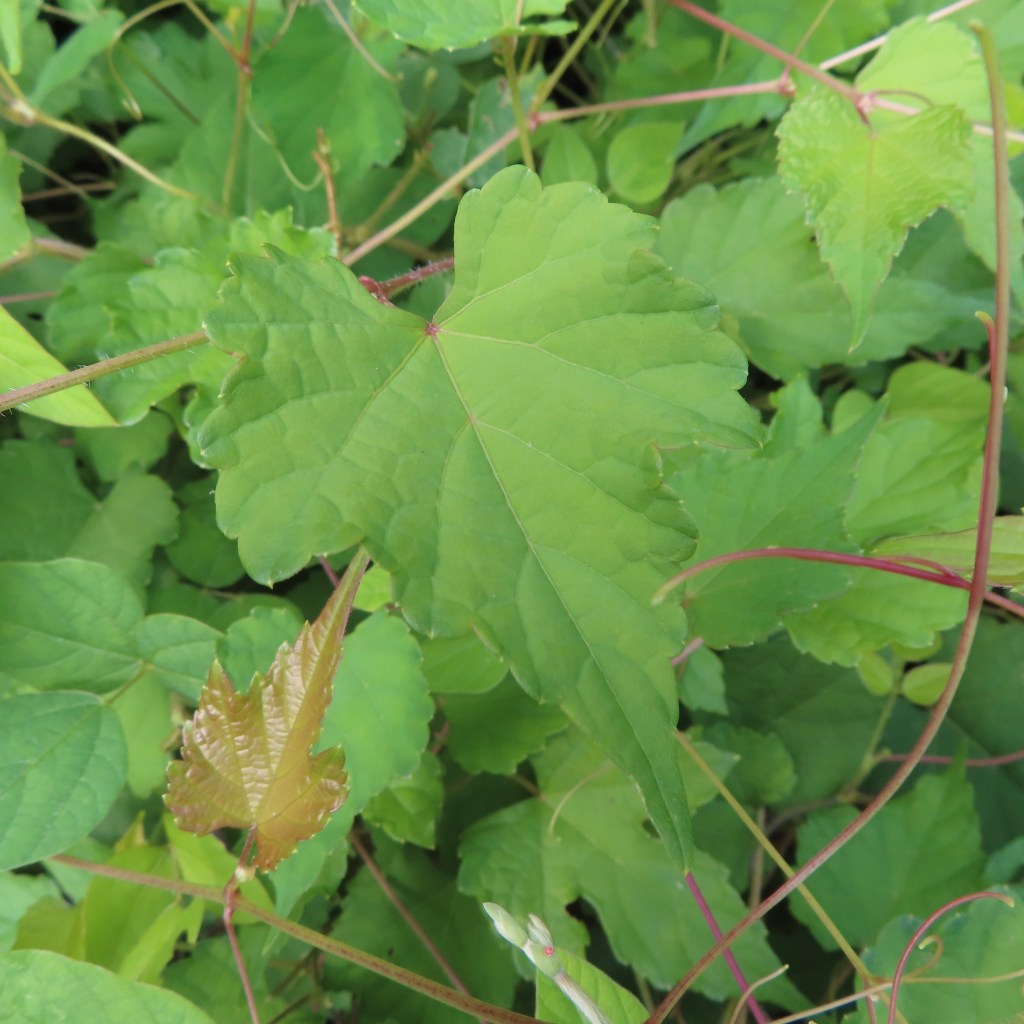
The unusual leaf shape of porcelain-berry is characteristic of Grape family plants.

Were it not for the alarming spread of porcelain-berry, it would be perceived as largely benign and even beneficial as are other grape family plants.  The porcelain-berry fruit can be safely eaten, providing some nutrition. However, it is not palatable, lacking the sugar content of cultivated grape varietals. In general, the two dozen species of wild grapes in North America, in which there is no reason not to include porcelain-berry, have edible fruits, shoots, and leaves. The average nutritional profile for 100 grams (~1/4 pound) of wild grape family fruits is 70 calories with several important minerals like potassium, calcium, phosphorous and iron and vitamins A and C in addition to the metabolically important B vitamins. [10] Similarly, wild grapes have a broad range of medicinal properties.  Native Americans used grape leaves made into a tea to treat stomachache and diarrhea and poulticed leaves were applied to treat rheumatism and headache. More recently, grape seed extracts have been shown to be effective in treating circulatory problems like varicose veins. [11] On the whole, it is reasonable to conclude that porcelain-berry is potentially a useful invasive.

References:

1. Young, J. National Research Council, Washington DC, “Fact Sheet, Porcelain-berry” National Park Service Plant Conservation Alliance Alian Plant Working Group, 20 May 2005, http://www.nps.gov/plants/alien

2. Zhiduan C. and Jun W. Ampelopsis glandulosa (Wallich) Momiyama, Bull. Univ. Mus. Univ. Tokyo. 2: 78. 1971″Flora of China online, vol. 12 p. 178-179.

3. Plants for a Future (PFAF) Charitable Database. “Porcelain Berry” https://pfaf.org/user/Plant.aspx?LatinName=Ampelopsis+brevipedunculata 

4. Hiker’s Notebook. “Autumn Leaf Color” at https://hikersnotebook.blog/2020/10/26/autumn-leaf-colors/

5. Nafici, S. “Weed of the Month, Porcelain Berry” Brooklyn Botanical Garden https://www.bbg.org/article/weed_of_the_month_porcelain_berry     

6. Pollan, M. The Botany of Desire, Random House, New York, 2001 pp. xiii-xxv.

7. Kling, A. “Invasions in your Woodland – Porcelain-berry” University of Maryland Extension. https://extension.umd.edu/resource/invasives-your-woodland-porcelain-berry-updated-2025/ 

8. Dingwell, S. “Unwanted and Unloved – Porcelain-berry” Virginia Native Plant Society. 12 August 2014.

9. McGovern, P. Ancient Wine, Princeton University Press, Princeton, New Jersey, 2003 pp 1-63.

10. Angier, B. Edible Wild Plants, Stackpole Books, Mechanicsburg, Pennsylvania, 2008, p. 80

11. Foster, S. and Duke, J., Medicinal Plants and Herbs, Houghton Mifflin Company, Boston, Massachusetts, 2000, p 338.

Raspberry

Black raspberries turn from red to black when fully ripe

Common Name: Raspberry, Black raspberry (photo above. Note that black raspberries are initially red), Blackcap, Thimbleberry, Framboisier noir (Quebec) – The etymology of raspberry is uncertain. One hypothesis is that it is simply a combination of rasp in the sense of being rough or harsh from French rasper, to scrape together. An alternative origin is from raspis, a sweet red wine popular in Europe in the Middle Ages. Berry is from beri, a Germanic word for grape. The red raspberry is also known as European red raspberry.

Scientific Name: Rubus occidentalis (black raspberry) and Rubus idaeus (red raspberry) –  Rubus is Latin for bramble-bush and, by extension, blackberry. The species occidentalis is from the Latin occidens meaning to go down or set, generally used to refer to the western hemisphere. The Black raspberry is indigenous to eastern North America where it was first classified. The species idaeus refers to Mount Ida in Asia Minor, where red raspberries originated.

Potpourri: The ubiquitous raspberry was indisputably one of the first plants to be recognized as a source of food for many animals, especially the naked apes that eventually evolved to Homo sapiens about 60,000 years ago. The prominently colorful berries, raspberry red in Eurasia where they originated, stood out from the verdant foliage, a distinction unseen by other mammals lacking the red vision of primates. Raspberries were almost certainly spread globally by migrating birds where new species arose as a result of evolutionary diverse habitats. In its current bramble form, raspberries resist consumption of its growing plant parts with conspicuous thorny outgrowths characteristic of its Rose Family taxonomy. Growing in dense thickets from root extensions called rhizomes, brambles like raspberry produce copious quantities of enticing berries to perpetuate its dominance in open, sunny areas. Black raspberries form impenetrable hedges along many trails, offering a succulent snack and an occasional prick to passing hikers.

Raspberries are aggregate fruits with prickles

Raspberries are not berries and they do not have thorns. The fruit is an aggregate, and the sharp-pointed protuberance is a prickle. The use of berry for any small, roundish fruit is as fraught in common parlance as the distinction between fruits and vegetables. A fruit is “a ripened ovary and its contents together with any adjacent parts that may be fused to it.” Fruits are the seed carriers of propagation. Grains like barley, vegetables like peas, and nuts like acorns are fruits. A fruit “in which the entire ovary ripens into a fleshy, often juicy and edible” is the botanist’s berry, inclusive of tomatoes, eggplant, red peppers, and watermelons. A drupe is different, having a layered ovary that gives rise to a central stone or pit that encloses the seed, like plums and peaches. Raspberries arise from flowers with multiple pistils (central organ of a flower), each producing a small drupe, sometimes called a drupelet. The multiple small fruits cling together, separating as a single unit that is called an aggregate. Rasp-aggregate would be a more correct name, but hardly useful.  Spines, thorns, and prickles are all sharp-pointed outgrowths from a plant surface that evolved to repel herbivores. Spines like those on barberries originated from leaves. Thorns like those on Osage orange arose from branches. Prickles like those on raspberries are the real stickers, emerging directly from stem tissues. [1]

Raspberries are classified as members of Rosaceae, the family of roses in the genus Rubus, known colloquially as brambles. With about 3,000 species, the rose family is not that large compared to the 20,000 species of the orchid family and 19,000 species of the composite family, inclusive of asters, daisies, and sunflowers. [2] However, the rose family is arguably the most renowned of all plant families from the human perspective. Its prominent floral and fruit products that proliferate the temperate zones of primary habitation are without equal in the kingdom Plantae. In addition to the many cultivars of roses that dominate the floral trade, they are the sine qua non for spectacles like the annual Pasadena parade and namesake bowl game and Kentucky’s running of the roses in the first of the three horseracing crowns. English wars have been named for them. The red rose Lancasters and white rose Yorks have nothing to do with the Lannisters and Starks even though they were both involved in throne games of a sort.  However, the fruits of the rose family that dominate at the supermarket are its most enduring legacy. Life would be lessened absent apples, pears, cherries, plums, and the various bramble berries. The success of the rose family is a result of the evolution of a number of traits that promote reproduction and dispersion. Having a diversity of fruits with the color, shape, and taste that appeal to birds and mammals results in spreading seeds far and wide in a dollop of fertilizer. More important, however, is asexual reproduction called apomixis by which rose plants can spread without pollinators. This is especially true of the brambles like raspberry that extend by horizonal, leafless stem structures called rhizomes. [3]

Rose family fruits in general and raspberries in particular have spread far and wide, part of Darwin’s “endless forms most beautiful and most wonderful” due to hybridization that results from a combination of seed dispersion and asexual apomixis. Apples abound in variety and raspberries are not far behind. There were already 41 varieties of raspberry in the United States in 1866. [4] Both apples and raspberries tend toward polyploidy, having multiples of the basic number of chromosomes, which can result in the reestablishment of sexuality to create new hybrids. This is further complicated with raspberries, that can have one of three different basic chromosome numbers (7, 8, or 9) to start with. This means that from their inception in Asia Minor, raspberries have spread across the globe in many hybrid forms, drawing the attention of the hominids doing the same thing. That they were well known by the time of the Roman Empire is well established. Pliny the Elder (aka Gaius Plinius Secundus), the noted Roman military leader and naturalist author, wrote in his magnum opus Naturalis Historia that the raspberry was “known to the Greeks as the Idæan bramble, from the place where it grows.”  Mount Ida is in Northwestern Turkey near the site of Troy, providing the species name idaeus of red raspberry. It was even then regarded as a medicinal plant, for Pliny notes that: “Its flower, mixed with honey, is employed as an ointment for sore eyes and erysipelas, and an infusion of it in water is used for diseases of the stomach.” [5] As raspberry seeds have been found at Roman forts on the British Isles, it is considered likely that the Romans spread the raspberry from its Asian origins throughout their vast empire into Europe and Africa. [6]

Raspberries have served as a wellspring for both nutritious food and medicinal remedy for the millennial span of western civilization. They found their way into the various herbal collections that appeared in Europe in the late 16th century. John Gerard, calling it the Raspis, Hinde-berry, or Framboise (French), notes that “the floures (sic), the leaves, and the unripe fruit, being chewed, stay all manner of bleedings. They heal the eies (sic) that hang out.” The ripe fruit is described as sweet, and “not unpleasant to be eaten,” [7] As the modern era erupted from the rediscovery of Greco-Roman writings in the Renaissance, the expansion of raspberries as one of the first fruits followed. By the 17th century, white and red cultivar raspberries were recognized in Great Britain that differed only in the color and taste of the fruit, the “white raspis a little more pleasant than the red.” Red wines were available at the “vintners made from the berries of Raspis that grow in colder countries.” The medicinal uses had also expanded, extending to the use of leaves “in gargles and other decoctions that are cooling and drying, but not fully to that effect” whatever that means. A syrup made from the berries “is effectual to cool a hot stomach, helping to refresh and quicken up those that are overcome with faintness.” And of course the berries were eaten “to please the taste of the sick as well as the sound.” [8] As the consumer era took off in the middle of the last century, the raspberry became a mass market food and one of the myriad herbal remedies to assuage modern melancholia.  

 Raspberries are nutritious, contributing to a healthy diet. They are one of the highest sources of dietary fiber (6.5 grams fiber per 100 grams wright) relative to the energy provided (100 kilocalories per 12.5 grams). In addition, they are high in vitamins C and K and in the minerals calcium, magnesium, potassium, and iron. Raspberries also contain a unique set of phytochemicals, secondary substances not involved in plant metabolism, that are likely the basis for the many historic folk medicinal uses. Anthocyanins, which are what make berries (and fall leaves) red, are noted for their antioxidant and anti-inflammatory activity, deactivating the free radicals (ionic forms) that tend to disrupt cellular activity. In vivo animal studies have found that consuming raspberries resulted in “reduced blood pressure, improved lipid profiles, decreased atherosclerotic development, improved vascular function, stabilization of uncontrolled diabetic symptoms (e.g., glycemia), and improved functional recovery in brain injury models”. [9] It may be concluded that the use of raspberries in the treatment of a variety of ailments has at least some rational basis due to actual chemical interactions operating above and beyond the placebo effect.

Native American herbal remedies provide one of the best examples of genuine folk medicine unadulterated by marketing hucksterism. The Iroquois Confederacy of the northeast had many uses for raspberry leaves and roots, including treating bloody diarrhea, as an emetic, to remove bile, to treat children with whooping cough, and, perhaps with some hyperbole, as a  “decoction taken by a hunter and his wife to prevent her from fooling around.”  Raspberries were also important as food, especially in winter when dried fruits were combined with hominy. Further south, Cherokee also used raspberry plants for digestive problems and as food but in the form of pies and jellies suitable for the milder climate. On the more practical side, the prickly stems were used for scratching itchy hard to reach places. In addition, it was used for coughs, boils, and, most significantly to current usage,  to treat postpartum pain. [10] Current usage as an herbal remedy follows those of Native American usage, with an emphasis on pregnancy issues.

The most prevalent use of raspberry over the last century has been during the last trimester of pregnancy to “relax the uterine muscles and facilitate birth.” [11] However, in Germany this is proscribed “because of lack of scientific support of claimed activities as a uterine tonic.” [12] The widespread use of raspberry leaves in herbal preparations for pregnancies has resulted in some serious scientific assessment. Approximately 50 percent of all pregnant women use some form of herbal treatments during pregnancy and the use of raspberry extracts as tea, tablets, or tincture ranges from 7 to 56 percent depending on the country. The claim made by the herbal industry is a “positive effect on childbirth through the induction of uterine contractions, acceleration of the cervical ripening, and shortening of childbirth.” No studies clearly demonstrate that products derived from raspberries have a clear effect on the biochemical pathways of pregnancy. A recent review concludes that “the consumption of raspberry extracts could translate into decreased dynamics, or even the inhibition of the cervical ripening process, which could undoubtedly translate into a more tumultuous and traumatic childbirth course.” It is increasingly clear in the medical community that the best way to stay healthy is to eat a balanced diet, exercise regularly, and avoid stress. Hiking along trails in the quiet of the forest and eating raspberries is a good place to start.

References:

1. Wilson, C. and Looms, W. Botany, 4th Edition, Holt, Rinehart and Winston, New York, 1967, pp 30-31, 285-304.

2. Niering, W. and Olmstead, N. National Audubon Society Field Guide to North American Wildflowers. Alfred A. Knopf, New York, 1998, p.354, 646, 746.

3. Cowan, R. “Rosales” Encyclopedia Britannica Macropedia, William and Helen Benton, Publishers, Chicago, 1972 Volume 15, pp 1150-1154.

4. Stuart, M. ed The Encyclopedia of Herbs and Herbalism, MacDonald and Company Publishers, London, 1987, p 255.

5. Pliny the Elder,  The Natural History – John Bostock, M.D., F.R.S. H.T. Riley, Esq., B.A. London. Taylor and Francis, Red Lion Court, Fleet Street. 1855. Book 16 Chapter 71 – https://www.perseus.tufts.edu/hopper/text?doc=Perseus:text:1999.02.0137:book=16:chapter=71&highlight=raspberry    

6. Burton-Freeman, B. et al “Red Raspberries and Their Bioactive Polyphenols: Cardiometabolic and Neuronal Health Links” Advanced Nutrition, Volume 7, Number 1 January 2016 https://www.ncbi.nlm.nih.gov/pmc/articles/PMC4717884/

7. Gerard, J. Herball – Or, Generall Historie of Plantes, John Norton, London, 1597. Pp 260-261

8. Parkinson, J. Paradisi in Sole, Paradisus Terrestris  1629. Reprinted by Methuen &Company, London, 1904, p 557 -558  https://www.gutenberg.org/files/69425/69425-h/69425-h.htm#Page_557 

9. Burton-Freeman et al, op. cit.

10. Native American Ethnobotany Data Base. http://naeb.brit.org/  

11, Polunin, M. and Robbins, C. The Natural Pharmacy, Collier Books, New York, 1992, p 122.

12. Foster, S. and Duke, J. Medicinal Plants and Herbs, Petterson Field Guide Series, Houghton Mifflin Company, New York, 2000, pp 264-265

13. Socha, M. et al “Raspberry Leaves and Extracts-Molecular Mechanism of Action and Its Effectiveness on Human Cervical Ripening and the Induction of Labor” Nutrients, Volume 15 Number 14, 19 July 2023. https://www.ncbi.nlm.nih.gov/pmc/articles/PMC10383074/