Bradford (Callery) Pear

A Bradford Pear tree on a ridge above the Shenandoah River probably escaped from a nearby development.

Common Name: Bradford pear, Callery pear, Braford Callery pear – The common name Bradford is eponymous, given to the tree to recognize the horticulturist who was the head of the USDA Plant Introduction Station in Glen Dale, Maryland where the cultivar of the Callery pear was first bred. Pear is from pirum, the Latin word for the fruit.

Scientific Name: Pyrus calleryana – The generic name is a variant of the Latin word for pear tree. The species name honors Joseph Callery (Giuseppe Calleri in his native Italian), a Catholic missionary to China who collected specimens of Asian native plants during his tenure there. He is recognized for having introduced the Callery pear to Europe in the 19th century.

Potpourri: Just as kudzu gained notoriety as the vine that ate the South, the Bradford pear is rapidly becoming the shrub that swallowed suburbia. As the Callery pear, it was originally imported from China in the early 20th century as an integral part of a United States Department of Agriculture (USDA) program to save the commercial pear industry from the devastation of a bacterial blight. The plan to use robust root stock resistant to blight from Callery pears grafted with the commercial, French pear was sound, as a similar method had been used in the late 19th century to resolve the “Great French Wine Blight” using American vine roots resistant to the American insect pest (a type of aphid) that caused it. [1] The French pear trees grafted to Chinese root stock flourished. Had it ended there, the monoculture stands of white petaled trees and shrubs that line many roads and dominate disturbed areas would never have occurred. The history of Bradford pear, like that of kudzu, is a cautionary tale of human intervention in ecosystems without a full understanding of the complexities of nature and evolution.

Before invasives demonstrated their ability to devastate native flora and fauna in the aughts of the 21st century, moving species randomly around the globe, sometimes purposely, was not only tolerated, but encouraged. Tomatoes, corn, and potatoes originated in the New World to become staples of European cuisine just as wheat, cotton and rice were imported and widely planted in the Americas. The genus and species scientific classification system of Carolinus Linnaeus still in use after over three hundred years was undertaken to organize the thousands of newly discovered plants submitted and named by field naturalists augmented by a list of descriptive nouns and adjectives, mostly in Latin. [2] The intentional importation of alien plants was mostly benign, with the exception of plants like dandelion, plantain, and garlic mustard that spread, crowding out the native species due to their superior resiliency. Bradford pears occupy a middle ground, having been introduced with good purpose, then intentionally hybridized to satisfy consumer demand for landscape trees. 

The story begins in the decades following the Civil War as Conestoga wagons forged ever westward to colonize the verdant valleys on the windward side of the Sierra Nevada. As herding gave way to agriculture in the late 19th century, the search for plants that would flourish there became the mission of the purposely established USDA Foreign Seed and Plant Introduction Office. Due to similarities in climate, east Asia was considered the best potential source for candidate botanicals. A stout-hearted  Dutch immigrant gardener cum naturalist named Frank Meyer with no fear of travel to remote areas to forage in relative isolation was recruited to undertake the mission. Like Darwin’s mission to collect specimens around the Pacific rim on HMS Beagle from 1841 to 1846, Meyer collected a wide variety of cereal grains, leguminous vegetables and fruits between 1905 and 1915 that eventually led to many of the food crops that have been cultivated in North America for over a century. Meyer’s initial forays did not seek out pears, as they were already well established in California,  Washington and Oregon. [3]

The genus Pyrus probably originated in the Tian Shen Mountains in the Xinjiang Province of western China. Pear trees hybridized as they spread throughout Eurasia as a natural progression by animals, especially birds, eating the much smaller fruit of wild pear trees and defecating its seeds. Cultivation of larger, sweeter pears preferred by Europeans predates historical records but probably started in Mesopotamia. The resultant European pear (P. communis) was brought to the colonies of the Americas by both the British and French from the east and the Spanish from the south giving rise to orchards as early as the 18th century. Pear groves proliferated, particularly in the Pacific Northwest to make pears the third most consumed fruit in the United States, trailing only apples and peaches. As with most commercially grown fruit trees, grafting is used to grow an appealing pear variant onto rootstock selected for its hardiness Since pear trees are therefore essentially identical clones―a genetic monoculture―they are subject to epidemics as a microbe that infests one will spread to them all. This is precisely what happened to the pear industry in the early 1900s. [4][5]

Meyer returned to the United States in 1916 to observe the effects of the fire blight caused by the bacterium Erwinia amylovora on pear orchards. Professor Frank Reimer of Oregon State University had initiated a program in 1912 to find a North American pear species that was resistant to the blight to no avail and enlisted the aid of Meyer to find an Asian pear species. When he returned to China in 1918, Meyer focused on Pyrus calleryana, noting in a communiqué to the USDA that the “form from the Yangtze Valley seems to be better suited for Oregon than the one from South China.” After trekking though China for some months to seek out the tree, he concluded in another letter that “Pyrus calleryana is simply a marvel. One finds it growing under all sorts of conditions; one time on dry, sterile mountain slopes; then again with its roots in standing water at the edge of a pond.”  In 1918, he proceeded to collect and ship 100 pounds of seeds back to the USDA for testing and began his journey home. He never made it, falling overboard to his death from a ship on the Yangtse River. His body was found thirty miles downriver on June 9, 1918. His colleague Reimer wrote “Mr. Meyer was one man in many thousands. He possessed a great brain and also a great heart.” [6] A suitable epitaph would be Frank Pearseed to stand beside John Chapman of Appleseed fame in the pantheon of American agronomy.

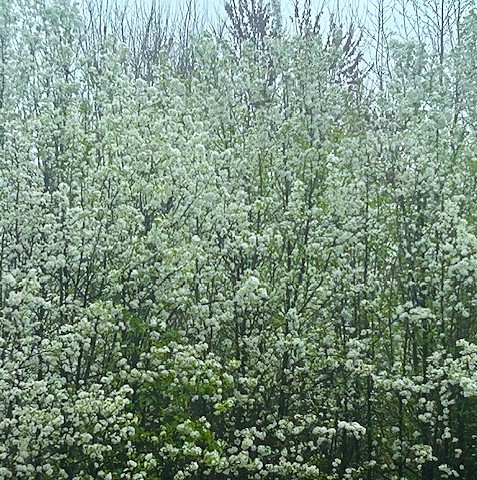
The showy spring florescence is one of the appeals of Bradford pear as a landscaping tree.

The seeds sent by Meyer were provided to USDA Plant Introduction Stations in Corvallis, Oregon and Glenn Dale, Maryland to assess the viability of P. calleryana as both root stock and as a new pear variant. The root stock proved to be resilient to the ravages of fire blight and was subsequently used to reestablish of pear orchards, saving the pear industry from devastation. Over three decades later, one of the Callery pear trees planted in Maryland caught the attention of a USDA employee named John Creech. Noting the glossiness of the leaves, the aesthetic, geometric balance of its spreading branches, and the lack of sharply spurred twigs that were typical of pear trees,  he concluded that it would make an exceptional landscaping tree. By grafting branches from the original tree onto rootstock of P. calleryana, he cloned a cultivar variant that he named the Bradford pear in honor of a horticulturist employed by the Glenn Dale facility. The landscaping tree was commercially released in 1962 and quickly became popular due to the attributes that drew Creech. According to a respected and seminal plant guide, “The Bradford pear, a selection of P. calleryana, has recently become popular as an ornamental because of its profuse spring flowers and red fall color.”  [7]

Bradford pear thicket along a road in Maryland

The Bradford pear became one of the primary trees lining the streets of American suburban sprawl built outward, a mecca from the noise and congestion of cities in the second half of 20th century. To satisfy the insatiable demand for variety in the cookie cutter sameness of burgeoning developments, twenty four variants of the Callery pear were introduced with catchy names ranging from Whitehouse to Autumn Blaze to augment the original Bradford cultivar. Like the ancestral Callery pears of China lauded by Meyer for their stamina and ubiquity, the Bradford pear and its variants were indomitable, thriving in poor soil that could be wet or dry, acidic or alkaline, resistant to disease, and reliably radiating branches of bouquets in spring and brilliant red fall foliage reminiscent of New England’s maples in autumn. Millions were planted across the country from California to Connecticut. [8] By 2015, Bradford pears had become the third most popular tree in New York City with a population of 58,000. The transition from desirable landscaping tree to pernicious pest occurred slowly, as the phalanxes of flowering white trees lining major roads could no longer be dismissed as part of a normal spring renaissance. [9]

What happened was hybridization. This was unexpected but could have been anticipated. Since Bradford pears and their ilk were clones in having been propagated by grafting small branches onto robust root stock (mostly P. calleryana), they were not able to cross pollinate and produce seeded fruits due to genetic incompatibility. However, the different horticultural cultivars were produced from pear seeds that were originally gathered by Meyer from all over China resulted in hybrids with different genotypes. This is the essence of the genetic diversity that Darwin first observed among the different specie of finches in the Galapagos Islands. As long as different hybrids are within individual bumble bee collection zones, chances are that eventually the pollen from a Bradford pear will find itself in the ovule of a receptive clone. The resultant fruit with its now mutant and fertile seeds, carried away for consumption by birds, especially European starlings and American robins, spread wherever and whenever the birds went, literally. Eventually, as a matter of evolutionary dynamics, a variant emerged that was super survivable. The Bradford/Callery pear has been listed as a “plant invader” by the US Fish and Wildlife Service in the mid Atlantic states since 2008. [10]


There is a certain amount of irony in introducing Callery pears to save the commercial pear industry from fire blight and then hybridizing it to create the hardy and aesthetic Bradford pear that has become a pernicious invasive. While other trees, like “tree of heaven” ailanthus and “empress tree” royal paulownia, have been introduced and become invasive, Bradford pears are unique in having been created by USDA plant breeders as a perceived public service. Contributing to the irony is that the fire blight bacterium that was the reason for the introduction of P. calleryana in the first place has reemerged as a major problem in the commercial pear industry due to its own evolutionary mutations. Walt Kelly’s Pogo cartoon for the first Earth Day provides the adage of the age: “We have met the enemy and he is us.” Barry Commoner, the father of ecology, proposed the law that “everything is connected to everything else,” a testimony to the complexities of the natural world. The only option at this point is to stop planting Bradford pears and their peers intentionally as landscape trees and to remove them whenever they spread into new habitats. There is evidence that the word is out. A sign posted at the trailhead at a Virginia State Park read “Wanted, Dead, not Alive, Callery Pear,” asking the public to “be on the lookout for this invasive intruder” and alert park staff so that it can be removed. The enemy strikes back.

References:

  1. Lukacs, P. Inventing Wine, A New History of one of the World’s Most Ancient Pleasures W. W. Norton and Company, New York, 2012, pp 169-174
  2. Wilson, C. and Loomis, W. Botany, 4th edition, Holt, Rinehart, and Winston, New York, 1967, pp 365-367.
  3. Culley, T. “The Rise and Fall of the Ornamental Callery Pear,” Arnoldia, Volume 74 Issue 3, 18 February 2017. https://arboretum.harvard.edu/stories/the-rise-and-fall-of-the-ornamental-callery-pear-tree/
  4. U.S. Department of Agriculture. “Pyrus Crop Germplasm Committee: Report and genetic vulnerability statement, September 2004” September 2004, Germ Resources Information Network (GRIN), pages 5-7
  5. Little, E. Field Guide to North American Trees, Alfred A. Knopf, New York, 1993, p 509
  6. Meyer, F. N. 1918. South China Explorations: Typescript, July 25, 1916–September 21, 1918. The National Agricultural Library. Available online at: https://archive.org/details/CAT10662165MeyerSouthChinaExplorations
  7. Brown, R. and Brown, M. Woody Plants of Maryland, University of Maryland, Port City Press, Baltimore, Maryland, 1999, p. 132.
  8. Higgins, A “Scientists thought they had created the perfect tree. But it became a nightmare” Seattle Times. 17 September 2018. https://www.seattletimes.com/nation-world/scientists-thought-they-had-created-the-perfect-tree-but-it-became-a-nightmare/
  9. McConnaughey, J. “Invasive Callery pear trees become a real menace” Washington Post, 17 May 2022

Hydropower

The Conowingo Hydroelectric Dam on The Susquehanna River is a two mile hike north of Susquehanna State Park along the railroad right of way that was installed to transport building materials for the dam, which opened in 1928.

Hydroelectricity is one of the three sources of renewable energy capable of providing electricity on a global scale. All three ultimately derive their energy from the sun. Photovoltaic or PV panels collect and transmit sun photon energy directly. Wind turbines collect the energy of pressure differences caused by temperature differences from the sun heating the earth’s surface. Hydro energy is more nuanced. The sun evaporates water from the oceans. As water vapor rises and moves with winds swirled by the Coriolis effect, clouds form and the vapor condenses to water falling as rain or snow. Water falling on land finds its way back to the ocean by forming rivers that flow from  higher to lower elevation. The potential energy of the water at higher elevation is converted to kinetic energy as it moves downhill. Turbines placed in the flow connected to electrical generators is hydroelectric power. Dams regulate the flow so that the power is constant and continuous rather than being subject to the whims of weather in floods and drought. Hydro has recently taken on a new role. Since wind and sun are intermittent but hydro is constant, the use for water has gained in importance linking the former to the latter. Power supplied  by wind and solar in excess of demand runs pumps to move water uphill to an elevated reservoir. The energy thus stored is reclaimed when the upper reservoir flows back downhill now directed through a hydroelectric generator. Pumped storage hydropower (PSH), as this arrangement is called,  thus provides energy storage, a mandatory capacity for a future global electrical system dominated by renewables.   

Hydropower is a broad and underutilized word that applies to any means by which water in its liquid state is used as a source of energy for human endeavor.  It is useful as an inclusive term that applies throughout the course of human history. Water for mills and the machinery of early, mainly textile factories, was generally called water power. Starting in the late 19th century, water became one of the main sources of generating electricity, mostly with the construction of dams, giving rise to the term hydroelectric power. Hydropower does not refer to the use of hydrogen gas as a source of energy (power is the rate of using energy), although this may one day become a neologism if hydrogen power proliferates. The similarity and possible confusion arises from the fact that Antoine Lavoisier, the father of chemistry, concocted the word hydrogen from Greek words meaning “I beget water” for the seminal work of Chemistry, published in English as Elements of Chemistry in 1790. The rationale for the name was that oxygen, meaning “I beget acid,” had been previously named based on the observation that sulfur, phosphorus and carbon produced acidic solutions when burned. Hydrogen mixed with oxygen “begot” water (2H2 + O2 = 2H2O), which was at the center of scientific inquiry from its inception.  Thales, a Greek philosopher of the 6th century BCE, held that water was the primary substance from which all other matter was formed. [1] While water is crucial to the evolution of life, the erosion of uplifted land back to the sea, and to the swirling chaos of weather, it falls short of being the elemental element. But it could be considered the elemental compound.

The use of water to do work dates from the dawn of prehistory as agriculture radiated outward from Mesopotamia and the first cities became food production and distribution centers. More mouths to feed with larger harvests gave rise to a better and more efficient way to make flour from threshed seeds in the Neolithic, literally New Stone Age.  The first written account of water turning a millstone to grind grain appears in the writings of Antipater of Thessalonica in the 1st century BCE: “Demeter (Greek goddess of agriculture) has reassigned to the water nymphs the chores your hands performed.” A horizonal wheel in a flowing stream was connected with an axle to a large circular shaped stone that rotated against a second stationary stone with the force otherwise provided by man or perhaps donkey power. The much more efficient vertical wheel that could use both the weight and the velocity of water required gearing to convert rotary motion to the horizontal stone was first described by the Roman engineer Vitruvius as hydraletae, Latin for water mills, in 27 BCE.  The watermill became the cynosure of the hamlets of England which grew in number from 6,000 according to the Domesday survey in 1086 to 30,000 in 1850. As the American colonies were settled and farmers migrated inland, watermills followed to make flour for daily bread to feed the burgeoning nation. Their remnants, long abandoned, abound.

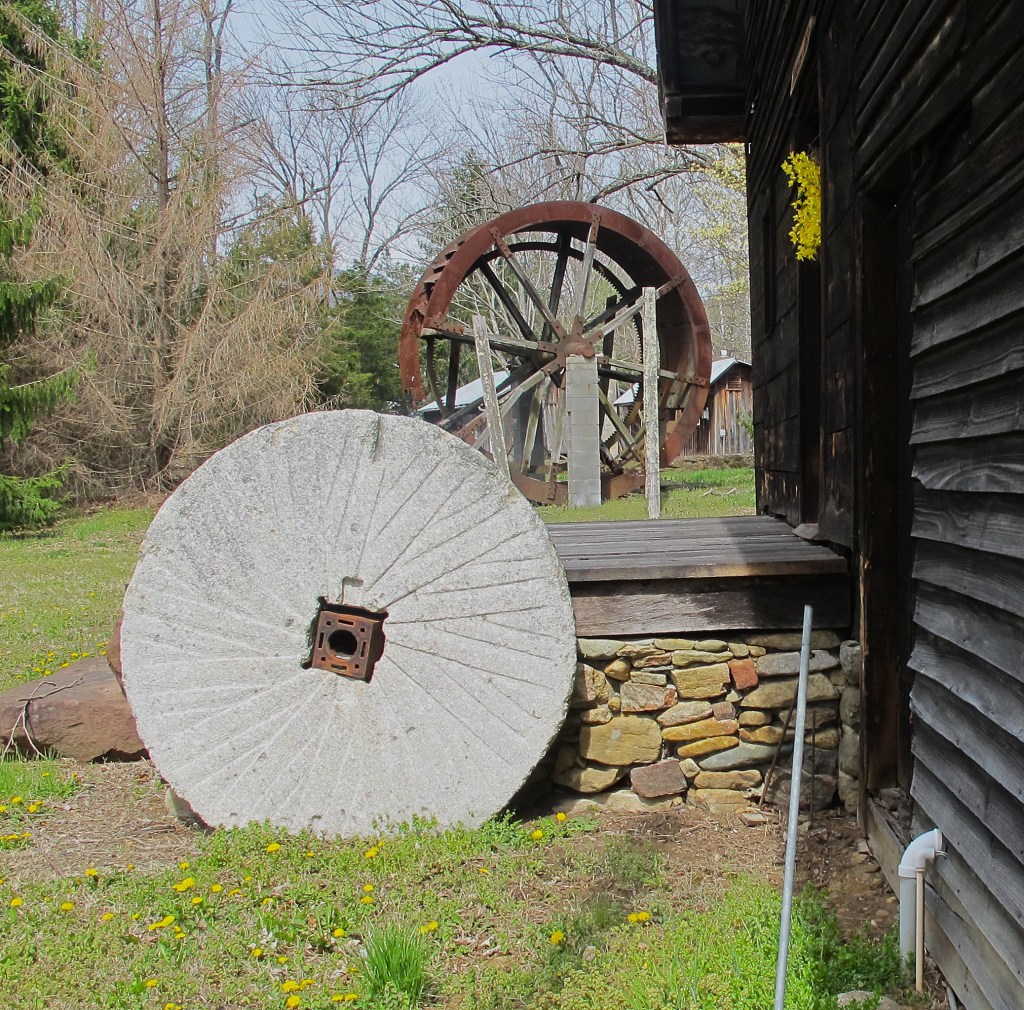
The mill at Nethers, Virginia is just down the road from the Old Rag Trailhead.

The use of water advanced from foundational milling of flour to powering industry as an integral part of the nascent Industrial Revolution in the early 19th century. It was a matter of economics, waterwheels were the most efficient sources of energy available. Two manual laborers could manually grind 15 pounds of flour per hour (200 watts), a mule-driven mill could double that, but a waterwheel produced about 200 pounds with a power of 2.000 watts or 2 KW―enough to feed a village of 3,500 inhabitants. Water power could be scaled up by enlarging the wheel and/or by employing multiple wheels. To supply the 1,400 fountains and waterfalls at  King Louis XIV’s magnificent palace at Versailles, near Paris, France, fourteen 30-foot wheels were installed  on the Seine River between 1680 and 1688 to drive 200 pumps. Glasgow, Scotland became a manufacturing entrepot in the 1830’s in part because of the massive water works on the Clyde River at Greenock with 20 waterwheels that could provide about 2,000 KW or 2 megawatts (MW). The full potential of water as a viable power source to meet the demands of expanding industry was the water turbine, invented by the French engineer Benoit Fourneyron in 1827. A turbine, named from the Greek word for whirling, uses curved blades with radial outward flow, increasing the efficiency of the traditional flat board waterwheel substantially. Water turbines were the primary source of power along the Merrimac River in Massachusetts, supplying 60 MW to hundreds of textile mills in 1875, 80 percent of all power. [2]

Waterwheels powered factories with rotary motion to turn pulleys linked by gears and belt drives to spindles for weaving fabric, to operate saw blades to cut lumber, and many other similar mechanical operations. Hydroelectricity became possible only after the invention of a device that could take the rotary motion imparted by a water turbine to generate current. The dynamo was invented by Michael Faraday in 1831 as a practical application of his discovery of induced electricity, that any conductive material moving through a magnetic field was induced to create a current of  moving electrons. The rotation of an iron rotor through a magnetic stator converted mechanical to electrical energy, giving rise to the induced current generator or dynamo. Any rotational device, such as a steam engine, could provide the motive force. Initial development of the dynamo generator as a practical device was one of the many inventions of the inimitable Thomas Edison at Menlo Park. The impetus was to provide a constant voltage source that was necessary to power the incandescent lights that he was working on as concurrent development with a stated goal of creating a central station for lighting all of New York City. The resultant dynamo, nicknamed “long-wasted Mary Ann” for its unusual two upright columns, was found to not only produce a nearly constant 110 direct current (DC) output but to do so at 90 percent efficiency, twice as much as its variable voltage predecessors. At 3 P.M. on Monday, September 4, 1882, Edison gave the order to start up four boilers to make steam for nine steam engines connected to Edison dynamos at Pearl Street Station in New York City to provide electricity to 400 incandescent lamps. [3]  While momentous as a practical demonstration of the use of electricity, the DC generated by Edison’s dynamos was limited in range to about one mile. The subsequent invention of alternating current (AC) would solve that problem.

Niagara Falls played a seminal role in the development of electricity as the backbone of modern industry. The prodigious flow of the Niagara River that carries the waters of the Great Lakes to the Atlantic Ocean over a 167 foot cliff has attracted tourists for centuries (Edison spent his honeymoon there) and inevitably those interested in harnessing its water power. A small waterwheel-driven saw mill constructed in 1759 was succeeded 80 years later by a generating station that provided a small amount of electricity supplied by a DC generator for mills in what had by now become a namesake village. The Cataract Construction Company was organized in the 1890’s with the express purpose of building a water tunnel to supply a large scale hydroelectric power plant to sell electricity to customers at a profit. However, unlike New York City with its closely clustered businesses, upstate New York was remotely situated and would require long distance transmission. [4] The technology of electrical generation underwent a sea change when George Westinghouse bought the patents of Nicolas Tesla (who originally worked for Edison at Menlo Park) to design an alternating current (AC) generator. As AC current could be transformed to higher voltages for efficient transmission over long distances, the decision, considered radical and risky at the time, was to install AC generators in the Niagara Falls hydroelectric plant. It  began transmitting power twenty miles to Buffalo, New York, in 1896, making it the first modern industrial mecca. Thereafter, 80 percent of all new generating capacity was AC as the nation’s electrical grid took shape with remote power stations, like hydroelectric dams, feeding a network of long-distance power lines. Niagara Falls was a watershed reservoir for the watershed technology of AC power.[5] It now boasts 60 generators producing 5,000,000 KW, or 5 gigawatts (GW).

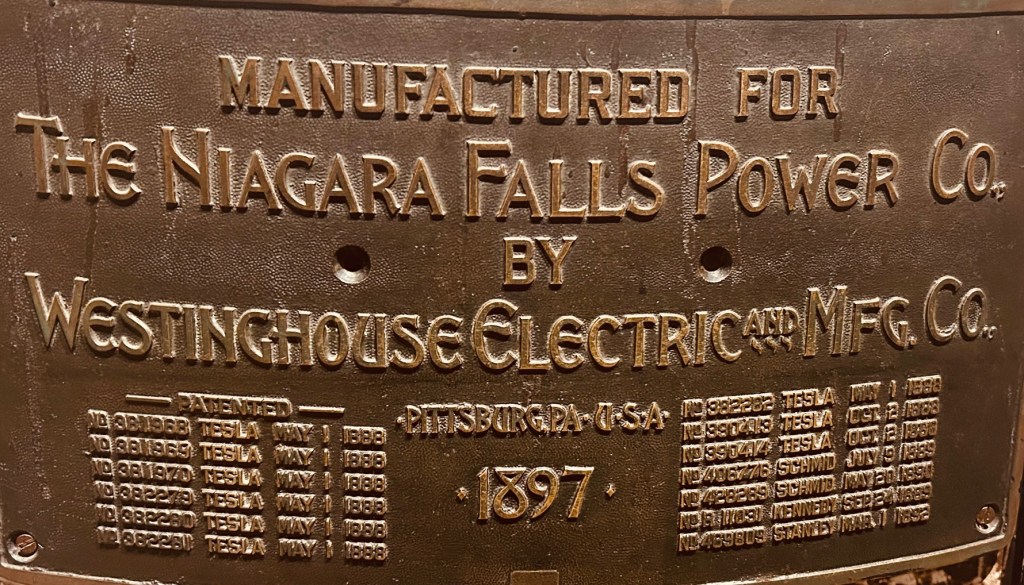
The nameplate from the Westinghouse AC generators in stalled at Niagara Falls is on display at the Smithsonian Museum of American History as one of the significant objects relating to power and industry

Construction of hydroelectric dams by the United States government resulted from congressional measures to address the international threat posed by Germany and its allies during the First World War after the sinking of the Lusitania in 1915.  The National Defense Act of 1916 doubled the size of the Regular Army and the National Guard and authorized the construction and operation of a nitrate plant for munitions “at a cost not more than 20 million.” President Woodrow Wilson chose  Muscle Shoals on the Tennessee River in Alabama as the site for a hydroelectric dam to provide power for the nitrate plant. This was at least in part a matter of investing in the impoverished south that had yet to fully recover from the devastation and disruption of the Civil War; Wilson was from Virginia. [6] The eponymous Wilson Dam, still in operation producing 663 MW of electricity, was not completed until 1924 and had no impact on the war, but a tremendous impact on the region. The Roaring Twenties optimism that infused the antebellum nation gave rise to stock speculation culminating in its precipitous plunge on Black Thursday, 24 October 1929. President Herbert Hoover, as an engineer and businessman, held to the belief that cajoling industrial and financial leaders to increase spending would staunch the downward spiral. Hoover vetoed a bill that would have converted the Muscle Shoals nitrate plant hydroelectric dam into a government run operation with the express purpose of providing electricity to the Tennessee region, preferring to have it run by private enterprise. By 1930, the Hoover Administration reluctantly concluded that some economic stimulus was warranted. Half a billion dollars was authorized for public works, including 65 million to construct Boulder Dam (later renamed Hoover Dam) on the Colorado River on the border between Arizona and Nevada. The economy continued to founder. Franklin Delano Roosevelt pledged to restore economic prosperity through federal government action in 1932 and was elected in a landslide with 472 of the 531 electoral college votes. [7]

Roosevelt’s New Deal ushered in the age of massive government programs, instituting a comprehensive plan to put the nation back to work. Building hydroelectric dams to bring power to the people was a core precept. With the Wilson Dam at Muscle Shoals as model, the US Congress passed the Tennessee Valley Authority (TVA) Bill in May 1933. It was one of the most important and far reaching initiatives in the history of the country. It gave the federal government the authority to construct and operate hydroelectric dams in a seven state region encompassing 40,000 square miles to “generate and sell electric power particularly with a view to rural electrification … and to advance the economic and social well-being of the people living in said river basin.” To accomplish this lofty goal, the government erected over 4,000 miles of transmission lines and subsidized rural electrification to quadruple the number of customers connected. The TVA is currently the largest public power provider in the United States and the fourth largest electric power provider with 29 hydroelectric sites employing over 300,000 people. The TVA model of government owned and operated hydroelectric dams to “use the facilities of a controlled river to release the energies of the people” was replicated in the Columbia River region of the Pacific Northwest. Construction of the Grand Coulee Dam in Washington State starting  in 1933 followed by the Bonneville Dam in Oregon in 1934. [8] By 1940, 40 percent of the electricity in the United States was provided by hydroelectric dams. The Depression Era ended with the full employment necessary to build the arsenal of democracy that won World War II. When it was over, nuclear energy of the atomic age replaced hydro as energy of the future.

Hydroelectric power has declined in importance in the United States over time, now providing only 6.2 percent of the electricity overall and 28.7 percent of that which is  renewable. This is the consequence of growing demand for electricity in an increasingly industrialized society relative to  static availability of appropriate locations for dam construction. Almost all of the good spots are taken and the older, larger capacity dams are over 80 years old . The United States is currently home to over 2,200 hydropower units that produce 80 gigawatts of electricity. Between 2010 and 2022, hydropower in the United States grew by only 2.1 GW almost entirely due to upgrades to existing hydroelectric dams (1.4 GW) and to additions of generators at 32 non-powered dams (550 MW). During the same period, 68 hydropower licenses were terminated for a total of 330 MW. By contrast in 2024 alone, the United States added 30 GW of solar power. [9]  Hydropower dams are in decline in the United States for several reasons. One is the droughts that are increasingly dire as global temperatures rise and more water evaporates. When the 2.1 GW Hoover Dam was completed in 1936, Lake Mead  was the largest reservoir in the United States. Due to a series of droughts in the 21st century, it has been reduced to as low as one quarter capacity with the plant’s four intake towers above the water line. [10] The second reason for the declining interest in hydropower is environmental. Dams disrupt the natural flow of sediments and impede the movement of fish upriver. The removal of the dams on the Elwha River on the Olympic Peninsula in Washington State in 2014 was the largest intentional dam removal  in world until the removal of the Klamath River dam in California in 2024.  A total of 1,951 dams were removed in the United Stats between 1912 and 2021. [11] Hydroelectric energy, while on the decline in the United States, is expanding in some areas of the world, notably China.

Unlike the network of hydroelectric facilities in the United States that were erected decades ago, global hydroelectric power was delayed until the broad industrialization that took hold in the  second half of the 20th century. Since the beginning of the 21st century, global hydropower has grown 70 percent, and now provides one sixth of  the world’s electricity. Hydroelectric power trails only coal and gas as third in overall capacity, is larger than all other renewable sources combined, and provides the lion’s share of electricity in 28 emerging and developing countries. Between 2021 and 2030 hydroelectric capacity is projected  to rise by 230 GW, an additional 17 percent. However, that marks a 23 percent reduction from the preceding decade of 2011 to 2020 indicating that the availability of sites with sufficient water flow and favorable geology is now reaching saturation worldwide. China is a case in point.  Between 2001 and 2010, it became the world leader in hydroelectric power with nearly 60 percent of global capacity. [12] The Three Gorges Dam of the Yangtze River, at 22.5 GW  the largest capacity hydroelectric plant in the world, was completed in 2003. During its nine year construction, the overall cost was over $30 billion, some of which was to resettle 1.3 million people displaced by the resultant reservoir. China’s growth has slowed since so that in 2025 it is still in first place, but with only 30 percent of global capacity. In a renewed bid to regain momentum, China recently approved the construction of  an even larger dam on the lower reaches of the Yarlung Tsangpo River that flows from Tibet to become the Brahmaputra in India and Bangladesh, where it empties into the Bay of Bengal. It is expected to be three times the size of the Three Gorges Dam and to cost $100 billion more. Aside from the international protests from the downstream countries, local Tibetans were involved in a protest in February of 2024 at the site of another dam. [13] [14]

Pumped Storage Hydro (PSH) facility encountered on a hike in central Germany.

While new hydroelectric projects are in decline, the use of water for energy storage, known as pumped storage hydro or PSH, is in the throes of a renaissance. There has always been a  need for large scale electricity storage. This is because electricity supply depends on the number and size of generators, which are traditionally either on or off. Electricity demand is variable depending on both diurnal workday activities and seasonal variation. To allow for some flexibility in balancing supply and demand, PSH was pioneered in the Swiss Alps in the early 1900’s. The basic idea is to use the excess supply during periods of low demand to operate pumps to move water from a low point to a higher point. The stored energy is used to augment supply when demand increases by allowing the water to flow back downhill through turbine generators. When the chimera of climate change energized the mandate for renewable energy sources, the storage problem got worse. Wind and solar are as variable on the supply side as the load on the demand side. While large scale rechargeable battery arrays can and have been used, they are not usually economically viable. There are 43 PSH units in the US with a storage capacity of 553 GWh, providing over 90 percent of all large scale electricity backup power. While 14,000 sites have been identified for possible PSH installations, the $2B price tag for a large unit is likely prohibitive. [15] While hydropower is a reliable and proven source of renewable energy with some limited storage capacity as PSH, it will not close the gap necessary to reduce carbon dioxide emissions on its own.

References:

1. Wothers, P. Antimony, Gold, and Jupiter’s Wolf, How the Elements were named. Oxford University Press, Oxford, England, 2019, pp 110 to 118, The fourth chapter of the book is entitled ‘H two O to O two H’ and is devoted to unravelling the chemical nature of water.

2. Smil, V. Energy in Nature and Society, General Energetics of Complex Systems, The MIT Press, Cambridge, Massachusetts, 2008, pp 180-184. Vaclav Smil is one of the world’s most respected authorities on power and energy. The book is encyclopedic.

3. Josephson, M. Edison, The Easton Press, Norwalk, Connecticut, 1986, pp 175-208.

4. https://www.niagarafrontier.com/power.html 

5. Needham, W The Green Nuclear Option, Outskirts Press, Denver, Colorado, 2022, pp 113-115

6. Link, A. Woodrow Wilson and the Progressive Era 1910-1917, Easton Press, Norwalk, Connecticut, 1982, pp 174-196

7. Wecter, D. Age of the Great Depression, The Macmillan Company, New York 1948.pp 44, 70.

8. Morison, S. and Commager, H. The Growth of the American Republic, Volume II, Oxford University Press, New York, 1950, pp 603-606.

9. Uria-Martinez, R. and Johnson, M. US Hydropower Market Report, US Department of Energy, Office of Scientific and Technical Management, Washington, DC. 2023

10. Kolbert, E. “A Vast Experiment, The Climate Crisis from A to Z” The New Yorker, 28 November 2022, p 47

11. Gleick, P. The Three Ages of Water, Public Affairs, Hachette Book Group, New York, 2023, pp 245-247

12. Hydropower Special Market Report to 2030  International Energy Agency 2020 https://iea.blob.core.windows.net/assets/4d2d4365-08c6-4171-9ea2-8549fabd1c8d/HydropowerSpecialMarketReport_corr.pdf     

13. “Dam!” The Economist, 4 January 2025, p 28.

14, Shepherd, C. “China pushes ahead with huge, and controversial, dam in Tibet” Washington Post 27 December 2024.

15. Kunzig, R. “Water Batteries” Science, Volume 383 Issue 6681, 26 January 2024, pp 359-363