Cougar

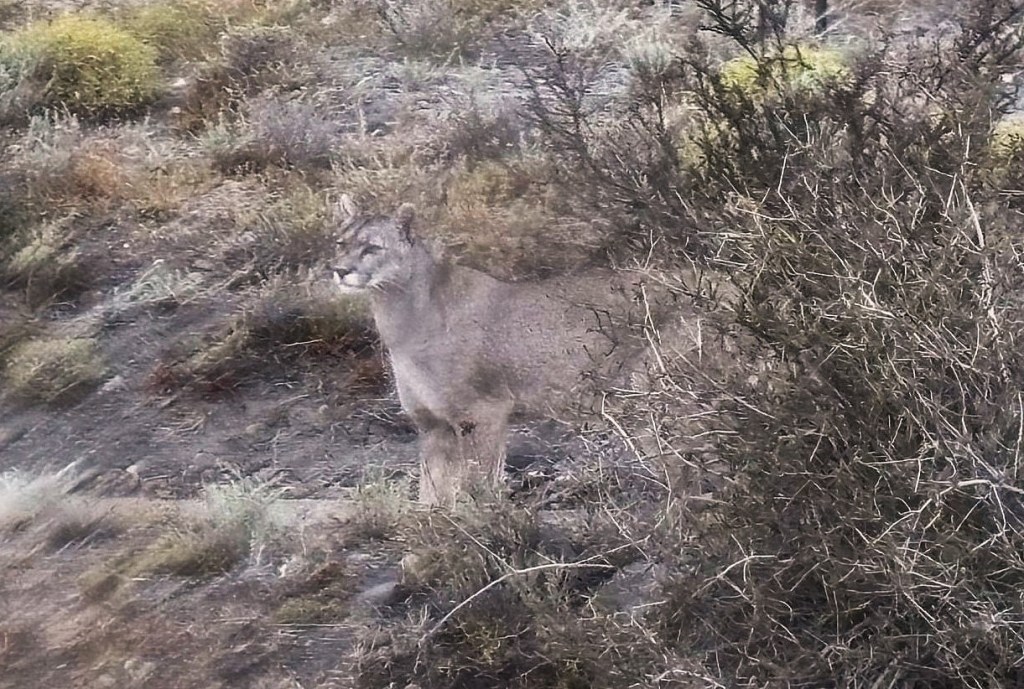
A cougar searches for guanacos, wild llamas indigenous to the grasslands of Patagonia, their primary prey

Common Name: Cougar, mountain lion, puma, catamount (cat of the mountain), panther, American lion, and many others – Cougar is derived from the language of the Tupi people, an indigenous group from central Brazil. The original name cuguacuarana was a modification of suasuarana, which literally meant false (rana) deer (suasu). This was presumably to distinguish the large cat with fur that was similar in color to deer from the jaguar, another large cat with spots which is also indigenous to South and Central America.

Scientific Name: Puma concolor – The generic name Puma is taken directly from the Quechua language of the natives of southern Peru in the Andes Mountains. Concolor means to have one, consistent color, noting the same attribute as the similarly colored deer – cougar etymology. Also listed on occasion as Felis concolor. Felis is the Latin word for cat. [1]

Potpourri:   The cougar has the largest geographic range of any terrestrial mammal in the Western Hemisphere, extending from the boreal forests of northern Canada and Alaska to the open grasslands of Patagonia at the southern tip of South America. As a solitary apex predator, it is without equal, adapting to extremes of climate and variety of prey from snowy tundra in the north across the desert Southwest into the rainforests of Brazil to elevations of over 15,000 feet in the Andes and back to sea level in southern Chile and Argentina. [2] Recognized and feared by many populations of people along the way, the cougar has accumulated a long list of common names … over forty applied according to the local languages of diverse tribal populations. The cougar/puma/mountain lion/et cetera holds the record for the most names of any mammal species [3] As a result, cougars convey a sense of mystery and intrigue in being somehow different animals even though they are the same.

Unlike most of the other large cats, cougars hunt day and night, favoring daylight in wilderness areas and night when near populated regions. Sightings by humans are almost universally fleeting resulting in frequent mistaken identities. The similarly colored bobcat (Lynx rufus) can easily look like a mountain lion based on a coup d’oeil of a darting large, brownish, furry animal. However, like the alleged encounters with yeti in the Himalayas and sasquatch in the Pacific Northwest, there have been no confirmed sightings of cougars in the Eastern United States for decades. This was the result of expanding settlement over the last two centuries and the near extirpation of the white-tailed deer, its primary food source. The last documented and validated records for cougar sightings were 1871 in Pennsylvania and 1887 in West Virginia. Further west confirmed sightings have been more recent; 1956 in Alabama and 1971 in Louisiana and Tennessee. [4] In 2008, the Smithsonian Conservation Biology Institute sponsored a six-month long program to assess the mammal populations along the Appalachian Trail corridor in Northern Virginia and Maryland using scented bait and a motion sensitive camera. With over 4,000 sightings including multiple bobcats, bears, and coyotes, among many others, there were no cougars.  While absence of evidence is not evidence of absence, it is indicative of rarity at the very least. That is not to say that cougars won’t be back, as the surge in white-tailed deer will likely draw the adventuresome seeking a reliable source of food at some point.

The near pole to pole range of the cougar is testimony to the geographic adaptability of the Felidae or cat family as a whole, which originated in Asia in the Oligocene Epoch 35 million years ago. The “intelligent” evolutionary design of the basic felid has stood the test of time as the 8 genera and 37 living species migrated globally. Almost all cats are solitary (only lions having pride in association) and share the characteristics of consummate predators―lithe, muscular bodies, tearing teeth and claws, keen senses, and camouflaged fur coats. This suite of attributes has changed little over the diaspora, testimony to the versatile success of cats. Based on DNA analysis of living cat species, the big cats of the genus Panthera, consisting of lions, tigers, leopards (including snow and clouded), and jaguars were first to become differentiated from ancestral species 10.8 million years ago in the Miocene Epoch, the age of mammals. Note that all the “big cats” could also be called panthers, and, for those with fur darkened by melanin for nocturnal hunting stealthiness like leopards and jaguars, the term black panther is widely used. It is hypothesized that an ancestral cat species migrated across the Beringian land bridge connecting Asia to Alaska 8 million years ago to give rise to the New World cats. The subsequent movement of cats through the Americas gave rise to cougars, lynxes, ocelots, and, ultimately, domestic cats. The closest DNA relative of the cougar is the cheetah, which evolved in North America and crossed back through Asia and into Africa about one million years ago to become the world’s fastest terrestrial animal. [5]

The cougar is not a “big cat” of the Panthera genus, a fact borne out by the observation that cougars don’t roar, a trait of note due in no small part to the MGM movie studio’s leonine opening sequence. The cougar might be thought of as the largest version of the domestic cat; both having diverse geographic and habitat adaptability suggests genetic similarity. The origins of cats as human companions has long stymied biologists since they don’t fit the pattern of domestication, lacking social group organization in which there is some sort of leadership hierarchy wherein the humans can become surrogate herd leaders. Herding cats is one of the maxims used to characterize missions impossible. The aloofness of cats is a matter of literary record; they are the “wildest of all wild animals” in Rudyard Kipling’s classic The Cat Who Walked by Himself. [6] Since the cat was proclaimed a sacred animal in the 5th dynasty of ancient Egypt about 4,000 years ago according to the hieroglyphic record, it was long thought that this led to domestication when cats proved their utility in ridding granaries of rodents. [7] However, recent archaeological and genetic research has revealed that domestication of cats began in Mesopotamia (Greek for mid river) between the Tigris and Euphrates over 10,000 years ago. DNA from 979 domestic and wild cats was analyzed to reveal that all cats evolved from Felis sylvestris lybica, the Middle East wild cat subspecies. In 2004, archaeologists digging on the island of Cyprus discovered a 9,500-year-old burial site containing a human and a cat, presumably imported as a pet from mainland Asia Minor (why else would they be buried together?). The current consensus is that domestic cats seeking rodent prey drawn by grain storage coevolved with humans in the Middle East as a matter of mutual benefit during the Neolithic (New Stone Age) Period. [8] Cougars that remained in the Americas sought larger prey and avoided human contact altorgether.

As an apex predator, cougars have a profound though largely unappreciated impact on ecosystems. Males occupy large, non-overlapping territories that range in size of over 500 square kilometers abutting several female territories that are about half that size. Other than biennial breeding during which they cohabitate for several weeks to propagate several cubs (not kittens), they live and hunt alone, which is the norm; 179 of 247 terrestrial carnivores are solitary. [9] A metanalysis of published research conducted several years ago revealed that puma-cougars preyed on 148 mammals, 36 birds, 14 reptiles and amphibians, and 5 fish. Of these, 40 species were found to avoid cougars due to fear effects, notably the cervids like deer of North America and camelids like the guanaco. the wild llamas of Patagonia. Predator avoidance results in reduced grazing, with evidence that 22 plant species benefited from the presence of cougars. Cougar deer kill has a more direct effect in removing on average one deer per week per cougar. The introduction of cougars to South Dakota is estimated to have saved over one million dollars due to a reduction in deer-vehicle collisions. [10] It is widely recognized that the burgeoning population of white-tailed deer in the Eastern United States is a matter of concern due to a combination of ecological damage in the consumption of seedling trees and the ever-present danger of running into one on the road. It is appropriate to at least entertain a change in public policy to promote the reintroduction of the mountain lion to the Appalachians.

There already is one population of cougars on the east coast in the state with the seventh highest population density. The Florida panther has struggled for survival against the onslaught of humanity for decades. Up until the beginning of the 20th century, the Puma concolor coryi, as the subspecies is designated taxonomically, ranged across the southeastern United States. Gradually, its preferred habitat of swampy forestland was cris-crossed by roads connecting population centers to the point that they retreated to southwestern Florida, where Big Cypress National Preserve and the adjacent Everglades National Park provide a survivable bastion. The population shrank to less than 50 animals and is now listed as threatened with projected extinction after 2050. [11] The problem is inbreeding, the bane of biology. Lack of mate variability promotes the advancement of harmful genetic traits, like low sperm count and heart murmurs in the case of the cougars. Over the last thirty years, efforts have been made to widen the gene pool. Eight Texas panthers were captured and released in south Florida in 1995. Thurty years later, sequencing of 29 genomes found “increased heterozygosity across the genome and reduced homozygous deleterious variants” which means increased diversity which promote survivability. [12] Florida panthers are so good at hunting white-tailed deer that there is some concern that deer hunting by humans needs to be curtailed as part of the statewide effort to save the panther, now that it is the official Florida state animal. [13] Having brought back bison, bears, eagles, condors, and wolves, it is high time for the renaissance of cougars.

References:

1. Webster’s Third New International Dictionary of the English Language, Unabridged, G. and C. Merriam Company, 1971.

2. The IUCN Red List of Threatened Species 2015: https://www.iucnredlist.org/species/18868/97216466      

3. Guiness Book of World Records –     https://www.guinnessworldrecords.com/search?term=cougar&page=1&type=all&max=20&partial=_Results&    

4. Whitaker, J. National Audubon Society Field Guide to North American Mammals, Alfred A. Knopf, New York, 1996. Pp 788-796.

5. Johnson, W. et al “The Late Miocene Radiation of Modern Felidae: A Genetic Assessment” Science, Volume 311 6 January 2006

6. Kipling, R. Just So Stories, The Odyssey Press, New York, 1902, pp 197-221.

7. “Cats” Encyclopedia Brittanica Macropedia, Willam and Helen Benton Publishers, Chicago, Illinois, 1972, pp 996-1000.

8. Driscoll, C. “The Taming of the Cat. Genetic and Archaeological findings hint that wildcats became housecats earlier- and in different place- than previously thought”. Scientific American. June 2009, Volume 300 Number 6 pp 68–75.https://pmc.ncbi.nlm.nih.gov/articles/PMC5790555/  

9. Elbroch, L. et al. “Adaptive social strategies in a solitary carnivore”. Science Advances. October 11, 2017, Volume3 Number 10.  

10. LaBarge, L. et al.  “Pumas Puma concolor as ecological brokers: a review of their biotic relationships”. Mammal Review. 18 January 2022, Volume 52, Number 3 pp 360–376. https://onlinelibrary.wiley.com/doi/10.1111/mam.12281  

11. Nowell, K. and Jackson, P.  “Wild Cats. Status Survey and Conservation Action Plan”. IUCN/SSC Cat Specialist Group. IUCN, Gland, Switzerland, 1996. p 131 http://carnivoractionplans1.free.fr/wildcats.pdf       

12. Simonti, C. “Saving the Florida Panther” Science 4 September 2025, Volume 389, Issue 6764.

13. Bled, F. et al “Balancing carnivore conservation and sustainable hunting of a key prey species: A case study on the Florida panther and white-tailed deer”Journal of Applied Ecology. 9 June 2022, Volume 59, Number 8 pp 2010–2022. https://besjournals.onlinelibrary.wiley.com/doi/10.1111/1365-2664.14201

Corn Snake

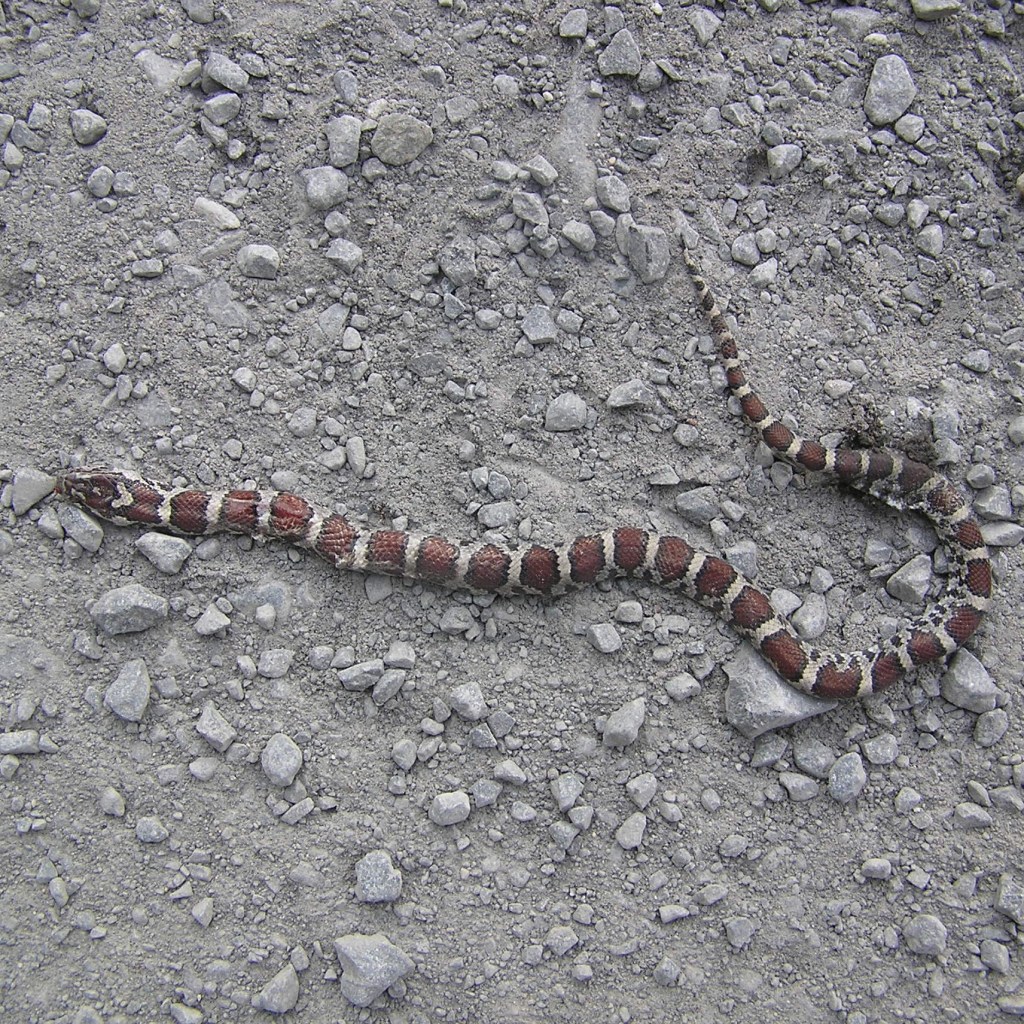
Corn Snakes are well camouflaged in the brown and tan leaf litter of forest soil.

Common Name: Corn Snake, Red rat snake, Red corn snake, Pine snake, Chicken snake – Corn may refer to habitat, as they frequent corn fields in search of rodents. Corn may also refer to appearance, as the alternating light and dark scales on the bottom, belly, or ventral side, resemble Indian corn with its similar contrast of light and dark kernels.

Scientific Name: Pantherophis guttata – The generic name means panther-snake (ophis) in Greek. The etymology of panther is not well established. Panthera is the genus of large cats (tigers, lions, leopards, and jaguars) that probably is from the Sanskrit word for tiger, pundarika. Panther widely applied to large cats that have a black coat for night stealth (i.e. black panther).[1] Its use in this case is likely due to the more common and prevalent black rat snake, also a member of the genus. The Latin word guttatim means “drop by drop” and may suggest a dappled pattern. [2] Formerly known as Elaphe guttata, the genus Elaphe has been reorganized in recent years due to DNA inconsistency but is still in wide usage in field guides. [3] Elaphe is Greek for deerskin, which may be due to tan color similarities.

Potpourri: Corn snakes are closely related to the more common black rat snakes and share many behavioral characteristics, especially a preference for rodents as repast. The alternative common name red rat snake is a measure of close association. Geographically, corn snakes inhabit only the warmer, southern regions of eastern North America, suggesting a preference for agricultural meadowlands where corn is common whereas their black cousins venture northward into New England. As with most snakes, the color and arrangement of scales are the main distinguishing feature. Corn snakes, though quite variable in hue with angular blotches that can range from red to brown to dark gray, are nonetheless distinct from the uniformly black scales of the black rat snake. [4] Since every aspect of an animals appearance and behavior must have arisen according to environmental factors as a matter of survival as a species, there must be a causal explanation for the color scheme.

Snakes comprise a physiologically consistent group of the class Reptilia in the suborder appropriately named Serpentes. Three lineages of reptiles emerged from the Permian extinction about 250 million years ago, when approximately 90 percent of all species were wiped out, most likely due to massive lava outflows incident to the formation of the supercontinent Pangaea. Two lineages survived through the succeeding Mesozoic era; the dominant dinosaurs of which birds are the only vestige; and the scaled reptiles which gave rise to lizards and then snakes. While the current, Cenozoic (post Pangaea) era is widely known as the age of mammals, it could equally be considered the age of birds, if numbers are more important, or the age of snakes if rapid adaptive radiation was the key criterion.  More than 90 percent of all reptiles living today are lizards or snakes, of which snakes are the vast majority with 2700 species on all continents except Antarctica. [5] Recent phylogenetic research has revealed through DNA associations that the ancestral rat snake arose in tropical Asia in the Eocene Epoch and crossed over the Beringian Land Bridge to North America in the Miocene about 25 million years ago, following the rodents that became their defining source of sustenance.[6]

The adaptive radiation of snakes to occupy new habitat niches precipitated changes in diet, behavior, and appearance as a matter of evolutionary mutations for survival. It is clear from the fossil record and from the presence of vestigial pelvic girdle and hind limb bones in some snakes that they evolved from four legged lizards. Legless reptiles are testimony to the irrefutable progression of Darwin’s evolution. Amphibians that first emerged from the oceans with fins needed legs for locomotion and scaly skin to maintain body fluids to continue as terrestrial reptiles. The success of snakes was necessarily advanced by the loss of quadrupedal capability. The most compelling rationale for this extreme retrogression is rodent burrows. Legs and feet get in the way when slithering down a rabbit hole to access its inhabitants. There was never going to be a case where a cold-blooded snake would chase down a warm-blooded mouse in the open, regardless of the ultimate outcome of Aesop’s tortoise and hare. Cornering rodents in their dens was the impetus and proto snakes with smaller legs were successful in survival, passing their genes down to their eventually legless progeny.[7]

Corn Snakes are often confused with milk snakes

The color scheme of corn rat snakes is also with purpose. For some animals, notably birds, colors are in many cases a matter of mate choice. This cannot be the case with reptiles with no visible distinction between the sexes save perhaps size. What is important is blending into the surrounding environment. If an animal is subject to predation, and most are, then being difficult to find is a survival asset. Snakes are subject to predation by carnivores like foxes, bobcats, and raccoons in addition to birds of prey like hawks. However, an equal and opposite reason for rat snake camouflage is stealth for predation. The black rat snake stands out, literally. Among the greens and dappled hues of the forest floor, jet black is hardly stealthy. Arguably, black confers stealth at night and this surely plays a role as black snakes hunt at night in summer and frequently climb trees in search of songbirds and squirrels. Corn snakes not so much, mostly lurking in underbrush like cornstalks in search of prey. While a limited data point, two corn snakes were eviscerated in Virginia in 1939 to reveal the remains of a field mouse, a skink lizard, and a wood-boring beetle. [8] The variable colors of corn snakes in darker blotches on a lighter background are not unlike those of other snakes like copperheads and timber rattlesnakes in addition to the nearly identical milk snake. It must be concluded that snake color pattern is not all that important as a survival attribute and color variability is therefore not constrained by it.

Detecting, localizing, overpowering, and killing prey for food is a matter of snake survival.  Sensory perception is therefore central to snake hunting success. Vision, hearing, and smell all play a role. Taste does not play a role, as snakes need no sensors to sample food swallowed whole and headfirst. The unblinking, lidless eyes of snakes are sinister and effective. Short range vision of corn rat snakes is good even under the low light conditions of darkness. Since snakes lack mammalian middle ears, connective eustachian tubes, and eardrums (tympana), they are relatively insensitive to airborne noise. However, sound induced ground vibrations are detected by conduction through the solid bones of the skeleton, allowing for initial detection of activity but lacking any directional specificity. Smell is the most important corn rat snake sense [9], enhanced by employing the tongue as an air sampling appendage. The twisting, forked tongue is an equally sinister snake attribute. Chemical molecules in the air that convey smell are sampled by the flickering tongue and deposited into two small ducts in the top of the mouth cavity. This repository is the vomeronasal, or Jacobson’s organ, which sends scent data to the brain for interpretation as food, foe, or friendly mate.[10] When a corn rat snake is encountered on the trail, it will first feel footsteps, localize with beady-eyed vision, and conduct a full evaluation with smells sampled lingually. It will respond according to instincts tempered by experience.

A corn rat snake’s reaction to its encounters with other animals depends on how its brain interprets what its sensory suite detects. According to the analogous mammalian amygdala, sometimes referred to as the reptilian brain, reactions include fight, flight, fear, and, if you happen to be a corn snake of the opposite gender, sex. The mnemonic used by neuroscientist students for these functions is “the 4 F’s” of the amygdala, substituting carnal knowledge fornication. If a threat is perceived and an escape route is open, corn snakes take flight and slither to safety. Laboratory testing has demonstrated that corn snakes are adept at finding an escape route based on spatial awareness and learning when confronted with multiple options. Fleeing to leaf litter bowers is a practiced strategy. [11] If cornered, corn rat snakes will fight, taking up a defensive, coiled, readiness to strike posture, bobbing and weaving to confront the threat. Corn rat snakes also vigorously shake their tails like rattlesnakes when threatened, lacking only the noise-making rattle. While the reason for this evolutionary trait is unknown, it is speculated that it is defensive, presenting a confusing tableau of a double-ended body to a potential predator. It is a relatively common trait among members of the Colubrid snake family.  However, if fear is not a factor according to the sensory profile and there are prospects for a meal or a mate, escape changes to engage.

The adaptations necessary and sufficient for snakes, obligate carnivores, to subdue their quarry without the benefit of arms and legs to hold and pummel or teeth to impale and tear is testimony to the consequential driving force of evolution.  Poisonous snakes engage in chemical warfare, injecting toxins with fangs to immobilize prey. The constrictors, like corn rat snakes, employ brute force. The widespread use of constriction among snakes suggests that it probably was an early adaptation, arising in the Paleocene Epoch, contributing to the rapid radiation of constrictor snakes to new habits. [12] An evaluation of prey handling complexity comparing constrictors with jaw holding and body pinning practiced by other species revealed the simplicity and effectiveness of the former. It is surmised that the constriction method evolved to subdue “vigorously struggling prey” which may have been necessitated to successfully catch and kill rodents. Constrictors mastered the physics of muscular compression. [13]

And then there is the matter of mating, which begins with sensory perception of a potential partner of the same species. Since snakes are solitary and mostly hidden from view over wide-ranging habitats, the importance of pheromones in mate localization cannot be understated. The search for a mate begins in early spring, and, if successful, results in the deposition by the female of up to 30 eggs in a secluded location chosen with enough heat (82 °F is ideal) and humidity to promote incubation. As with almost all reptiles, there is no parental support and protection. The eggs must remain undiscovered by predators for over 60 days when they hatch out as foot-long juveniles. In the three years that it takes to reach full size; many are lost to the gene pool due mostly to either becoming prey or due to the inability to find prey. [14] For corn rat snake population stability, one male and one female must, on average, survive, meet, and mate from each clutch of eggs. In the native habitat in the southeastern United States, corn rat snakes hold their own, in spite of being killed by humans, many of whom wrongfully fear all snakes. For those who like snakes, corn rat snakes make good pets, as they are docile and do not object to being handled. This has led to corn rat snakes becoming an invasive species in many of the islands of the Caribbean as they have been imported and escaped to a predator free habitat. [15]

References:

1. Webster’s Third New International Dictionary of the English Language, Unabridged, G. C. Merriam Company, Chicago, 1971, p 1632

2. Simpson, D. Cassell’s Latin Dictionary, Wiley Publishing, New York, 1968, p 211.

3. Crother, B.  “Scientific and standard English names of amphibians and reptiles of North America north of Mexico, with comments regarding confidence in our understanding” Society for the Study of Amphibians and Reptiles Herpetological Circular. 2012 Volume 39: pp 1–68

4. Behler, J. and King, F. National Audubon Society Field Guide to North American Reptiles and Amphibians, Alfred A Knopf, New York, 1979, pp 604-607

5. Starr, C. and Taggart, R. Biology 5th Edition, Wadsworth Publishing Company, Belmont, California, 1989, pp 580-585.

6. Burbrink F. and Lawson, R “How and when did Old World rat snakes disperse into the New World?”. Molecular Phylogenetics and Evolution. 27 September 2006 Volume 43 Number 1pp 173–189.

7. Title, O. et al “The macroevolutionary singularity of snakes” Science, 22 February 2024, Volume 383 Number 6685. pp 918-923.

8. Linzey, D. and Clifford, M. Snakes of Virginia, University of Virginia Press, Charlottesville, Virginia, 1981, pp 96-102

9. Saviola, A et al “Chemosensory responses to chemical and visual stimuli in five species of colubrid snakes”. Acta Herpetologica. 19 April 2012 Volume 7 Number 1 pp 91–103

10. Dowling, H. “Reptilia” Encyclopedia Brittanica, Macropedia, University of Chicago, Illinois, 1974. Volume 15 pp 725-739.

11. Holtzman, D. et al “Spatial learning of an escape task by young corn snakes, Elaphe guttata guttata“. Animal Behavior. January 1999 Volume 57 Number 1 pp 51–60.

12. Greene, H. and Burghardt, G.  “Behavior and Phylogeny: Constriction in Ancient and Modern Snakes”, Science 7 April 1978. Volume 200 Number 4337.

13. Saviola, A. and Bealor, M. “Behavioral complexity and prey-handling ability in snakes: gauging the benefits of constriction”. Behavior. 30 May 2007 Volume 144 Number 8 pp 907–929.

14. Smithsonian Zoo. Eastern corn snake | Smithsonian’s National Zoo and Conservation Biology Institute   

15. Commonwealth Agricultural Bureaux International. (CABI) database https://www.cabidigitallibrary.org/doi/10.1079/cabicompendium.84655

Hydropower

The Conowingo Hydroelectric Dam on The Susquehanna River is a two mile hike north of Susquehanna State Park along the railroad right of way that was installed to transport building materials for the dam, which opened in 1928.

Hydroelectricity is one of the three sources of renewable energy capable of providing electricity on a global scale. All three ultimately derive their energy from the sun. Photovoltaic or PV panels collect and transmit sun photon energy directly. Wind turbines collect the energy of pressure differences caused by temperature differences from the sun heating the earth’s surface. Hydro energy is more nuanced. The sun evaporates water from the oceans. As water vapor rises and moves with winds swirled by the Coriolis effect, clouds form and the vapor condenses to water falling as rain or snow. Water falling on land finds its way back to the ocean by forming rivers that flow from  higher to lower elevation. The potential energy of the water at higher elevation is converted to kinetic energy as it moves downhill. Turbines placed in the flow connected to electrical generators is hydroelectric power. Dams regulate the flow so that the power is constant and continuous rather than being subject to the whims of weather in floods and drought. Hydro has recently taken on a new role. Since wind and sun are intermittent but hydro is constant, the use for water has gained in importance linking the former to the latter. Power supplied  by wind and solar in excess of demand runs pumps to move water uphill to an elevated reservoir. The energy thus stored is reclaimed when the upper reservoir flows back downhill now directed through a hydroelectric generator. Pumped storage hydropower (PSH), as this arrangement is called,  thus provides energy storage, a mandatory capacity for a future global electrical system dominated by renewables.   

Hydropower is a broad and underutilized word that applies to any means by which water in its liquid state is used as a source of energy for human endeavor.  It is useful as an inclusive term that applies throughout the course of human history. Water for mills and the machinery of early, mainly textile factories, was generally called water power. Starting in the late 19th century, water became one of the main sources of generating electricity, mostly with the construction of dams, giving rise to the term hydroelectric power. Hydropower does not refer to the use of hydrogen gas as a source of energy (power is the rate of using energy), although this may one day become a neologism if hydrogen power proliferates. The similarity and possible confusion arises from the fact that Antoine Lavoisier, the father of chemistry, concocted the word hydrogen from Greek words meaning “I beget water” for the seminal work of Chemistry, published in English as Elements of Chemistry in 1790. The rationale for the name was that oxygen, meaning “I beget acid,” had been previously named based on the observation that sulfur, phosphorus and carbon produced acidic solutions when burned. Hydrogen mixed with oxygen “begot” water (2H2 + O2 = 2H2O), which was at the center of scientific inquiry from its inception.  Thales, a Greek philosopher of the 6th century BCE, held that water was the primary substance from which all other matter was formed. [1] While water is crucial to the evolution of life, the erosion of uplifted land back to the sea, and to the swirling chaos of weather, it falls short of being the elemental element. But it could be considered the elemental compound.

The use of water to do work dates from the dawn of prehistory as agriculture radiated outward from Mesopotamia and the first cities became food production and distribution centers. More mouths to feed with larger harvests gave rise to a better and more efficient way to make flour from threshed seeds in the Neolithic, literally New Stone Age.  The first written account of water turning a millstone to grind grain appears in the writings of Antipater of Thessalonica in the 1st century BCE: “Demeter (Greek goddess of agriculture) has reassigned to the water nymphs the chores your hands performed.” A horizonal wheel in a flowing stream was connected with an axle to a large circular shaped stone that rotated against a second stationary stone with the force otherwise provided by man or perhaps donkey power. The much more efficient vertical wheel that could use both the weight and the velocity of water required gearing to convert rotary motion to the horizontal stone was first described by the Roman engineer Vitruvius as hydraletae, Latin for water mills, in 27 BCE.  The watermill became the cynosure of the hamlets of England which grew in number from 6,000 according to the Domesday survey in 1086 to 30,000 in 1850. As the American colonies were settled and farmers migrated inland, watermills followed to make flour for daily bread to feed the burgeoning nation. Their remnants, long abandoned, abound.

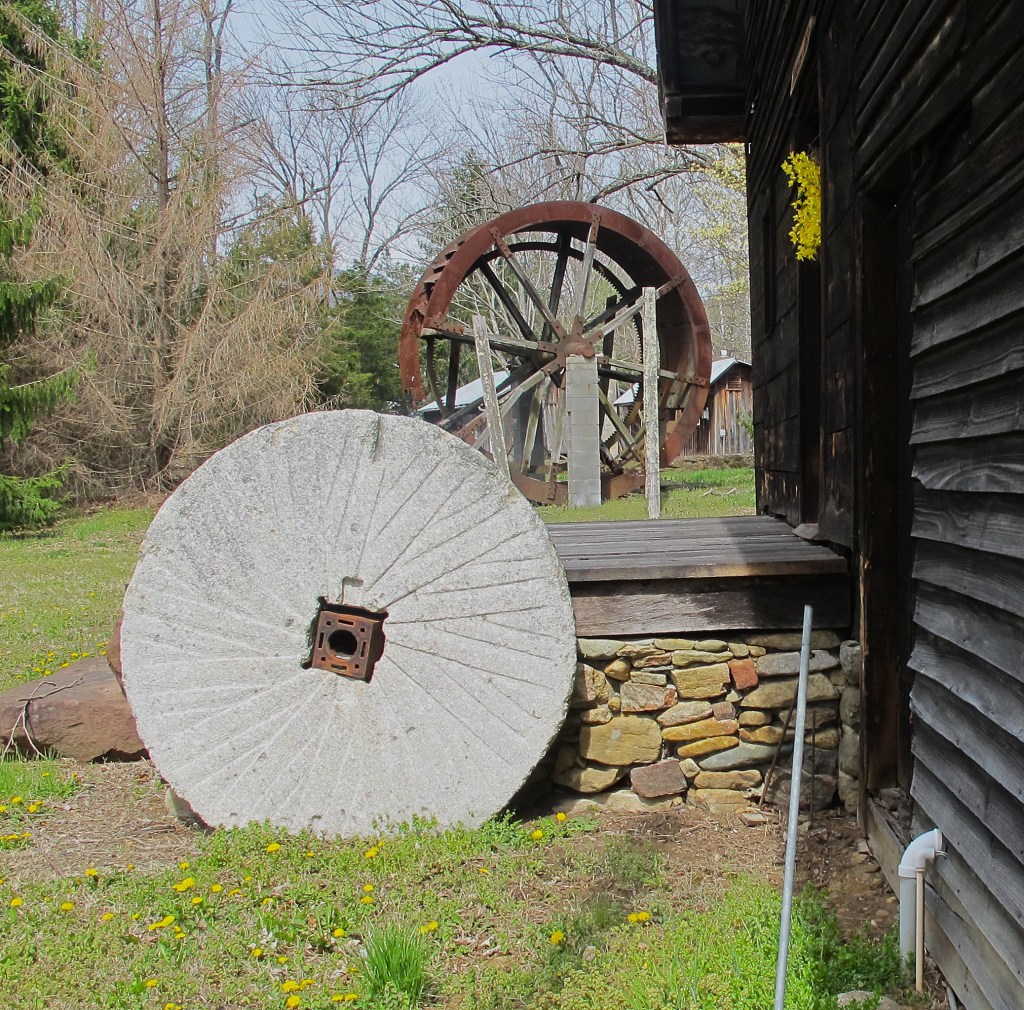
The mill at Nethers, Virginia is just down the road from the Old Rag Trailhead.

The use of water advanced from foundational milling of flour to powering industry as an integral part of the nascent Industrial Revolution in the early 19th century. It was a matter of economics, waterwheels were the most efficient sources of energy available. Two manual laborers could manually grind 15 pounds of flour per hour (200 watts), a mule-driven mill could double that, but a waterwheel produced about 200 pounds with a power of 2.000 watts or 2 KW―enough to feed a village of 3,500 inhabitants. Water power could be scaled up by enlarging the wheel and/or by employing multiple wheels. To supply the 1,400 fountains and waterfalls at  King Louis XIV’s magnificent palace at Versailles, near Paris, France, fourteen 30-foot wheels were installed  on the Seine River between 1680 and 1688 to drive 200 pumps. Glasgow, Scotland became a manufacturing entrepot in the 1830’s in part because of the massive water works on the Clyde River at Greenock with 20 waterwheels that could provide about 2,000 KW or 2 megawatts (MW). The full potential of water as a viable power source to meet the demands of expanding industry was the water turbine, invented by the French engineer Benoit Fourneyron in 1827. A turbine, named from the Greek word for whirling, uses curved blades with radial outward flow, increasing the efficiency of the traditional flat board waterwheel substantially. Water turbines were the primary source of power along the Merrimac River in Massachusetts, supplying 60 MW to hundreds of textile mills in 1875, 80 percent of all power. [2]

Waterwheels powered factories with rotary motion to turn pulleys linked by gears and belt drives to spindles for weaving fabric, to operate saw blades to cut lumber, and many other similar mechanical operations. Hydroelectricity became possible only after the invention of a device that could take the rotary motion imparted by a water turbine to generate current. The dynamo was invented by Michael Faraday in 1831 as a practical application of his discovery of induced electricity, that any conductive material moving through a magnetic field was induced to create a current of  moving electrons. The rotation of an iron rotor through a magnetic stator converted mechanical to electrical energy, giving rise to the induced current generator or dynamo. Any rotational device, such as a steam engine, could provide the motive force. Initial development of the dynamo generator as a practical device was one of the many inventions of the inimitable Thomas Edison at Menlo Park. The impetus was to provide a constant voltage source that was necessary to power the incandescent lights that he was working on as concurrent development with a stated goal of creating a central station for lighting all of New York City. The resultant dynamo, nicknamed “long-wasted Mary Ann” for its unusual two upright columns, was found to not only produce a nearly constant 110 direct current (DC) output but to do so at 90 percent efficiency, twice as much as its variable voltage predecessors. At 3 P.M. on Monday, September 4, 1882, Edison gave the order to start up four boilers to make steam for nine steam engines connected to Edison dynamos at Pearl Street Station in New York City to provide electricity to 400 incandescent lamps. [3]  While momentous as a practical demonstration of the use of electricity, the DC generated by Edison’s dynamos was limited in range to about one mile. The subsequent invention of alternating current (AC) would solve that problem.

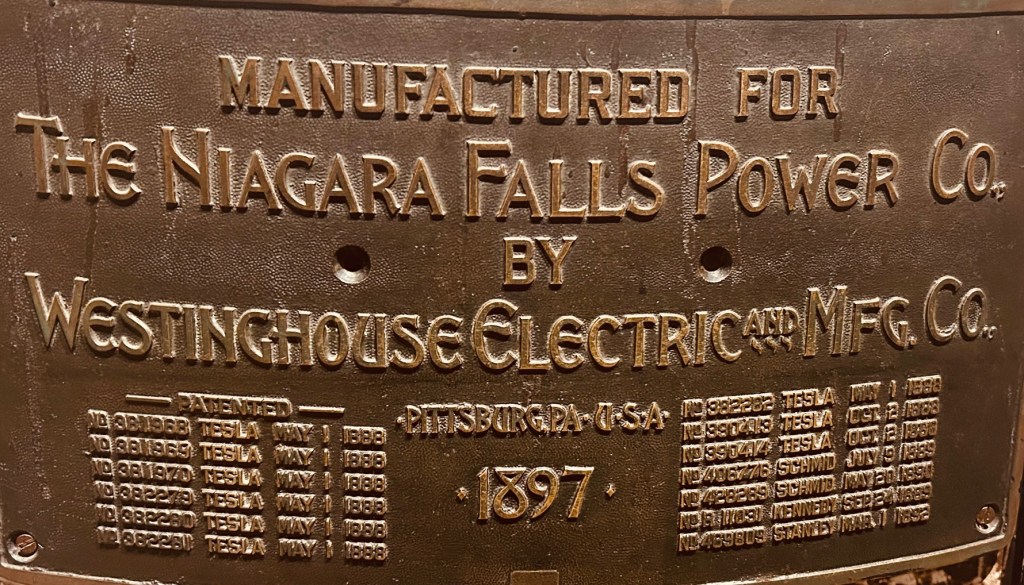
Niagara Falls played a seminal role in the development of electricity as the backbone of modern industry. The prodigious flow of the Niagara River that carries the waters of the Great Lakes to the Atlantic Ocean over a 167 foot cliff has attracted tourists for centuries (Edison spent his honeymoon there) and inevitably those interested in harnessing its water power. A small waterwheel-driven saw mill constructed in 1759 was succeeded 80 years later by a generating station that provided a small amount of electricity supplied by a DC generator for mills in what had by now become a namesake village. The Cataract Construction Company was organized in the 1890’s with the express purpose of building a water tunnel to supply a large scale hydroelectric power plant to sell electricity to customers at a profit. However, unlike New York City with its closely clustered businesses, upstate New York was remotely situated and would require long distance transmission. [4] The technology of electrical generation underwent a sea change when George Westinghouse bought the patents of Nicolas Tesla (who originally worked for Edison at Menlo Park) to design an alternating current (AC) generator. As AC current could be transformed to higher voltages for efficient transmission over long distances, the decision, considered radical and risky at the time, was to install AC generators in the Niagara Falls hydroelectric plant. It  began transmitting power twenty miles to Buffalo, New York, in 1896, making it the first modern industrial mecca. Thereafter, 80 percent of all new generating capacity was AC as the nation’s electrical grid took shape with remote power stations, like hydroelectric dams, feeding a network of long-distance power lines. Niagara Falls was a watershed reservoir for the watershed technology of AC power.[5] It now boasts 60 generators producing 5,000,000 KW, or 5 gigawatts (GW).

The nameplate from the Westinghouse AC generators in stalled at Niagara Falls is on display at the Smithsonian Museum of American History as one of the significant objects relating to power and industry

Construction of hydroelectric dams by the United States government resulted from congressional measures to address the international threat posed by Germany and its allies during the First World War after the sinking of the Lusitania in 1915.  The National Defense Act of 1916 doubled the size of the Regular Army and the National Guard and authorized the construction and operation of a nitrate plant for munitions “at a cost not more than 20 million.” President Woodrow Wilson chose  Muscle Shoals on the Tennessee River in Alabama as the site for a hydroelectric dam to provide power for the nitrate plant. This was at least in part a matter of investing in the impoverished south that had yet to fully recover from the devastation and disruption of the Civil War; Wilson was from Virginia. [6] The eponymous Wilson Dam, still in operation producing 663 MW of electricity, was not completed until 1924 and had no impact on the war, but a tremendous impact on the region. The Roaring Twenties optimism that infused the antebellum nation gave rise to stock speculation culminating in its precipitous plunge on Black Thursday, 24 October 1929. President Herbert Hoover, as an engineer and businessman, held to the belief that cajoling industrial and financial leaders to increase spending would staunch the downward spiral. Hoover vetoed a bill that would have converted the Muscle Shoals nitrate plant hydroelectric dam into a government run operation with the express purpose of providing electricity to the Tennessee region, preferring to have it run by private enterprise. By 1930, the Hoover Administration reluctantly concluded that some economic stimulus was warranted. Half a billion dollars was authorized for public works, including 65 million to construct Boulder Dam (later renamed Hoover Dam) on the Colorado River on the border between Arizona and Nevada. The economy continued to founder. Franklin Delano Roosevelt pledged to restore economic prosperity through federal government action in 1932 and was elected in a landslide with 472 of the 531 electoral college votes. [7]

Roosevelt’s New Deal ushered in the age of massive government programs, instituting a comprehensive plan to put the nation back to work. Building hydroelectric dams to bring power to the people was a core precept. With the Wilson Dam at Muscle Shoals as model, the US Congress passed the Tennessee Valley Authority (TVA) Bill in May 1933. It was one of the most important and far reaching initiatives in the history of the country. It gave the federal government the authority to construct and operate hydroelectric dams in a seven state region encompassing 40,000 square miles to “generate and sell electric power particularly with a view to rural electrification … and to advance the economic and social well-being of the people living in said river basin.” To accomplish this lofty goal, the government erected over 4,000 miles of transmission lines and subsidized rural electrification to quadruple the number of customers connected. The TVA is currently the largest public power provider in the United States and the fourth largest electric power provider with 29 hydroelectric sites employing over 300,000 people. The TVA model of government owned and operated hydroelectric dams to “use the facilities of a controlled river to release the energies of the people” was replicated in the Columbia River region of the Pacific Northwest. Construction of the Grand Coulee Dam in Washington State starting  in 1933 followed by the Bonneville Dam in Oregon in 1934. [8] By 1940, 40 percent of the electricity in the United States was provided by hydroelectric dams. The Depression Era ended with the full employment necessary to build the arsenal of democracy that won World War II. When it was over, nuclear energy of the atomic age replaced hydro as energy of the future.

Hydroelectric power has declined in importance in the United States over time, now providing only 6.2 percent of the electricity overall and 28.7 percent of that which is  renewable. This is the consequence of growing demand for electricity in an increasingly industrialized society relative to  static availability of appropriate locations for dam construction. Almost all of the good spots are taken and the older, larger capacity dams are over 80 years old . The United States is currently home to over 2,200 hydropower units that produce 80 gigawatts of electricity. Between 2010 and 2022, hydropower in the United States grew by only 2.1 GW almost entirely due to upgrades to existing hydroelectric dams (1.4 GW) and to additions of generators at 32 non-powered dams (550 MW). During the same period, 68 hydropower licenses were terminated for a total of 330 MW. By contrast in 2024 alone, the United States added 30 GW of solar power. [9]  Hydropower dams are in decline in the United States for several reasons. One is the droughts that are increasingly dire as global temperatures rise and more water evaporates. When the 2.1 GW Hoover Dam was completed in 1936, Lake Mead  was the largest reservoir in the United States. Due to a series of droughts in the 21st century, it has been reduced to as low as one quarter capacity with the plant’s four intake towers above the water line. [10] The second reason for the declining interest in hydropower is environmental. Dams disrupt the natural flow of sediments and impede the movement of fish upriver. The removal of the dams on the Elwha River on the Olympic Peninsula in Washington State in 2014 was the largest intentional dam removal  in world until the removal of the Klamath River dam in California in 2024.  A total of 1,951 dams were removed in the United Stats between 1912 and 2021. [11] Hydroelectric energy, while on the decline in the United States, is expanding in some areas of the world, notably China.

Unlike the network of hydroelectric facilities in the United States that were erected decades ago, global hydroelectric power was delayed until the broad industrialization that took hold in the  second half of the 20th century. Since the beginning of the 21st century, global hydropower has grown 70 percent, and now provides one sixth of  the world’s electricity. Hydroelectric power trails only coal and gas as third in overall capacity, is larger than all other renewable sources combined, and provides the lion’s share of electricity in 28 emerging and developing countries. Between 2021 and 2030 hydroelectric capacity is projected  to rise by 230 GW, an additional 17 percent. However, that marks a 23 percent reduction from the preceding decade of 2011 to 2020 indicating that the availability of sites with sufficient water flow and favorable geology is now reaching saturation worldwide. China is a case in point.  Between 2001 and 2010, it became the world leader in hydroelectric power with nearly 60 percent of global capacity. [12] The Three Gorges Dam of the Yangtze River, at 22.5 GW  the largest capacity hydroelectric plant in the world, was completed in 2003. During its nine year construction, the overall cost was over $30 billion, some of which was to resettle 1.3 million people displaced by the resultant reservoir. China’s growth has slowed since so that in 2025 it is still in first place, but with only 30 percent of global capacity. In a renewed bid to regain momentum, China recently approved the construction of  an even larger dam on the lower reaches of the Yarlung Tsangpo River that flows from Tibet to become the Brahmaputra in India and Bangladesh, where it empties into the Bay of Bengal. It is expected to be three times the size of the Three Gorges Dam and to cost $100 billion more. Aside from the international protests from the downstream countries, local Tibetans were involved in a protest in February of 2024 at the site of another dam. [13] [14]

Pumped Storage Hydro (PSH) facility encountered on a hike in central Germany.

While new hydroelectric projects are in decline, the use of water for energy storage, known as pumped storage hydro or PSH, is in the throes of a renaissance. There has always been a  need for large scale electricity storage. This is because electricity supply depends on the number and size of generators, which are traditionally either on or off. Electricity demand is variable depending on both diurnal workday activities and seasonal variation. To allow for some flexibility in balancing supply and demand, PSH was pioneered in the Swiss Alps in the early 1900’s. The basic idea is to use the excess supply during periods of low demand to operate pumps to move water from a low point to a higher point. The stored energy is used to augment supply when demand increases by allowing the water to flow back downhill through turbine generators. When the chimera of climate change energized the mandate for renewable energy sources, the storage problem got worse. Wind and solar are as variable on the supply side as the load on the demand side. While large scale rechargeable battery arrays can and have been used, they are not usually economically viable. There are 43 PSH units in the US with a storage capacity of 553 GWh, providing over 90 percent of all large scale electricity backup power. While 14,000 sites have been identified for possible PSH installations, the $2B price tag for a large unit is likely prohibitive. [15] While hydropower is a reliable and proven source of renewable energy with some limited storage capacity as PSH, it will not close the gap necessary to reduce carbon dioxide emissions on its own.

References:

1. Wothers, P. Antimony, Gold, and Jupiter’s Wolf, How the Elements were named. Oxford University Press, Oxford, England, 2019, pp 110 to 118, The fourth chapter of the book is entitled ‘H two O to O two H’ and is devoted to unravelling the chemical nature of water.

2. Smil, V. Energy in Nature and Society, General Energetics of Complex Systems, The MIT Press, Cambridge, Massachusetts, 2008, pp 180-184. Vaclav Smil is one of the world’s most respected authorities on power and energy. The book is encyclopedic.

3. Josephson, M. Edison, The Easton Press, Norwalk, Connecticut, 1986, pp 175-208.

4. https://www.niagarafrontier.com/power.html 

5. Needham, W The Green Nuclear Option, Outskirts Press, Denver, Colorado, 2022, pp 113-115

6. Link, A. Woodrow Wilson and the Progressive Era 1910-1917, Easton Press, Norwalk, Connecticut, 1982, pp 174-196

7. Wecter, D. Age of the Great Depression, The Macmillan Company, New York 1948.pp 44, 70.

8. Morison, S. and Commager, H. The Growth of the American Republic, Volume II, Oxford University Press, New York, 1950, pp 603-606.

9. Uria-Martinez, R. and Johnson, M. US Hydropower Market Report, US Department of Energy, Office of Scientific and Technical Management, Washington, DC. 2023

10. Kolbert, E. “A Vast Experiment, The Climate Crisis from A to Z” The New Yorker, 28 November 2022, p 47

11. Gleick, P. The Three Ages of Water, Public Affairs, Hachette Book Group, New York, 2023, pp 245-247

12. Hydropower Special Market Report to 2030  International Energy Agency 2020 https://iea.blob.core.windows.net/assets/4d2d4365-08c6-4171-9ea2-8549fabd1c8d/HydropowerSpecialMarketReport_corr.pdf     

13. “Dam!” The Economist, 4 January 2025, p 28.

14, Shepherd, C. “China pushes ahead with huge, and controversial, dam in Tibet” Washington Post 27 December 2024.

15. Kunzig, R. “Water Batteries” Science, Volume 383 Issue 6681, 26 January 2024, pp 359-363

Catoctin Formation

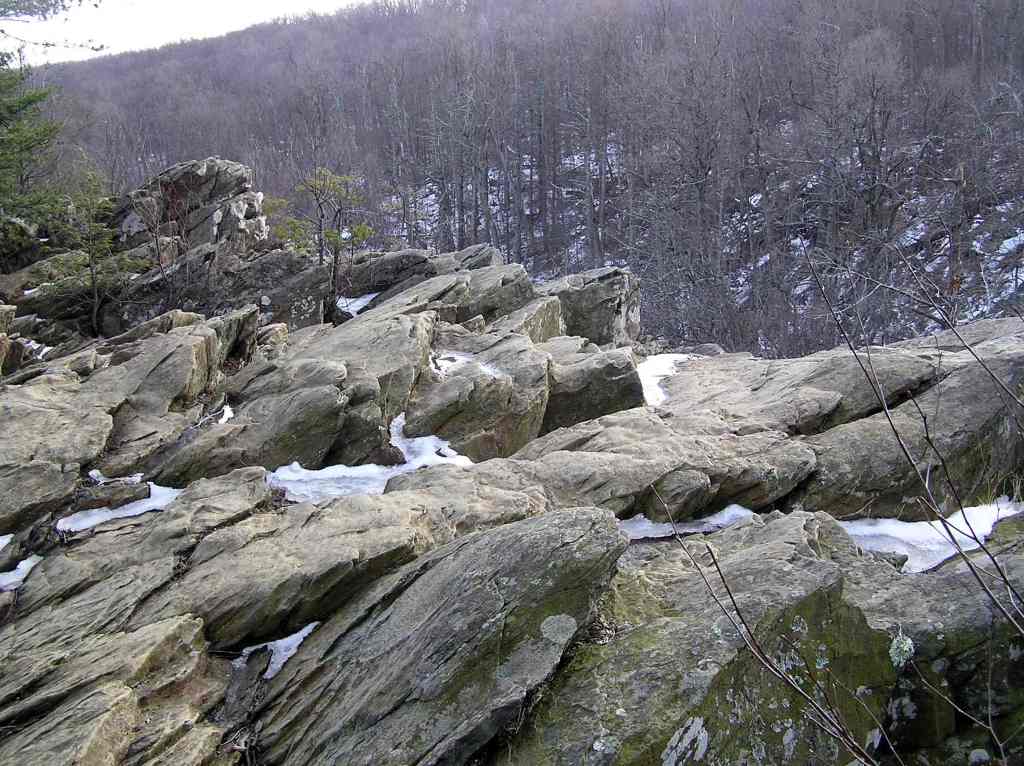
After about 600 million years, the Catoctin Formation still looks like lava.

Catoctin Formation:  A catoctin is defined as “a residual hill or ridge that rises above a peneplain and preserves on its summit a remnant of an older peneplain,” where peneplain is “an erosion area of considerable area and slight relief.” [1] It is derived from Catoctin Mountain in north-central Maryland where the Catoctin Formation was first noted as consisting of a geologic plain rising above a plain. Some sources contend that a tribe of Native Americans called Kittocton were resident in the general area and if that is the case, it is almost certain that Catoctin is a toponym. [2] However, the existence of a tribe named Kittocton is probably specious as the tribe is not listed by the National Geographic Society. [3] Many geographical names came into common parlance without any records―ancient wooded hill, land of many deer and speckled mountain have also been proffered as the meaning of Catoctin in one of now lost Native American languages.  

Potpourri: The Catoctin Formation is the most recognizable geological feature of the Blue Ridge Province of the Appalachian Mountains. Its origin as lava that flowed out of fissures in the earth’s crust is evident in the sequential cascades that solidified as they spread over the pre-Cambrian landscape about 600 million years ago (mya). Even though it was named for Catoctin Mountain, where it can only be seen in a relatively few and out of the way places, it is the capstone rock assemblage in Shenandoah National Park. The Marshall Mountains dominate the northern section of the park, benches of lava flowing outward to form the roadbed for Skyline Drive.  White Oak Canyon, a cynosure of the central section follows the circuitous lava flow path. The Appalachian Mountains are over a billion years old. In contrast, the 60-million-year-old Rocky Mountains and even younger Himalayas are relative newcomers to terra firma. The Catoctin Formation is the keystone that connects the arc of the ancient past to the ever-evolving present. [4] How could magma from earth’s liquid mantle flow through and then out over the crust in a place that is now as placid and peaceful as a national park in western Virginia?  

Plate tectonics emerged as a coherent and scientifically supported theory of geology in the middle of the last century. It was first postulated by the German meteorologist Alfred Wegener in 1915 based on the conformity of the contours of the western coastline of Africa and the eastern coastline of South America. Supporting observations of geologic and fossil similarities that straddled not only South America and Africa, but also Australia and India could only be explained if these areas had at one point been connected in a single land mass, eventually named Gondwanaland for a region in India. The idea that massive continent-sized chunks could somehow move around, floating on top of a pool of molten rock agitated by planetary rotation and lunar gravity, and plow through oceanic crust like an ice breaker seemed too fanciful to many geologists until the middle of the century when further research revealed a viable mechanism. Sea floor spreading was confirmed by the observance of magnetic field shifts in solidifying magma flows in the mid-ocean ridges to provide a source of new crust. That earthquakes recurred in known prone zones led to the notion that plate movement was involved. The term subduction was given to the sliding of great arcs of oceanic crust under adjacent and less dense regions of crust to be remelted as magma in the mantle. With a supply of new magma emerging from the ridges and a recycling facility for old magma in subduction, there was no need to plow through anything. [5] So what has all this got to do with the Catoctin Formation?

The tectonic plates, many with lower density sections that are the land mass continents contained within their boundaries, have been floating around driven by the chaotic forces of physics by the liquid mantle for most of Earth’s 4.5-billion-year history. When two plates with the less dense continental crust float into each other, subduction is not an option and a headlong crash results. When an irresistible force meets an immovable object, something has to give and the only option is skyward. The result is an orogeny, from the Greek oros, meaning mountain. The mountain building orogeny that created the original Appalachian Mountains about 1.2 billion years ago is named Grenville for a small town in Quebec on the Canadian Shield central core of the North American plate. Wegener’s preliminary hypothesis that there was a contiguous area he called Gondwanaland was later expanded to include a second northern land mass named Laurasia that joined to form the supercontinent Pangaea (Greek for all earth) about 300 mya. Over the last several decades, additional geological analysis of bedrock on a global scale has concluded that the movement of plates results in the reassembly of at least 75 percent of all the jigsaw puzzle of landforms into a supercontinent roughly every 750 million years. Pangaea was proceeded by Rodinia, a name derived from the Russian word rodit meaning to give birth as it was at first thought that Rodinia was the original supercontinent that gave birth to all others. Further research has posited an additional supercontinent named Columbia that precedes Rodinia with evidence of additional combinations that extend as far back as the Proterozoic Eon that started 2.5 billion years ago. [6]

Catoctin Formation dike through older bedrock

The bedrock of the Appalachian Mountains was then the result of the collision of the land mass containing North America named Laurentia with the land mass containing northwestern Eurasia named Baltica that gave rise to what was to become Laurasia (North America and Eurasia) about 1.2 billion years ago. When Rodinia started to break apart about 700 mya, fissures opened, allowing magma in the form of lava to flow upward out of the mantle, through the bedrock of the Grenville orogeny, and spread out over its surface. This is the fons et origio of the Catoctin Formation.  Continued expansion in a manner similar to the opening of the eponymous Atlantic Ocean in the present geologic age resulted in its precursor named Iapetus, the father of Atlas in Greek Mythology. Initially, the cooled magma was covered by rough gravel at the shallow waters edge as the mountains were worn away by erosion. As the ocean expanded, the now submerged Appalachian bedrock with its lava coating became covered by smaller sized particles, and eventually the fine silted sand of mid ocean. The gradation of sediments of stone to pebble to sand on top of the Catoctin Formation is evident in the present day Weverton, Harper’s, and Antietam formations that make up the Chilhowee Group. [7] Iapetus stopped opening and began to close about 400 mya, creating Pangaea from Laurasia and Gondwanaland with a series of three orogenies named Taconic, Acadian, and finally Alleghany as the various plates collided from north to south. The resultant Appalachian Mountains were probably as high or higher than the Rockies at their peak uplift. Pangaea’s disassembly started near the end of the Mesozoic Era about 65 mya and is still in progress, the once buried lava rocks of the Catoctin Formation now in full view after millennia of erosion of the once majestic mountains to create the coastal plane. [8]

Geology as the science dealing with the physical nature and history of the earth has evolved extensively through the ages; even the rather obvious origins of lava have been misunderstood. While the Greeks and Romans appreciated the nature of lava and eruptions (the burial of Pompeii by the eruption of Vesuvius in 79 CE could hardly have been misinterpreted), the ensuing Dark Ages of biblical doctrine stifled the study of nature. According to Archbishop James Ussher of Ireland, the earth was created on Sunday, 23 October, 4004 years Before Christ and Noah’s flood was responsible for all current landforms. Even when science rebounded after the Renaissance, geology was especially difficult since it is mostly out of sight in tangled knots of rocky confusion. The noted German geologist Abraham Werner conceived that a universal ocean originally covered the earth and that all rock precipitated from it, dismissing the volcanic origins of lava altogether. His adherents, which included most geologists in the eighteenth century, were called Neptunists for the Roman God of the Oceans Neptune. The Vulcanists named for the Roman god of fire and the hearth, restored lava to its true provenance as magma emerging from fiery mantle. The word lava came into wide use in the 17th century from the Italian dialect around Naples, Italy (near Vesuvius) and meant something like falling― presumably from Vulcan’s home which had become a volcano.  Lava, in current parlance that reflects decades of study, comes in three basic forms: A’a for rough, fragmented blocks; Pahoehoe for smooth, undulating flows; Pillow for lava that emerges under water. A’a and pahoehoe are of Hawaiian origin due to the importance of the perennial lava flows that were key to early studies in volcanology. The lava of the Catoctin Formation is primarily dry, flowing, pahoehoe.

The primary constituent of the Catoctin Formation is basalt (from the Greek basanites, a type of slate used to test gold from basanos meaning test).  Basalt is an igneous (ignis is Latin for fire) rock, the generic name for any rock created directly from magma, the liquid rock of the mantle. Because of the low silica content, basalt has a low viscosity, so that the lava flow can move relatively quickly and travel as far as 20 kilometers from the source, which can be either a single vent or a long fissure.  Basalt is erupted at temperatures that range from about 2000 to 2100 °F, to become either a’a or pahoehoe depending on temperature and topography.  Basalt is the most abundant igneous rock in the earth’s crust, comprising almost all of the ocean floor. A rock is defined by the combination of minerals that it contains. A mineral is “a natural substance, generally inorganic, with a characteristic internal arrangement of atoms and a chemical composition and physical properties that are either fixed or that vary within a definite range.” [9] The primary minerals that make up the rock basalt are pyroxene and feldspar.

Pyroxene is from the Greek pyr and xeno meaning “alien to fire.” The pyroxene of Catoctin Formation basalt is a complex of different minerals that are silicates of magnesium and calcium and which include iron and manganese.  The general formula is X(Si,Al)2O6 where Xcanbe calcium, sodium, iron, or magnesium.  Magma that contains significant amounts of magnesium (Mg) and iron (Fe) is called mafic as an acronym for these elements. The other major component of magma consists primarily of feldspar and silica; it is called felsic according to the same logic. Feldspar, the other major constituent of Catoctin Formation basalt, is a complex of aluminum silicate minerals, i.e. containing aluminum and silica, in combined with potassium (KAlSi3O8), sodium (NaAlSi3O8) or calcium (CaAlSi2O8). Feldspar is derived from feldspat, German for “field flake” referring  to common rocks typically strewn about an open area that could readily be cleaved into flakes.  Feldspar comprises over fifty percent of the earth’s crust. The similarity between basalt and feldspar in terms of elemental composition is due to the dominance of oxygen in chemical combinations. The earth’s crust is about 50 percent oxygen combined with 30 percent silicon, 8 percent aluminum with iron, calcium, sodium, potassium and magnesium making up most of the balance at 2 to 5 percent each. [10]

The basaltic lava flows that first emerged from the mantle during the breakup of Rodinia have been subject to 600 million years of change. This included some millions of years under the Iapetus Sea and the crushing pressures of the assemblage of Pangea. The effects of the pressures and temperatures of deep depths and orogenies on existing rocks changes their shape, structure and properties. The name for the resultant rocks is metamorphic, literally changed body. To provide an overarching order to the otherwise intricate complexities of the mineral combinations of individual rocks, they are subdivided into three general types. Igneous rocks of the magma were first, solidifying in the first days of the nascent Earth’s cooling. Water evaporated from the primordial oceans precipitated as rain over lava lands, causing the erosion to transport grain by grain into the ocean to form sediments that gradually sank under their own weight to form sedimentary rocks. As the physics of balancing forces formed separated plates that drifted in their own magma ocean, the resulting colossal forces changed or metamorphosed the igneous and sedimentary rocks. Sedimentary shale became slate and igneous basalt became metabasalt. The Catoctin Formation that remains is the result of an unimaginable journey that took it from the peak of the tallest mountains to the deep sea and back again. While it still retains its basic lava-like appearance in places, it is comingled with many other rock types with their own histories. It has equally been subjected to differing environs that changed its core composition.

Catoctin Formation bounded by metabolized sandstones.

The Catoctin Formation has the colloquial name greenstone due to the gray-green coloration of many outcroppings, a result of its metamorphic journey. The Catoctin basalt is comprised of phenocrysts (large crystals) of plagioclase feldspar named albite in a fine-grained matrix of the minerals chlorite, magnetite, actinolite, pyroxene and epidote.   Epidote is a structurally complex mineral of calcium, aluminum, iron and silicon [Ca2 (Al, Fe) 3(SiO4)3(OH)] that has a green color described as pistachio.  It is this mineral that, when present, gives the Catoctin Formation a distinctive greenish hue. The sequential lava flows over an extended period are reflected in the diversity of the Catoctin Formation. The boundaries between the lava flows are marked by breccias, metatuffs, and metasandstone.  Breccia is a rock comprised of smaller rock fragments cemented together by sand, clay and/or lime.  These rocks identify areas where a crust formed on a lava flow that was disrupted by subsequent flows.  A tuff is a porous rock created by a consolidation of volcanic ash.  The metabolized tuffs, or metatuffs, are attributed to a rapidly moving cloud of molten ash.  The metabolized sandstones, or metasandstones, mark the boundary between one lava flow, a period of erosion and sedimentation, and a second lava flow. [11]

References:

1. Webster’s Third New International Dictionary of the English Language, C. G. Merriam Co.  Encyclopedia Brittanica, Inc, Chicago, 1971 p 354, 1669.

2. http://www.npshistory.com/publications/cato/index.htm   

3. “Indians of North America” National Geographic, Volume 142, Number 6, December 1972

4.Gathright, T., Geology of the Shenandoah National Park, Virginia Department of Mineral Resources Bulletin 86, Charlottesville, Virginia, 1976, pp 19-25.

5. Cazeau, C., Hatcher, R., and Siemankowski, F. Physical Geology Harper and Row Publishers, New York, 1976, pp 374-393.

6. Meert, J. “What’s in a name? The Columbia (Paleopangaea/Nuna) supercontinent”. Gondwana Research. 14 December 2011, Volume  21 Number 4 pp 987–993.    https://www.gondwanaresearch.com/hp/name.pdf   

7. James Madison University Geology Notes –  https://csmgeo.csm.jmu.edu/geollab/vageol/

8. Schnidt, M. Maryland’s Geology, Shiffer Publishing, Arglen, Pennsylvania, 2010, pp 88-112.

9. Dietrich, R. Geology and Virginia, The University Press of Virginia, Charlottesville, Virginia, 1970, p 4.

10. Cazeau et al op cit.

11. USGS Geological Survey Bulletin 1265 “Ancient Lavas in Shenandoah National Park Near Luray, Virginia” https://www.nps.gov/parkhistory/online_books/geology/publications/bul/1265/sec2.htm