


Common Name: Bradford pear, Callery pear, Braford Callery pear – The common name Bradford is eponymous, given to the tree to recognize the horticulturist who was the head of the USDA Plant Introduction Station in Glen Dale, Maryland where the cultivar of the Callery pear was first bred. Pear is from pirum, the Latin word for the fruit.
Scientific Name: Pyrus calleryana – The generic name is a variant of the Latin word for pear tree. The species name honors Joseph Callery (Giuseppe Calleri in his native Italian), a Catholic missionary to China who collected specimens of Asian native plants during his tenure there. He is recognized for having introduced the Callery pear to Europe in the 19th century.
Potpourri: Just as kudzu gained notoriety as the vine that ate the South, the Bradford pear is rapidly becoming the shrub that swallowed suburbia. As the Callery pear, it was originally imported from China in the early 20th century as an integral part of a United States Department of Agriculture (USDA) program to save the commercial pear industry from the devastation of a bacterial blight. The plan to use robust root stock resistant to blight from Callery pears grafted with the commercial, French pear was sound, as a similar method had been used in the late 19th century to resolve the “Great French Wine Blight” using American vine roots resistant to the American insect pest (a type of aphid) that caused it. [1] The French pear trees grafted to Chinese root stock flourished. Had it ended there, the monoculture stands of white petaled trees and shrubs that line many roads and dominate disturbed areas would never have occurred. The history of Bradford pear, like that of kudzu, is a cautionary tale of human intervention in ecosystems without a full understanding of the complexities of nature and evolution.
Before invasives demonstrated their ability to devastate native flora and fauna in the aughts of the 21st century, moving species randomly around the globe, sometimes purposely, was not only tolerated, but encouraged. Tomatoes, corn, and potatoes originated in the New World to become staples of European cuisine just as wheat, cotton and rice were imported and widely planted in the Americas. The genus and species scientific classification system of Carolinus Linnaeus still in use after over three hundred years was undertaken to organize the thousands of newly discovered plants submitted and named by field naturalists augmented by a list of descriptive nouns and adjectives, mostly in Latin. [2] The intentional importation of alien plants was mostly benign, with the exception of plants like dandelion, plantain, and garlic mustard that spread, crowding out the native species due to their superior resiliency. Bradford pears occupy a middle ground, having been introduced with good purpose, then intentionally hybridized to satisfy consumer demand for landscape trees.
The story begins in the decades following the Civil War as Conestoga wagons forged ever westward to colonize the verdant valleys on the windward side of the Sierra Nevada. As herding gave way to agriculture in the late 19th century, the search for plants that would flourish there became the mission of the purposely established USDA Foreign Seed and Plant Introduction Office. Due to similarities in climate, east Asia was considered the best potential source for candidate botanicals. A stout-hearted Dutch immigrant gardener cum naturalist named Frank Meyer with no fear of travel to remote areas to forage in relative isolation was recruited to undertake the mission. Like Darwin’s mission to collect specimens around the Pacific rim on HMS Beagle from 1841 to 1846, Meyer collected a wide variety of cereal grains, leguminous vegetables and fruits between 1905 and 1915 that eventually led to many of the food crops that have been cultivated in North America for over a century. Meyer’s initial forays did not seek out pears, as they were already well established in California, Washington and Oregon. [3]
The genus Pyrus probably originated in the Tian Shen Mountains in the Xinjiang Province of western China. Pear trees hybridized as they spread throughout Eurasia as a natural progression by animals, especially birds, eating the much smaller fruit of wild pear trees and defecating its seeds. Cultivation of larger, sweeter pears preferred by Europeans predates historical records but probably started in Mesopotamia. The resultant European pear (P. communis) was brought to the colonies of the Americas by both the British and French from the east and the Spanish from the south giving rise to orchards as early as the 18th century. Pear groves proliferated, particularly in the Pacific Northwest to make pears the third most consumed fruit in the United States, trailing only apples and peaches. As with most commercially grown fruit trees, grafting is used to grow an appealing pear variant onto rootstock selected for its hardiness Since pear trees are therefore essentially identical clones―a genetic monoculture―they are subject to epidemics as a microbe that infests one will spread to them all. This is precisely what happened to the pear industry in the early 1900s. [4][5]
Meyer returned to the United States in 1916 to observe the effects of the fire blight caused by the bacterium Erwinia amylovora on pear orchards. Professor Frank Reimer of Oregon State University had initiated a program in 1912 to find a North American pear species that was resistant to the blight to no avail and enlisted the aid of Meyer to find an Asian pear species. When he returned to China in 1918, Meyer focused on Pyrus calleryana, noting in a communiqué to the USDA that the “form from the Yangtze Valley seems to be better suited for Oregon than the one from South China.” After trekking though China for some months to seek out the tree, he concluded in another letter that “Pyrus calleryana is simply a marvel. One finds it growing under all sorts of conditions; one time on dry, sterile mountain slopes; then again with its roots in standing water at the edge of a pond.” In 1918, he proceeded to collect and ship 100 pounds of seeds back to the USDA for testing and began his journey home. He never made it, falling overboard to his death from a ship on the Yangtse River. His body was found thirty miles downriver on June 9, 1918. His colleague Reimer wrote “Mr. Meyer was one man in many thousands. He possessed a great brain and also a great heart.” [6] A suitable epitaph would be Frank Pearseed to stand beside John Chapman of Appleseed fame in the pantheon of American agronomy.

The seeds sent by Meyer were provided to USDA Plant Introduction Stations in Corvallis, Oregon and Glenn Dale, Maryland to assess the viability of P. calleryana as both root stock and as a new pear variant. The root stock proved to be resilient to the ravages of fire blight and was subsequently used to reestablish of pear orchards, saving the pear industry from devastation. Over three decades later, one of the Callery pear trees planted in Maryland caught the attention of a USDA employee named John Creech. Noting the glossiness of the leaves, the aesthetic, geometric balance of its spreading branches, and the lack of sharply spurred twigs that were typical of pear trees, he concluded that it would make an exceptional landscaping tree. By grafting branches from the original tree onto rootstock of P. calleryana, he cloned a cultivar variant that he named the Bradford pear in honor of a horticulturist employed by the Glenn Dale facility. The landscaping tree was commercially released in 1962 and quickly became popular due to the attributes that drew Creech. According to a respected and seminal plant guide, “The Bradford pear, a selection of P. calleryana, has recently become popular as an ornamental because of its profuse spring flowers and red fall color.” [7]
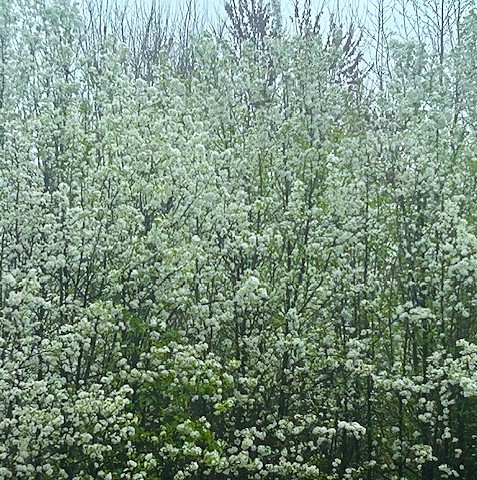
The Bradford pear became one of the primary trees lining the streets of American suburban sprawl built outward, a mecca from the noise and congestion of cities in the second half of 20th century. To satisfy the insatiable demand for variety in the cookie cutter sameness of burgeoning developments, twenty four variants of the Callery pear were introduced with catchy names ranging from Whitehouse to Autumn Blaze to augment the original Bradford cultivar. Like the ancestral Callery pears of China lauded by Meyer for their stamina and ubiquity, the Bradford pear and its variants were indomitable, thriving in poor soil that could be wet or dry, acidic or alkaline, resistant to disease, and reliably radiating branches of bouquets in spring and brilliant red fall foliage reminiscent of New England’s maples in autumn. Millions were planted across the country from California to Connecticut. [8] By 2015, Bradford pears had become the third most popular tree in New York City with a population of 58,000. The transition from desirable landscaping tree to pernicious pest occurred slowly, as the phalanxes of flowering white trees lining major roads could no longer be dismissed as part of a normal spring renaissance. [9]
What happened was hybridization. This was unexpected but could have been anticipated. Since Bradford pears and their ilk were clones in having been propagated by grafting small branches onto robust root stock (mostly P. calleryana), they were not able to cross pollinate and produce seeded fruits due to genetic incompatibility. However, the different horticultural cultivars were produced from pear seeds that were originally gathered by Meyer from all over China resulted in hybrids with different genotypes. This is the essence of the genetic diversity that Darwin first observed among the different specie of finches in the Galapagos Islands. As long as different hybrids are within individual bumble bee collection zones, chances are that eventually the pollen from a Bradford pear will find itself in the ovule of a receptive clone. The resultant fruit with its now mutant and fertile seeds, carried away for consumption by birds, especially European starlings and American robins, spread wherever and whenever the birds went, literally. Eventually, as a matter of evolutionary dynamics, a variant emerged that was super survivable. The Bradford/Callery pear has been listed as a “plant invader” by the US Fish and Wildlife Service in the mid Atlantic states since 2008. [10]
There is a certain amount of irony in introducing Callery pears to save the commercial pear industry from fire blight and then hybridizing it to create the hardy and aesthetic Bradford pear that has become a pernicious invasive. While other trees, like “tree of heaven” ailanthus and “empress tree” royal paulownia, have been introduced and become invasive, Bradford pears are unique in having been created by USDA plant breeders as a perceived public service. Contributing to the irony is that the fire blight bacterium that was the reason for the introduction of P. calleryana in the first place has reemerged as a major problem in the commercial pear industry due to its own evolutionary mutations. Walt Kelly’s Pogo cartoon for the first Earth Day provides the adage of the age: “We have met the enemy and he is us.” Barry Commoner, the father of ecology, proposed the law that “everything is connected to everything else,” a testimony to the complexities of the natural world. The only option at this point is to stop planting Bradford pears and their peers intentionally as landscape trees and to remove them whenever they spread into new habitats. There is evidence that the word is out. A sign posted at the trailhead at a Virginia State Park read “Wanted, Dead, not Alive, Callery Pear,” asking the public to “be on the lookout for this invasive intruder” and alert park staff so that it can be removed. The enemy strikes back.
References:
- Lukacs, P. Inventing Wine, A New History of one of the World’s Most Ancient Pleasures W. W. Norton and Company, New York, 2012, pp 169-174
- Wilson, C. and Loomis, W. Botany, 4th edition, Holt, Rinehart, and Winston, New York, 1967, pp 365-367.
- Culley, T. “The Rise and Fall of the Ornamental Callery Pear,” Arnoldia, Volume 74 Issue 3, 18 February 2017. https://arboretum.harvard.edu/stories/the-rise-and-fall-of-the-ornamental-callery-pear-tree/
- U.S. Department of Agriculture. “Pyrus Crop Germplasm Committee: Report and genetic vulnerability statement, September 2004” September 2004, Germ Resources Information Network (GRIN), pages 5-7
- Little, E. Field Guide to North American Trees, Alfred A. Knopf, New York, 1993, p 509
- Meyer, F. N. 1918. South China Explorations: Typescript, July 25, 1916–September 21, 1918. The National Agricultural Library. Available online at: https://archive.org/details/CAT10662165MeyerSouthChinaExplorations
- Brown, R. and Brown, M. Woody Plants of Maryland, University of Maryland, Port City Press, Baltimore, Maryland, 1999, p. 132.
- Higgins, A “Scientists thought they had created the perfect tree. But it became a nightmare” Seattle Times. 17 September 2018. https://www.seattletimes.com/nation-world/scientists-thought-they-had-created-the-perfect-tree-but-it-became-a-nightmare/
- McConnaughey, J. “Invasive Callery pear trees become a real menace” Washington Post, 17 May 2022


 Hiker's Notebook