


Common Name: Porcelain-berry, Amur peppervine, Blueberry climber, Porcelain berry vine – Porcelain is a hard and translucent ceramic made from kaolin (a type of clay) mixed with a variety of other minerals such as feldspar and quartz noted for its aesthetic properties. The multi-colored berries of this grape family vine are similarly attractive.
Scientific Name: Ampelopsis brevipedunculata – The genus is derived from ampel, the Greek word for grapevine. The species name means short (brevi in Latin) peduncle, the main stem that holds the flower that becomes the seed-bearing berry when fertilized. Formerly (and more frequently) listed as A. glandulosa and more recently as A. glandulosa var brevipedunculata.
Potpourri: While kudzu may be the vine that ate the South, porcelain-berry is well on its way to becoming the vine that ate New England. Both are invasive plants of the first order, combining supercharged seed reproduction and rapid vegetative growth of up to 15 feet in a single season. They are also both vines, employing the insidious and parasitic characteristic of using stems of other plants for support, the floral equivalent of spineless. Both plants were intentionally introduced to North America in the late 19th century mostly for their appearance. In the age of horticultural innocence that then prevailed, the only consideration for importation of alien plants was as an attractive addition to a garden. All went well for a time, until the mass movement of people from cities to suburbia with lawns and gardens after 1950. Porcelain-berry went with them, now in close proximity to natural fields and forests to which it soon spread unchecked. The exponential growth of invasives in the last twenty years does not augur well for the future of humanities’ continuing diaspora into exurbs and beyond. [1] In that garden plants are selected by horticulturalists for their hardiness and rapid growth, their emergence as invasive species when unintentionally released is no surprise.
The name Amur peppervine is apropos, as the plant is native to the Amur River basin that extends from Mongolia eastward through central China into the Strait of Tartary and ultimately the Pacific Ocean. It is also indigenous to Japan, India and parts of Southeast Asia having spread southward and eastward. [2] On its home turf, where porcelain-berry evolved in concert with a community of native and competing flora and predatory fauna, it is held in check. All that is gone with transplantation an ocean away in an equally fertile and climatically consistent locality like North America. In the absence of any of the constraints that drove its evolutionary characteristics in its homeland, some plants (and animals) can spread unchecked and outcompete native species.

There are several factors that contribute to the success of porcelain-berry over the native flora of North America. Success may seem an ill-chosen description for a nuisance invasive, but proliferation and dominance are the evolutionary goal of every living thing. In late spring to early summer, an array of small, greenish-white flowers appear in flat-topped clusters called cymes that offer the promise of nectar to visiting pollinators. Porcelain-berry is monoecious, meaning that each plant has both male and female flowers, facilitating fertilization by roving pollinators, mostly bees. In early fall, the now fertilized flowers give rise to the reproductive berries, that start out white and gradually change to yellow, lilac, green, and turquoise. The attractive multi-colored berries that have been compared to miniature bird eggs are what drew the horticulturalists and their gardener clients in the first place, giving rise to the name porcelain-berry as a marketing moniker to evoke the comparable beauty of its namesake ceramic. [3] It is ironic that China is the fons et origo of porcelain, dating from the Han Dynasty of the first century CE. Porcelain was called china without attribution in the United States for many years. It is doubly ironic that Japanese stilt grass, called packing grass for its functional purpose, was the material used to protect the imported porcelain/china during transit whence it escaped into the wild as discarded shipping waste to become invasive, now joined by porcelain-berry.
The rainbow-hued berries afford an appealing visual palette that must be attractive to animals, mostly birds; humans are somewhat more sophisticated animals with similar aesthetic preferences. Since the fruits produced by most plants are nearly universal in having a single hue when ripe, it is relevant to consider not only how color variability is accomplished, but also why. It is well established that the reds and blues of fruits and flowers are due to the chemical anthocyanin, which literally means “blue flower” in Greek. It was named colored cell sap by the German botanist Ludwig Marquart in 1835 when he determined that it formed by the reaction between the sugar produced by the plant and proteins in the sap. [4] Most plants leave it there, the green chlorophyll-colored fruits infused with colored cell sap to turn them mostly red but sometimes blue. The color change indicates ripeness to roving animals to promote fruit consumption that spreads the seeds of propagation for the next generation. Amur peppervine creates a second chemical from the broad category of phytochemicals called flavonols that interact with anthocyanin to produce color variability. [5] This must be by design and not by chance.
Flower and fruit colors are evolutionary elements that result from a random mutation that proved effective in advancing the porcelain-berry genetic code. Accordingly, it is probable that the color-changing flavonol, once initiated, resulted in increased consumption, propagation, and germination of new generations with the multi-colored fruits. Eventually, these became dominant to the extent that all future generations carried the flavonol genetic code. Or, if one were to follow the logic of Michael Pollan in The Botany of Desire, it could be that the driving force was human aesthetics, spreading the seeds in order to fulfill a desire for berries of porcelain beauty. [6] Whatever effects different colors may have on attracting animals, the facility with which porcelain-berry seeds germinate and their multi-year viability also contributes to its spread. And even if there are no seeds, the plant spreads vegetatively and asexually by sprouting from its roots. [7] Taken together, the end result of seed and vegetative growth is a highly invasive plant that “is making a bold attempt to take over the world.” [8]
There is another good reason why the porcelain-berry was imported and widely planted without ecological concern or constraint. One of the key field identification features of porcelain-berry is that it has leaves that frequently look like those of the wild grape, although they can vary considerably, even on the same plant. This is because peppervine belongs to Viticeae, the grape family, cultivated since antiquity for fermentation as wine. When and where viniculture started is a matter of some conjecture, but the inclusion of Dionysus as the god of wine in Greek Mythology suggests a Paleolithic time frame. Recent research using DNA analysis of wine-stained chards from the Transcaucasian region provide evidence that modern wine making dates to at least 3,000 BCE. While 99 percent of modern wine is made from one of the many variants of Vitis vinifera var sylvestris, there are almost 1,000 species globally and it is almost certain that many other varieties were made into wine. [9] Therefore, most members of Homo sapiens that emerged in Africa about 50,000 BCE were familiar with some type of grape. The idiom I heard it through the grapevine has been around for awhile.
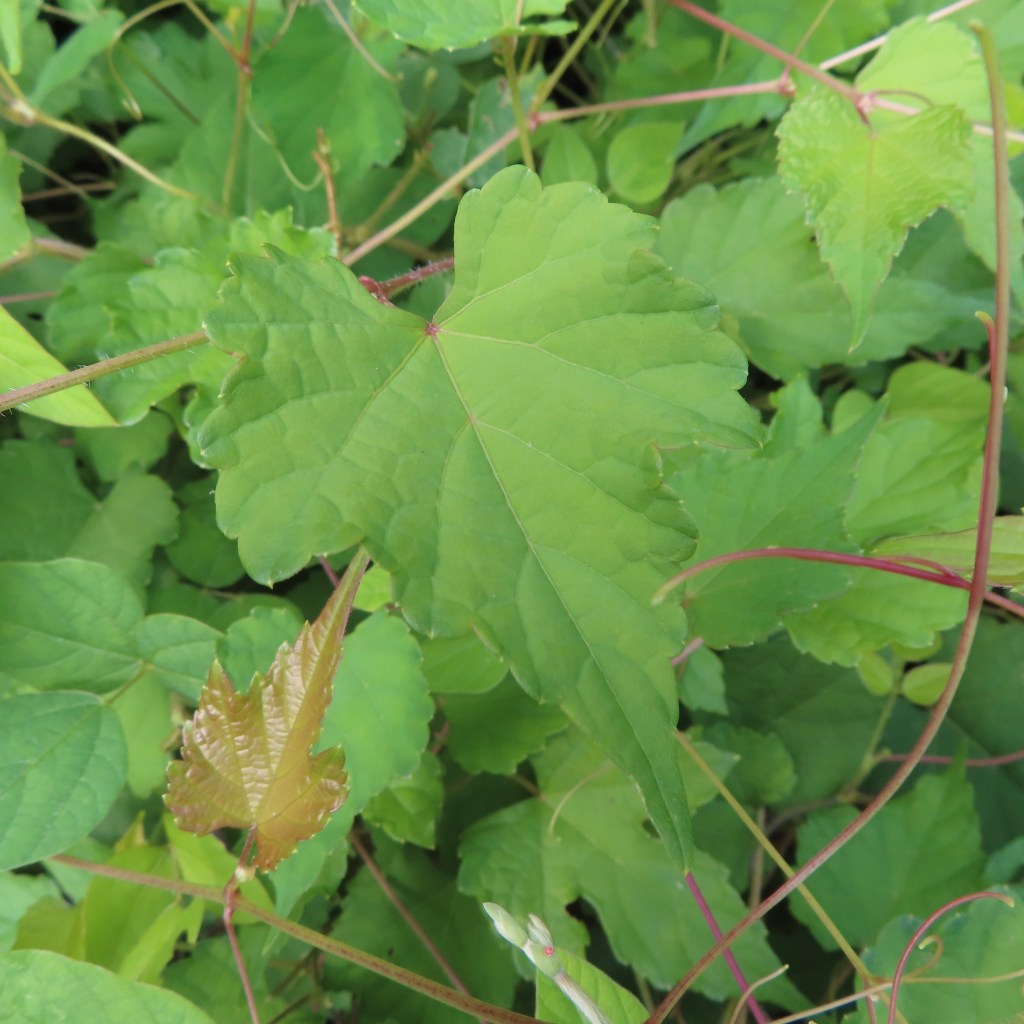
Were it not for the alarming spread of porcelain-berry, it would be perceived as largely benign and even beneficial as are other grape family plants. The porcelain-berry fruit can be safely eaten, providing some nutrition. However, it is not palatable, lacking the sugar content of cultivated grape varietals. In general, the two dozen species of wild grapes in North America, in which there is no reason not to include porcelain-berry, have edible fruits, shoots, and leaves. The average nutritional profile for 100 grams (~1/4 pound) of wild grape family fruits is 70 calories with several important minerals like potassium, calcium, phosphorous and iron and vitamins A and C in addition to the metabolically important B vitamins. [10] Similarly, wild grapes have a broad range of medicinal properties. Native Americans used grape leaves made into a tea to treat stomachache and diarrhea and poulticed leaves were applied to treat rheumatism and headache. More recently, grape seed extracts have been shown to be effective in treating circulatory problems like varicose veins. [11] On the whole, it is reasonable to conclude that porcelain-berry is potentially a useful invasive.
References:
1. Young, J. National Research Council, Washington DC, “Fact Sheet, Porcelain-berry” National Park Service Plant Conservation Alliance Alian Plant Working Group, 20 May 2005, http://www.nps.gov/plants/alien
2. Zhiduan C. and Jun W. “Ampelopsis glandulosa (Wallich) Momiyama, Bull. Univ. Mus. Univ. Tokyo. 2: 78. 1971″, Flora of China online, vol. 12 p. 178-179.
3. Plants for a Future (PFAF) Charitable Database. “Porcelain Berry” https://pfaf.org/user/Plant.aspx?LatinName=Ampelopsis+brevipedunculata
4. Hiker’s Notebook. “Autumn Leaf Color” at https://hikersnotebook.blog/2020/10/26/autumn-leaf-colors/
5. Nafici, S. “Weed of the Month, Porcelain Berry” Brooklyn Botanical Garden https://www.bbg.org/article/weed_of_the_month_porcelain_berry
6. Pollan, M. The Botany of Desire, Random House, New York, 2001 pp. xiii-xxv.
7. Kling, A. “Invasions in your Woodland – Porcelain-berry” University of Maryland Extension. https://extension.umd.edu/resource/invasives-your-woodland-porcelain-berry-updated-2025/
8. Dingwell, S. “Unwanted and Unloved – Porcelain-berry” Virginia Native Plant Society. 12 August 2014.
9. McGovern, P. Ancient Wine, Princeton University Press, Princeton, New Jersey, 2003 pp 1-63.
10. Angier, B. Edible Wild Plants, Stackpole Books, Mechanicsburg, Pennsylvania, 2008, p. 80
11. Foster, S. and Duke, J., Medicinal Plants and Herbs, Houghton Mifflin Company, Boston, Massachusetts, 2000, p 338.
 Hiker's Notebook
Absolutely fascinating, as usual. Thanks, William!
Barbara Southworth
LikeLike