

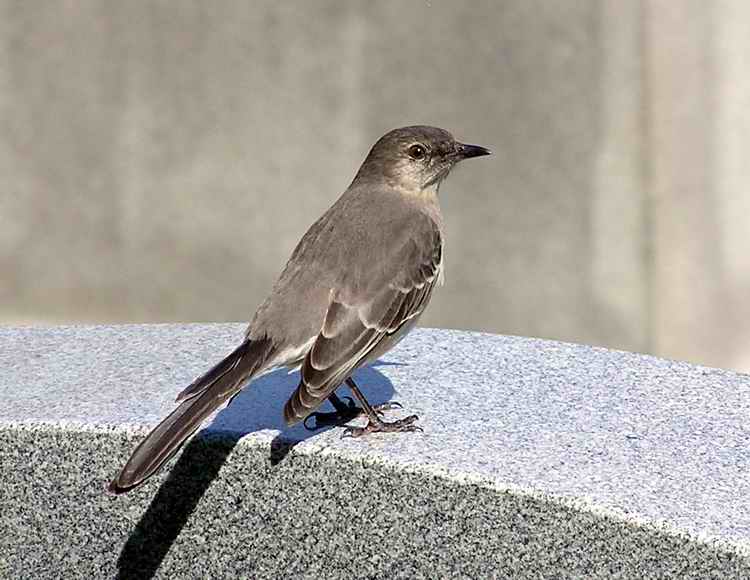
Common Name: Mockingbird, Northern mockingbird – The name mockingbird emphasizes an ability to repeat numerous sounds, especially those of other birds. The name is unintentionally pejorative as the word mock is from the French moquer with a connotation of making fun of usually in a derisive way. A better choice would be mimic-bird, but common is not necessarily sensical.
Scientific Name: Mimus polyglottos – The generic name is from Greek as mimos via Latin as mimus which both mean to imitate. The species name is also taken from Greek as the word for speaking many languages. [1] Taken together as “mime of many tongues,” it is one of the most apropos of all scientific names, surpassing the common name in relevance.
Potpourri: The mockingbird is one of the more successful species of the avian diaspora that followed the extinction of all of the other dinosaurs, including many birds. Its most notable characteristic is an extensive repertoire of up to 200 different songs learned and expressed over the life of a male mockingbird (females sing less). Not infrequently, the songs are mimics not only of other birds, but also of random notes from natural sources. As a relatively drab bird feathered in many shades of gray, it is unobtrusive and easy to overlook. In spite of this, it is one of the three birds that dominate the state birds lists, almost all in the Southeast from Texas to Florida. This is no doubt due to its mastery of birdsong that is broadcast through the air to the ears of its ardent admirers.
Mockingbirds are members of the order Passeriformes commonly known as perching birds in that they have feet with three toes forward and one toe backward to facilitate grasping tree branches firmly and securely. Passeriformes comprise the largest order of the Class Aves and are frequently referred to as songbirds, even though songbird is technically a suborder. Over fifty percent of all bird species are passerines. Like most perching songbirds, mockingbirds are mostly monogamous, building nests in trees with a clutch of 2 to 4 eggs laid two or more times a year, and caring for fledglings from feeding to flight training. Mockingbirds stand out from their many cohorts in three general characteristic behaviors: The frequency and variety of birdsong, periodic extension of the wings to reveal white feathers called wing flashing, and aggression toward animals, other birds, and even humans. [2]
Mockingbirds, catbirds, and thrashers constitute the Mimidae Family, which, as its name indicates, are conjoined by superior singing skills. Its constituents include 11 genera with about 34 species worldwide; four genera and ten species perch and nest in North America. There is significant variation in the quality and quantity of song among the different species, from the catbird’s singular meow of its namesake to the complex intonations of the mockingbird. The brown thrasher is considered by most ornithologists to the apex chanteur. The mockingbird, however, is only marginally less gifted and earns plaudits from the general public due in large part to its ubiquity in the suburban habitats to which is has become well adapted. Both mated and unmated (looking for a mate) male and female mockingbirds sing with remarkable diversity that includes not only mimicking the songs or other birds but also a variety of random noises like a creaky wheelbarrow or whistling humans. While estimates vary considerably among different sources, the general consensus about 100 totally different songs with estimates ranging to over 200 at the top of the range. [3]
Why mockingbirds perform multi-song serenades is subordinate to the larger question of why birds sing at all. There are a number of plausible explanations, including signaling to a mate, looking for a mate, threatening an intruder, warning of a threat from an intruder, and that they simply enjoy making different sounds. There is no shortage of theories with limited factual data based on observation. Most if not all birds make a noise of some sort from the croaking of ravens to the honking of geese that are probably for signaling among the members of the flock and not much else. Songbirds go beyond monotone to multitone melodies sometimes syncopated with trills, warbles, and whistles. From the physiological perspective, songbirds symphonize because they can, having a unique “voice box” called a syrinx which has two sides that can be independently controlled to produce two different tones at the same time. This must have been an evolutionary adaptation that could only have been retained and refined as it related to enhanced survival and procreation, suggesting mate selection as its provenance.
Most birds are monogamous for a good reason. Two birds are necessary so that one can sit on the nest eggs while the other forages for food, both of which are required for up to two weeks until altricial chicks reach maturity. Mate choice is the general term for the sexual selection across the animal kingdom that can be defined as “any pattern of behavior shown by members of one sex, that leads to their being more likely to mate with certain members of the opposite sex than with others” [4] The degree to which this governs animal behavior is evident in the rituals of adolescent humans. While it is not possible to know with certainty what a female bird is looking for, there are some certainties. For bird species like mockingbirds with both sexes identically plumed, selection must be based on audible and/or behavioral factors as appearance like that of the sexually dimorphic cardinals is lacking. Field observations of singing mockingbirds have revealed that unmated male mockingbirds sing and move around more than mated males, suggesting that both activities play a role in seeking sexual union. [5]
Since mockingbirds are creative composers using mimicry as source material, the enumeration of their various songs is neither straightforward nor really possible. This has not stopped those enthralled with bird watching from making the attempt. As an example, one observer spent ten years mastering the different calls of 35 mockingbirds and noted a “repertory of imitations of thirty to thirty-five species which includes about 50 different imitations since several songs of some species are noted.” He reached the surprising conclusion that most of the different songs were inherited from “many generations back” while only a few were added by listening to the local environment. [6] Given the variability and geographic dispersion of mockingbirds, it would be improbable that one could conclude that there is a singular characteristic mockingbird song. It is reported that some mockingbirds have a separate repertoire for the spring season and a second set for fall. [7] Given the high level of mimicry, it also calls into question how birders seeking high count numbers can ever reliably establish speciation without visual sighting. But that in no way diminishes the pleasure of serenely walking through the woods enjoying the serenade of a mockingbird. As expressed by Longfellow’s poem Mocking-Bird [8]:
Then from a neighboring thicket the mocking-bird, wildest of singers,
Swinging aloft on a willow spray that hung o’er the water,
Shook from his little throat such floods of delirious music,
That the whole air and the woods and the waves seemed silent to listen.
Wing flashing is an equally confusing behavioral characteristic that has confounded conclusive categorization. It consists of a rapid opening and closing of the wings and tail feathers simultaneously to create a series of white flashes contrasting brightly with the drab, gray plumage. Mockingbirds have been observed conducting a series of wing flashes over a field of open grass and then swooping down to administer the coup de grâce as the insects emerge from hiding. [9] However, the technique is not generally very successful. As a second caveat, rapid wing gestures are conducted by other members of the Mimidae Family that do not have contrasting white feathers. The use of wing flash has also been observed as a means to surprise and chase away intruders in the establishment and defense of territory, to fend off predators, and, tellingly, by males to court females. [10] The latter cause is likely its provenance, for if female mockingbirds prefer males that flash, the trait, whatever its genetic source, would be passed on to progeny and preserved as an inherited penchant..
Mockingbirds are aggressive by avian standards. It is likely that their inherent pugnacity led them to habituate suburban habitats where frequent contact with humans and their artifacts is inevitable. One experiment evaluating mockingbird-human interaction consisted of individuals repeatedly posing a threat by closely approaching the nests of 24 different mockingbirds. After the second approach, the mockingbirds recognized the intruder and launched increasingly aggressive assaults to attempt to drive them away. [11] Another manifestation of mockingbird aggression is known as “shadow boxing,” in which it attacks its own image, typically as reflected from glass or from a car mirror. The response, which can last for several seconds, involves repeated thrusts accompanied by wing flashes. [12] This is a self-evident manifestation of evolutionary behavior that enhances survival by driving off predators while stopping short of a self-destructive kamikaze attack. The origin story of birds supports the general notion that they are highly evolved survivors.
While it has long been hypothesized that birds were related to dinosaurs, one group of which was even called bird-hipped, conclusive proof was lacking. The recent discovery of fully feathered fossil bird-dinosaurs carbon-dated to 150 million years ago established bird-dinosaurs as actual and therefore factual. The end-Cretaceous extinction 66 million years ago was caused by a meteoric impact with a force of about one million atomic bombs near the Chicxulub Pueblo on Mexico’s Yucatan Peninsula that blocked the sun for weeks and led to years of winter. The dinosaurs perished due to lack of food, including those flying dinosaurs equipped with teeth. Birds with seed-cracking beaks survived on the long-lasting seed repositories of plant DNA that eventually also restored some of the land plants. A period of explosive evolution followed, as birds and mammals filled the now vacant habitats of the “terrible lizards,” resulting ultimately but not inevitably in Homo sapiens and Mimos polyglottos. [13]
The avian clade lost the gene responsible for the sweetness receptor in its dinosaur evolutionary past, during which flowers and fruits played an insignificant role in plant reproduction. Recent genomic research revealed that passerine or songbirds evolved a sweet receptor as a random mutation of the umami or protein receptor during their rapid expansion during the current Cenozoic Era. [14] Mockingbirds, like most songbirds, rely on fruits, mostly berries, for sustenance through the winter. They are also accused of plundering farmers’ fields, particularly tomatoes in Texas, and grapes in Florida. [15] This is likely because of they are frequently seen in the vicinity and wrongfully accused. A detailed study, in which 417 mockingbirds were dissected, revealed their stomach contents was 47.81 percent animal and 52.19 percent vegetable. The vegetable material was almost entirely wild berries, including pokeberry, elderberry, and mulberry. [16] It is, therefore, still a sin To Kill a Mockingbird.
References:
1. Webster’s Third New International Dictionary H. Benton Publisher, Merriam Webster Company, Chicago, 1971
2 Adlerfer, J. ed National Geographic Compete Birds of North America, National Geographic, Washington,” DC. pp 495-502.
3. Farnsworth, G. et al. “Northern Mockingbird (Mimus polyglottos), version 1.0”. Birds of the World. Cornell University. 4 March 2020
4. Rosenthal, G. Mate Choice, Princeton University Press, Princeton, New Jersey, 2017, p 10.
5. . Lewin, R. “Mockingbird song aimed at mates, not rivals” Science, Research News, 19 June 1987 Volume 236. Issue 4808.
6. Laskey, A. “A Mockingbird Acquires His Song Repertory,” The Auk: 1944 Volume. 61: Issue 2, Article 3. In Digital Commons, University of South Florida, September 2024
7. “Northern Mockingbird Life History, All About Birds, Cornell Lab of Ornithology”. https://web.archive.org/web/20121020164934/http://www.allaboutbirds.org/guide/Northern_Mockingbird/lifehistory
8. https://discoverpoetry.com/poems/mockingbird-poems/#google_vignette
9. . Fairfield, G. and Fairfield J. “Wing Flashing Behavior in a Northern Mockingbird” Ontario Birds, December 1997. Volume 15 Number 3.
10. . Peltier S. et al . “Wing-flashing in Northern mockingbirds while foraging and in response to a predator model”. Northeastern Naturalist 2019
11. Levey, D. et al . (2009-06-02). “Urban mockingbirds quickly learn to identify individual humans”. Proceedings of the National Academy of Sciences. 2 June 2009 Volume 106 Number 22 pp: 8959–8962.
12. Callaghan, C. “Shadow-boxing’ by a Northern Mockingbird (Mimus polyglottos),” Florida Field Naturalist: 2017 Volume 45 : Issue 1 , Article 4.
13. Brusatte, S. “Bird Evolution” Scientific American, May 2026 pp 46-51.
14. Barker, F. “A Shift in Taste” Science, Volume 373 Issue 6551m 9 July 2921 pp 154-155
15. Holdsworth, G. “Protecting Your Tomatoes From Mockingbirds”. Vegetable Gardener. 30 May 2013.
16. Beal, F. et al. “Common birds of southeastern United States in relation to agriculture.” U.S. Department of Agriculture (USDA) Farmer’s Bulletin 755, 1916, p. 9. available at https://www.biodiversitylibrary.org/page/56848073#page/13/mode/1up

