Tiger Beetle

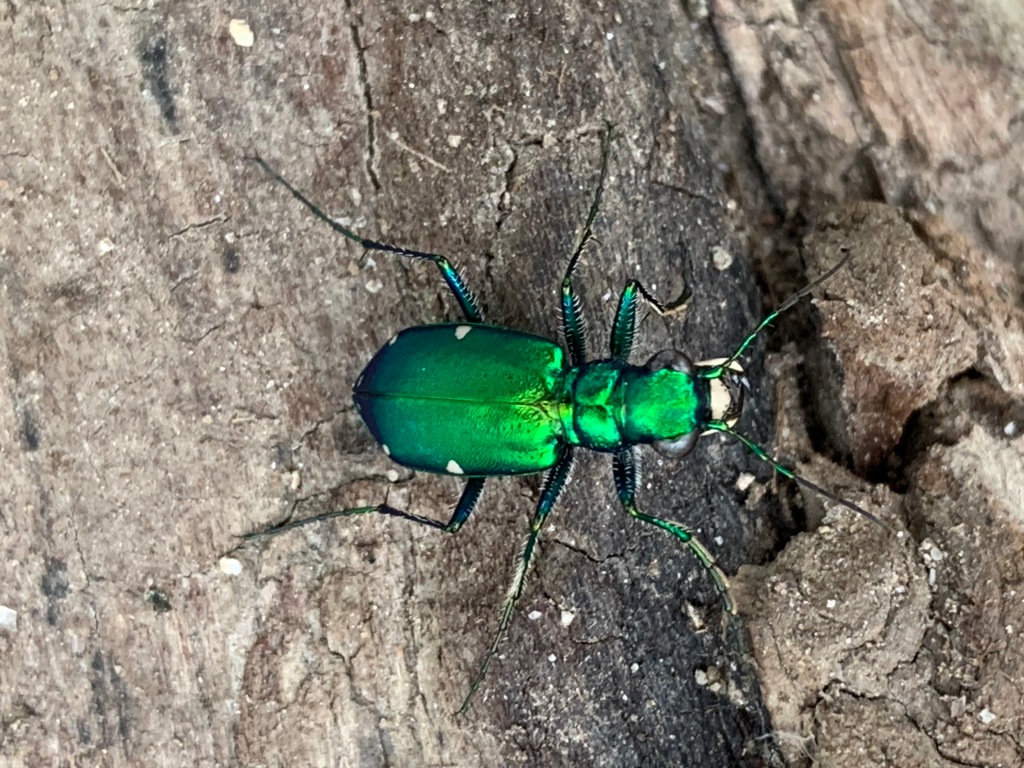
The Tiger Beetle is easy to spot as it sprints across the field of view, a metallic green flash.

Common Name: Six-Spotted Green Tiger Beetle – It is evident on inspection that the tiger analogue  has nothing to do with physical appearance. The yellow and black stripes of the tiger are only one of its signature characteristics … the other is consummate predator. Tiger beetles are similarly noted for their ability to chase down prey with tiger-like ferocity on a smaller scale. The tiger beetle of eastern North America is bright green with as many as six white spots around the periphery of the carapace, though the number can vary and some lack spots altogether.

Scientific Name: Cincindela sexguttata – The iridescent metallic shine of the carapace is captured in the genus name, as Cincindela means “glow-worm” in Latin. Guttae means spots or marks on animals, so the species name meaning “six little spots” is a direct translation, as sex is six linguistically.

Potpourri: The order Coleoptera is the largest in the animal kingdom; one of every three insects  is a beetle. There are over 300,000 species worldwide with one tenth of that number in North America, including the ladybugs that eat aphids, the American carrion beetles that consume carcasses, and the tumble bug that buries dung balls for use as larval food. Beetles comprise a menagerie in form, fit, and function that has filled every niche possible in the tangled web of life, the original Beatlemania.  Their most notable trait is the dorsal covers called elytra that provide armored protection to the wings, encasing the delicate, diaphanous membranes to avert tearing damage. The robust aerial mobility thus sustained adds to a substantive set of survival traits. Completely metamorphosing through egg, larva and pupal stages to adult, beetles are mostly predacious, eating whatever they can find. [1] Coleopterans are ancient, dating from the end of the Permian about 300 million years ago with the emergence of gymnosperm plants that were likely their original niche habitat ― the pine bark beetles decimating the western North American conifer forests are among their successful successors. [2] The robustness of the beetle form and function is evident in their persistence across eons of time. An analysis of over 5,000 beetle fossils from 200 sites revealed that there have been 214 different families since their first appearance and that 179 are still in existence … some of the original families have persisted throughout. [3] Tiger beetle fossils date from only the Cretaceous, about 140 million years ago, and are, as such, one of the more recent types; there are now 2300 species globally. [4] Beetles are one of nature’s more “intelligent” designs.

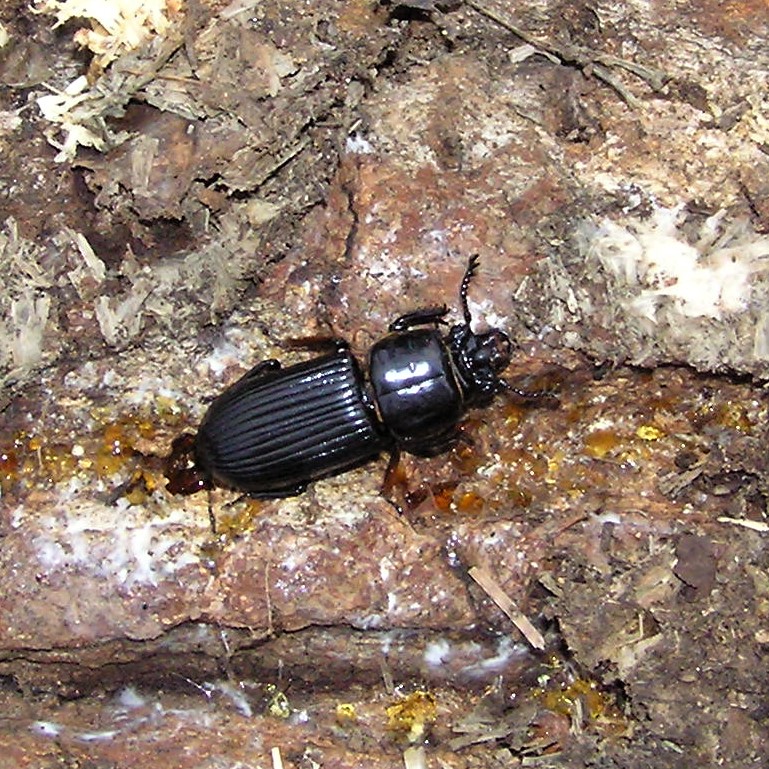
Tiger beetles are sometimes considered a subfamily of Carabidae, the ground beetles. They are both in the suborder Adephaga, which means “voracious” in Greek, a nomenclature accounting for their status as apex predators of leaf litter and rotting wood. The distinction between ground and tiger beetles is a matter of habitat and behavior. Ground beetles are primarily nocturnal hunters, spending their daylight hours hidden under rocks or burrowed into logs where they are frequently found in scurrying hordes. They are mostly dark brown or black as a matter of crypsis, blending into the dark colors of forest detritus. It is hypothesized that the wing covers or elytra that characterize the beetles evolved as a protective measure for living under bark. This is supported by the relative simplicity of the carabids with flat, oval bodies having a smooth surface and moderately long antennae and appendages, suggesting that they were among the earliest beetle forms.

Ground beetles are cryptically dark

The tiger beetle is the yang to the ground beetle yin, barreling across the trail in broad daylight with a Times Square neon flash. Their most noteworthy characteristic is speed which is important both in pursuit of prey and in escape from predation. The standard stratagem is standing stock still at a location affording some visibility of an open area, like a trail. The sight of a moving object that could be food instigates a Gadarene sprint to intercept and attack. Likewise, a looming shadow, such as that cast by a passing hiker, triggers the same frenetic response, only this time to escape in the leaf litter. They are frequently seen bolting across the trail to the nearest hiding place, the bright green streak is hard to miss. Just as the ground beetles live in drab-colored obscurity, the tiger beetles scintillate with a metallic sheen. The effect is similar to a liquid crystal in reflecting polarized, aligned light when subjected to unpolarized, random light of the  sun’s rays. This is achieved with a complex layering of the exoskeleton with alternating five, six, or seven sided cells that could hardly be random.[5] But what is the purpose of green and flashy? Bright colors are easier for predators to spot just as they are easier for intended prey to avoid. Evolution would not favor a mutation that made hunting (and nutrition)  more difficult nor one where being eaten becomes more likely.  The bright color trait has been retained through evolutionary generation, however, so it must promote survival rather than hinder it regardless of how illogical that seems.  It likely has something to do with species identification for mate selection, as there are literally thousands of beetles to choose from.

Two aspects of the bounding beetle are immediately apparent: high speed and abrupt stops. The hinged joints for which the arthropods are named are epitomized in the six long legs of tiger beetles. They can move at over half a meter per second, which is about one mile per hour. While this does not approach absolute world record time, relativity is relevant. The body length of a tiger beetle is about ten millimeters which means that it is moving at the rate of fifty body lengths per second ― this would equate if scaled up  to ten times the speed of a world class human sprinter. The fastest known tiger beetle is Cincindela hudsoni which is indigenous to Australia … it can move at 2.5 meters per second, outrunning a similar sized cheetah. The alternating stop-and-go staccato foot race is also a result of high speed. The tiger beetle is literally going too fast to maintain an adequate visual input for sensory continuity and must therefore stop to reconnoiter from time to time, mostly to vector toward its intended unwitting prey. [6] There is an obvious problem with this scenario. If it can’t see, how does it avoid obstacles that must surely lie along a random path? Like sight-impaired people negotiating movement with the help of a white probe, tiger beetles hold their antennae rigidly just off the ground as mechanical sensors. Experimentally, it has been demonstrated that blinded tiger beetles can avoid a barrier placed in their path but that those with shortened antennae run headlong into it. [7]    

From the perspective of arthropods, beetles lead a full life that usually starts with sex. The male reproductive organ known as the aedeagus (from Greek ta aidoia meaning “the genitals”), is inserted into the bursa copulatrix (something like copulating purse) of the female who stores the sperm in the saclike spermatheca until the time is right. With all of the indistinguishable beetles scurrying about in the duff, how is it that a male of one species successfully mates with a female of the same species? This same conundrum faced the French entomologist René Jeannel  in his study of the thousands of nearly identical cave beetles in the Mediterranean Basin. After a lifetime of spelunking and dissecting, he revealed one of nature’s strange but true secrets: the shape of the aedeagus was different for each separate species of cave beetle, an observation he revealed in his 1955 memoir L’édéage (which is the French spelling). Since then, field research has revealed that this is the rule and not the exception concerning animal procreative anatomy. In some cases, such as the 35 species of North American bumblebee, this is the only reliable taxonomy tool. There is some speculation as to why this is so. The obvious “lock-and-key” theory that comes readily to mind when considering accesses of his kind may not be correct. A more nuanced sexual stimulation purpose is gaining ground … that the joy of sex extends to the lower branches of the tree of life, and even into ground around it. [8]

Assuming that a male beetle finds a like-minded mate, which we now know is constrained by other factors of which venery (sexual indulgence) may be involved, the female lays eggs on or near a food supply and they hatch into larvae. Tiger beetle larvae learn the other form of venery (hunting) early in life. It is a pity that a word as rich in meaning as venery has become archaic, which is only the case due to lack of use … a good reason to use it. Insect larvae are for the most part pulpy and worm-like with no defense save toxicity against predators. Feeding mostly on vegetation, they can lay waste to an entire crop in their relentless, rapid, and continuous growth, pausing only  for pupation to the adult stage. Tiger beetle larvae are bushwhacking carnivores, a harbinger of the adult predators that they will become. Bare sand or open ground habitat is chosen by adult females as an egg repository to suit the larval smorgasbord consisting mostly of ants and small flies. After digging a burrow with their large jaws, the larvae back into the hole and anchor themselves with rigid hooks, their considerable maw now positioned in the ambush mode. The passage of a hapless wayfarer triggers the lunging larval jaw at the end of its anchored body that clamps down in less than an eye blink’s time (much less actually, as an eye blink takes a tenth of a second and the larva takes a hundredth). A successful strike yields a protein meal, which is masticated to the liquid state with regurgitated digestive fluids. The insect juice is then consumed, the larger chunks filtered by hairs called setae on the labium/lip, a spider-like cuisine retained in adulthood. [9] Life in the soil is nasty, brutish, and short, just like war-torn human society as Thomas Hobbes observed in Leviathan.

 Tiger beetles and their closely related (and sometimes conflated) carabid cousin ground beetles are benign from the anthropocentric perspective, other animals like  other insects probably deem them less likable. They are generally significant vectors for pest control (a “pest” being defined by humans as any animal that eats anything agriculturally grown) particularly against the sap-sucking aphids that can devastate cereal crops and sugar beets, and even their fellow (not so benign) coleopterans like weevils. Field studies aimed at improving biological controls as substitutes for sometimes harmful chemical pesticides have found that agricultural practices like deep plowing are inimical to carabid/tiger populations [10].  Given the great diversity of the carabids ― there are 40 thousand species world-wide and two thousand in North America, there remains much that is unknown concerning their feeding habits. In laboratory testing on those species that have been subject to investigation, they will eat almost anything proffered, including slugs and moth caterpillars. It is generally agreed that the presence of a significant population of “good” beetles can reduce crop damage by up to 40 percent. There are at least a number of notable species that eat weed seeds, suggesting a possible alternative to herbicides, the most expensive component of pest control at $27 billion annually. [11] So the next time you are hiking and see a flash of green, pick your next step carefully as a tiger may await. And the next time you turn over a log and surprise a beetle congregation, put it back, they may be saying grace.

References:

1. Milne, L. and M. National Audubon Society Field Guide to North American Insects and Spiders, Alfred A. Knopf, New York, 1980, pp 533-540.

2. Gressitt, J. “Coleoptera” Encyclopedia Britannica, Macropedia, William Benton, University of Chicago, 1974, Volume 4, pp 828-837.

3. Perkins, S. “Beetles almost never go extinct” Science, 17 March 2015.

4. https://www.semanticscholar.org/paper/A-comprehensive-molecular-phylogeny-of-tiger-Gough-Duran/e0133c024b8218c934b7b90f8117fec5a40fd8dc

5. “Bright Shiny Beetles” Science, 24 July 2009, Volume 325, Issue 5939 p 366

6. https://news.cornell.edu/stories/1998/01/tiger-beetles-go-blind-chasing-prey-high-speeds 

7. https://www.sciencedaily.com/releases/2014/02/140211113704.htm

8. Schilthuizen, M. Nature’s Nether Regions, Viking Penguin, New York, 2014, pp 28-64.

9. Marshall, S. Insects, Their Natural History and Diversity, Firefly Books, Buffalo, New York, 2006, pp 258-261.

10. Kromp B.  (1999). “Carabid beetles in sustainable agriculture: a review on pest control efficacy, cultivation aspects and enhancement” Agriculture, Ecosystems and Environment. June 1999 Volume 74 Issues 1–3 pp 187–228.

11. https://extension.psu.edu/ground-and-tiger-beetles-coleoptera-carabidae#:~:text=%20Ground%20and%20Tiger%20Beetles%20%28Coleoptera%3A%20Carabidae%29%20,a%20major%20role%20in%20agroecosystems%20by…%20More%20

Autumn Leaf Colors

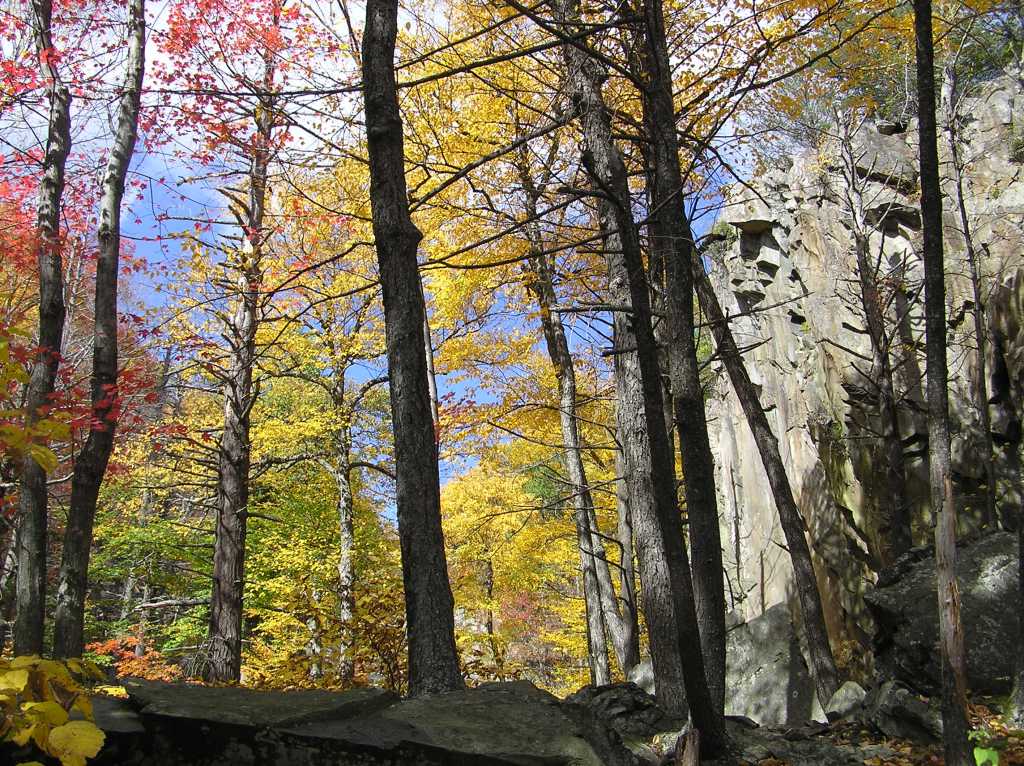
The White Oak Canyon Trail in Shenandoah National Park with red maple and white oak trees bounded by the basaltic rocks of the Catoctin formation a vestige of ancient lava flows.

The color of falling fall leaves is one of the most dramatic acts of nature. Sugar maples are spectacular, turning reddish-orange and complementing the monochromatic vibrancy of the aptly named red maple, which was Thoreau’s favorite tree. In his essay “Autumnal tints” he remarks that ” By the twenty-fifth of September, the red maples generally are beginning to be ripe…. conspicuous with all the virtue and beauty of a maple – Acer rubrum. We may now read its title, or rubric, clear. Its virtues, not its sins, are as scarlet…. The whole tree thus ripening in advance of its fellows attains a singular preëminence, and sometimes maintains it for a week or two. I am thrilled at the sight of it, bearing aloft its scarlet standard for the regiment of green-clad foresters around, and I go half a mile out of my way to examine it. A single tree becomes thus the crowning beauty of some meadowy vale, and the expression of the whole surrounding forest is at once more spirited for it” and, with perhaps a touch of sarcasm “I do not see what the Puritans did at this season when the maples blaze out in scarlet. They certainly could not have worshipped in groves then. Perhaps that is why they built meeting-houses and fenced them round with horse-sheds for.” [1] It is hard to be dour in the kaleidoscope of autumn leaves.

The dark red oaks and crimson tupelos also stand out against the prevalent  yellows of the hickories and tulip poplars that turn golden as if touched by Midas. Had there been maple trees in the Levant, the biblical rainbow covenant against another flood may well have been the painted forest. This would follow the anthropocentric view that prevailed through most of recorded history – that the reds and yellows were created to alert mankind to the onset of winter with the promise of spring’s return. But that is surely not the case. All things in nature have a reason. So why do leaves change their colors in the fall? And, specifically, why red? The fundamental mechanisms attributed in lore to the palette of Jack Frost are established botanical principles. Leaves change color in the fall because the plant senses the colder temperatures and shuts down the production of chlorophyll. When greenness abates, other colors of the leaf are revealed depending on what pigments are present for that particular plant.  The yellow and orange colors come from carotenoid compounds (carotene and xanthophyll) and the red color from a flavonoid pigment called anthocyanin.  Ultimately, they all turn brown due to tannin, and most of them fall off as leaf litter; some trees like white oaks and beeches retain their withered leaves all winter, a phenomenon called marcesence. [2]

The importance of photosynthesis that occurs within plant cells in bodies called chloroplasts cannot be overstated, as almost all living things depend on it directly or indirectly. The reaction of carbon dioxide and water that produces sugars and oxygen using the photon energy of the sun is the essential elixir of life. In chemical terms:

               6CO2  + 6 H2O + 672 kilocalories  =>  C6H12O6 (glucose) + 6O2

The chlorophyll molecules (C55H70O5N4Mg) in the chloroplasts absorb the energy of light extending from the longer wavelength infrared through the visible spectrum to the shorter wavelength ultraviolet and execute the reaction in a complex series of steps in two separate operations called photosynthesis I and II. The process is not very efficient, converting only about 3 percent of the absorbed energy into chemical energy, but that is enough for rain forests and buffalo herds. An interesting and revealing feature of the photosynthetic processes is that the atmosphere’s supply of  oxygen for animal respiration comes from the water that chlorophyll electrolyzes to use the energetic electrons of hydrogen and not from the carbon dioxide that it consumes in equal measure. Another interesting point about chlorophyll is that magnesium and four nitrogen atoms framework molecular structure to which all of the other elements bond ― and why these two elements are so critical to plants. Chlorophyll absorbs light primarily at the red and violet/blue ends of the spectrum and not in the middle green wavelengths which is the reflected color we observe. Chlorophyll makes up about 20 percent of the volume of a leaf cell.

The other relevant components of the plant cell are the chromoplasts, which contain some of the yellow and orange carotenoids, and the vacuoles, which contain anthocyanin. The function of the carotenoids is not well established … they are not directly involved in photosynthesis. However, they are there for a reason, which is thought to involve protecting chlorophyll from excessively bright sunlight and indirectly supporting photosynthesis. One irrefutable fact is that they look yellow because they absorb the other wavelengths of the visible spectrum. Vacuoles are essentially  cell cisterns. Plant cells start off completely filled with protoplasm containing the nucleus, chloroplasts and other organelles. As plant cells mature, vacuole chambers form that are essentially repositories for any substances created by the cell not necessary or desirable in the cytoplasm ― they can also function as support or growth expansion reservoirs. They are similarly used by fungi and animals to a lesser extent than plants. The generic name for the material occupying plant vacuoles is cell sap. The PH of the sap determines whether the anthocyanin molecules that they contain are red or blue according to relative acidity. [3]

A more scientific explanation of autumnal leaf senescence is a bit more complicated.  Deciduous trees (those that lose leaves … evergreens are ever green) have a layer of cells at the base of each leaf called the abscission. Seasonal temperature fluctuations eventually reach a sensory limit based on tree type and habitat  signaling the abscission cells grow a cork-like membrane to interrupt the flow of nutrients to the leaf. The seasonal variations of environmental influence on biological function is called phenology, the scientific field that governs the degree and timing of fall colors. The leaf, now bereft of any nutrition, begins to die. The first thing to go is the chlorophyll, as it requires a robust nutrient flow to maintain the photosynthetic factory, which is officially closed for the season. So much for the verdant hues of summer. The yellow carotenes and xanthrophylls are large molecules sharing space in the chloroplasts with the now defunct chlorophyll, and also populating the separate chromoplasts. They are more stable than chlorophyll since they are not directly involved in photosynthesis so they persist, resulting in the crown of yellow leaves that invite the sun’s brilliance to the dark of the woods. The red of anthocyanin is another matter. It is not a permanent leaf chemical constituent but must be manufactured by the plant, a matter of some complexity and energy expenditure.  The classic explanation for anthocyanin is that it is produced by plants that have high sugar content. When the abscission layer forms in the fall, the sugar is trapped in the leaf and is converted to anthocyanin. Thus, when you have a dry, low H2O summer, little sugar is produced, and the fall colors are subdued.  In point of fact, however, quite the opposite is true, as a hot, parched summer is likely to yield more color.  Research into the phenology of fall foliage over the last several decades   has upended the traditional rationale. Anthocyanin production by different plant species is a complicated phenomenon and not just a matter of sugar.  [4]

Anthocyanin has been studied by scientists for several centuries. Originally called ‘colored cell sap,’ it is formed by the reaction between the sugar produced by the plant and proteins in the sap. It was named by the German botanist Ludwig Marquart in 1835, the Greek anthos meaning flower combined with kyanos meaning blue, it can also be red as is the case with most tree leaves (there are a few trees with bluish leaves or needles – blue spruce for example).  Early research focused on the red and blue anthocyanin coloration of fruits and flowers, as the color was important in attracting seed dispersing and pollinating animals and insects to economically important agricultural products. More recently, the fundamental question as to  why (some) leaves turn red, or, more broadly, why some leaves produce anthocyanin became a matter of serious investigation. There are several theories.   One involves a phenomenon known as photoinhibition.  Under bright light conditions, damage to photosynthetic plant tissues occurs when one part of the two-part photosynthesis (recall chlorophyll and photosynthesis I and II) process is blocked or inhibited. Anthocyanin has the property that it absorbs damaging light wavelengths of photoinhibition which are outside the wavelength range of other leaf chemicals.  Anthocyanin is thus one of several strategies that an individual plant may evolve to limit the damaging effects of photoinhibition and  maintain the tree’s sugar production capacity under adverse light conditions.

Anthocyanin is also an antioxidant.  Intense sunlight results in the production of reactive oxygen species and free radicals (molecules with a negative charge due to having one or more free, unpaired, electrons), which react strongly with cell membranes, proteins, and DNA, the destruction of which can lead to the death of the cell.  This problem is experienced by all living things whose survival is a matter of organic chemistry.  Vitamin C or ascorbic acid and vitamin E are noted antioxidants,  recommended as dietary supplements to reduce their deleterious effects; anthocyanin has four times the antioxidant capacity of these vitamins.  This is the source of the general precept that a glass of red wine (containing the anthocyanin of the grape skin) a day is good for you, the hyperbole of the market economy driven by artificial media-driven consumer demand. Anything with colored cell sap would do just as well, like apples and plums (or apple jack and plum brandy). [5]

Even with the demonstrated protective capacity of anthocyanin to reduce photoinhibition damage and to neutralize free radicals, it is not clear why a tree would produce this rather large molecule (with constituents that might better be invested in food storage for the winter) just before it sheds its leaves.  There are a number of other theories that have been advanced as alternative.  One is that the anthocyanin is a catalyst that allows the plant to reabsorb nutrients such as nitrogen from the leaf before it falls, reinforcing the plant for its eventual emergence from the somnolence of winter in the sap rising spring. A second thesis concerns biological evolution – that the red color either acts to protect the leaf from being eaten by other animals or that it attracts selected animals to eat the leaf for propagation purposes. There is some evidence that there is a correlation between trees that are weakened and leaf color suggesting that anthocyanin may be a remedy against parasites, notably aphids.[6] Or even that aphids recognize a weakened tree by its color and look elsewhere for promising egg-laying sites.[7] Reds and oranges are not infrequently employed by animals as a signal of toxicity (known as aposematism) to ward off predators … red efts and monarch butterflies are good examples.  There is also evidence that some tropical trees have red tips to ward off predators until they mature, at which time the leaves turn green to maximize production.  Conversely, chimpanzees and monkeys in Uganda use the red coloration of leaf tips to locate the tenderest leaves. Berries are red to attract birds.

So, why do leaves turn red?  They turn red because that they contain anthocyanin. Why do leaves produce anthocyanin?  Not yet altogether certain on that account. Empirical evidence favors the so-called sunscreen effect, as brighter colors will always follow a late summer period of intense solar heating. There are some theories about the nature of anthocyanin production, but, if it is so beneficial to a plant, why do only some plants have it?  And why aren’t more leaves red all the time?  The answer is that chance in the form of random mutation propels evolutionary change. The plants that make anthocyanin survived more frequently and had more offspring in the environment where this proved to be a winning stratagem. Others did not. The climate change of the current Anthropocene Epoch is one such environmental forcing function. Increased levels of carbon dioxide are demonstrably good for plants as one of their three baseline requisites (with water and sun). This will likely delay the onset of color change as leaf life is extended. [8] Geographically, cool weather trees like sugar maples will migrate northward, granting Canadians exclusive rights to the maple leaf of their flag. [9]   Plants and animals find their niche through trial and error.  Chance mutations lead each organism down a circuitous path to a survivable place in the ecosystem, to eat and reproduce before being eaten. The big brain of Home sapiens is simply an evolutionary adaptation that worked perhaps too well.  And that is the glory of nature.  Which is why leaves turn red in the autumn … which follows summer as the earth continues on its annual orbit tilted just enough for seasonal variance.

1. Thoreau, H. “Autumnal Tints” The Atlantic Monthly October 1862. Available at https://archive.vcu.edu/english/engweb/transcendentalism/authors/thoreau/autumnal.html

2. Little, E. The Audubon Filed Guide to North American Trees Eastern Region. Knopf, New York, 1996. pp 375-411.

3. Wilson, C. and Loomis, W. Botany, Fourth Edition, Holt, Rhinehart and Winston, New York, 1967, pp 37-110.

4. Kricher, J. and Morrison, G. A Field guide to Eastern Forests of North America, Houghton Mifflin Co. Boston, 1988. Pp 6-36.

5. Lee, D. and Gould, K. “Why Leaves Turn Red,” American Scientist Volume 90, 2002 pp 524-531. A seminal article on international studies to determine what causes plants to make anthocyanin. A publication of Sigma Xi.

6. Archetti, M., “Evidence from the domestication of apple for the maintenance of autumn colours by coevolution”. Proceedings of the  Biological  Sciences, 22 July 2009, Volume 276 Number 1667 pp 2575-2580.

7. Hamilton, W., Brown, S. P. “Autumn tree colours as a handicap signal”. Proceedings of the Royal Society B: Biological Sciences. 22 July 2001, Volume 268 Number 1475 pp  1489–93.

8. Taylor, G. et al “Future atmospheric CO2 leads to delayed autumnal senescence”. Global Change Biology. 29 October 2007, Volume 14 Number 2 pp 264–75.

9. Long, K. “Climate change affects fall foliage” Washington Post, 20 October 2020

Burdock

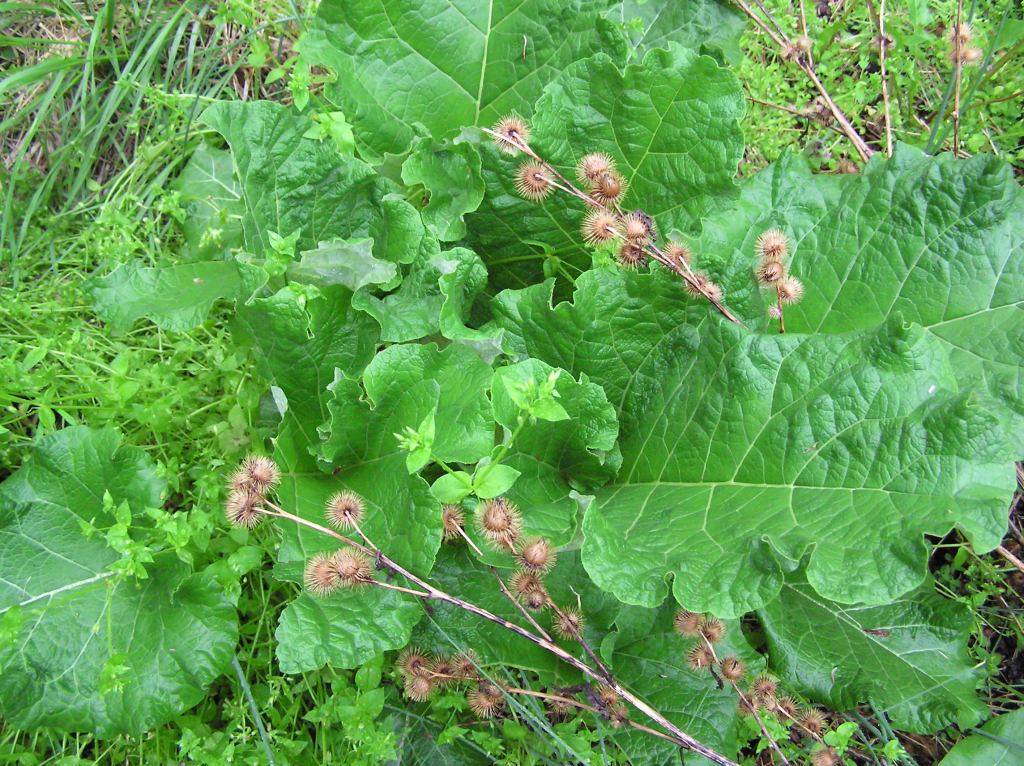
The burrs of burdock are what inspired Velcro, a neologism from the words velour meaning velvet and crochet meaning hook in French

Common Name: Burdock, Beggar’s buttons, Burr seed, Cocklebur, Fox’s clote,  Love leaves, Gobo (Japanese), Bardane (French), Kletterwurzel (German), Niubang (Chinese), Lampazo (Spanish) – Both burr and dock have Old English etymologies referring to anything bristly for the former and anything weedy for the latter. Burdock as a combination of the two is an apt description of a weedy plant with seeds that stick to anything with texture, like hiking pants.

Scientific Name: Arctium minus –  The generic name is from arktos, the Greek word for bear. The north pole is similarly named Arctic for its association with the constellation Big Dipper or Ursa Major, the great bear that marks its direction in celestial navigation. The association of arktos or bear with the burdock plant is probably due to the rough burrs that are its most notable characteristic. The species name minus  means small to distinguish it from the larger A. lappa or great burdock, which can be over nine feet tall. Lappa is burr in Latin so the inference would be “bear burr.”

Potpourri:   The Eurasian linguistic diversity of the names for the  plant called  burdock in the English of its western edge is indicative of the continental extent of its native range. It is equally a measure of the degree to which local populations came up with independent local names according to their own cultures even though their languages may have had a common origin, mostly Indo-European. Even in English, the many folksy descriptions referring to its tenacious seed cases packaged as furry burrs that can only be removed one by one make it clear that people have dealt with this weedy seed-spreader for a long time. A dock is a plant in the genus Rumex of the Buckwheat family along with the many species of smartweed and knotweed in the genus Polygonum that compete for turf along the trail. All are noted for weedy dominance of open areas. We all know what a burr is ―the synonymous bristle is its essence. So what could be worse than a dock with burrs? A bigger burdock.

Burdock is a biennial, producing just large leaves the first year

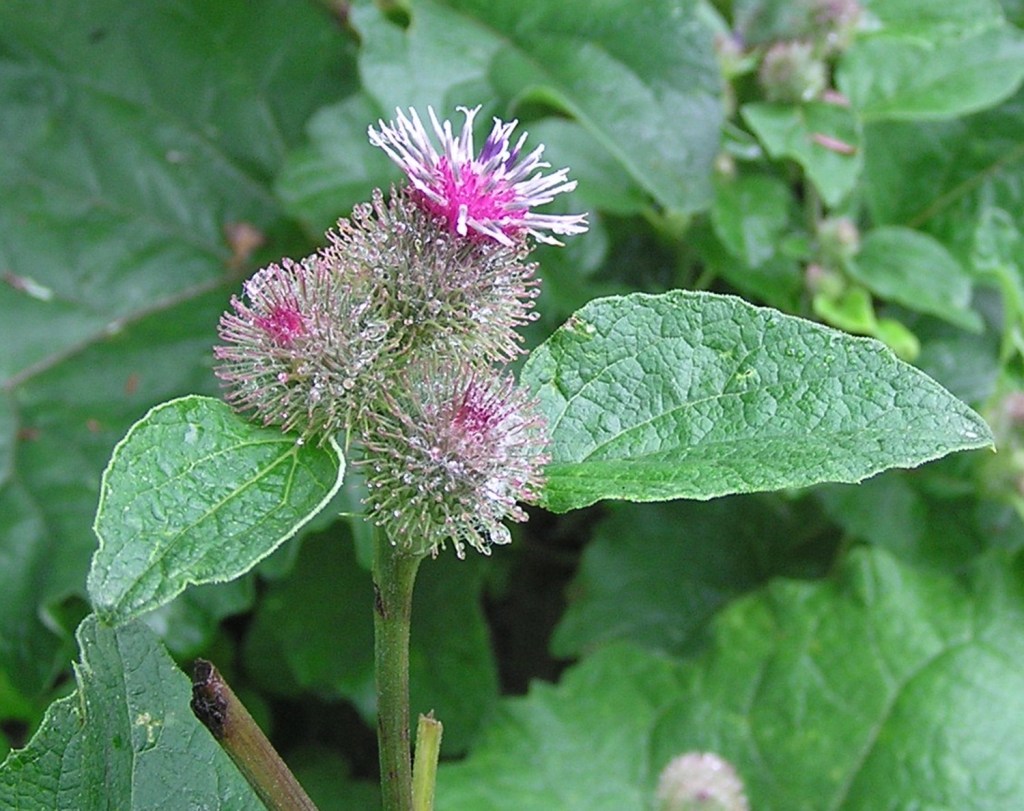
Burdock is a member of Asteraceae, a family that is often called Composite, Sunflower or Daisy. Only the orchid family rivals it for size and diversity, each having thousands of genera and tens of thousands of species. The most notable taxonomic feature is what appears to be an unusually large single flower.  A verisimilitude, the big “flower” is really a composite (hence the name)  of many small, individual florets collocated there. Each floret is a separate functional flower that will produce a seed … the ubiquity of sunflower seeds is exemplary. [1] Burdock is biennial, having a two-year life cycle that starts with the growth of large, lanceolate (lance-shaped) basal leaves that are hard to miss, projecting outward from the base more than a foot in all directions. With a well-established photosynthetic foundation, stalks called peduncles arise in the second year expanding into branched panicles of multiple  inflorescences. The complex supporting structure for each group of florets in a composite flower is called an involucre, and each of the individual bracts (modified leaves) that form its base are called phyllaries. Burdock has many variants, a testimony to its adaptation survival skills. While the composite arrangement  of the floret-flowers of Asteraceae would appear to be a cumbersome compromise, it is among the most successful. The many florets of the community  perch atop a lofty stem to attract pollinators that dwell on the smorgasbord,  fertilizing as they go. The many seeds are ready for the next step, getting to germination. Burdock evolved one of the better ways of doing this. [2]

To fully and literally appreciate the tenacity of evolution’s trial and error test of random mutations to see what works is to take a walk through autumnal woods where burdock is not uncommon (it is weedy after all [3]). A hiker, like any other furry animal that brushes up against the erect spikes festooned with prickly ornaments, will walk away with a few. This is what happened to the Swiss electrical engineer cum inventor George de Mestral while hiking through the woods with his dog in 1941 (some sources say 1948). As he pulled away the burrs one by one, he was surprised by the degree of force required to dislodge them. A microscopic inspection revealed the reason … each burr was covered with tiny hooks that caught in the loops of the dog’s fur or the fabric of his pants. In what may have been the first epiphany that nature’s innovations were relevant in the modern era, he reasoned that this “hook-loop” mechanism could be repurposed as a fastener. Thus began a ten year quest to prove that engineering ain’t easy. Working with a number of skeptical textile companies and cotton, he soon realized that making the loops was readily achieved with standard weaving and sewing technologies ―but that hooks were another matter. After a long stretch of trial and error, he chanced upon using nylon as the hook material that could be fabricated as a loop and then cut at an angle to make two hooks. The nylon had just the right rigidity to hold its shape with enough flexure to permit separation from the enmeshed loops without undue force. In 1955, the patent was awarded for Velcro®, a neologism created by combining velour, the French word for velvet with crochet, meaning hook. For many years, it was an interesting oddity with miniscule market share amid the zippers, snaps, and buttons. And that would have been that had NASA not concluded that Velcro would be the  ideal fastener for astronauts clad in clumsy protective suits. Overnight, Velcro became the rage as the epitome of the Space Age. It has since become the attachment of choice for any application where an object must be held fast but which can be readily and rapidly removed without the need for clumsy digital manipulation. [4] One of Barry Commoner’s four laws of ecology is “Nature knows best.” Burdock exemplifies it.

The composite flowers can produce up to 300,000 seeds from one plant.

Every successful plant becomes so by a sequence of random mutations that impart better ways to survive. This includes at least two fundamental qualities. The first is producing and sowing seeds for the next generation in a place where they can germinate … burdock is a super seeder; one plant can produce over 300,000 seeds The second is not getting eaten by either a large herbivore or by armies of leaf-eating insects.  This usually results in the random mutation and selection of genetic mutants to make  phytochemicals with noxious smells or tastes and/or prickly thorns to keep predators at bay. Burdock is exceptionally endowed with the  chemicals of exclusion. This is evident from field observation ― its large, basal leaves are easily accessible to grazing animals or marauding insects but show no signs of damage. Chemical engineering is a root function, its products conveyed up the stalk to the photon-catching chlorophyl-green of the leaves. Laboratory analysis of burdock root has revealed an abundance of terpenoids, sulfurous acytelenic compounds and five antioxidant caffeoylquinic acid compounds. [5] While the efficacy of the chemicals from the burdock factory for medicinal human treatments may be subject to legitimate scientific inquiry and assessment, there can be no doubt that burdock has been used throughout Eurasia for millennia and by Native Americans ever since their introduction to the Americas. Burdock therefore figures prominently in herbal medicine as near panacea.

The debate between herbalists and certified medical prescribers concerning treatment options for various ailments is one of lore versus science, centuries versus decades, and to some extent spiritual versus practical. Herbalists point to the long-term empirical evidence of successful treatments where scientists require double blind trials and statistics. Herbalists decry the hegemony of pharmaceutical companies and their profitability and medical practitioners complain of quack medicine. Burdock is at the epicenter of this debate in that it has a global usage history with some scientific evidence that it works. Its purported benefits are legion. Made into an herbal tea or  ptisan, it allegedly purifies the blood, increases bile and urine excretion (diuretic) while simultaneously improving digestions and sweating.  Other uses include rheumatism, gonorrhea, liver ailments, and gout. Chinese purveyors of traditional medicine (TCM) use it to treat vertigo, measles, as a wash for skin rashes like eczema, and as an antibacterial and antiseptic agent for sore throats, abscesses, snakebite, flu and constipation. [6] These claims can at times rise to the level of exhortation that are reminiscent of the notorious “snake oil salesmen” of the nineteenth century where the only law was caveat emptor. For example, one text claims that it will heal a damaged liver in less than two weeks. [7] On the medical side, the National Institutes of Health (NIH) acknowledges and delineates the traditional uses including diabetes, bacterial infections, HIV, cancer, and kidney stones with the caveat that “there is currently insufficient human evidence regarding the efficacy of burdock for any indication.”  One specific herbal product provides a good example of the herbal dilemma. NIH states that “burdock is an ingredient in the popular purported cancer remedy, Essiac®,” [8] but a scientific study completed in 2006 concluded that “Essiac does not appear to improve health related quality of life or mood states. Future studies are needed to determine whether other clinical outcomes, such as cancer reoccurrence, are affected by Essiac.” [9] The herbal-science debate is neither new nor finished, and it probably never will be.

In spite of a chemical constituency that would suggest a bitter toxicity with an unpleasant sulfur smell, burdock has an equally storied past as potherb. Traditionally, the roots and young stems were cleaned, trimmed and boiled to improve palatability and cook off some of the more volatile compounds. [10] In Japan, gobo is prepared in this manner as one of the ingredients in sukiyaki.   According to the American botanist Charles Millspaugh, however, “the plant is so rank that man, the jackass, and the caterpillar are the only animals that will eat it.” [11] Among Native Americans, the tribes of the Iroquois confederacy consumed burdock as a dietary mainstay, even drying the roots for winter storage to be used in cold weather soups. In the spring and summer, the young leaves were cooked and seasoned. [12] As a testimony to the invasive nature of burdock, even the Hawaiians were among its consumers, believing that the roots had aphrodisiac and body strengthening  properties, giving bundles of roots to newly betrothed couples as a wedding send-off. There may be something to this. A recent scientific study was conducted in which four groups of ten laboratory mice (forty total) were given different amounts of burdock by gavage, the polite but euphemistic term for force-feeding. After four weeks, the mice were evaluated for forelimb grip strength and for fatigue by forcing them to swim to exhaustion. In what should probably be troubling as a matter of ethics, the mice were all killed one hour after completing the torture tests and dismembered so that their liver and muscles could be evaluated for glycogen content. Glycogen is the storage compound for glucose in animals and is the primary source of endurance energy (runners train for marathons by gradually increasing distance over time to encourage glycogen storage in the muscles for use on race day). The study concluded that “a significant increase in tissue glycogen storage with burdock supplementation, which could enhance endurance performance.”  [13] Think of it this way. Burdock is a weed that is scientifically beneficial for animal health and endurance. Promoting its use as an alternative to meat and manufactured supplements would be both good for humans and good for the land we live on. It also might justify the sacrifice of forty mice.

References: 

1, Niering, W. and  Olmstead, M. National Audubon Society Field Guide to North American Wildflowers. Alfred A. Knopf, 1998, pp 354-357, 704-709.

2. http://www.efloras.org/florataxon.aspx?flora_id=1&taxon_id=242416085 

3. https://plants.usda.gov/core/profile?symbol=ARMI2

4. https://lemelson.mit.edu/resources/george-de-mestral     

5. Maruta, Y et al. “Antioxidative caffeoylquinic acid derivatives in the roots of burdock (Arctium lappa L.)”. Journal of Agricultural and Food Chemistry. 1 October 1995  43 (10): 2592

6. Foster, S. and Duke, J. A Field Guide to Medicinal Plants and Herbs, Houghton Mifflin Company, Boston, 2000, pp 186-187.

7. Balch, P. Prescription for Herbal Healing. Penguin Books, New York,  January 2002.

8.https://web.archive.org/web/20100717095144/http://www.nlm.nih.gov/medlineplus/druginfo/natural/patient-burdock.html

9. Zick S. et al. “Trial of Essiac to ascertain its effect in women with breast cancer (TEA-BC)” (PDF). Journal of Alternative and Complementary Medicine. November 10, 2006 Volume 12 (10): 971–980.

10. Elias, T. and Dykeman, P. Edible Wild Plants, Sterling Publishing Company, New York, 1990, pp 112-113.

11. Sanders, J. Hedgemaids and Fairy Candles, Ragged Mountain Press, Camden, Maine, 1995, pp 222-223.

12. http://naeb.brit.org/uses/search/?string=arctium

13. Chen, W. et al. “Effect of burdock extract on physical performance and physiological fatigue in mice”. Journal of Veterinary Medical Science. October 2017 Volume 79 (10) pp. 1698–1706.

Rock Tripe

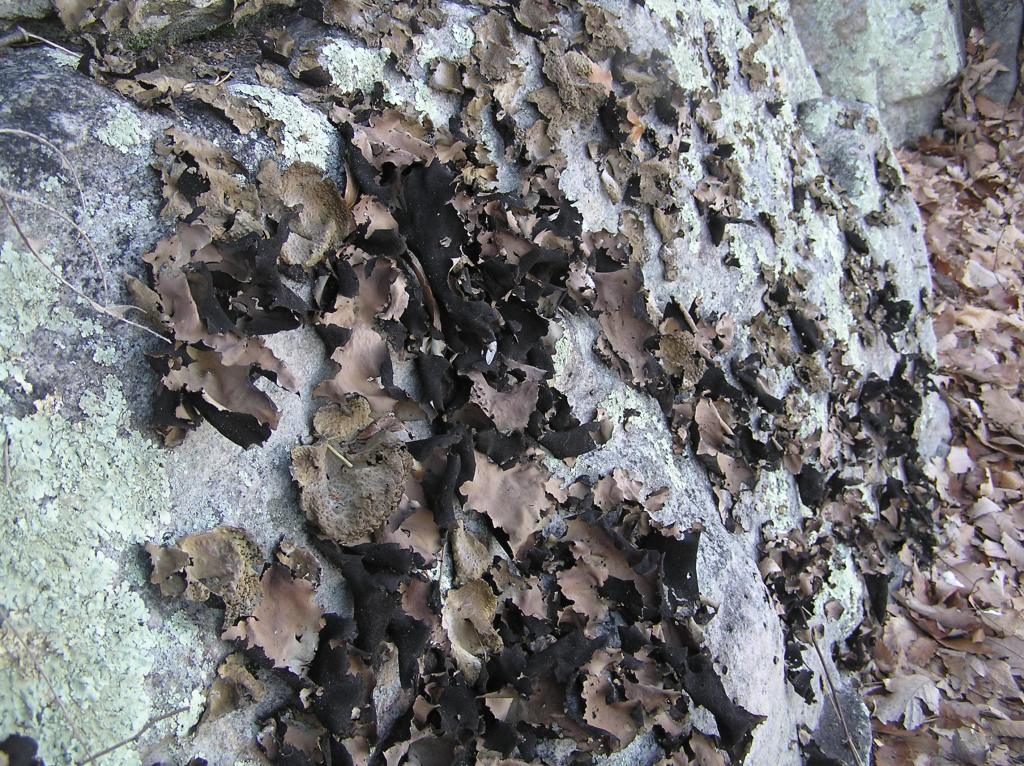
Rock Tripe Lichen attached to a rock at 2,000 feet in Shenandoah National Park

Common Name:  Rock Tripe, Navel lichen –   The common name is a direct translation of tripe-de-roche, the French name for the lichen. Tripe is the name for the wall of the stomach of a ruminant animal when consumed as a food. It has taken on a number of secondary meanings that generally convey a notion of being worthless or of inferior quality. Thus the common name conveys that it is a poor quality food, like tripe, that is found on rocks.

Scientific NameUmbilicaria mammulata – The genus is derived from the Latin umbilicus meaning navel (the umbilical cord attachment point); the whorled shape of the lichen with its single attachment point is similar in appearance to a navel – note that  the common name navel lichen (used by the USDA) is based on this association.  The species name is from the Latin word mammula meaning small breast. This is in reference to the presence of  papillae on the lower, black surface of the lichen; a papilla is a small, rounded bump, like goose flesh. The term mammular means covered with papillae. The net result is a lichen that looks like a navel and is covered with small bumps.

Alexander von Humboldt is credited with the observation that biology varies equally by elevation or latitude which he noted in the ascent of Mount Chimborazo in the Andes at the dawn of the nineteenth century. [1] For species that are distributed mostly or wholly in Nordic regions, in part because the air is more pristine, this equivalence allows for access by  ascent. The Appalachian Mountains rise from the eastern side of the North American (tectonic) plate in a literal blue ridge of billion-year old granitic rock overlooking the Piedmont “foot of the mountain” to the east like a brooding parent. This is the realm of rock tripe, with large, rounded structures that comprise the main body called the  thallus that appear to be the peeling chips of a badly botched paint job. Inky black on the bottom, they are held in place by a single attachment point near the center. The lighter colored top surface faces the sun’s photons that provide the energy processed by algae of the genus Trebouxia.  Rock tripe is of course a type of lichen; a dual organism that consists of both a fungus and an alga (some also have cyanobacteria) that live in mutualism, a type of symbiosis in which both constituents share the benefits of the association. A lichen has been called a fungus that has discovered agriculture; the fungus constitutes the bulk of the extant vegetative body or thallus. The algal partner or photobiont having been incorporated as a source of photosynthetic energy.  The close mutual relationship allows lichens to occupy extremely adverse environmental habitats that range from isolated rock outcrops in the frigid rarefied atmosphere at elevations over 6,000 meters; there are over 3,600 species of lichen in North America alone. Rock tripe are among the hardiest of the lichens, they can survive extreme drought for over 62 weeks. The survival of lichens in axenic environments lends credence to the notion that the first aquatic plants to make landfall in the Silurian Period some 400 million years ago were some form of algae that brought along their fungal partners for structure and support, the mycorrhizal associations of most of our Holocene Epoch plants are perhaps vestigial.

Rock Tripe covering an outcrop of Silurian sandstone on Massanutten Mountain

The “rock” part of rock tripe is clear, as a mineral substrate is both necessary and sufficient for its domicile. What about tripe?  Tripe is defined as either the portion of a ruminant animal’s stomach consumed as food or it can mean anything worthless or offensive. In the minds of all vegetarians and many others, the two meanings are synonymous. As a vegetarian in practice and an omnivore in spirit, some expatiation is warranted. Tripe is an exemplar of British cuisine, which is noted for meat and potato delicacies like bangers and mash; a Tripe Marketing Board persists in homage to its former glory. [2] Offal is the general term for the internal organs of animals; the more popular connotation is refuse or garbage with a synonymy even more pronounced. Two mitigating factors are germane to any discussion of the consumption of animal parts; one historical and the other philosophical. Historically, paleolithic hunters cherished the perishable internal organs for their own consumption in the field, dragging the meat back to their encampments for others. Stomachs were especially prized and may well have been consumed along with their contents. In medieval times, abattoirs were gruesome affairs, butchers standing knee deep in animal parts covered with their blood. Every part was put to use: the intestines for sausages; heads for head cheese; and random scraps for scrapple among many others.  [3] The antiseptic package of hamburger and the guarantee of adequate food whenever hungry was preceded by eons of everything edible being eaten. Philosophically, the total consumption of anything that is killed for its life-giving meat is justifiable according to food chain ecology. Cows can eat grass and humans can’t; as long as the former are afforded a reasonable life ended by a swift and painless death, the latter are surely legitimate in making a meal of them. On the other hand, fewer cows means less of the greenhouse gas methane from their belching, which is another issue altogether. Not eating them in the first place is something to consider … most edible fungi have significant amounts of protein and all eight essential amino acids. As omnivores, we get to choose. Regardless,  humans will eat  just about anything (including each other) to stay alive – which is where rock tripe comes in.

Since the lichens called rock tripe thrive in the harshest arctic climates and maintain their viability through the winter, they have long served as a source of emergency food by Native Americans. The French name tripe-de-roche precedes the translation into the English rock tripe; the provenance of the term is Canadian.  The Inuit peoples of the Canadian arctic regions considered rock tripe to be a food of last resort, to be eaten only in times of starvation, its continuous use thought to be pathological.  Other Native Americans found it more palatable, incorporating it into their routine regimen of food gathering and preparation. For example the Cree, which constitute the largest group of First Nations (Native Canadians, or in Quebecois, Autochthones), used it as an additive to fish broth to make a thick soup that was not only eaten for nutrition but was considered to be somewhat medicinal, affording nourishment to the sick. [4]

The early explorers of the North America became aware of the use of rock tripe as a survival food from the indigenous peoples, and used it on occasion of isolation to stave off starvation. Most notable was the first expedition of Sir John Franklin to map out the Northwest Passage from Europe to Asia from 1819 to 1822. In the second year of the exploration, the party of 20 was forced to return on foot when their two birch bark canoes became damaged. Franklin’s journal recorded the epic journey which has become one of the epitomes of deprivation: “Previous to setting out, the whole party ate the remains of their old shoes, and whatever scraps of leather they had, to strengthen their stomachs for the fatigue of the day’s journey …. The tripe-de-roche, even where we got enough, only serving to allay the pangs of hunger for a short time.”  Nine of the party succumbed to the ordeal. [5] Franklin survived only to perish with 134 officers and sailors on the HMS Erebus and HMS Terror on his fourth quest for the Northwest Passage; they were last seen in July of 1845. It is hypothesized from Inuit sources and the remains of the stranded mariners that they must have escaped the ships and set out over the ice in desperation. Some of the skeletal bones showed signs of knife marks suggesting that cannibalism may have been a last resort. That is what can happen when you can’t find any rock tripe. The two ships were located lying about 100 miles apart off King William Island in northern Canada using side-scan sonar about five years ago as the area has become largely ice-free due to global warming. The Northwest Passage is now very nearly a reality, but for all the wrong reasons. [6]

Cooked Rock Tripe is both nutritious with good fungal taste and texture

The different species of the genus are global in scope with different local names according to custom, including shi er meaning “rock ear” in Chinese, ‘stone mushroom’ soegi posot meaning “stone mushroom” in Korean and iwatake meaning “crag mushroom” in Japanese. Ironically, U. esculenta, a rock tripe species indigenous to Asia,  is considered a delicacy. It is so sought after that harvesters repel down steep slopes to collect it, favoring wet weather to reduce the risk of crumbling of the delicate lichen. [7] The nutritional and medicinal value of rock tripe fungi has been investigated experimentally to evaluate its viability as a survival food. A lichen supplementation was given to female mice for three weeks to measure its effects on growth, metabolism and immune function in comparison to a control group fed a standard diet.  The lichen-fed mice had a higher growth rate and ate more than the control group. Testing of the vital organs, including the heart, liver, kidneys and spleen revealed the lichen diet had no deleterious effects. The study concluded that rock tripe was not only a good source of nutrition in survival situations but that it acted to stimulate the immune system, as manifest in an increase in the production spleen B-lymphocytes. A second evaluation of several varieties of rock tripe found that they manifested substantive anti-bacterial activity against most of the bacteria tested. [8] Rock tripe is certainly worth a try, if only to survive the winter, but those are, alas, becoming shorter and warmer. It is plentiful, readily harvested, easy to cook, and has a texture that promotes palatability. Simply pluck from the side of  a rock, take it home, wash it, and boil it for about ten minutes for an excellent additive to soups or salads.

1. Rahbek, C. et al “Humboldt’s enigma: What causes global patterns of mountain diversity?” Science, 13 September 2019, Volume 365, Issue 6458, pp. 1108-1113.

2. https://tripemarketingboard.co.uk/

3. Tannahill, R., Food in History, Three Rivers Press, New York, 1988, pp 12-18, 291-292.

4. Brodo, I., Sharnoff, Sylvia and Sharnoff, Stephen, Lichens of North America, Yale University Press, New Haven, 2001 pp 78-83. The essential lichen reference

5. Davis, R. Sir John Franklin’s Journals and Correspondence First Arctic Land Expedition (1819-1821) Champlain Society, 1995.

6. Vaidyanathan, G. “Mysterious lost ships, HMS Terror and Erebus, reveal new layer of clues in Arctic” Washington Post, 27 November 2016

7. Riedel, T. “Eating Iwatake, A Rock Tripe from Japan”, Fungi, Volume 7, Number 2-3 Summer 2014. Pp 63-65.

8. Ng, I. and Kälman, S. “The lichen rock tripe (Lasallia pustulata) as survival food: effects on growth, metabolism and immune function in Balb/c mice.” Natural Toxins 1999, Volume 9 Number 6, pp 321-329.

Snapping Turtle

Snapping Turtle West Virginia 200716
Female Snapping Turtle just after crossing a road to find a good place to lay eggs in a location remote from predation and near water where hatchlings might survive. 

Common Name: Snapping Turtle, Common Snapping Turtle – The name refers to the prominent toothless beak that has a powerful, snapping bite for capturing prey and for defense. The term “common” is sometimes added to distinguish this species from the larger and more fearsome alligator snapping turtles that inhabit the Gulf Coast northward along the Mississippi River and its tributaries.

Scientific Name: Chelydra serpentina – The genus is from Chelydros, the Greek word for an amphibious serpent or a tortoise. Serpens is the Latin word for a creeping animal, usually taken to mean a snake (serpent). The leitmotif of snake may be due to the snapping turtle’s unusually long tail.

Potpourri:  Snapping turtles have an unsavory reputation as aquatic aggressors, lurking in the depths of freshwater ponds to lop off the extremities of innocent waders.  The resultant chelonaphobia, a form of zoophobia … the unreasonable fear of animals … applies to those who see turtles as terrible, preventing those afflicted from getting into the water in the first place. Turtle phobia can only apply to snapping turtles … box turtles hide form intruders in their armored sanctuaries and painted turtles slip into the water when approached. There is at least a modicum of  rational apprehension of water immersion due to the possible presence of large, aggressive marine predators like some sharks that (rarely) attack humans with nightmarish consequences exaggerated by cinematic jaws. But in spite of the University of Maryland motto, there is no reason to “fear the turtle.” There is no record of anyone ever being killed by a snapping turtle and the incidence of injury of any kind is vanishingly small, mostly on land due to improper handling. While snapping turtles do bite with a bone crushing finality, it is no more or less that many other animals which are larger and more mobile. Nothing to fear but fear itself.

Snapping turtles are in a separate family (Chelydridae) in the turtle order (Testudines) of the reptile  class (Reptilia) with kindred crocodiles, snakes, and lizards. They are among the oldest of all animal groups, having evolved from the earliest reptiles about 200 million years ago, long before the age of the related and now extinct dinosaurs. That they survived the Cretaceous-Paleogene (K-Pg) extinction 66 million years ago with their avian cousins as the thunder lizards perished en masse along with three fourths of all living things is testimony to the resilient “intelligent design” of natural evolution.  Testudinal structure is a case study in  the random course of genetic mutation  that has no plan, but which rarely but inexorably succeeds by repetitive trial and error. Turtles are unlike any other reptile in having a carapace exoskeleton, a horny toothless beak, and the bones and ligaments of locomotion located inside the rib cage. [1] Their abrupt appearance in the fossil record absent a gradual transition through stages of partial shell hybrid variants has been a perennial issue with paleobiologists. Specifically, how could the ribs that had always been the vertebrate organ cage become body armor?

A turtle shell seems to be a relatively simple structure with an arched top comprised of polygonal scales called scutes with a flattened bottom plastron as foundation. However, complexity is biology’s handmaiden ― there are about sixty separate bones growing in synchrony to form the whole. The rib bones in turtles grow straight through the muscle in which they would become embedded in most vertebrates until they reach the dorsal (back) tissue that is known as the carapacial ridge. Here they release bone morphogenic proteins (BMPs) and hedgehog proteins that convert the nearby tissue cells into bone, filling in the spaces around the fifty-odd segments like mortar in the brick wall of the carapace. The nine bones of the plastron follow a different path ―no ribs and no tissue ossification. Here the bone cells expand independently, fusing together like those that form the brain-encasing skull except they encase the body. [2] It is feasible that the mutation in the bone forming cells occurred randomly, imparting an almost immediate enhancement survival benefit in the form of a fortress palladium. The turtle as battle tank succeeded and the mutation was passed on as a  cladistical advantage.  While we should not fear the turtle, the whole body shield renders the turtle fearless, like their teenage ninja mutant namesakes. The snapping turtle especially so.

Snapping turtles are apex predators of North American freshwater habitats with almost nothing to fear until humans came along. They are seldom seen as they spend the majority of their time hidden in the mud and ooze at the bottom of a pond or lazy river where quiescence prevails. There they lurk as a cryptic mud-colored mound until a proximate  potential meal appears. Alligator snapping turtles (Macroclemys temmincki) take this one step further with a worm-like appendage that is anchored to the bottom of their maw as lure to passing fish. The coup de grace is administered by the snapping beak deployed at the business end of the long, flexible neck that can extend outward some thirty centimeters, about two-thirds of the length of the shell. As observations of snapping turtle predation are limited by the black of their lagoon habitat, dietary preference research requires capture and dissection. Not surprisingly, slow bottom dwellers like crayfish, catfish and diving beetles are among the more likely menu alternatives, but toads, tree frogs, muskrats, and even waterfowl are occasional entrées. Snapping turtle predation of pond ducks and migrating geese is one of the bones of contention concerning their presence in water habitats, particularly those that qualify as private property. A study conducted in 1943 found that less than one percent of the stomach contents of 470 snapping turtles consisted of bird remains. While other studies have asserted avian losses exceeding ten percent, the general vilification of snapping turtles contributes to some exaggeration of decimation. [3]

The lore of snapping turtles as malevolent monsters of the deep is a matter of American acculturation. Comics and cartoons frequently depict barefoot boys jumping out of ponds with a turtle snapped onto a toe. The perception of snapping turtles as hurtful is due primarily  to their pugnacity when encountered on land, the only time that they are readily observable.  Any animal will trend toward wariness and become aggressively defensive when away from its natural habitat home, water in this case. An inquisitive human intruder only makes things worse. However, they only lunge and snap when cornered, and will only bite when proffered something that is bite-sized, like a twig (or a finger perhaps).  A second fear factor is the ominous appearance of the nutcracker beak,  a formidable weapon designed to do real damage. This is an evolutionary trade-off that favored powerful jaws for bone-crunching carnivores … turtles that feed mostly on plants and invertebrates get by with much less. [4]  Association with the alligator snapping turtle with the size and strength to  sever a finger renders all of their kith and kin suspect. Rumors abound of a human finger being found inside one caught by trappers for alligator snapper stew, a popular dish in bayou country. One confirmed case of finger loss involved a group of intoxicated bar patrons and a bet as to whether anyone could stick their finger into an alligator snapping turtle’s mouth and pull it out before it snapped shut. [5] No prestidigitation there. In their natural aquatic environment, snapping turtles are docile, noted mostly for their curiosity which can result in a slight bump as they investigate swimmers or boats snout first. When approached in the wild in their home waters, they do not even bite, much less snap.

Snapping turtles are well suited to riparian wetlands and boggy marshes. A prime location has an average water depth of about two feet so that the occupant can sit on the bottom and poke its head above the surface for an occasional gulp of air. These are reserved for the larger males that predominate ― might makes right is more than an aphorism in the wild. They have been observed in the same location for stretches of up to ten years, when they eventually are displaced by a younger, stronger, or larger rival.  Life consists of  walking along the bottom with deliberation eating the aquatic plants that typically comprise over fifty percent of their diet. One study found that over 90 percent of the contents of the stomachs of 278 individuals was plant material. [6] Snapping turtles have superior vision both above and below water with an optical range that extends to directly overhead. The larger males are mostly sedentary, ensconced in the mud waiting for their unwitting faunal prey … the more spry, younger turtles are more likely to hunt for food. Smaller males and females occupy less desirable and more marginal waterways that contribute to a density that can be as many as 30 adult turtles  in a single acre. The bucolic regimen of lounging in the water with plenty of food comes to an end in winter when hibernation in a frozen pond is the only option and spring when the hormones of procreation mandate their expiation in the sexual union of new life.

The tilt of the Earth’s axis creates the seasons in succession consequent to the annual orbit of the sun. In the temperate latitudes, winter’s dark and cold shadows are an existential risk for turtles that live in water that freezes. One of the attributes of the perfect pond is having a depth that is below the freeze line with adequate vegetation to provide oxygenated (aerobic) water for survival.  These goldilocks spots become the hibernacula not only for the resident, staked-claim dominant males but also for guest turtles that can congregate  in a small area sometimes stacked vertically. There they live in suspended animation for up to six months at the northern reaches of their range  with no food and no air with body temperatures just above freezing.  Hibernation is one of the most compelling cases for evolution, the shutdown of all but essential activity a matter of physiological adaptation. Dissolved oxygen that still persists early in winter is absorbed through the skin and the membranes of the mouth to sustain the metabolism of the slowly pulsating heart. When the oxygen runs out, sugar and fat breakdown continues for a time causing an increase in acidity that eventually becomes  life threatening. In one laboratory experiment in a water tank held at near freezing with bubbling nitrogen to maintain anaerobic conditions, turtles survived for four months, their blood PH dropping for a neutral 8.0 to a near lethal 7.1. Southern populations of turtles not accustomed to hibernation only survived for one month in the same experiment. [7] Practice, even among turtles, makes perfect. When spring comes to the hibernaculum pond and the ice melts, the dominant male chases everyone else out of the water and they all set off looking for someone to mate with … like spring break at the beach.

Snapping Turtle Hatchling Columbia 200523
Snapping Turtle Hatchling making its way to water and safety.

Male snapping turtles are aggressive and sex does not appear to be consensual since females attempt to flee when pursued. This is an anthropocentric perception as it would be at best difficult to determine what constitutes normal behavior for a male or female snapping turtle; they are all perpetually gruff by human standards. Females are much more peripatetic than males, travelling several miles in search of a location that will provide some survivability benefit to the 22 to 62 eggs that will be laid. Prime nesting sites are mostly upstream of home ponds on sandy banks adjacent to water into which the vulnerable hatchling turtles can rapidly move. It is along these watercourse causeways  that the males wait in ambush.  Since females can store sperm for several years, neither copulation nor nest building to lay eggs is necessarily an annual event. In any given year, 72 percent of females deposit their eggs at a nesting site that is almost always the same site used previously. This is not a particularly good strategy, as up to 90 percent of the nests are destroyed on the first night by egg-eating foxes, racoons, skunks, opossums, and coyotes. [8] But it works well enough, as snapping turtle populations are, at least for now, stable.

The journey of snapping turtles, particularly females, over long distances through sometimes dense forested areas to the same location every other year or so raises questions about navigation. This conundrum pertains to animals in general … migratory birds travelling thousands of miles over continental spans to return to nesting grounds and salmon seeking their birth stream after years foraging in the open ocean, among others. There are several candidates that could plausibly be involved in geographic positioning. Transits made above ground could use the positions of the sun, moon, and stars augmented in some cases by landmarks where available and perhaps by wind direction, temperature, and air  composition. Waterborne transits could use marine parameters like salinity, suspended solids, acidity, and currents  for orientation. Much more likely, however, is the one parameter that is universal and does not depend on temperature, elevation, or cloud cover ― magnetism. Lines of magnetic flux vary on the macroscopic scale of the north and south poles and on the local scale by the presence of magnetite.  The ability to use the magnetic field as a sensor is called spontaneous magnetic alignment (SMA) and appears to use two types of magnetoreception mechanisms. The first is a magnetite-based (MBM) and is thought to be the basis for a geographical map (where am I?) of different field strengths and inclinations. The second type is more esoteric in that it involves complementary light inputs. Known as the radical-pair mechanism (RPM), it involves a linkage between photopigments and magnetism that hypothetically provides directional inputs (where do I go?).   Snapping turtles have been experimentally shown to respond to variations in radiofrequency (RF) signals that emulate magnetism. [9] At this point, there is more theory than fact, but one thing is certain. Turtles and other animals can find their way back against insuperable odds to the same place and it can’t be luck or magic.

Even though snapping turtles are ubiquitous and listed as being of “least concern” in species data bases, there is reason to consider conservation measures now before it is too late.  This is especially true in Canada, where many of the  empowered First Nations peoples refer to  North America “Turtle Nation” and believed that a turtle allowed the earth to be created on its back. This is not as implausible as it sounds. Western lore includes the notion that the flat earth rested on the back of a turtle swimming in an endless sea. This is not all that far removed from the “modern” scientific ever expanding universe that began with a big bang containing dark matter and dark energy that have not yet been defined. It surely can have nothing to do with turtles, though, unless they are dark matter. The life cycle of turtles is stressed. Snapping turtles become sexually mature only after a decade or so, live for a long time, and rely on frequent reproductive events that result in high mortality rates for embryos and hatchlings to maintain the population. It has been estimated that the probability of an embryo surviving to reproduce in adulthood is 0.1 percent (1 out of every 1,000). The concern is that with this population dynamic, the loss of an adult can result in serious and possibly irreparable harm. People are the problem.  The human horde encroachments include habitat destruction for more houses, road kills along the paved accesses to the new houses, and increases in predator populations like racoons that share human habitats. Adding insult to injury are more direct assaults including fishing bycatch, the killing of snapping turtles by people who kill snakes for the same reason, and legal and illegal “harvesting.” As an example, between 1996 and 2006, the US Fish and Wildlife Service recorded over one million snapping turtles shipped overseas in the illegal wildlife trade. Yes, Virginia, the enemy is us and Santa Claus has nothing to do with it.


References:

  1. Behler, J. and King, F. National Audubon Society Field Guide to Amphibians and Reptiles, Alfred A. Knopf, New York, 1979, pp 425-437.
  2. Pennisi, E. “Neural Beginnings for the Turtle’s Shell” Science, 13 February 2004, Volume 303, Issue 5660, pp 951.
  3. http://www.virginiaherpetologicalsociety.com/reptiles/turtles/eastern-snapping-turtle/eastern_snapping_turtle.php
  4. Herrel, A. et al. “Evolution of bite performance in turtles”. Journal of Evolutionary Biology. 25 October 2002, Volume 15 Issue 6 pp 1083–1094. https://onlinelibrary.wiley.com/doi/full/10.1046/j.1420-9101.2002.00459.x
  5. Gibbons, J. W. “Can a Snapping Turtle bite off a finger?”24 June 2018 Savannah River Ecology Laboratory, University of Georgia http://archive-srel.uga.edu/outreach/ecoviews/ecoview180624.htm
  6. Cameron, M. Committee on the status of Endangered Wildlife in Canada (COSEWIC) Assessment and Status Report, “Snapping Turtle, Chelydra serpentina” 2008 at http://publications.gc.ca/collections/collection_2009/ec/CW69-14-565-2009E.pdf
  7. Heinrich, B. Winter World, Harper Collins, 2003, pp 145-156
  8. Kynast, S. “Snapping Turtles” Tortoise Trust Web Site at http://www.tortoisetrust.org/articles/snappers.htm
  9. Landler, L. et al “Spontaneous Magnetic Alignment by Yearling Snapping Turtles: Rapid Association of Radio Frequency Dependent Pattern of Magnetic Input with Novel Surroundings”. PLoS ONE 10(5). 15 May 2015. https://www.ncbi.nlm.nih.gov/pmc/articles/PMC4433231/
  10. Management Plan for the Snapping Turtle (Chelydra serpentina) in Canada [Proposed]. Environment and Climate Change Canada (2016).  Species at Risk Act Management Plan Series. Ottawa: Ottawa, Environment and Climate Change Canada  https://www.registrelep-sararegistry.gc.ca/virtual_sara/files/plans/mp_snapping%20turtle_e_proposed.pdf

The Compleat Ambler

What the slowness of walking in nature can do for physical and mental health for those trapped in the electronic, sedentary world of computers and cars. The why and what of hiking to supplement the when and how. Available at most bookstores now.

Compleat Ambler CoverBoost your health with a walk through the seasons of nature
Discover the many physical and mental benefits of unplugging from the digital world and taking a walk in nature! As affluent societies have become more urban, they have become more sedentary and anxious in equal measure. The frequently frenetic movement from home to car to office to sit at a computer screen at the beginning of the day, repeated in reverse order at its end, has wreaked havoc on our bodies and our brains.

The Compleat Ambler is a recipe to brave the newfound world of what’s out there waiting to be seen—a guide to what is interesting and what matters in nature: the flora, fauna, fungi, and geology of the great outdoors. Revisit what our ancient ancestors knew: that  exploring the natural world reawakens the body’s own evolved strictures to reach and maintain a balance of mental, physical, and moral well-being. Trekking through the seasons—with the flowers of spring, the birds of summer, the fruits of fall, the rocks of winter—The Compleat Ambler eloquently illustrates why it’s so important that we “eat right, walk more, and seek trees.”

About the Author: William Needham holds degrees in science from MIT, engineering from Duke, education from Troy State, and business from Central Michigan—an eclectic educational background that reveals his wide-ranging interests. He has trained as a Master Naturalist in the state of Maryland and as an active hike leader with the Sierra Club, along with serving seven years as a docent at the Smithsonian American History Museum in Washington, D.C. After retiring as a captain in the U.S. Navy submarine service, William met his wife, Marina, while hiking on the Appalachian Trail in Pennsylvania. They currently live in Columbia, Maryland.

Walkingstick

OLYMPUS DIGITAL CAMERA
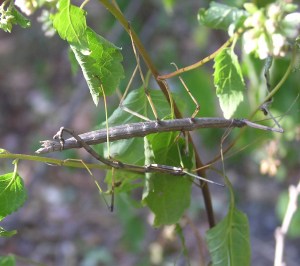
The brown, twig-like walkingstick can only be easily seen when silhouetted against the background of the green leaves that it eats.

Common Name: Northern Walkingstick, Common American Walkingstick – Probably the most appropriately named of all invertebrates … for all intents and purposes, this insect looks like a stick that is, incongruously, walking on spindly legs. Even though it is named northern, its geographic range extends south to Florida and west to New Mexico.

Scientific Name: Diapheromera femorata  –   The generic name has no established etymology, but may imply that the use of chemical signals (pheromones) by these insects, “dia-” meaning consisting of. The species name is from femur, the Latin word for thigh and the name of the longest human leg bone. The plural form is femora so multiple femurs are implied.

Potpourri: Walkingsticks are not hiking poles although the two terms have been used synonymously with the former applied the latter but not vice versa. The walkingstick is a twig-like insect with legs to get from place to place, metaphorically like the poles that help the hiker do the same. Along with leaf insects that look like leaves, the walkingstick is one of the most compelling arguments for evolution according to Darwinian survival of the fittest. There can only be one reason why the complexities of a living, breathing, ambulating animal would be packed into an unlikely longitudinal and tubular package that looks like a stick except to fool a predator and thereby survive to procreate. Those that looked more like twigs over time became lunch less often, having off-spring that looked even more like twigs – and so on.  Ultimately, the near perfect foil as indistinguishable from the perch on which it stands.

Historically, walkingsticks were placed in the order Orthoptera, which was an odd assortment of insects with a life cycle characterized by partial metamorphosis – egg, nymph, and adult with no pupation ― the nymph looks like a small adult.  This taxonomy was impractical and unwieldy as it grouped cockroaches, mantids, grasshoppers, and crickets which have the straight wings for which the order was named (orthos is straight and ptera are wings in Greek) with the much more distinctive walkingsticks which are mostly wingless. Orthopteroid is still used as a descriptive unofficial category to refer to these insects with the addition of earwigs and termites, which, like mantids, are evolved from cockroaches. [1] The new stick insect order is Phasmatodea, from phasma, the Greek word for apparition or ghost. Insects that are almost invisible due to their extreme crypsis like the walkingsticks and the mostly Australasian leaf insects (there are none in the Americas) have long evoked a sense of the supernatural and were considered an anomalous category for which numerous names were variously applied, such as Cheleutoptera, Ambulatoria, and Spectra (from the Latin word for ghost). [2] Absent the theory of evolution, their presence would suggest that a twig or a leaf had suddenly come alive like the argumentative  apple trees of Oz or the methodical ents of Middle Earth; a specter was the only available. explanation from the animist perspective. The taxonomy of the phasmids, as they are commonly called, is far from settled but the walkingstick insects are tentatively placed in several suborders and the walking leaf insects are for the present in the family Phylliidae. This will surely change.

Walkingstick Nymph AT 130816
The small, green walkingstick nymph is vulnerable to predation

Walkingsticks are an extreme case study of adaptations that must be made by all living things to survive in an ecological niche, humans excepted as makers of the dominant “niche” at the expense of other species. Life starts for the hatchling walkingstick as a nymph emergent on the forest floor in mid-June elongated in form like the walkingstick it will become, but diminutive in stature and bright green in color. Rather than a stick, it might be mistaken for any of the green larvae that course about the forests and are the provender for many a predator. The nymphs walk to the nearest thing they can find and climb to the leaf level under the cover of darkness to begin a life of eating and growing. That is if they get that far. If a cement post is first encountered as a tenuous refuge, it won’t be for long, as the now obvious green shape is on display for any passing birds, the nemeses of walkingsticks. Their only defense at this stage is sacrificial amputation. Since a predator is likely to grab the first thing that it can, this would likely be one of the six conveniently extended legs. Walkingstick nymph legs are detachable to allow the body with the remaining five legs to survive; the removed leg regenerates within a few days to restore full mobility.   Of the approximate one thousand species of walkingstick, almost all are found in tropical climates, where foliage is dense and escape more probable … there are only ten species  in North America. [3]

Walkingstick nymphs that are either more fortuitous or perhaps have a better sensor suite find there way up a tree and out on a branch that supports multitudes of leaves extended by petioles from twigs. While not all that selective, they prefer black cherry (Prunus serotina) or hazelnut (Corylus americana) trees, choosing oaks (Quercus spp) as an alternative. As obligate herbivores, nymphs settle on an individual leaf to strip the preferable cellulose-rich plant tissues leaving only the vascular vein plumbing as a matrix of thin piping in its wake, skeletonizing the leaf. Those that remain concealed and can continue eating will molt (technically called ecdysis), shedding their green skin for the brown colors of  the twigs they traverse. The molting process  is repeated four more times going through each phase at about a two week interval as transitional forms called instars. The maturation to adulthood takes a long time that varies according to temperature … cooler weather promotes the growth of the nymphs. The period varies with annual and geographic weather differences that have been measured by field testing to vary from  74.7 days in one year followed by 84.9 days in the next. The unit degree-day is used as a direct measure of the time at temperature requirement for an individual plant or animal. It provides a metric for phenology, the study of natural phenomena that progress according to climate. It is determined relative to a standard mean temperature, mostly 65ºF in the United States, and can be applied above or below that level for cooling or heating. The northern walkingstick nymph requires 1835 degree days to reach adulthood―roughly 120 days if the average temperature is 80ºF. Over time this results in broader distinctions in growth and reproduction. Northern walkingsticks that are really in the north (New England and southern Canada) have a biannual life cycle while southerly northern walkingsticks reproduce annually. [4]

OLYMPUS DIGITAL CAMERA
A male walkingstick clamping to the abdomen of the female in preparation for copulation.

At some point in (almost) every animal’s life, there comes a time (puberty in humans), when growth is complete and sex becomes the predominant concern. Species survival mandates procreation. For the most part, this involves the combination of genes from a male and a female to literally engender some variation that enhances survivability in a changing world. Male walkingsticks are generally smaller than the females and in some species they attach themselves and ride on the back of the female until a time of her choosing. The tail of the male is configured into a clasper to latch on to the abdomen of the female to assist in positioning (Cheleutoptera, one of the alternate order names, is derived from chele, the Greek word for claw) so that mating can proceed with the transfer of a spermatofore. Many phasmids have the ability to produce fertilized eggs absent the participation of the male, a not uncommon characteristic called parthenogenesis. [5] Self-fertilization has the advantage of guaranteed progeny for short term survival  with the disadvantage of decreasing genetic diversity for long term survival.

The result of a tryst or non-tryst fertilization is between one hundred and one thousand eggs, dropped from the treetops to the duff below. Oviposition occurs one egg at a time beginning in late August and ending in October eventually covering the ground with as many as 400 eggs per square meter. The eggs of phasmids are rugged, coated with a layer of calcium oxalate, and sculpted and have the colors, shapes, and textures of various plant seeds … the eggs of the northern walkingstick look like the seeds of legumes.  The hard outer shell protects the embryo through the winter to survive until spring when the nymph emerges. It probably evolved to prevent wasp predators from penetrating the eggs. The eggs also have a rounded protuberance called a capitulum at one end that is similar in appearance to an oily appendage on many plant seeds called an elaiosome.  The unusual egg  characteristics contribute to egg dispersal. Ants collect seeds with elaiosomes and take them back to their nests to remove the nutritive lipids and proteins, leaving the reproductive portion intact, contributing to plant propagation. Bloodroot, spring beauty and trilliums, among others, use ants to distribute their seeds in this way, a mutualistic arrangement called myrmecophily. Ants fooled by the capitulum of the walkingstick eggs are unwitting accomplices in moving them to a safe location for the winter. The hard-shelled eggs also protect against damage when passing through the digestive system of avian predators after having consumed gravid female walkingsticks. Excised eggs were fed to one of the known bird walkingstick predators and its fecal pellets collected three hours later. Twenty percent of the eggs were still viable and two were successfully hatched into nymphs. [6] The ability to hitch a ride on the backs of ants or in the belly of a bird may explain the wide geographic dispersal of northern walkingsticks, which typically spend their entire lives in the same tree.

One would think that evolution would surely have stopped with the “intelligent design” of an insect that looks like a stick with eggs that look like seeds. The contest between prey and predator is a continuum, however, as faster cheetahs foster even faster impalas. Birds are a highly evolved class of animals with about 200 million years of refinements largely to enhance their search for food, particularly high protein insects. Their keen eyesight can discern the slightest variation in a background pattern as impetus to take note and action. As the winds blow, the boughs move with graceful undulations that transmit through the interconnecting branches to the leaves and twigs. A walkingstick standing still on a moving twig is a sitting duck for a watchful drake.  Crypsis, the ability of an animal to avoid detection, is widely employed by both predators and prey to stealthily creep to within striking distance for the former or blend into the background for the latter. In most cases this takes the form of colors and shapes, the tiger stripes that mimic tall sunlit grasses and chameleon lizards that change color to become incognito are well known examples. Most backgrounds don’t move so the companion behavior pattern of those seeking to hide is to freeze, as toads do instinctively when threatened. But twigs move, so most walkingsticks do too. Studies of walkingsticks swaying in concert with the amplitude and periodicity of the wind-generated movement of twigs on which they perch have concluded that they are synchronous. [7] When the grim reaper beckons, having rhythm matters. Some walkingsticks have taken this one step further, employing chemical weapons in the form of irritating sprays that deter not only birds, but also mammals and even other insects. [8]

The long, thread-like, jointed legs of the stick insect are ungainly, splayed out in all directions in support of the cumbersome cylindrical body like a tethered Macy’s parade balloon. They are not  the strut-like simple appendages that they seem, as walking on uneven surfaces with different textures at odd angles is a gravitational challenge. Each leg is terminated in a two-part foot pad with a toe that is adhesive and a heel that is what may be called stick-slip, having adjustable adhesive qualities. The physics of mobility require each foot to  stay where it is placed firmly yet yielding to removal without undue force when motion proceeds. To do this effectively is evidently an important feature of walkingstick behavior, as the heel pads incorporate three features to ensure it sticks when pressure is applied, but slips freely when needed. The surface is covered with rounded individual hairs that flatten like a squash ball when squashed, resulting in a larger surface areas. As the weight or pressure is increased a second. shorter group of hairs is engaged to broaden the base. At the most compressed and adherent state, the hairs bend over to add a third dimension to the contact surface. The net result is a lot of friction for minimal applied force that can be readily and rapidly applied and released so the walkingstick can walk. [9] The modes and methods of the stick insects is of interest to science as a possible mechanism to enhance footwear performance just as the overall carriage of the ambulating animal may be useful in designing all-terrain robots. [10]

 By all accounts, the walkingstick measures up as a success in the forest survival struggle. It is well hidden in its camouflaged exoskeleton, it reproduces with large numbers of protectively coated eggs, it eats voraciously but not too exclusively, it grows fast, and  it gets around. So why is there not a plague of walkingsticks on occasion like the biblical locusts? They are both orthopteran insects  so they are closely related. The swarming behavior of locusts is technically called kentromorphism, brought about by environmental factors that promote density dependent behaviors. It is the gregariousness of species that overwhelms an ecosystem. Walkingsticks are mostly solitary and they can’t fly, so large scale tree or crop devastation has not been an historical problem. They only spread at the rate of an eighth of a mile a year, even taking ants and birds into account. However, on a more regional scale, there have been numerous occasions where serious environmental degradation has been experienced. One report from 1874 noted the denuding of 25 acres of white oak and hickory trees in Yates County, New York. The density of walkingsticks was such that “they cluster upon a limb or fence-rail so thickly that they pile up upon one another, and one cannot enter the wood where they are, without having numbers on his clothing”. The worst recorded outbreak was in Ogemaw County, Michigan in 1936, when 2500 acres of oak trees were “completely stripped by the middle of July.”  [11] However, unless they gain the mobility of flight through some future mutation, walking sticks will remain interesting, if esoteric, insects.


References

  1. Marshall, S. Insects, Their Natural History and Diversity, Firefly Books, Buffalo, New York, 2006, pp 58-64.
  2. Latreille P. Histoire Naturelle, Générale et Particulière des Crustacés et des Insectes. 1802-1805, Books 1–14, Paris. http://www.insecta.bio.spbu.ru/z/nom/Spectra.htm
  3. Milne, L. and Milne, M. National Audubon Field Guide to Insects and Spiders, Alfred A. Knopf, New York, 1980, pp 445-446.
  4. Harrington, L. and Sannino, D. “Diapheromera femorata”, Animal Diversity Web. at http://animaldiversity.org/accounts/Diapheromera_femorata / University of Michigan Museum of Zoology, 2011.
  5. http://phasmidstudygroup.org/phasmids
  6. Suetsugu, K. et al “Potential role of bird predation in the dispersal of otherwise flightless stick insects” (PDF). Ecology. 29 May 2018 Volume 99 (6) pp 1504–1506.
  7. Bian, X. et al “The swaying behavior of Extatosoma tiaratum : motion camouflage in a stick insect?” Behavioral Ecology, Volume 27, Issue 1, January 2016, pp 83–92 at https://academic.oup.com/beheco/article/27/1/83/1742619
  8. Dossey, A. et al. “Developmental and Geographical Variation in the Chemical Defense of the Walkingstick Insect Anisomorpha buprestoides“. Journal of Chemical Ecology. 10 April 2008 Volume 34 (5). pp 584–590.
  9. Pys.Org University of Cambridge “How stick insects honed friction to grip without sticking” 19 February 2014 at https://phys.org/news/2014-02-insects-honed-friction.html
  10. Dean, J. et al. “Control of Walking in the Stick Insect: From Behavior and Physiology to Modeling”. Autonomous Robots. November 1999, Volume 7 (3) pp 271–288.

11. Baker, E. “The worldwide status of stick insects (Insecta: Phasmida) as pests of      agriculture and forestry, with a generalized theory of phasmid outbreaks”. Agriculture and Food Security. 1 December 2015 Volume 4 (22) at https://agricultureandfoodsecurity.biomedcentral.com/articles/10.1186/s40066-015-0040-6

St. Johnswort

Saint Johnswort Common_Dolly Sods 160716

Common Name: St. Johnswort, Common St. Johnswort, Klamath weed, Goatweed, Perforate St. Johnswort – Saint John refers to Saint John the Baptist. The predominant etymology is that the flower blooms on or about 24 June, the Feast Day of Saint John in Catholic hagiography. There are several other theories that are described in detail below. Wort is from wyrt, Old English for herb.

Scientific Name: Hypericum perforatum – The generic name is probably a combination of hypo meaning below and erice, the Latin word for heath to describe its rocky, shrubby preferred habitat. Alternative explanations have been suggested as discussed below. The leaves have small translucent dots that look like little holes – perforare is Latin for “to bore through.”

Potpourri:  St. Johnswort is good and bad … but not ugly. Numerous anther bearing male stamens project from the base of the ovary like a shock of spiky blond hair in a unique display of floral beauty. It is good as one of the most renowned medicinal plants with a tradition of healing that dates to antiquity. It is bad in part for the same reason. Plants produce chemicals to protect themselves from herbaceous insects. The unintentional consumption of large quantities of that same chemical by plodding herbivores can be pernicious. St. Johnswort is also good as a garden cynosure and several cultivars are grown horticulturally for that purpose. But this is also bad, as they can escape into the wild where reproductive success can overwhelm the delicate balance of an ecosystem. Nature is gray as a balance between the opposites of black and white … what is good for some is relative to that which is bad for others.

The Feast Day of Saint John the Baptist was perhaps the third most important holy day (whence holiday) in the medieval Christian calendar with the birth of Jesus on 25 December second and his Easter Sunday resurrection first. It is celebrated on 24 June, which is six months prior to Christmas in accordance with Luke’s Gospel (1:36) wherein the angel Gabriel informed Mary on the night of her immaculate conception that “your kinswoman Elizabeth in her old age has also conceived a son; and this is the sixth month with her who was called barren.” Just as Christmas conveniently falls near the winter solstice to coincide with the folk festivals that preceded it, Saint John’s day is close to its summer solstice counterpart with Earth at the solar antipode. Both holidays took advantage of extant customs and social gatherings and repurposed them from pagan saturnalia to deistic ritual. Saint John’s festival was replete with local customs that varied according to the time and the tradition. Among the more ecumenical of midsummer celebrations was the gathering of flowers, St. Johnswort among them. It was in many cases it was hung over the door to ward off evil spirits giving rise to a dubious alternate explanation of the genus name Hypericum as Greek for above (hyper) the door (eikon). [1]

The naming of one flower among many for a day given to the celebration of John the Baptist seems unlikely. An alternative etiology is that St. Johnswort was one of the most notable medicinal herbs in the Levant in an age when violent, bloody rampage and rape were rife. The Crusades were the culmination of the spread of Christianity north from Rome and Constantinople to the various Germanic and Slavic tribes that succeeded Pax Romana. Led by the Franks, the crusaders set out with religious fervor stoked by Pope Urban II in 1095 to free Jerusalem from the perceived Moslem yoke, eventually establishing a presence in the eastern Mediterranean that lasted until the fall of Acre in 1291. The Knights Hospitaller or Knights of Hospital of St. John the Baptist were formed to succor the Christians in the Holy Land in 1120, becoming “one of the noblest charitable bodies in the Christian world.” They certainly used a common herb for the treatment of their charges, which, due to their success as healers and fame as protectors, became identified with them as St. Johnswort. After the fall of Acre, the Hospitallers eventually resettled to Malta where they became the Knights of Malta until they disbanded five centuries later in 1799. [2] The legacy of their symbolic healing was retained eponymously with the wort they used.

 It is not then surprising that St. Johnswort was gathered to celebrate the midsummer holiday. This was not just because it happens to bloom at about that time in northern temperate climates but because it was always good to have a store on hand for medical exigency. John Gerard was one of the more notable herbalists of sixteenth century England as the superintendent of gardens of one of Queen Elizabeth I’s primary advisors. He is credited with establishing the first comprehensive survey of medicinal plants even though his work is mostly plagiarized from an earlier work by the Dutch botanist Rembert Dodoen. [3] Gerard’s prescription for St. Johnswort was to steep the leaves, flowers, and seeds in olive oil and strain them to produce an “oile of the colour of blood” that could then be used as a “most precious remedie for deep wounds … or any wound made with a venomed weapon … because I know that in the world there is not a better.” [4] The reputation of St. Johnswort was further enhanced by divine provenance with the invocation of the doctrine of signatures by the botanist William Coles. The “signatures” idea started in central Europe with the assertion that God had made “herbs for the use of men” with “particular signatures, whereby a man may read, even in legible characters, the use of them.” Therefore, since the leaves of St. Johnswort are perforated with holes “like the pores of a man’s skin,” it was a “sovereign remedy for any cut in the skin.” [5]

With the benefit of modern laboratory assay, it is now known that St. Johnswort is a chemical cornucopia. The flowers, buds, leaves, and roots collectively contain at least ten classes of biologically active compounds ranging from amino acids to xanthones including thirty separate constituents.[6] While some of these are necessary for the operations necessary to be a plant like photosynthesis, some are the result of ecological factors with which the plant must have contended in the past up to and including the present. This adjunct group, known generally as secondary metabolites, consists of molecular combinations randomly produced in response to things like sucking insects and pervasive bacteria. The war of the worlds that determines survival sub rosa is what makes plants (and fungi) excellent sources for potential human medicinals, as we seek to repel the same invaders. When the epidermal shield is breached by accident or assault, the body is wide open for exploitation. The chemicals of St. Johnswort have proven to be effective in stemming the tide of infection. One recent study tested oil extracts of Hypericum perforatum in incision models finding that they “possess remarkable wound healing and anti-inflammatory activities supporting the folkloric assertion.” [7]

The use of St; Johnswort has long since been extended well past basic first aid for cuts and bruises to a panacea for anything that ails the body either physically, or, in a thoroughly modern twist, mentally. Brewed as one ot the many herbal tea concoctions either in whole or in part, it has been promoted as a treatment for bladder problems, intestinal worms, diarrhea, and dysentery, among others. While there have been no clinical trials to prove efficacy, it is not beyond reason that the complex chemistry of St. Johnswort could have some ameliorative affect at least for some … and then there is the placebo effect; it works because you think it will. The known biologically active compounds of St. Johnswort include choline, pectin, rutin, sitosterol, hyperforin, hypericin, and pseudohypericin. The latter two compounds are notable as having anti-retroviral properties that are a key attribute of AIDS medications. [8] However, it is in mental health applications, notably depression, that St. Johnswort has been subject to rigorous trial and assessment. The results are mixed.

Treatment for mental disorders is not an exact science. There are no objective guidelines based on independent physical parameters on which to base diagnosis and treatment … no blood samples and no lungs to listen to. The Diagnostic and Statistical Manual of Mental Disorders (DSM) has eighteen broad categories ranging from anxiety disorder to sexual dysfunction. Diagnosis relies on verbal feedback from a patient concerning subjective assessments of moods, aspirations, and other quality of life measures. Treatment is largely trial and error prescription with a mix of psychopharmaceutic drugs and dose rates until there is patient-reported improvement. Mixing St. Johnswort with other drugs is the main reason for controversy concerning its use. Many studies have been undertaken to determine that it works if taken as a singular medication for depression. For example, a metanalysis of 66 studies involving over fifteen thousand mental health patients found that “hypericum extracts were found to be significantly superior to placebo, with estimated odds ratios between 1.69 and 2.03.” Further, there were fewer adverse effects with St. Johnswort than with other tested drugs so that patients were able to stick to the medication program. [9] The National Institutes of Health (NIH) is the gold standard for the health efficacy of medications. While it does not rule out St. Johnswort as a treatment for depression, it is emphatically stated that “combining St. John’s wort and certain antidepressants can lead to a potentially life-threatening increase in your body’s levels of serotonin, a chemical produced by nerve cells.” [10]

St. Johnswort is not a single plant. It is a family formally named Hypericaceae that consists of eight genera and over four hundred species that extends geographically across both temperate and tropical regions. The characteristic features of its constituents are shrubby plants having clustered flowers with five separate petals and five separate sepals and numerous stamens that are mostly yellow to orange. [11] Common St. Johnswort earned its moniker by being the most expansive species in the family. It is more than common, however. According to the USDA, it is an official weed in seven states, listed with the caveat “Caution: This plant may become invasive.” While it only invades disturbed areas generally leaving established habitats intact, it forms dense colonies that will crowd out native species nearby. [12] H. perforatum is native to Europe and was either accidentally introduced to North America with packing materials or purposely transplanted as a medicinal herb or ornamental garden flower … it was first noted in Pennsylvania in 1793. One century later it had migrated to the western United States and by 1940 it had reached Canada. It has since become a serious invasive problem in Mexico, Argentina, Chile, South Africa, Reunion, Japan, Australia, New Zealand and Hawaii. [1]

Common St. Johnswort is a problem because it is an extraordinarily successful plant. Each individual shrub produces an average of 33,000 seeds in a single season and each seed remains viable for at least three years―about half are still potent after fifteen years. The many seeds are small and therefore light enough to be dispersed by wind for distances as far as thirty meters, germinating even in marginal soils in shady locations. Once established, seed growth is supplemented by vegetative growth as rhizomes extend outward from the parent plant to produce a copse that then predominates. The seeds are also sticky to adhere to the coats of any passing animals for further dissemination. Aside from invasive weediness, a second problem arises incident to consumption of Common St. Johnswort by grazing animals.   One of the unintended consequences of its complex chemical cocktail is that it causes photosensitization. This self-descriptive term means that exposed areas become sensitive to the photons of the sun’s energy field, particularly those in the ultraviolet range. For animals including humans, light-colored areas absorb more energy and are damaged … something like severe sunburn. This can wreak havoc with white (but not black) sheep and any other animal with white patches like horses and cattle. [1]

The alternative name Klamath weed is a case in point. The Klamath River basin of California was an important livestock grazing area that had succumbed to a gradual infestation of Common St. Johnswort in the early twentieth century. Starting in 1922, Dr. Harry Smith of California’s Department of Food and Agriculture sought a biological control agent, identifying several beetles that might be compatible. However, local resistance to introduced phytophagous species in a dense agricultural area stymied trials―a common issue due to fears of potential damage to cash crop staples. However, by 1944 over two million acres of rangeland had been essentially rendered useless by the “Klamath weed” and land prices plummeted as ranchers were unable to raise cattle due to the debilitating effects of photosensitization. Three candidate beetles were approved for introduction from Australia where they had already been successfully deployed from their native Europe to control St. Johnswort. In spite of the acclimatization issues due to seasonal reversal, one of the three (Chrysolina quadrigemina) survived and thrived. Five thousand were released in 1946 to establish a population of three million by 1950 which were then distributed throughout the western states.  After ten years, St. Johnswort had been reduced by over ninety percent as land values rose by a factor of four saving over three million dollars a year. [13]

St. Johnswort is one of the most notable examples of ethnobotany―the complex interplay between plants and people. Within the constraints of its indigenous fons et origio, it evolved chemicals to deter herbivores from its destruction and an industrial scale reproductive capacity to advance its quest for survival and dominance. Resourceful hunter gatherers learned of its potency through random trial and error, making it a key ingredient of the herbal healer’s medicine chest. It spread with the advances of civilization whose pioneers brought it with them wherever they went to treat the wounds incurred as rite of passage. Unchecked by local predators in these new places, St. Johnswort proliferated unabated. Reestablishing nature’s balance to control its epidemic proliferation mandated the importation of its native beetle predators to its new habitat. After centuries of relocation and decades of remediation, St. Johnswort is once again living in harmony with its environment. The only difference is that what once was used for physical wounds has been repurposed to treat the depressed mental wounds that seem quid pro quo to the frenetic pace of human endeavor.  One can only wonder what John the Baptist might have thought of this.


References:

  1. https://www.cabi.org/isc/datasheet/28268 The Commonwealth Agricultural Bureau International is the primary agency for tracking invasive species and its impact on the food supply. This is a comprehensive fact sheet that also includes history, lore, and usage.
  2. Durant, W. The Story of Civilization, Volume 4, The Age of Faith, Simon and Schuster, New York, 1950 pp. 585-613.
  3. http://exhibits.hsl.virginia.edu/herbs/herball/
  4. Gerard, John, Generall Historie of Plantes, John Norton Publisher, London, England, 1597, pp. 123-124.
  5. Coles William, The Art of Simpling, Angell in Cornhill, England, 1656 p. 87 reprinted by Provoker Press, St. Catherines, Ontario, Canada, 1968
  6. Greeson, J. et al. “St. John’s wort (Hypericum perforatum): a review of the current pharmacological, toxicological, and clinical literature”. Psychopharmacology 5 January 2001 Volume 153 (4): pp. 402–414.
  7. Süntar, I. et al “Investigations on the in vivo wound healing potential of Hypericum perforatum L”. Journal of Ethnopharmacology 3 February 2010 Volume 127: pp. 468–77
  8. Foster, S. and Duke, J. Medicinal Plants and Herbs, Houghton Mifflin Company, Boston, 2000, pp.128-129.
  9. Linde K. et al (February 2015). “Efficacy and acceptability of pharmacological treatments for depressive disorders in primary care: systematic review and network meta-analysis”. Annals of Family Medicine. 13 January 2015 Volume 13 (1): pp. 69–79. https://www.ncbi.nlm.nih.gov/pmc/articles/PMC4291268/
  10. “St. John’s Wort”. National Center for Complementary and Integrative Health, US National Institutes of Health. September 2016. https://www.nccih.nih.gov/health/st-johns-wort
  11. Niering, W. and Olmstead, N. National Audubon Field Guide to North American Wildflowers, Alfred A. Knopf, New York, 1998, pp. 557-561.
  12. https://plants.sc.egov.usda.gov/factsheet/pdf/fs_hype.pdf
  13. https://faculty.ucr.edu/~legneref/biotact/ch-66.htm (University of California, Riverside).