


Common Name: Deer Truffle, Deer balls, Hart’s balls, Warty deer truffle, Fungus cervinus (cervus is Latin for deer), Lycoperdon nuts (Lycoperdon is a genus of puffball fungi) – Truffle is a French variant of the Latin word tuber meaning lump or knob. Both truffles and tubers (like potatoes) are generally globular in shape. The association with deer is attributed to finding them in locations frequented by stags during mating season. This gave rise to the belief that truffles are aphrodisiacs.
Scientific Name: Elaphomyces granulata – The generic name is a literal translation of Greek, deer (elaphos) fungus (mykes). The Latin granulum is used directly in English as granule, referring here to the protuberances on an otherwise smooth surface. A loose translation of the scientific name would be “warty deer fungus,” one of the common names.
Potpourri: The deer truffle genus Elaphomyces is one of the most important mycorrhizal genera in temperate and subarctic forests, establishing and maintaining the ecosystem balance between plants and fungi. They are also an important source of food for small mammals like mice and voles on every continent except Antarctica. Deer truffles are equally favored by their namesake, notably the red, roe, and fallow deer species of Europe. Of the 49 species of deer truffle so far recognized worldwide, 20 are European. E. granulatus is one of the most important North American species. A related species, E. muricatus, has been used in Mexico, both as “a stimulant, for remaining young and treating serious wounds” and “in shamanic practices in association with psychoactive Psilocybe species.” [1] Limited research in the 21st century has revealed that E. granulatus has enzymes that are known to reduce inflammation in addition to a variety of anti-oxidants with potential medicinal applications for humans.
Deer truffes are among the most common of underground fungi globally, and equally one of the least documented. The lack of scientific research on deer truffles is due partly to their sub rosa, subterranean obscurity and ignorance about their ecological importance. Even when uncovered, they look like lumpy balls of dirt. However, unlike the more famous black and white truffles of Europe, they are neither redolent with beguiling aromas nor palatable. Taste testers report that the main body is like “thick cream that tastes like nothing,” a rind that is “rubbery but can be chewed quickly,” and “a taste that goes in the direction of earthy forest floor.” They are, nonetheless, relished by rodents. [2]
Truffle is defined as “any of an order (Tuberales) of fleshy, edible, potato-shaped ascomycetous fungi that grow underground.” However, truffle is broadly applied to any hypogenous (below ground) fungus that is shaped like a tuber, which is the thickened part of an underground plant stem like those of the yam, cassava, and potato. According to historical etymology, any roundish shaped globule dug out of the ground was a tuber and/or truffle. [3] The distinction between plant and fungi kingdoms was not established until the 20th century so it would have made no difference whether the earthen globule was a plant tuber or a fungal truffle. The lumpiness meaning is inherent in chocolate truffle, a confection shaped like a truffle having no fungal ingredients. The terms edible and ascomycetous in the definition require some elucidation.
Edible does not necessarily mean by humans, but merely that it is or can be eaten for nutrition by an animal. Being edible is also a matter of importance, as fungal truffles reproduce by spores that must be transported for propagation. Above ground or epigenous fungi/mushrooms accomplish this with airborne wind dispersion, a mechanism not available to truffles buried several centimeters deep. Truffles must usually be consumed by an animal to transport the spores to new fertile ground and must thus be at least palatable. The need to attract animals is key to the inimitable smell and taste of certain species of truffles. It is probable that some truffles are unearthed and broken open without being eaten to release spores, so consumption is not absolutely mandatory although certainly the norm. Insects and worms that tend to feed on fungi may also play a role. Edible is a broad term in this context.
The term ascomycetous is a bit more complicated. The vast majority of fungi typically called mushrooms are in the subkingdom Dikarya which means “two nuclei” in Greek. Dikaryotic cells replicate with cell division of one nucleus from one “parent” and one from the other as they grow so that each new cell has two nuclei until the creation of reproductive spores through meiosis to pass the combined DNA to future generations. The way in which spores are produced divides Dikarya into two phyla, Basidiomycota and Ascomycota. Basidiomycetes produce four spores at the end of a club-shaped structure called a basidium. Most of the fungi that look like a mushroom with a cap or pileus at the top of a stem or stipe in addition to the various bracket fungi, puffballs, and stinkhorns fall into this category. Ascomycetes produce eight spores inside a sac-like structure called an ascus, Greek for wineskin or bladder. The asci are typically arrayed on a concave surface giving rise to the more common name “cup fungi” for ascomycetes. Most fungi, including yeasts, rusts, smuts, lichens, and, notably, truffles are ascomycetes. [4] False truffles are basidiomycetes that look like truffles―ball-shaped structures that grow below ground.
Both truffles and false truffles followed different ancestral trajectories to become nearly identical in size, shape, and disposition due to similar environmental factors, a process called convergent evolution. Richard Dawkins offers that this is because “however many ways there may be of being alive, it is certain that there are vastly more ways of being dead.” Organisms tend to come up with similar ways to survive in the unforgiving environments of nature. Life above ground can be dangerous due to predatory and environmental challenges making it advantageous to seek refuge in the soil. Many animals also do this. It is hypothesized that truffles evolved from cup fungi and false truffles evolved from mushrooms like agarics and boletes as a matter of random mutation resulting in improved survival. However, it could equally be the other way around, i.e. fungi may have originally been underground ”truffles” and evolved mushroom stems and gills for spore wind dispersion. DNA sequencing of the world-renowned Périgord black truffle corroborated the estimate that Pezizomycetes, the largest group of Ascomycota that includes truffles, separated from other fungal lineages 450 million years ago, just as the first plants advanced onto land from the sea. [5]
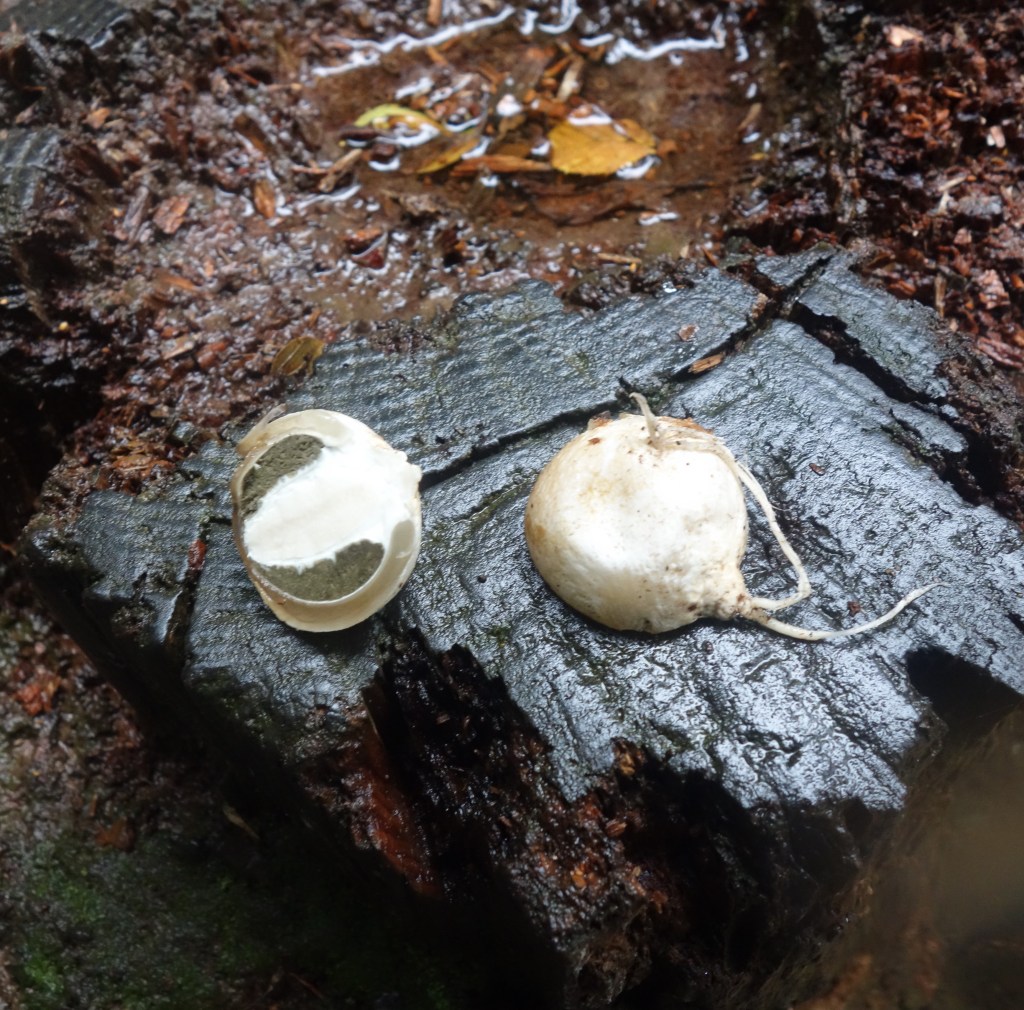
Most fungi start as a root-like structure called a hypha emanating from one spore joining up with another hypha from another spore to form a mycelium, the tangled mass of hyphae that defines the fungus. Since no species can survive without reproducing at some point, the mycelium must somehow send spores somewhere to start anew. Just as plants have devised ingenious ways to spread seeds, so have fungi to spread spores. Mushrooms start as underground bodies called primordia that are formed by the mycelium. They erupt upward on a stem into open air when the time is right to expose the spore bearing gill or pore surface to transporting winds. In the case of truffles and false truffles, the spores are contained in the tuber-like body that is attached to and grows from the mycelium but remains underground. The evolutionary pathway for the truffles and false truffles was to attract animals with enticing smells, not all that different from plants producing flowers with complex chemical scents to attract pollinators. Note that it is important for truffle smell signaling to start only when the spores are fully mature and ready to transport. Animals drawn by the smell to eat them transport truffle spores unwittingly wherever and whenever they “go.” [6]
Animals attracted to truffles and false truffles are globally diverse, inclusive of deer, bears, and rabbits in the Northern Hemisphere and armadillos, baboons, and wallabies in the Southern Hemisphere. [7] Underground fungi offer a food source that is relatively independent of surface conditions making them especially important to cohabitating animals. While most if not all forest dwelling mammals consume truffles on occasion, it is the burrowing squirrels and voles that are best equipped to use them as a major food source. With a keen sense of smell and claws to dig up buried acorns, there can be no doubt that squirrels are truffle aficionados. One well studied example is the California red-backed vole of the Pacific Northwest which subsists almost entirely on truffles. A study in the Oregon Coast Range involving vole capture and evisceration found that truffles made up 85 percent of consumed food, the balance was mostly lichens, also predominantly fungal. The northern flying squirrel, with a range from Alaska to North Carolina, is a nationwide spreader of truffle spores. [8] The extent of the role that truffles play in forest ecology as both providers of key soil nutrients like phosphorous and nitrogen to trees and as food for foragers is not well studied and therefore mostly unknown. This relationship is called mycorrhizal (meaning fungus root in Greek) and was first discovered by a biologist named Albert Frank in 1885 while employed by the King of Prussia to attempt to cultivate truffles. [9] Since there is no above ground evidence and animals need to be literally caught in the act, data are mostly anecdotal. However, one can gather some insight of the range, diversity, and importance of truffles from the aptly named “desert truffles.”
A desert is a dry, barren place incapable of supporting almost any plant or animal life. And yet, truffles thrive across North Africa and the Middle East all the way to China. Eking out a tenuous existence with shrubby plants with which they are mycorrhizal, they are surprisingly ubiquitous. They are sold in many local markets and consumed as an important food source over a vast region, noted for having a taste characterized as “delicate, not pungent.” They are reportedly relatively easy to find as they grow close to the surface and make the ground harder, a property that can be discerned with experience by rubbing a bare toe over the area. [10] As Mesopotamia was the cradle of western civilization, the long history of truffles as both food and medicine there is telling. Truffles have historically been a substitute for meat throughout the Arabian peninsula. Truffles (kama’ah in Arabic) appear in the Koran as preventive medicine, used as promoters of longevity and good health much as many other fungi are in Asia. This a measure of their reputed anti-oxidant, anti-inflammatory, and immune modulating activity. 11] The cultural importance and extensive range of desert truffles across a broad swath of Eurasia is a strong indicator that they are key components of the plant-fungi global ecological partnership. While truffles are surely common and keystone in many regions, almost all of what is known and studied about the nature and nurture of truffles derives almost in entirety from detailed study of a few species that are among those granted the rubric “true truffles.”
True truffles are the epitome of European gastronomy. The black truffle of the Périgord region in southern France (Tuber melanosporum) is surpassed only by the white truffle of the Piedmont region of northern Italy (Tuber magnatum) in desirability and exorbitant cost. The reason for the difference is supply and demand, the universal economic law. White truffles are rarer because, unlike their cultivated French cousins, they grow only under naturally appropriate conditions and require specialized skills to locate. Consequently, in local Italian trattoria, one can purchase risotto with black truffles for about 20 euros, but risotto with white truffles will run over five times as much. [12] The reason for truffle demand is the redolence they impart to food, beguiling gourmands in their search for epicurean nirvana. It is telling that truffles were originally hunted with domesticated female pigs attracted by their aroma which includes the steroid alpha-androstenol, also found in the saliva (and breath) of rutting boars. The same chemical is found in the underarm emanations of men and in the urine of women, and, while the sexual role of the steroid in human sexuality has not been proven, it has been demonstrated. Men rating photographs of (clothed) women for sexual attractiveness gave higher marks when smelling alpha-androstenol. [13] In that smell is intertwined with taste according to the neural-networked brain, the irresistible allure of truffles to humans probably has deeper meaning and possibly including subliminal sexual arousal. It is no wonder that they are considered to be aphrodisiacs. Perhaps at least mentally they are.
It is almost certain that boars that have roamed wild across Europe for millennia were the coevolutionary partners of white and black truffles, spreading their spores far and wide. It is probable that humans first became aware of truffles in association with hunting wild boars. Thus began the long partnership between domesticated pigs and people in the pursuit of pleasure. Dogs have mostly replaced pigs as the truffle hunter’s sensory companion. Heavy, sedentary pigs required carting to truffle forest habitats and had to be forcibly prevented from eating their quarry; many a truffle hunter lost a finger to an overzealous pig. Dogs are not sexually attracted to truffles and must therefore receive olfactory training, much like drug-sniffing dogs of the DEA. This takes a great deal of time and effort, which must of necessity include the use of valuable, short-lived truffles. Trained truffle dogs are dear, commanding prices of over 15,000 euros but rarely sold. They can transit and search woodlands with ease and are not overwhelmed by lust for consumption. In fact, most truffle dogs don’t even like them, though apparently some do. Dogs have different taste preferences, as do their best friends. But not pigs, apparently. [14] The wild boar fungus story has a recently discovered twist. Of 48 boars killed in hunts in Bavaria, Germany, 88 percent had radioactive cesium levels (from Chernobyl) exceeding safety standards. It is considered likely that eating fungi that tend to bioaccumulate heavy metals were the source, especially truffles. [15]
References:
1. Paz, A. et al . “The genus Elaphomyces (Ascomycota, Eurotiales): a ribosomal DNA-based phylogeny and revised systematics of European ‘deer truffles'”. Persoonia. 30 June 2017. Volume 38 Number 1 pp 197–239.
2. “Deer Truffles – biology, ecology, distribution and occurrence of Elaphomyces or False truffle” https://www.umweltanalysen.com/en/elaphomyces-deer-truffles/
3. Neufeldt. V. ed Webster’s New World Dictionary of American English, Third College Edition, Simon and Schuster, New York, 1988, p 1435, 1438.
4. Lincoff, G. National Audubon Society Field Guide to North American Mushrooms, Alfred A. Knopf, New York, 1981, pp 323, 377.
5. Martin, F. et al “Périgord black truffle genome uncovers evolutionary origins and mechanisms of symbiosis” Nature, 28 March 2010, Volume 464 pp 1033-1038. https://www.nature.com/articles/nature08867
6. Arora, D. Mushrooms Demystified, Second Edition, Ten Speed Press, Berkeley, California, 1986 pp 739-741, 841-865.
7. Trappe J. and Claridge A.” The Hidden Life of Truffles” Scientific American April 2010.
8. Stephenson, S. The Kingdom Fungi, Timber Press, Portland, Oregon, 2010 pp 200-205.
9. Frank, A.B. “Über die auf Wurzelsymbiose beruhende Ernährung gewisser Bäume durch unterirdische Pilze” [On the nourishing, via root symbiosis, of certain trees by underground fungi]. Berichte der Deutschen Botanischen Gesellschaft. 1885 Volume 3: pp 128–145.
10. Schaechter. E. In the Company of Mushrooms, Harvard University Press, Cambridge, Massachusetts, 1997, pp 161-167.
11. Khalifa, S. et al “Truffles: From Islamic culture to chemistry, pharmacology, and food trends in recent times” Trends in Science and Food Technology, Volume 91, September 2019, pp 193-218. https://www.sciencedirect.com/science/article/abs/pii/S0924224418303406
12. Goldhor, S. “Hunting the White Truffle” Fungi. Volume 8 Number 3, Fall 2015, pp 18-23.
13. Kendrick, B. The Fifth Kingdom, Third Edition, Focus Publishing, Newburyport, Massachusetts, 2000 pp 281-283.
14. Campbell, D. “Sketches from the Italian Truffle Hunt.” Fungi, Volume 11 Number 1, Spring 2018, pp 20-25.
15. Rains, M. “Germany’s radioactive boars are a bristly reminder of nuclear fallout” Science, 30 August 2023.


 Hiker's Notebook