Ground Beetle

Ground beetles are apex predators of the teeming communities of invertebrates that inhabit the soil under logs, rocks, and leaf litter.

Common Name: Ground Beetle, Black Ground Beetle, Common Black Ground Beetle – Beetle, as insect, is of Old English origin as bitula from bitan a verb meaning “to bite”. This eventually devolved to bityl in Middle English, with the same pronunciation as the current spelling. Beetle can also mean a heavy wooden mallet in which case it is derived from the Old English bietel, which is derived from the verb “to beat”, as in Beatles [1]

Scientific Name: Pterostichus spp – The genus name is a combination of the Greek words pteron meaning “wing” and stichon meaning “divided by lines”. This refers to the pattern of parallel grooves that extend along the thicken wings called elytra (Greek meaning “sheath”) that cover and protect the dorsal side of beetles. The abbreviated spp signifies species pluralis and is used to refer to a genus and all of its species. There are 150 species of Pterostichus in North America. [2]

Potpourri: While it may seem that there could be nothing more mundane than a common black ground beetle, they are an important capstone species as apex predators of the detritus-covered soil that serves as the font for almost anything that grows. They are ubiquitous, also implied by mundane, which can mean worldly in addition to commonplace. Beetles comprise the order Coleoptera, the largest order in Kingdom Animalia, and make up about a third of all insects. There are some 300,000 species of beetles globally of which about ten percent are indigenous to North America. Coleoptera is a direct Latin translation of the Greek koleooptera meaning “sheathed wings”.  The most distinctive features of beetles are the hard, rigid anterior wings called elytra that are not used for flight but sheath and protect the underlying delicate membranous flight wings. [3] Darwin is frequently credited with the observation that “The Creator would appear as endowed with a passion for stars, on the one hand, and for beetles on the other, for the simple reason that there are nearly 300,000 species of beetle known, and perhaps more, as compared with somewhat less than 9,000 species of birds and a little over 10,000 species of mammals.” The quote is properly attributed to the Neo-Darwinist J. B. S. Haldane. [4]

Beetles are prolific in part because they have carved out unique and surprisingly innovative niches in the tangled web of diverse ecosystems. They come in many shapes and sizes to suit the specifics of their subsistence profile. Tiger beetles are close cousins of ground beetles that chase down their prey at high speed over open ground. Tumblebug scarabs roll up balls of dung as hatcheries and first home for their progeny. Lady bird beetles are divinely benign (called cows of the Virgin Mary in France) for devouring aphids that suck plant fluids and destroy crops. Japanese beetles are an invasive blight to any gardener seeking to specialize in roses or fruit trees. Carrion beetles finish off the carcasses of anything too small or unpalatable to larger predators. Blister beetles exude toxins to protect their eggs from being eaten, named for its effects on the flesh of humans. Ground beetles are the generalists of the lot, living quiet lives under logs, rocks, and wet leaves of the forest. Turn over any log and you are likely to find one or more.

Ground beetles comprise the family Carabidae and are therefore also known as carab beetles or simply carabids. The family name is from the Greek word karabos, originally a type of crab which probably carried over to ground beetles due to the similarity of the hardened outer shell, which serves as an armored shield. Both crab and beetle shells are held together with chitin, an organic polymer that is also the main structural component of most fungi and many algae. Chitin is underappreciated as an important biological compound relative to cellulose, the primary structural component of plant cell walls. Both are polysaccharides, comprised of a string of many (poly) sugars (saccharides). The saccharide of choice for both chitin and cellulose is glucose, better known for its role as animal blood sugar, joined end to end with oxygen bonds. About one half of all carbon that comprises earth’s organic life, sometimes referred to as the biosphere, is cellulose. This amounts to one exagram (10 with 18 zeroes) of carbon that is processed and degraded annually, the mass of a mid-sized asteroid. Chitin differs from cellulose in structure only in having one side-bonded acetyl molecule and is only slightly less abundant as a carbon repository. [5]

Ground beetles also proliferate due to physiological attributes that promote adaptability. The most obvious design feature is the hardened, protective carapace they develop as adults, a property of all beetles. Box turtles live long lives due to the coevolution of a similar structure that wards off all but the most determined assaults. Beetles are attacked by fewer predators than other insects. [6] But there is more to beetles than an “intelligent” design. A study of the response of ground beetles to a combination of abiotic factors such as temperature and humidity and biotic factors such as competition and parasites revealed three distinct advantages: (1) Ground beetles are eurytopic, meaning that they can withstand a wide range of environmental conditions; (2) Ground beetles are adventurous rovers that seek out and colonize new areas; (3) Ground beetles are omnivorous and will consume anything edible. [7] But, as Michael Pollan points out in The Omnivore’s Dilemma, there is some danger in food selections due to toxins and a balance of different nutrients is required. Ground beetle experiments have demonstrated an innate selectivity that accounts for overall nutrition. Beetles fed a pretreatment diet lacking protein subsequently sought out protein-rich foods. A similar behavior was found with lipid or fat nutrient levels.[8]

Of the 3,000 plus carabids in North America, most are voracious predators, both as larvae and as adults. The family Carabidae is in the suborder Adephaga, which literally means glutenous in Greek.  With strong jaws for crushing, they are surprisingly fast and agile. The larvae even have two claws at the end of each of their six legs called urogomfi (literally tail-tooth in Greek) for grasping writhing prey. Ground beetle consumption is prodigious. They can eat over twice their body weight in a single day. In the beetle version of the classic movie Cool Hand Luke in which Paul Newman eats 50 hard-boiled eggs, this would equate to fifty repetitions or 2,500 eggs.  This gustatory act, which would seem to violate the laws of physiology and maybe physics as well is empowered in part by the manner in which food is consumed. Ground beetles regurgitate digestive fluids that partially decompose the crushed carcass to facilitate ingestion as a partially liquified meal, a behavior they share with spiders. And what do they eat? Basically, anything organic that is smaller than they are, which typically consists mainly of invertebrates such as worms, mollusks, and the larvae of other insects (including caterpillars and cockroaches). [9]     

Because of their ubiquity and dining habits, ground beetles are generally good for agriculture, the science (and art) of farming. This is because they consume many things that are bad for agriculture. Crop pests are more frequently remediated with pesticides. Since chemicals that kill tend to be toxic to other living things that cohabit the targeted areas, applying them can also adversely affect the ground beetle population. As a case in point, a field experiment was conducted in Britain to measure the effects of pesticides applied to rid cabbage patches of the maggots (larvae) of the cabbage root fly. The surprising result was that the cabbage fields to which the chemical was applied suffered more maggot damage than those unsprayed as control. Investigation revealed that over 30 species of beetle ate the eggs and larvae of the offending predator and that the pesticide reduced their number to the extent that more root flies survived. [10] Two of the laws proposed by Barry Commoner, the father of ecology, are “Nature knows best,” and “Everything is connected to everything else.” Ground beetles are proof positive, and studies of cultivation practices have been conducted to determine best practices. These have shown that deep tillage depletes ground beetle population whereas reduced tillage with organic fertilization and green manuring promotes them. [11]

Most ground beetles look alike. In fact, the photograph above may very well be a bessbug, a similar beetle that lives in the same rotting log habitat but does not compete with ground beetles since bessbugs consume decaying wood and are not predatory. Even entomologists that specialize in beetles have trouble telling them apart.  The obscure French entomologist René Jeannel (1879 – 1965) spent most of his life studying the speciation of nearly identical cave beetles. After a career of detailed research, he discovered that one of the most reliable identification tools to distinguish one beetle from another was the shape of the male reproductive organ called aedeagus from the Greek aidoia meaning genitals. This practice has continued to the present; it is a relatively common practice for biologists to use both male and female genitalia as a key indicator of species.

Beetle aedeagi generally consist of a capsule-shaped organ from which an inflatable sac extends like a windsock. The extended “penis” is studded with bristles and spines, which must have some purpose as beetles are bisexual and intercourse is de rigueur for procreation. The current hypotheses is that male beetle semen contains chemicals that influence female sexual behavior and that this effect is enhanced by being directly transferred to the blood via spine puncture wounds. Recent experiments employed a micro laser gun to remove some male penal spines to form a test group to compare with a fully-spined control group. The end result was that females impregnated with the fully spined group produced more offspring. The presence of spines on the male sexual appendage is not as outlandish as it sounds. Spines (made of keratin, like hair) are also found on many primates and rodents and there is evidence based on residual DNA that they were they were at some point present on Homo sapiens. [12] So beetles do matter after all.

Footnote: No article on beetles would be complete without reference to the origins of the name of the inimitable Beatles. John, Paul, and George started out as the Quarry Men without a drummer in Liverpool in the late 1950’s. As they gradually developed the sound for which they are so well known today, they decided they needed a more memorable stage name. John is quoted as saying that he was “just thinking about what a good name the Crickets (Buddy Holly’s band) would be for an English group when the idea of beetles came into my head”. He is also credited with changing the spelling to Beatles “to make is look more like beat music, just as a joke”. The original spelling was Beatals.  After a short experiment with Long John and the Silver Beatals, presumably to sound more like Buddy Holly and the Crickets with a literary flourish, Beatals became simply Beatles and the rest is history. [13]

References:

1. Webster’s Third New International Dictionary of the English Language, Unabridged, Merriam Webster Co, Philippines, 1971, p 197.

2. Marshall, S. Insects. Their Natural History and Diversity, Firefly Books, Buffalo New York, 2006, pp 258-259, 287.

3. Milne, L. and M. The National Audubon Society Field Guide to Insects and Spiders, Alfred A. Knopf, New York, 1980, pp 533-621.

4. Haldane, J.B.S. What is life? The Layman’s View of Nature, L. Drummond, London. 1949, p 258 (Verified on paper by Stephen Goranson at Duke University)

5. Voet, D. and J. Biochemistry, John Wiley and Sons, New York, 1990, pp 255-257.

6. Gressitt, J. L. “Coleoptera” Encyclopedia Britannica Micropedia, Volume 4 pp 828-837 William and Helen Benton, publisher, University of Chicago. 1974.

7. Thiele, H. “Carabid Beetles in Their Environments. A Study on Habitat Selection by Adaptations in Physiology and Behavior”. Science August 1978, Volume 201 Issue 4357.

8. Mayntz, D. et al “Nutrient-Specific Foraging in Invertebrate Predators” Science 7 January 2005, Volume 307 Number 5706

9. Goncalves, M. “Relationship Between Time and Beetles in Mata de Cocal” Review of Brazilian Meteorology, Volume 32, Number 4, October 2017.  https://www.scielo.br/j/rbmet/a/kJPLKtB3gLTdfTcMB9vM4Vd/?lang=pt

10. Nardi, J. Life in the Soil, University of Chicago Press, Chicago, Illinois, 2007, pp 136-138

11. Kromp, B. “Carabid beetles in sustainable agriculture: a review on pest control efficacy, cultivation impacts and enhancement” Agriculture, Ecosystems, and Environment, Volume 74, Issues 1-3, June 1999 pp 187-228 https://www.sciencedirect.com/science/article/abs/pii/S0167880999000377?via%3Dihub   

12. Schilthuizen, M. Nature’s Nether Regions, What the Sex Lives of Bugs, Birds, and Beasts Tell Us About Evolution, Biodiversity, and Ourselves. Penguin House, New York, 2014, pp 28-31, and pp 150-157.

13. Spitz, B. The Beatles, Little, Brown and Company, New York, 2005. pp 175, 181, 196.

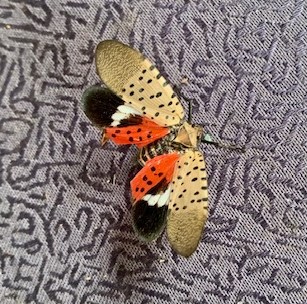
Spotted Lanternfly

The adult spotted lanternfly has a head and eyes similar to the closely related cicada

Common Name: Spotted Lanternfly, Chinese blistering cicada, Spot clothing wax cicada – The term lanternfly is generally applied to several families of planthopper insects even though there is no known species that emits light. Most planthoppers are small insects that are colored to blend into the backdrop of greens and browns. This species of lanternfly is distinctive in having prominent spots on its folded forewings.

Scientific Name: Lycorma delicatulaLyco is Latin for wolf and could possibly be in reference to a color or texture of the body or wings. A more plausible etymology is a derivative of lychnus, Latin for lamp. The species name means dainty or nice. So, it could be construed as delicate lamp, consistent with the common name.

Potpourri: The spotted lanternfly is the latest North American invasive insect invader. It has taken its place alongside Japanese beetles, gypsy moths (spongy moths since 2022), and woolly adelgids in the rogue’s gallery of unwelcome invertebrates.  The invasive species epidemic is the unintended yet almost inevitable result of global trade in shipping containers that pass from continent to continent with almost anything inside in numbers that preclude anything close to universal screening. The spotted lanternfly has followed the invasive biological playbook in reproducing geometrically, eating everything in sight, and taking advantage of an environment devoid of any serious predation. It is unique among insect pests in having been preceded by its favorite host plant, Ailanthus altissima or tree of heaven, which was imported from Asia and intentionally planted for its robust tenacity and rapid growth. It was the tree of Betty Smith’s iconic “A Tree Grows in Brooklyn.” It became the tree that grows everywhere in North America as a ready source of food for its Asian lanternfly cohort.

The spotted lanternfly is a planthopper, a group consisting of mostly tropical, inconspicuous insects that are easily confused with treehoppers, leafhoppers, and froghoppers in the “endless forms most beautiful” of the class Insecta. In that they extract the liquid nutrient produced by plants with a hollow beak, literally sap-sucking, they are generally placed in the order Hemiptera. These are the true bugs as opposed to the more common use of the word bug for almost any insect like ladybugs that are beetles. Hemiptera is Latin for half wing, referring to the forewing that is solid at the base and membranous at the tip. Some entomologists separate those bugs with wings that are membranous from base to tip in a separate suborder Homoptera meaning same wing. The homopterans consist of three broad groups: cicadas, aphids, and planthoppers. [1]

As a close cousin of aphids and cicadas, it is easy to understand why there might be a problem with spotted lanternflies. Aphids are perhaps the most economically damaging insect in the global temperate regions that constitute the breadbasket for most of humanity. Cicadas are masters of reproduction, producing millions of offspring in seventeen, thirteen, or single year cycles. The spotted lanternfly reproduces with cicada fecundity and sucks sap with aphid voracity. Having been first introduced into Pennsylvania in 2014, they have spread with Malthusian certainty over the mid-Atlantic states to the extent that there is a hue and cry for some form of countermeasure before epidemic populations ensue. This will be difficult if not impossible since they feed on a wide variety of plants, are not palatable to most insect predators, deposit mounds of excrement called honey dew that attracts other pests and pathogens and pass from the scene only after having mated and laid massive egg deposits that are well protected and hidden by a waxy overcoat. [2]

The bright orange contrasting wing bars may be a aposematic warning of toxicity to birds.

Even though spotted lanternflies prefer the tree of heaven, they are not finicky. They have been found feasting on over 100 different hosts from 33 plant families that include but are not limited to vines, ornamentals, specialty plants and fruit trees. The list of plants narrows considerably as they grow and molt. Like all insects, lanternflies have a life cycle based on metamorphosis. They overwinter as eggs that hatch in spring as nymphs that are black with white spots that must extract plant sap to survive. As they grow over the next several months, they literally get too large for the original carapace and must molt several times to form a new, somewhat larger body called an instar.  The first three instars are similarly diminutive and inconspicuous nymphs that move to ever larger plants to provide the additional amount of nutrients needed for their larger-sized appetites.  The fourth instar marks a radical change in appearance. The adult is metamorphosed by evolution’s magical genetics into a much larger body with moth-like wings that are brightly colored with stark contrast. It is the adult spotted lanternfly that is nemesis of vineyards and orchards. [3]

Brightly colored defenseless animals seem a contradiction. The goal of every living thing is to reproduce to perpetuate the species. Getting eaten before mating and oviposition leads to genetic extinction. Many animals hide from predators by adapting their coatings to match the colors and textures of their environment. This is called crypsis. However, if an animal is poisonous to its predators it is advantageous from the evolutionary perspective to make that clear in advance. It does not help if the poison is only detected after the insect’s body is mangled. Bright coloration to alert predators of potential toxicity is called aposematism. The monarch butterfly, which consumes the poisonous milkweed plant is the classic example. And this, apparently, is where the tree of heaven comes in. A simple field test of this predator alert effect on birds was conducted using two different batches of suet, one made with crushed spotted lanternflies that had eaten Ailanthus altissima and one with spotted lanternflies that had not. Birds preferred the latter, demonstrating that consuming tree of heaven was effective in protecting the spotted lanternfly. [4] That they actually evolved their distinctive bright orange wing bars to indicate toxicity is correlated but not proven. It has been suggested that the closed forewings are cryptic so that the spotted lanternfly can hide on tree trunks but that the aposematic flash of orange occurs when they are under attack by a pecking bird.  

If the spotted lanternfly ate only A. altissima, that would be a good thing. Were it not for its other inimical activities, it could even be considered a biological control against the tree of heaven, which has invasive problems of its own. This is in part because of its chemistry, producing cytotoxic alkaloids that suppress the growth of other plants. One of its chemicals, named ailanthone for the genus, reduces the growth of other plants by 50 percent at a concentration of only 0.7 ppm. [5] It is not known which of the secondary metabolites of the tree are employed by the spotted lanternfly, but there is some serious chemistry going on. The spotted lanternfly has been used in traditional Chinese medicine since the twelfth century to reduce swelling, presumably due to its tree derived toxins.  Spotted lanternflies have become a biological bane due primarily to their second favorite food, the plant sugars fructose and sucrose that are especially concentrated in the genus Vitis, which includes the various grapes of the global wine industry. [6] In North America, there are 40 other known hosts, including black walnut, tulip tree, oriental bittersweet, multiflora rose, and hops, a key beer flavoring ingredient. [7]

Sap sucking insects require the same three basic inputs necessary for all plants, animals, and fungi: carbohydrates for energy, lipids for membranes, and proteins for amino acids. Sap is high in carbohydrates but low in protein. Much more sap must be extracted than is needed for carbohydrate energy to get enough protein for growth. The result of the extra input of sugar is more output as insect excrement or frass. The high sugar frass produced by sap-sucking insects is fittingly called honeydew. Some ant species herd and protect aphids to collect honeydew as food for their larval offspring. The honeydew of spotted lanternflies becomes a social problem due to their numbers and the volume excreted. The sticky goo builds up on whatever is underneath, which may include things like picnic tables and lawn furniture that become stained with mold. Honeydew is also attractive as a food source for stinging insects like yellow jackets that are disruptive to outdoor human activities.  [8]

The ootheca are almost impossible to see in between ridged tree bark

The global spread of spotted lanternflies is mostly due to the coating that they apply to their eggs that both conceals and protects them. Each gravid female lays about 40 eggs and then secretes a brownish, waxy substance to cover them. The end result is an oothecum, a thick-walled egg case similar to that made by cockroaches. While most insects lay eggs on host plants that will serve as the first meal for the emergent larvae or nymphs, spotted lanternflies will use almost any available surface with a preference for the vertical. In most cases, the ootheca are further protected by placement in obscure locations that range from tree bark fissures several meters above the ground to stone monoliths and building walls. Once the process is complete, the ootheca are almost impossible to find absent a detailed inspection which can only be effective if you already have a good idea where to look. As the egg casing ages, it looks more and more like dried mud, making identification even more challenging. It is believed that the first spotted lanternflies arrived in Pennsylvania as an oothecum attached to a shipment of landscaping stones, almost certainly sent in a shipping container from Asia. [9]

Control and containment of the spotted lanternfly is evolving in concert with its radiating spread outward from its point of origin with concomitant economic damage. Estimates at this point are speculative as they are based on extrapolation of local damages in infested areas. Pennsylvania, where the spotted lanternfly first appeared, may see damages of up to $100 million annually due to crop loss. If spotted lanternflies spread to the Pacific Northwest, losses to cherry, wine grape, and hops crops in Washington are estimated at about $4 billion.  Two spotted lanternflies have already been found in Oregon on packing containers and ceramic pots that both came from Pennsylvania. They were dead, but egg cases cannot be too far behind. [10]

The three basic methods to exterminate pest insects are mechanical, chemical, and biological. Mechanical means range from the satisfying but fruitless attempts to find and squash the bugs to affixing host trees with some form of baited trap. In the case of lanternflies, glue coated sheets, some with attractive pheromones, have been tried with limited success but with the caveat that bycatch of birds and butterflies is always a concern. As discussed above, finding and scraping egg masses is not feasible and getting rid of its preferred tree of heaven host that are the dominant tree along many miles of US highways would be nearly impossible.

This leaves chemical and biological as the only two viable means to combat the spotted lanternfly invasion. Pesticides like neonicotinoids (Dinotefuran is prescribed by federal agencies) and organophosphates are effective, but they are general agents that have been implicated in reducing beneficial insect populations like honeybees. The other problem with pesticides is the development of immunity by species through natural selection. There will almost always be individual insects that are resistant to a pesticide due to the randomness of mutation. The resistant mutants survive the poison to propagate their genes, replacing those that were killed by it.  A second issue is the economic cost of using pesticides over large areas, relegating most applications to field size acres instead of the county size square miles that are necessary for extirpation. Vineyards in Korea that were sprayed with pesticide were rapidly repopulated by spotted lanternflies from nearby forested areas. [11]

Biological controls are more promising. A lot of attention has been paid to the role of birds, which are put off by the toxins that spotted lanternflies extract from the tree of heaven.  It was even suggested that if 70 percent of the spotted lanternflies could somehow be kept from their favorite food, then birds would do the rest. This was proffered with the caveat that “we need to do everything we can” even if this cannot. [12] The best place to look for biological controls is in the country of origin, where the local ecosystem keeps the target species in check. One promising possibility is a wasp native to China that parasitizes up to 80 percent of spotted lanternflies. However, introducing an alien predator species is cumbersome due to the need to test both its efficacy on the target species and its possible harmful effects on other species. However, biological control is in all likelihood the only way to prevent the dystopia of spotted lanternfly proliferation over the long term.

References:

1. Marshall, S. Insects, Their Natural History and Diversity, Firefly Books, Buffalo, New York, 2006, pp 91-104.

2. . “Spotted Lanternfly Pest Alert” (PDF). USDA-APHIS. USDA https://www.aphis.usda.gov/sites/default/files/alert-spotted-lanternfly.pdf  

3. Barringer, L. “Lycorma delicatula (spotted lanternfly)”. www.cabi.org. 17 December 2021

4. Kranking, C. “Birds Are One Line of Defense Against Dreaded Spotted Lanternflies” Audubon Magazine, 17 September 2021. https://www.audubon.org/news/birds-are-one-line-defense-against-dreaded-spotted-lanternflies    

5. https://hikersnotebook.blog/flora/deciduous-trees-and-shrubs/ailanthus-tree-of-heaven/

6. Dara, S.; Barringer, L.;  Arthurs, S. (2015). “Lycorma delicatula (Hemiptera: Fulgoridae): A New Invasive Pest in the United States”. Journal of Integrated Pest Management. 20 November 2015 Volume 6 Number 1. pp 1–6. https://academic.oup.com/jipm/article/6/1/20/2936989?login=false

7. Murman, K, et al. “Distribution, Survival, and Development of Spotted Lanternfly on Host Plants Found in North America”. Environmental Entomology. 31 October 2020 Volume 49 Number 6. pp 1270–1281. https://academic.oup.com/ee/article/49/6/1270/5947504?login=false

8. Barringer, op cit.

9. . Urban, J..; Leach, H. “Biology and Management of the Spotted Lanternfly, Lycorma delicatula (Hemiptera: Fulgoridae), in the United States”. Annual Review of Entomology. 23 January 2023. Volume 68 Number 1 pp. 151–167. https://www.annualreviews.org/content/journals/10.1146/annurev-ento-120220-111140    

10. Department of Agriculture. “Pest Alert: Spotted lanternfly Lycorma delicatula”. Oregon Department of Agriculture Fact Sheets and Pest Alerts    https://www.oregon.gov/oda/shared/Documents/Publications/IPPM/SpottedLanternflyPestAlert.pdf              

11. Dara. S. et al op cit.

12. Grandoni, D. “Squashing lantern flies (sic) isn’t enough; it might be time to send in the birds” Washington Post 7 March 2024.