Masting Behavior of Trees

Acorn mast from white oak trees occurs about every 5 years, evidence of variability

Common Name: Masting – The production of copious quantities of deciduous tree nuts in a single year followed by several years of minimal nut production. The phenomenon involves all nut trees, regardless of species, within a well-defined geographical region.

 Scientific Name:  Seed masting or Mast Seeding – A slightly more technical term to emphasize that the purpose of masting is to accentuate seed propagation to promote new tree growth.

Potpourri: Mast is a noun of Anglo-Saxon origin (mæst in the original Old English form using the ligature æ) that refers to the accumulation of various kinds of nuts on the forest floor that served as food for farm animals, particularly domesticated hogs. Pannage is a mostly arcane term for the pasturing of animals in the forest to take advantage of the mast, a practice that played a major role in the sociological development of rural life in Europe. As the swine population grew in concert with the human population, the pannage season had to be restricted, traditionally from the feast of Saint Michael (September 29) to the last day of November.  Pigs were brought to the New World with the earliest expeditions, notably that of Hernando De Soto in the southeast from 1539 to 1542, the progenitors of the razorback. Hogs became central to the salt pork and fatback cultures of the Appalachian and Ozark Mountains, the oak-chestnut forests providing the mast for their sustenance. [1]

The process by which trees produce mast is called masting. The curious thing about masting is that it is not a continuous process but rather is cyclic. Every three to five years a tree will produce prodigious quantities of nuts; in between the “masts,” it will produce almost none. The span of time between masts varies according to tree species and a host of other ecological and climate factors and can be as long as ten years. It is a matter of common experience that many kinds of trees exhibit this behavior at the same time over a large geographic area. This poses two conundrums: (1) Why do the trees regulate their nut production in a boom or bust manner?; and (2) How do they manage to coordinate the same cycle with other trees over a large area? Individual tree masting is called variability and the coordination among masting trees is called synchrony. [2]

Variability has had two hypothetical explanations: resource responsiveness and economy of scale.  The basic precept of resource responsiveness is that an individual tree will respond to the resources at its disposal. In a good year with plenty of rain and sunlight, a tree would have more resources with which to manufacture more nuts, which would subsequently be more likely to propagate in a moist, nutrient rich environment.  The primary resources of interest (rain and an adequacy of sunlight) are determined by prevailing weather conditions. Since weather patterns extend over an extended geographic area, resource tracking could also explain synchrony, as all the trees would be subject to the same cycle of resources.

Nature is not that simple, however. The fact is that variations in weather do not correlate with masting; moist and sunny weather does not produce a mast crop any more than dry and overcast weather prevents one. Weather is not cyclic; a wet year is not necessarily followed by a dry year. Masting is much more consistent in periodicity and result, cycles of high nut production occurring on a regular, periodic basis. However, there is one aspect of resource utilization by masting trees that does track with mast cycles, the resources expended by the tree. A significant resource investment (estimated to be about 10 percent of its total nutrients) must be made by a tree to produce the flowers that, when fertilized, produce the seed nuts. What this means is that trees grow slowly during mast years and more rapidly in non-mast years as the resources are shifted from reproduction to growth.   This suggests that masting is part of a complex evolutionary behavior pattern that must derive from an ecological stimulus – economy of scale variability.

The term economy of scale refers to the general precept that benefits will be magnified by the scale of the population size. Buying in bulk lots distinguishes wholesale from retail with the former gaining the economy of scale reduced costs of larger quantities.  There are two corollaries associated with the economy of scale theory for masting variability – predator satiation and pollination efficiency. In predator satiation, masting is stimulated by a tree’s adaptive strategy for survival in a world of nut-eating predators (notably squirrels). By producing a super-sized nut crop, the predators become satiated so that an adequate number of nuts will survive to succeed for propagation of the tree species.

The seven white oaks in my backyard so overwhelm the squirrel population with acorns in a mast year that they scamper about in confusion with too many nuts to eat or bury. A rough calculation based on extrapolation yields a total over 200,000 acorns. When squirrels cross from the back yard to the front past the side of the house, they are confronted with an equally overwhelming mass of hickory nuts from the hickory trees there, which, of course, mast in synchrony with the oak trees. The predator population is held in check during the non-mast years, when the parsimony of production is reflected in declining populations. In the economy of scale paradigm, each nut in a mast year has a greater probability of escaping predation.
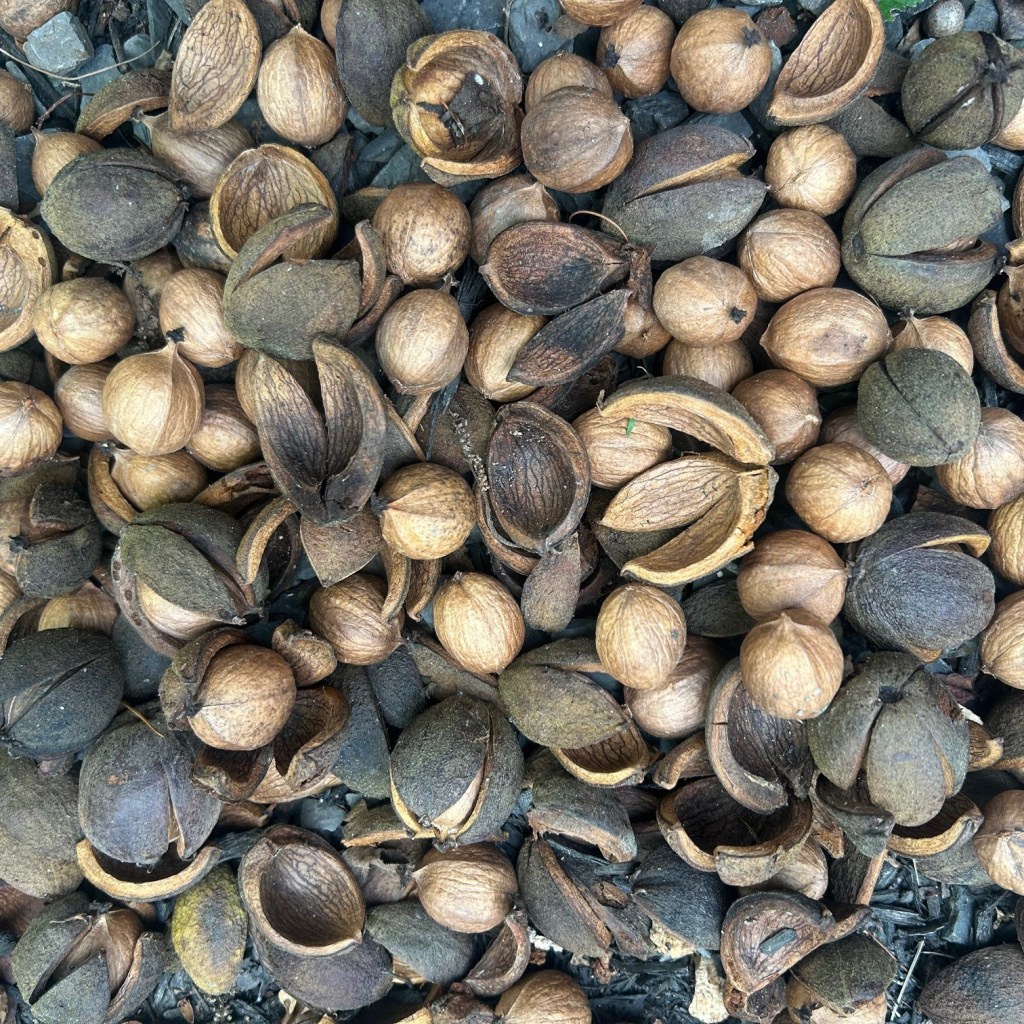
Hickory nut mast 10 meters away from acorn mast above, evidence of synchrony

Pollination efficiency is based on the notion that it is more efficient from the resource standpoint for a plant to successfully propagate if there are a large number of sites for germination. This is not true for all plants. Flowering (Angiosperm) plants employ insect pollination, meting out nectar advertised by their attractive flowers to take advantage of male pollen transport to the female ovary of another plant. Chicory is a good example, as only a few flowers open each day and each expires at day’s end. Oak and hickory trees are monecious (male and female flowers are on the same tree) and their pollen is transported from staminate to pistillate flowers by the wind.  From the standpoint of reproductive success, it is advantageous for oaks to fill the air with pollen from many trees at the same time, saving up energy during off-years. Fungi are also mostly wind-pollinated and accordingly produce spores in prodigal proportions; a giant puffball is estimated to contain about 7 trillion spores.

Field testing for experimental evidence of predator satiation and pollination efficiency as causative factors for the masting behavior of trees is difficult and the results tenuous. For example, a study of masting trees in a 6-hectare study area estimated pollination efficiency by counting the total number male flowers and the number of nuts produced from1988 to 1993. Testing for predator satiation is even more difficult; one must not only show that predators were satiated but also that the interval between masting events was sufficient to result in a decrease in predator population. The same study utilized the number of nuts that had evidence of insect predation relative to those that were undamaged as a measure of satiation. The year-to-year variance in nuts with evidence of insect predation was used to determine the mast interval. The study concluded that both effects were observable, pollination efficiency having a greater impact than predator satiation. [3]

But the real conundrum is not why trees mast as individuals (variability), but how they coordinate their activities over large areas and across different species (synchrony). It is a matter of direct observation and scientific study that they do. A survey of acorn production was initiated in 1994 to quantify acorn production of blue oaks at 10 different sites at separated by up to 700 kilometers in California. The conclusion, after eleven years of study was that “acorn production extends to pretty much every blue oak, a population of 100 to 200 million individuals.” A more comprehensive literature survey of relevant references on nut production by various trees was organized by W.D. Koenig, a professor at UC Berkeley. A review of 72 sites and 5,000 data points revealed that synchronization of seed production was statistically significant in populations separated by 2500 kilometers. [4] One may conclude that synchrony occurs over long distances and involves almost every tree. So how do they do it?

Three mechanisms are germane to any discussion of synchronization of activities among plants or animals: chemical, reproductive, and environmental. The use of chemicals to transmit signals among individuals is common. However, it is not likely that this is pertinent to the case of masting as chemicals act over much shorter ranges than is observed in masting tree populations. Reproductive synchronization in arboreal terms is called pollen coupling. The concept is that if a tree depends on the pollen from a second tree to produce the fruit nut, then it must be synchronized with it. Implicit in this is that the tree that is providing the pollen must be at some relevant distance away. The effective distance over which pollen is effective in achieving fertilization is of value in forest management; recently completed studies have revealed that pollen is only effective within a range of about 60 meters, hardly on the order of the observed ranges of masting behavior. [5] A second reason that this mechanism is irrelevant here is that both oak and hickory trees are monecious, so the pollen doesn’t need to travel more than a few meters. Since it is not likely that chemical or reproductive effects result in the long-distance synchrony of masting, one must conclude that the only other reasonable choice would be environmental.

The notion that resource responsiveness to the environment causes the masting behavior of individual trees, i.e. variability, was ruled out above based on field observation. The question is how environmental resources that could not cause masting variability would nonetheless be the cause for masting synchrony.  It is the difference between weather and climate, the former term referring to the short-term manifestation of the latter. The idea that the environment can cause synchronous fluctuation in population size is not new. It is called the Moran effect after the Australian statistician who showed that the correlation of two populations at different locations was equal to the correlation in their common environmental influence (if they were subject to the same basic parameters).  It has been demonstrated empirically in many organisms, from viruses in the body to caribou in Greenland. [6]

It is therefore possible that geographically wide-ranging climate conditions cause trees to mast in synchrony. It is not known at present what aspect of the climate is predominate, if, in fact, it is that simple. There is some evidence that temperature may be a key parameter. The study of the California oaks was correlated with the mean temperature in April over the course of the eleven years of data. April was chosen as the most important month for masting, as it is when the trees produce the male and female flowers that result in nuts that ultimately fall as mast. The spatial synchronization of April temperatures was found to be even more strongly correlated than the masting of the oaks. The rationale is clear: the periodic fluctuations of temperatures (perhaps caused by the cyclic El Nino phenomenon) operate in synchronization with masting over the same geographic area. [7]

Or maybe it is something else altogether. The recent demonstration of the communion of all of the trees in the forest in concert with their mutualistic fungal partners may offer an alternative hypothesis. It is demonstrably true that the stronger trees in a forest send nutrients to the weaker trees in the forest and the trees in the sun send nutrients to the understory trees in the shade in order to keep the forest ecosystem in balance [8], then why wouldn’t these same signal paths send the signal to make more nuts? As the nutrient levels build up in the tree roots and fungal mycelia during high growth years, a crescendo point is reached and each and every tree gets a boost of energy to make it a mast year. This would certainly explain synchrony, and, given the vast dimensions of the “wood-wide web” it would also explain regional geographic expanse. All of the trees in the forest would benefit from an increased likelihood of the growth of saplings that would eventually succeed their parent trees so that the forest as “mega-organism” survived.

A similar and probably related observation is that many fungi will gather their resources for years only to erupt in a single year that results essentially in what might be considered a mast of mushrooms. There are many similarities as fungal spores, like the pollen of trees, benefit from a large cohort; each germinating spore creates a hypha that must find a mate. The fact that oaks have an especially large number of fungi with which they form mycorrhizal associations is quite likely why they are so successful as climax forest tree species in part due to the benefits of masting to longevity in a healthy forest. [9]

Another point to ponder at this juncture is why the masting phenomenon is restricted only to nut trees like oaks. What about the seed-bearing cones of conifers? It is not uncommon to traverse a pine forest, noting the soft tread of pine needles and a profusion of cones. The pine needles are indicative of a little noted characteristic of evergreens. They lose their needles just as deciduous trees shed their leaves. They just don’t do it all at once but take about four years to recycle all needles (longer for firs and spruces).  Cone masting is more of a challenge, however, because it takes three years to produce a cone. Year one requires moisture and sunlight to prime the cone by accumulating resources, year two must be dry to enhance pollination, and year three must be wet and sunny for cone growth. While cone trees “mast” based on field observation experience, there does not appear to be any synchrony between conifers masting cones and deciduous trees masting nuts. This has led to the hypothesis that cone bearing trees produce copious seeds when environmental conditions favor germination as opposed to the more social sharing behavior of nut trees.  [10]
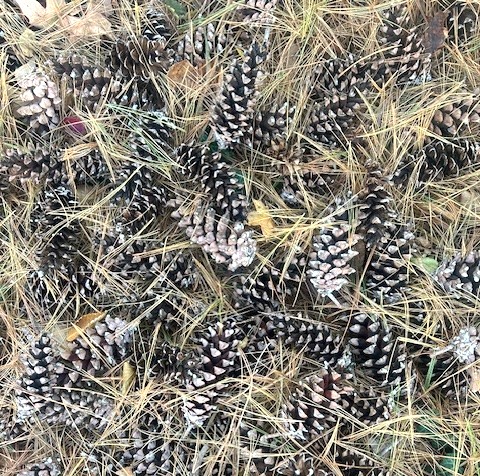
Pine trees also produce many cones with their embedded pine nuts on a periodic basis like oak and hickory trees

Over the last twenty-five years, research to better understand tree masting and its effects of forest health has continued, expanding across the globe from its mostly North America and Europe roots and to involve specialists from fields other than botany. Of note is confirmation of the wide geographic range of masting synchrony that has been shown to be of intercontinental scale, extending to over thousands of kilometers. This suggests that fluctuating weather patterns driven by some environmental factor (the 11-year sunspot cycle has been proposed) must be key to synchrony as nothing else could be so widespread.  One of the more influential studies concluded that masting was the fundamental driver of animal behavior: “variable acorn crop size drives a chain reaction linking deer populations, ticks, and Lyme disease along with mouse populations, ground-nesting birds, and gypsy moths”.

The fundamental debate is now focused on the relative importance of resource matching (that masting depends on some limited resource), and economy of scale (that masting depends on genetic evolutionary trends of the tree species). A resource budget model has been proposed that unites the two with advantages of evolving to produce mountains of acorns weighed against the resources needed for synchronous reproduction. [11] The bottom line is that there is not (yet) an accepted comprehensive explanation for masting, despite its importance to the health of forests and the animals and fungi that live in them. It may well be that we are just at the threshold of understanding the real, complex nature of forests.

References:

1. DeVoto, B. The Course of Empire, The Easton Press, Norwalk, Connecticut, 1988. pp 23-31.

2. http://uslancaster.sc.edu/faculty/scarlett/acrnsmry.htm  

3. Shibata, M. et al “Causes and Consequences of Mast Seed Production of Four Co-occurring Carpinus species in Japan” Ecology, January 1998, pp 9 – 12 This paper documents a thorough field test of masting hypotheses.

4. Koenig, D. and Knops, J. “The Mystery of Masting in Trees” American Scientist Volume 93 July-August 2005. Pp 340-349.

5. Knapp, E. et al “Pollen-limited reproduction in blue oak: Implications for wind pollination for fragmented applications” Oecologia 128 March 2001 pp 48-55.

6. Moran, P. A. P. “The statistical analysis of the Canadian lynx cycle. II. Synchronization and meteorology” Australian Journal of Zoology, June 1953 pp. 291–298.

7. Koenig, D. and Knops, J. Op. cit.

8. Klein, T. et al “Belowground carbon trade among tall trees in a temperate forest.” Science 15 April 2016, Vol. 352, Issue 6283, pp. 342-344.

9. Binion, D. et al Macrofungi Associated with Oaks of Eastern North America, West Virginia University Press, Morgantown, WV, 2008.

10. Lauder, J.  “The Science of Masting: Why are there so many acorns (or cones)?” Sierra Streams Institute. 15 October 2024 https://sierrastreamsinstitute.org/2024/10/15/the-science-of-masting-why-are-there-so-many-acorns-or-cones/    

11. Koenig D. A Brief History of Masting Research Philosophical Transactions of the Royal Society, 26 March 2021 Volume 376
Horsenettle

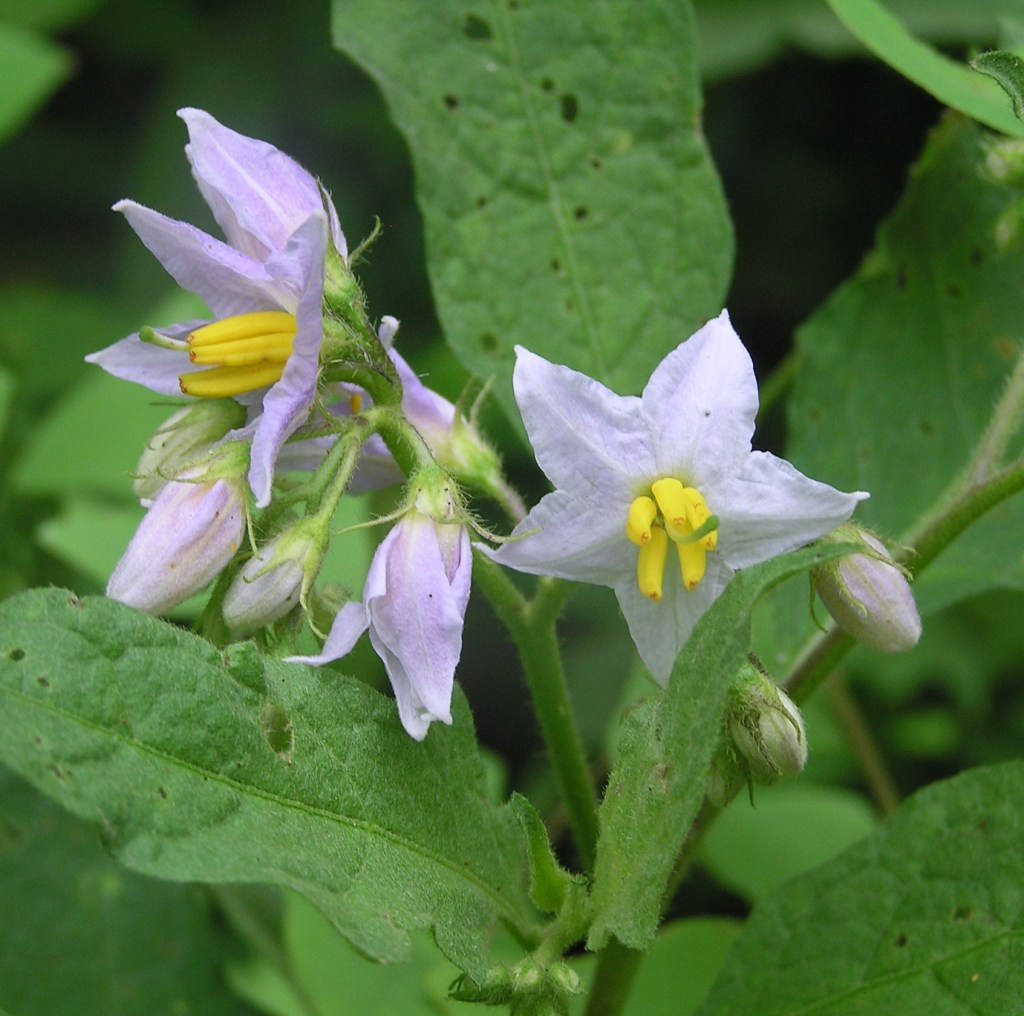
Horsenettle flowers range from light purple to white, all with tubular yellow stamens to attract pollinators

Common Name:  Horsenettle, Bull nettle, Carolina horse nettle, Apple of Sodom, Devil’s potato, Thorn apple, Wild tomato, Poisonous potato – A nettle is a plant of the genus Urtica noted for stinging hairs. The name has been widely applied to other plants that have prickles like the horsenettle. The horse association is likely due to the fact that horsenettle plants are commonly found in pastures, like those fenced off for horses.

Scientific Name: Solanum carolinense – Solanum is Latin for nightshade. The genus name is attributed to Pliny the Elder (Gaius Plinius Secundus), a Roman military commander and naturalist in the first century AD. The origins of Solanum are unclear, but sol is Latin for sun; there is a sunberry flower in the nightshade family. The similarity in spelling to the Latin word solamen which means comfort is another possible etymology. [1] Plants of the Solanum genus have historically been widely used as medicine for a variety of ailments and conditions.  The species name is reference to the North American colony Carolina where it was first noted, probably before its division between north and south.

Potpourri: The horsenettle is a weed according to the standard definition as it grows where humans don’t want it to grow and crowds out preferred plants. If weediness is a matter of garden aesthetics, however, an argument can be made that the five-petalled white or purplish star with five yellow elongated stamens projecting from the center has some appeal. If weediness is detrimental to food crops like soybeans and wheat awaiting harvest from farm fields, then eradication with herbicides may be justified. Horsenettle is also poisonous to the extent that it is included in edible wild plant field guides as a cautionary measure to prevent gathering the wrong things when edible plants are sought. [2] But it is also medicinal, having been used by Native Americans and subsequently by colonizing Europeans for centuries. This, too, is not unusual, as horsenettle is a member of the Nightshade family, a rogue’s gallery of deadly plants that also includes potatoes, tomatoes, peppers, and eggplants, mainstay edibles of western cuisines. Horsenettle is bad weed, good medicine, and has ugly prickles.

Another thing that can be said about weeds like horsenettle is that they are successful plants, able to flourish in marginal soils and spread outward in profusion. That is what all living things aspire to do, perpetuating their own kind following the recipe for survival by being fittest. Darwin came to recognize that competition among plants was equal to if not more than that among animals, even as Galapagos finch beaks became his focus. As a backyard scientist with inimitable curiosity, he conducted an field test in his backyard by clearing six square feet down to bare soil to observe the emergence of native weeds. He noted that “out of 357 no less than 295 were destroyed, chiefly by slugs and insects,” the detail testimony to thoroughness. As confirmation, he repeated the experiment on a second area of established turf, noting that “out of twenty species … nine species perished” because the “more vigorous plants gradually kill the less vigorous.” [3] It is evident that becoming a successful weed is an evolutionary feat rather than a routine event. It is also apparent that the weeds that persist and become human problems are the cream of the weed crop, exceptionally evolved with propagative efficiency.

Horsenettles are poisonous because they produce an alkaloid chemical named solanine, the name derived from Solanaceae, the Nightshade family of almost 4,000 plant species in nearly 100 genera. Alkaloids are complex organic chemical compounds that can in many cases have physiological effects on animals ranging from medicinal like morphine, hallucinogenic like mescaline, and stimulants like nicotine (the “ine” suffix is prescribed). The root alkali is derived from the Arabic word for the calcined ashes of the saltwort plant, and refers to molecules that are basic (pH > 7), the opposite of acidic. Alkaloids are mostly bitter, which is undoubtedly the reason why bitter is one of the five tastebud types also including sweet for sugars, salt for minerals, sour for ripeness, and savory for proteins. Bitterness warns of  poison and most animals avoid bitter plants like horsenettle. The genetic code for bitterness taste sensors was retained by the survivors; individuals that lacked sensitivity learned about bitter poisons the hard way. Up until the nineteenth century, plant compounds were only known through trial and error. The alkaloid associated with the poison hemlock (coniine) was the first to be synthesized in 1886. [4]

The taxonomy of plants is based on familial similarities. The production of a specific alkaloid is typically a shared characteristic. This is true of the nightshades (Solanaceae) just as it is of buttercups (Ranunculaceae), poppies (Papaveraceae) and barberries (Berberidaceae). Alkaloid concentrations vary among the different species of a plant from plentiful to nearly nonexistent. The nightshades range from almost no alkaloid in tomatoes, potatoes, and eggplant to substantial amounts in horsenettle and tobacco. Why plants produce alkaloids is uncertain. Experiments have shown that tomatoes grafted onto tobacco stems produce no solanine.  Conversely, tobacco grafted onto tomato stocks does. This would indicate that solanine isn’t involved in growth or metabolism. However, that is not to say that there is not a purpose for a plant to make a complex chemical compound, which takes energy and raw materials. There is more to life than growth and there is more to genetics than the here and now. Alkaloids may be vestigial remnants that once had a purpose in the evolutionary past but which is no longer relevant.

Horsenettle fruits look like small tomatoes

Alkaloids may also have a role in reproduction, as some plants produce high levels during seed and fruit formation which become depleted when the seed is ripe. Horsenettle fruits look like miniature tomatoes. Whether they are toxic or not is an open question. One source says “the berries are the most toxic when they are mature” [5] and another says “all parts of the plants, except the mature fruit, are capable of poisoning livestock” [6] Since poisoning experiments on humans and livestock are not ethically acceptable, almost all reports of poisoning are anecdotal. It is probable that immature fruits are poisonous and mature, ripe fruits are not. This makes sense, as plants produce fruit to be eaten by animals so that the seeds are distributed in a dollop of fertilizing manure. For example, all parts of the mayapple are poisonous except the ripe fruit. Experiments with livestock that consumed ripe horsenettle fruits have shown that the seeds pass through the gut unharmed, exactly as would be intended and predicted. [7]

The relationships between animals and plants are complex. This is particularly true when it comes to alkaloids. Ostensibly, plants produce the bitter compounds through random genetic mutation and eventually a formulation occurs that keeps animal predation in check. However, in the niche-centric ecology of survival, the opposite must also occur. That is, animals that evolve some form of immunity to certain alkaloids in certain plants gain the advantage of abundant food avoided by competitive herbivores. The example of the monarch butterfly caterpillars eating milkweed that is poisonous to nearly all other animals is well known. Experimentation has shown that this is more the rule than the exception. When the Panama Canal was built in the early twentieth century, the flooding of Gatun lake created Barro Colorado Island where a Smithsonian Field Station was opened in 1924 to conduct long term experiments of evolution in an isolated biosphere. A recent study of the 174 caterpillars found on the island found that they were “picky eaters” is choosing which types of over 200 toxic compounds they would consume. This “encourages diversification, as new species with new, temporarily insect-proof toxin profiles emerge.” [8] It is not therefore surprising that a fair number of insects, and some animals, eat horsenettle leaves, stems, and fruit.

The vast majority of twenty first century humans have plenty to eat―in many cases too much. There is no cornucopia in the wild where life is “nasty, brutish, and short” according to Thomas Hobbes. Many insects and a few animals consume not only the horsenettle fruit, but also the bitter, normally poisonous leaves and stems as well.  A study conducted in Virginia over a period of six years (1996-2002) revealed that 31 insects from six different orders ate horsenettle voraciously. In fact, a detailed survey of 960 horsenettle plants found that the plants were severely damaged. And it wasn’t just bugs, as meadow voles also consumed horsenettle with no apparent ill effects. The most damaging insect species were those that also fed on other Nightshade family plants including the eggplant flea beetle and the false potato beetle in keeping with the evolutionary pathway of alkaloid tolerance.  Fruits were assessed separately due to their importance in propagation as the seed bearing component of the plant. The three species accounted for 75 percent of fruit damage were false potato beetles, pepper maggots, and meadow voles. [9] This also provides some validity to the overall scheme of life with plants producing sweet, tasty fruit to attract animals for seed dissemination.  

As is the case with many plants that are listed as poisonous to animals in general and humans in particular, horsenettle has historically been used for medicinal purpose. In the eons that preceded the Renaissance in the arts and sciences, treatment of human and livestock ailments was a matter of local lore and tradition using naturally occurring substances, mostly plants. Essentially, the chemicals created by a plant for its own use and protection provided similar benefits when consumed by an animal. In the case of horsenettle, the Cherokee who were indigenous to Virginia and the Carolinas where it originated were its most inventive purveyors. The leaves were used internally to dispel worms (apparently worms don’t like it either) and externally to treat poison ivy (although one would think that Cherokee had figured out the “leaves of three let it be” rule). Fruits were boiled in grease to treat dogs with mange and the seeds of the fruit were made into a sore throat gargle. [10] The Native American uses of native plants were in many cases adopted by early colonists so that these “natural remedies” appeared in the early listings of drugs. Horsenettle was listed in the United States Pharmacopeia  from 1916 to 1936 as a treatment for epilepsy, and, in keeping with the “snake oil” practices of unregulated past, both an aphrodisiac and a diuretic. It has long since disappeared from the apothecaries shelves, and is now mostly known for its toxicity. A modern medicinal plant guide concludes with “fatalities reported in children from eating berries.” [11]

References:

1. Simpson, D. Cassell’s Latin Dictionary, Wiley Publishing New York, 1968, pp 560, 772.

2.  Elias T. and Dykeman, P. Edible Wild Plants, Sterling Publication Co. New York, 1990, p 265.

3. Darwin, C. On the Origin of Species, Easton Press, Norwalk, Connecticut, 1976, p.50.

4. Manske, R, “Alkaloids” Encyclopedia Britannica, Micropedia, William Benton Publisher University of Chicago, 1974, Volume 1 pp 595-608.

5. North Carolina State University Agricultural Extension https://plants.ces.ncsu.edu/plants/solanum-carolinense/   

6. Bradley, K. and Hagood, E.  “ Identification and Control of Horsenettle (Solanum carolinense) in Virginia” http://www.ppws.vt.edu/scott/weed_id/horsenettle.PDF           

7.  https://www.illinoiswildflowers.info/prairie/plantx/hrs_nettlex.htm

8. “One hundred years of plenitude” The Economist, Science and Technology, 6 July 2024. p 64.

9. Wise, M. “The Herbivores of Solanum carolinense (Horsenettle) in Northern Virginia: Natural History and Damage Assessment” Southeastern Naturalist,  1  September 2007,  Volume 6,  Number 3, pp 505-522.

10. Native American Ethnobotany Data Base http://naeb.brit.org/  

11. Duke, J. and Foster, F. Medicinal Plants and Herbs, Peterson Field Guide Series 2nd edition, Houghton Mifflin Company, Boston, 2000, p 206.

Spotted Lanternfly

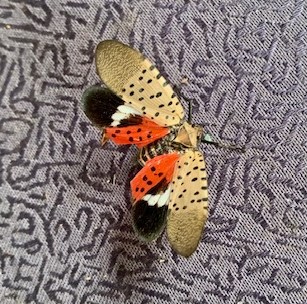
The adult spotted lanternfly has a head and eyes similar to the closely related cicada

Common Name: Spotted Lanternfly, Chinese blistering cicada, Spot clothing wax cicada – The term lanternfly is generally applied to several families of planthopper insects even though there is no known species that emits light. Most planthoppers are small insects that are colored to blend into the backdrop of greens and browns. This species of lanternfly is distinctive in having prominent spots on its folded forewings.

Scientific Name: Lycorma delicatulaLyco is Latin for wolf and could possibly be in reference to a color or texture of the body or wings. A more plausible etymology is a derivative of lychnus, Latin for lamp. The species name means dainty or nice. So, it could be construed as delicate lamp, consistent with the common name.

Potpourri: The spotted lanternfly is the latest North American invasive insect invader. It has taken its place alongside Japanese beetles, gypsy moths (spongy moths since 2022), and woolly adelgids in the rogue’s gallery of unwelcome invertebrates.  The invasive species epidemic is the unintended yet almost inevitable result of global trade in shipping containers that pass from continent to continent with almost anything inside in numbers that preclude anything close to universal screening. The spotted lanternfly has followed the invasive biological playbook in reproducing geometrically, eating everything in sight, and taking advantage of an environment devoid of any serious predation. It is unique among insect pests in having been preceded by its favorite host plant, Ailanthus altissima or tree of heaven, which was imported from Asia and intentionally planted for its robust tenacity and rapid growth. It was the tree of Betty Smith’s iconic “A Tree Grows in Brooklyn.” It became the tree that grows everywhere in North America as a ready source of food for its Asian lanternfly cohort.

The spotted lanternfly is a planthopper, a group consisting of mostly tropical, inconspicuous insects that are easily confused with treehoppers, leafhoppers, and froghoppers in the “endless forms most beautiful” of the class Insecta. In that they extract the liquid nutrient produced by plants with a hollow beak, literally sap-sucking, they are generally placed in the order Hemiptera. These are the true bugs as opposed to the more common use of the word bug for almost any insect like ladybugs that are beetles. Hemiptera is Latin for half wing, referring to the forewing that is solid at the base and membranous at the tip. Some entomologists separate those bugs with wings that are membranous from base to tip in a separate suborder Homoptera meaning same wing. The homopterans consist of three broad groups: cicadas, aphids, and planthoppers. [1]

As a close cousin of aphids and cicadas, it is easy to understand why there might be a problem with spotted lanternflies. Aphids are perhaps the most economically damaging insect in the global temperate regions that constitute the breadbasket for most of humanity. Cicadas are masters of reproduction, producing millions of offspring in seventeen, thirteen, or single year cycles. The spotted lanternfly reproduces with cicada fecundity and sucks sap with aphid voracity. Having been first introduced into Pennsylvania in 2014, they have spread with Malthusian certainty over the mid-Atlantic states to the extent that there is a hue and cry for some form of countermeasure before epidemic populations ensue. This will be difficult if not impossible since they feed on a wide variety of plants, are not palatable to most insect predators, deposit mounds of excrement called honey dew that attracts other pests and pathogens and pass from the scene only after having mated and laid massive egg deposits that are well protected and hidden by a waxy overcoat. [2]

The bright orange contrasting wing bars may be a aposematic warning of toxicity to birds.

Even though spotted lanternflies prefer the tree of heaven, they are not finicky. They have been found feasting on over 100 different hosts from 33 plant families that include but are not limited to vines, ornamentals, specialty plants and fruit trees. The list of plants narrows considerably as they grow and molt. Like all insects, lanternflies have a life cycle based on metamorphosis. They overwinter as eggs that hatch in spring as nymphs that are black with white spots that must extract plant sap to survive. As they grow over the next several months, they literally get too large for the original carapace and must molt several times to form a new, somewhat larger body called an instar.  The first three instars are similarly diminutive and inconspicuous nymphs that move to ever larger plants to provide the additional amount of nutrients needed for their larger-sized appetites.  The fourth instar marks a radical change in appearance. The adult is metamorphosed by evolution’s magical genetics into a much larger body with moth-like wings that are brightly colored with stark contrast. It is the adult spotted lanternfly that is nemesis of vineyards and orchards. [3]

Brightly colored defenseless animals seem a contradiction. The goal of every living thing is to reproduce to perpetuate the species. Getting eaten before mating and oviposition leads to genetic extinction. Many animals hide from predators by adapting their coatings to match the colors and textures of their environment. This is called crypsis. However, if an animal is poisonous to its predators it is advantageous from the evolutionary perspective to make that clear in advance. It does not help if the poison is only detected after the insect’s body is mangled. Bright coloration to alert predators of potential toxicity is called aposematism. The monarch butterfly, which consumes the poisonous milkweed plant is the classic example. And this, apparently, is where the tree of heaven comes in. A simple field test of this predator alert effect on birds was conducted using two different batches of suet, one made with crushed spotted lanternflies that had eaten Ailanthus altissima and one with spotted lanternflies that had not. Birds preferred the latter, demonstrating that consuming tree of heaven was effective in protecting the spotted lanternfly. [4] That they actually evolved their distinctive bright orange wing bars to indicate toxicity is correlated but not proven. It has been suggested that the closed forewings are cryptic so that the spotted lanternfly can hide on tree trunks but that the aposematic flash of orange occurs when they are under attack by a pecking bird.  

If the spotted lanternfly ate only A. altissima, that would be a good thing. Were it not for its other inimical activities, it could even be considered a biological control against the tree of heaven, which has invasive problems of its own. This is in part because of its chemistry, producing cytotoxic alkaloids that suppress the growth of other plants. One of its chemicals, named ailanthone for the genus, reduces the growth of other plants by 50 percent at a concentration of only 0.7 ppm. [5] It is not known which of the secondary metabolites of the tree are employed by the spotted lanternfly, but there is some serious chemistry going on. The spotted lanternfly has been used in traditional Chinese medicine since the twelfth century to reduce swelling, presumably due to its tree derived toxins.  Spotted lanternflies have become a biological bane due primarily to their second favorite food, the plant sugars fructose and sucrose that are especially concentrated in the genus Vitis, which includes the various grapes of the global wine industry. [6] In North America, there are 40 other known hosts, including black walnut, tulip tree, oriental bittersweet, multiflora rose, and hops, a key beer flavoring ingredient. [7]

Sap sucking insects require the same three basic inputs necessary for all plants, animals, and fungi: carbohydrates for energy, lipids for membranes, and proteins for amino acids. Sap is high in carbohydrates but low in protein. Much more sap must be extracted than is needed for carbohydrate energy to get enough protein for growth. The result of the extra input of sugar is more output as insect excrement or frass. The high sugar frass produced by sap-sucking insects is fittingly called honeydew. Some ant species herd and protect aphids to collect honeydew as food for their larval offspring. The honeydew of spotted lanternflies becomes a social problem due to their numbers and the volume excreted. The sticky goo builds up on whatever is underneath, which may include things like picnic tables and lawn furniture that become stained with mold. Honeydew is also attractive as a food source for stinging insects like yellow jackets that are disruptive to outdoor human activities.  [8]

The ootheca are almost impossible to see in between ridged tree bark

The global spread of spotted lanternflies is mostly due to the coating that they apply to their eggs that both conceals and protects them. Each gravid female lays about 40 eggs and then secretes a brownish, waxy substance to cover them. The end result is an oothecum, a thick-walled egg case similar to that made by cockroaches. While most insects lay eggs on host plants that will serve as the first meal for the emergent larvae or nymphs, spotted lanternflies will use almost any available surface with a preference for the vertical. In most cases, the ootheca are further protected by placement in obscure locations that range from tree bark fissures several meters above the ground to stone monoliths and building walls. Once the process is complete, the ootheca are almost impossible to find absent a detailed inspection which can only be effective if you already have a good idea where to look. As the egg casing ages, it looks more and more like dried mud, making identification even more challenging. It is believed that the first spotted lanternflies arrived in Pennsylvania as an oothecum attached to a shipment of landscaping stones, almost certainly sent in a shipping container from Asia. [9]

Control and containment of the spotted lanternfly is evolving in concert with its radiating spread outward from its point of origin with concomitant economic damage. Estimates at this point are speculative as they are based on extrapolation of local damages in infested areas. Pennsylvania, where the spotted lanternfly first appeared, may see damages of up to $100 million annually due to crop loss. If spotted lanternflies spread to the Pacific Northwest, losses to cherry, wine grape, and hops crops in Washington are estimated at about $4 billion.  Two spotted lanternflies have already been found in Oregon on packing containers and ceramic pots that both came from Pennsylvania. They were dead, but egg cases cannot be too far behind. [10]

The three basic methods to exterminate pest insects are mechanical, chemical, and biological. Mechanical means range from the satisfying but fruitless attempts to find and squash the bugs to affixing host trees with some form of baited trap. In the case of lanternflies, glue coated sheets, some with attractive pheromones, have been tried with limited success but with the caveat that bycatch of birds and butterflies is always a concern. As discussed above, finding and scraping egg masses is not feasible and getting rid of its preferred tree of heaven host that are the dominant tree along many miles of US highways would be nearly impossible.

This leaves chemical and biological as the only two viable means to combat the spotted lanternfly invasion. Pesticides like neonicotinoids (Dinotefuran is prescribed by federal agencies) and organophosphates are effective, but they are general agents that have been implicated in reducing beneficial insect populations like honeybees. The other problem with pesticides is the development of immunity by species through natural selection. There will almost always be individual insects that are resistant to a pesticide due to the randomness of mutation. The resistant mutants survive the poison to propagate their genes, replacing those that were killed by it.  A second issue is the economic cost of using pesticides over large areas, relegating most applications to field size acres instead of the county size square miles that are necessary for extirpation. Vineyards in Korea that were sprayed with pesticide were rapidly repopulated by spotted lanternflies from nearby forested areas. [11]

Biological controls are more promising. A lot of attention has been paid to the role of birds, which are put off by the toxins that spotted lanternflies extract from the tree of heaven.  It was even suggested that if 70 percent of the spotted lanternflies could somehow be kept from their favorite food, then birds would do the rest. This was proffered with the caveat that “we need to do everything we can” even if this cannot. [12] The best place to look for biological controls is in the country of origin, where the local ecosystem keeps the target species in check. One promising possibility is a wasp native to China that parasitizes up to 80 percent of spotted lanternflies. However, introducing an alien predator species is cumbersome due to the need to test both its efficacy on the target species and its possible harmful effects on other species. However, biological control is in all likelihood the only way to prevent the dystopia of spotted lanternfly proliferation over the long term.

References:

1. Marshall, S. Insects, Their Natural History and Diversity, Firefly Books, Buffalo, New York, 2006, pp 91-104.

2. . “Spotted Lanternfly Pest Alert” (PDF). USDA-APHIS. USDA https://www.aphis.usda.gov/sites/default/files/alert-spotted-lanternfly.pdf  

3. Barringer, L. “Lycorma delicatula (spotted lanternfly)”. www.cabi.org. 17 December 2021

4. Kranking, C. “Birds Are One Line of Defense Against Dreaded Spotted Lanternflies” Audubon Magazine, 17 September 2021. https://www.audubon.org/news/birds-are-one-line-defense-against-dreaded-spotted-lanternflies    

5. https://hikersnotebook.blog/flora/deciduous-trees-and-shrubs/ailanthus-tree-of-heaven/

6. Dara, S.; Barringer, L.;  Arthurs, S. (2015). “Lycorma delicatula (Hemiptera: Fulgoridae): A New Invasive Pest in the United States”. Journal of Integrated Pest Management. 20 November 2015 Volume 6 Number 1. pp 1–6. https://academic.oup.com/jipm/article/6/1/20/2936989?login=false

7. Murman, K, et al. “Distribution, Survival, and Development of Spotted Lanternfly on Host Plants Found in North America”. Environmental Entomology. 31 October 2020 Volume 49 Number 6. pp 1270–1281. https://academic.oup.com/ee/article/49/6/1270/5947504?login=false

8. Barringer, op cit.

9. . Urban, J..; Leach, H. “Biology and Management of the Spotted Lanternfly, Lycorma delicatula (Hemiptera: Fulgoridae), in the United States”. Annual Review of Entomology. 23 January 2023. Volume 68 Number 1 pp. 151–167. https://www.annualreviews.org/content/journals/10.1146/annurev-ento-120220-111140    

10. Department of Agriculture. “Pest Alert: Spotted lanternfly Lycorma delicatula”. Oregon Department of Agriculture Fact Sheets and Pest Alerts    https://www.oregon.gov/oda/shared/Documents/Publications/IPPM/SpottedLanternflyPestAlert.pdf              

11. Dara. S. et al op cit.

12. Grandoni, D. “Squashing lantern flies (sic) isn’t enough; it might be time to send in the birds” Washington Post 7 March 2024.