

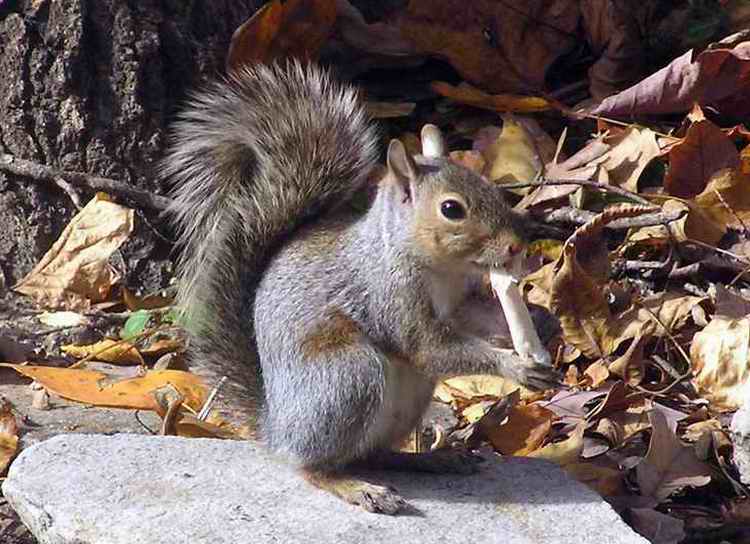
Common Name: Gray Squirrel, Eastern gray squirrel, Migratory squirrel, Timber squirrel, Silvertail – The word squirrel is an anglicized version of the Latin word for squirrel, sciurus. Although there are several variations in coloration including black and brown, gray is the most prevalent. Native to Eastern North America, they are technically Eastern. Western and Mexican gray squirrel variants are nearly identical.
Scientific Name: Sciurus carolinensis – The generic name is derived from the Greek words skia, meaning “shadow”, and oura, meaning “tail”, combined as skiouros which became sciurus in Latin. [1] Carolinensis is a Latinized form of Carolina where it was first classified. The large “shadow tail” is a distinguishing trait.
Potpourri: The abundance of gray squirrels in both urban and suburban human habitats is a testimony to the adaptability and endurance of the species. The ultimate synanthropes, they thrive in central city parks, along tree-lined boulevards, dispersing out beyond the treed lots of individual homesteads to the forests from which they came. Wherever there are nut-bearing trees, there will be the rodents that have perfected a lifestyle of graceful leaps from one to another, grounding only to gather and eat or bury the fruits from which future forests will arise. While they are beloved by those who admire the aerial art of their acrobatics and perpetual animation, they are disparaged by those whose houses are damaged and gardens ravaged. The stuffed toy animal cuteness of squirrels can neither be denied nor ignored.
Gray squirrel proliferation is a matter of genetic-driven adaptation. They are members of the order Rodentia, the most successful grouping of class Mammalia, comprising one quarter of all mammal families and half of all species. From mice to marmots inclusive of engineering beavers and armed porcupines, rodents spread out over the landscape denuded of dinosaurs in the Cenozoic Era which they helped definitize as the age of mammals. The influence of genetics on the taxonomic orders created by Linnaeus in the 18th century started at the turn of the last century and has accelerated ever since. One of the many revelations has been to divide placental mammals into four clades: Afrotheria for the mammals that evolved in Africa, Xenarthra for species unique to South America, Laurasiatheria for the northern hemisphere collections of carnivores and unguents, and finally Euarchontoglires, mostly rodents, rabbits, and primates, like humans. [2] While the exactitude of these associations is a work in progress, the fact that rodents are among our closest relatives is no longer a matter of conjecture. It really is a rat race after all.
The order Rodentia consists of mostly small mammals that possess one pair of upper and lower incising teeth that continue to grow for their entire life at a rate of about two to three millimeters every week. The gnawing behavior of rodents is thus a matter of necessity as unchecked dental growth would eventually obstruct feeding. Hard objects are preferable owing to higher levels of abrasion leading to friction with human populations when the boards of wooden houses and barns are destroyed. [3] The hard insulation of electrical cables has also been subjected to gnawing. In 1987, the NASDAQ stock exchange was shut down for over an hour due to a power outage that resulted from squirrel damage. [4] Other than gnawing, non-stop teeth, rodents are relatively primitive, unspecialized mammals; simple, scampering quadrupeds. As such, they are also warm-blooded, fur-bearing, and milk producing. They survive even though surrounded by predators for which they are a prime entree through stealth, agility, and the production of profuse offspring, enough of whom survive.
Gray squirrels are named for fur color, which ranges from pale gray to a grizzled dark that sometimes turns black. Melanism is a pigmentation of hair follicles or skin cells that is a universal mammalian trait. It is more common among animals in northern ranges as it results in 18 percent less heat loss at -10 degrees C and a 20% lower basal metabolic rate. In the case of the black squirrel, evidently genetics and interbreeding played a role. Biologists in the UK found that the gene responsible for melanism originated with reddish fox squirrels and that interbreeding introduced it into the lineage of gray squirrels. [5] Guess who’s coming to dinner?
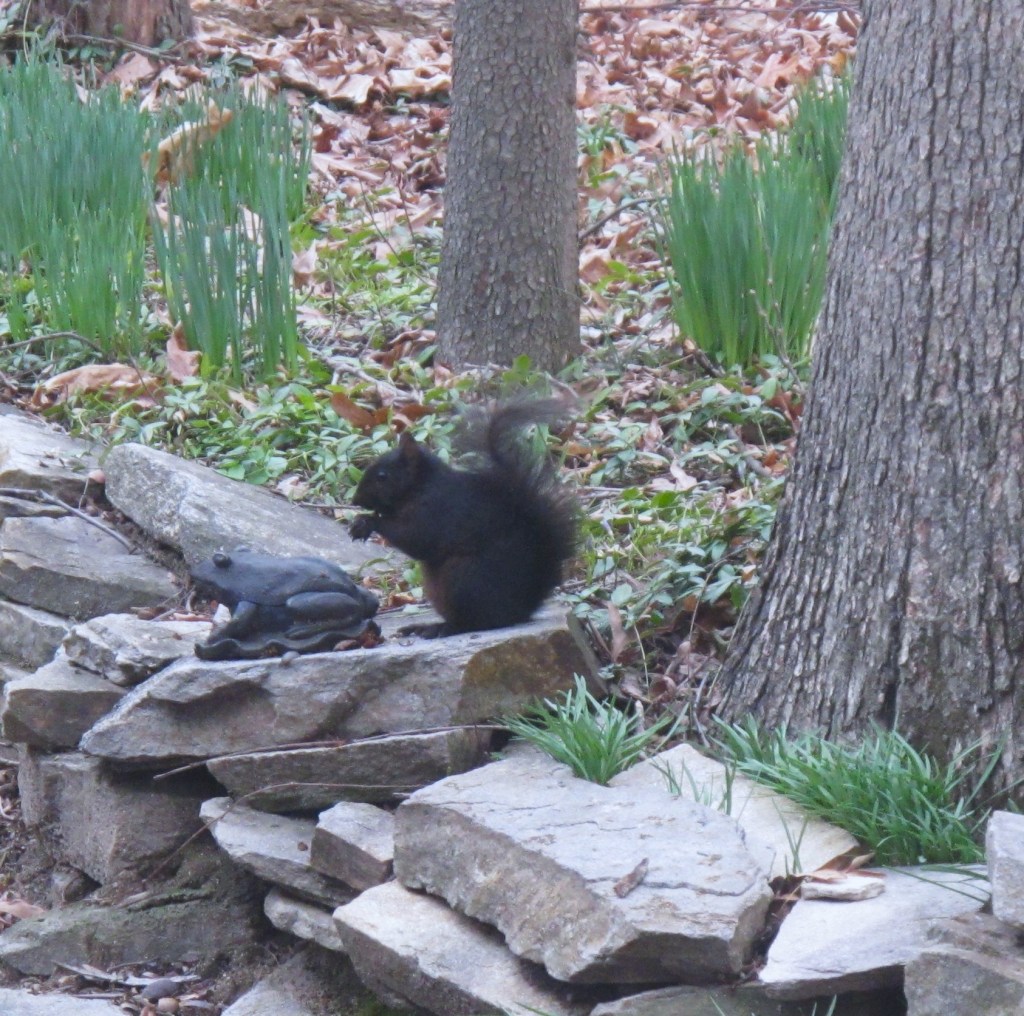
The pelage (coat) of the gray (and black) squirrel has an inner layer of short fur for warmth and an outer layer of “guard hairs” that protect the fur; the long hairs on the tail are the basis for the common name Silvertail. The tail is an important appendage, as it is used as a shield when fighting, a blanket when cold, a rudder when swimming, and a shade when hot − the latter providing the basis for the name for the squirrel in Greek: skia oura meaning shadow tail. [6] The tail is also used as a means of communication, signaling anger, excitement, fear or curiosity. It has striped coloration on young squirrels, becoming a single solid color at maturity. Most importantly, the tail is a means of steering and balancing when running and jumping between branches in trees, the trait that distinguishes the arboreal gray squirrels from the more common ground squirrels living in underground burrows hoping no snakes find the entrance.
Gray squirrels are well adapted to their arboreal habitat. They have excellent vision that is accentuated by the depth perception that the parallax of their eyes enables. Their strong legs are capable of leaps in excess of eighteen feet at treetop elevations. They can ascend and descend a tree trunk of any girth, as the sharp rear claws dig into the bark in any direction, the back legs being capable of a rotation of one hundred and eighty degrees. If they fall, their tails provide parachute-like air resistance to slow their descent. [7]
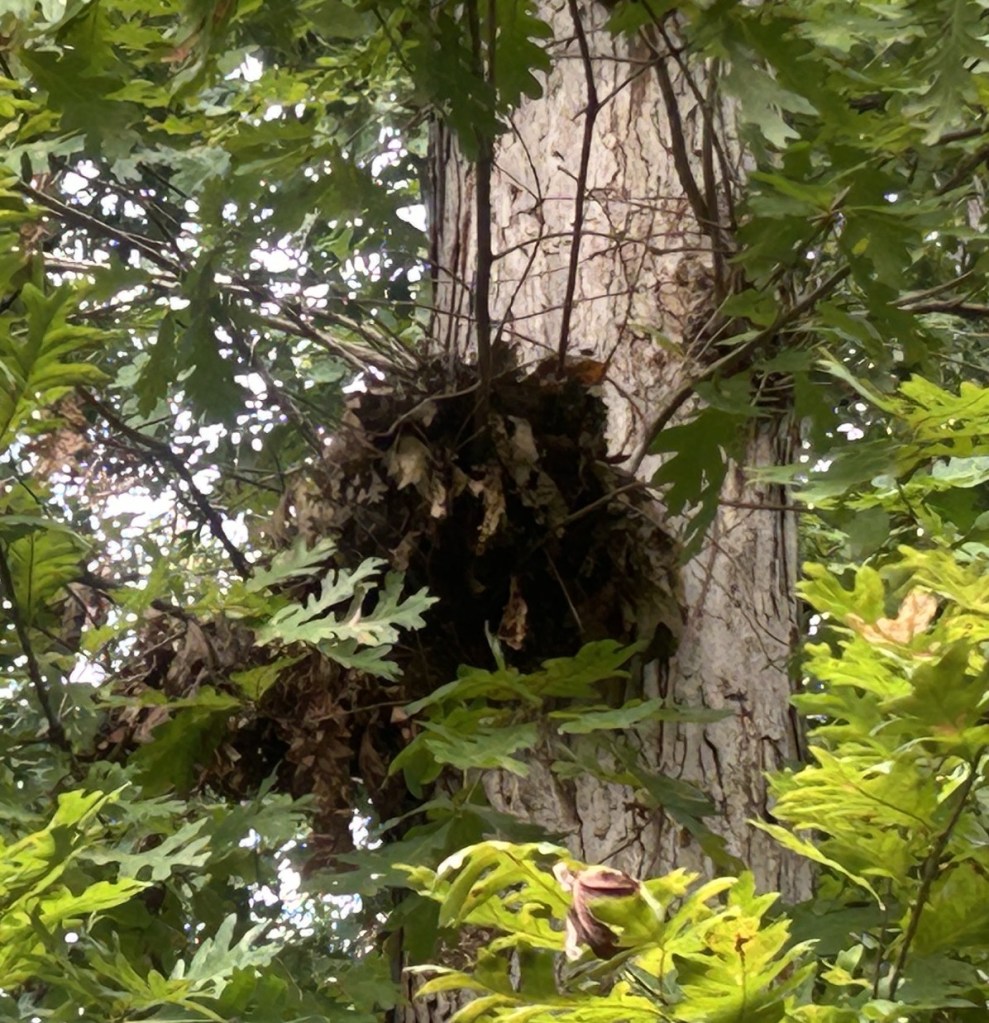
As squirrels spend most of their time in trees, they have evolved three different types of dwellings: winter and summer dreys and dens. Dreys are made out of leaves and other forest detritus. The winter drey is a robust affair constructed of branches and leaves located in the main fork of a tree high enough to evade terrestrial predators but low enough to escape the ravages of severe weather. The summer drey is generally a flimsier affair and may be only a platform of leaves about thirty feet off the ground. The den is the most secure of the three, consisting of a hole about three inches across leading to a cavity at least twelve inches deep in a mature tree with decaying heartwood. The dreys and dens are normally collocated in the same stand of trees to allow movement among them according to food supplies and predators. One can approximate the number of squirrels in the area by tallying two squirrels for every three nests. Since squirrels get adequate hydration from the foods they eat, they do not need to descend from the trees to drink, minimizing their exposure to predators.
Male and female squirrels are the same size and have the same coloration and cannot be readily distinguished except by behavior. Males compete against each other to mate with females, a process that involves a chase that ends when the female decides to accede to the emotive male; copulation lasts less than thirty seconds. Breeding occurs between December and February and again from May to June, the female producing one litter of 2 to 4 young in late winter (sheltering in the den) and a second litter in midsummer (sheltering in the drey). The young are raised solely by the female; the worst fights among normally playful and docile squirrels occur when males approach the nests of lactating females. After the mating season, the testicles of the male squirrels shrink in size from seven grams to one gram so they look like they have been castrated. This may be the genesis of the widely held myth that red squirrels castrate gray squirrels. [8]
One of the more surprising aspects of gray squirrel behavior is that they are active through the winter. This is especially noteworthy as most other squirrel family (Sciuridae) rodents including chipmunks, groundhogs, and marmots hibernate in winter torpor. Gray squirrels build well-insulated nests in trees (like birds), have perfected the specialized food storage technique of scatter-hoarding, and eat enough through winter to keep their plump bodies supplied with warm blood. [9] Gray squirrels have a very high metabolism, maintaining a body temperature of about 101 degrees F. To do this, they need to eat about their own weight in food every week. During the late summer and fall, they consume about a third more than required for sustenance to fatten up for the winter. They preferentially feed on the nuts, flowers and buds of oak, hickory, pecan, walnut, and beech trees. However, squirrels move extensively around their home ranges according to the availability of food, generally consuming only one type of food at a time. Their diet extends to a wide variety of trees and flowers, including the seeds and catkins of gymnosperms such as cedar, hemlock and pine. They are omnivorous and they will eat insects, bones, bird eggs, fledglings, frogs, and fungi (as in the photograph above).
One of the more notable aspects of the behavior of the gray squirrel is the practice of “scatter hoarding.” Unlike most other small mammals, gray squirrels do not store food in a centralized location. Rather, food is stored in the form of buried nuts, not in the location where they are found, but in remote, shallow, individual holes dug with the forefeet and covered with dirt to a depth of about ¼ inch. One postulated reason for this behavioral anomaly is that it prevents competing animals from raiding their food supply. They frequently conceal their activities from other squirrels to the extent that burials are faked, carrying out the motions without actually caching the nut. Squirrels do not remember where they buried each nut, as is popularly believed. Rather, they rely on an acute sense of smell to find the buried nuts, even under snow. In one study, scientists buried nuts independently of the squirrels in the same area where they had buried their own. Both varieties were located and removed by the squirrels with approximately equal likelihood. [10]
As the acorns of oak trees figure prominently in the squirrel diet, scatter hoarding has implications to the health and diversity of oak forests. There are two basic groups of oak trees, red oaks with high fat and high tannin acorns (and leaves with pointed lobes) and white oaks, which are lower in fat and tannin (with round-lobed leaves). Red oak acorns remain dormant throughout the winter whereas white oak acorns germinate almost immediately. Accordingly, squirrels store red oak acorns and eat white oak acorns. Alternatively, they may store a white oak acorn, but only after biting off the end of the nut that contains the embryo to prevent germination. [11]
Large mass movements of gray squirrels have been observed historically to occur in September. These movements are known as emigrations vice migrations, as the squirrels permanently move to new environs. In the early colonial period, when the eastern forests were more extensive, this behavior was much more prevalent. In the 1840’s John Audobon noted the “wandering habits and … singular and long migrations” of squirrels and believed they were a different species which he named S. migratorius whence the common name migratory squirrel derives. As emigrations occur in September when food is plentiful, causation is a pertinent question. The predominant theory is that variances in oak tree acorn production, known as masting, create surges in the squirrel population that become manifest as the more numerous squirrels begin searching for nuts to bury for the winter the year following the mast year, when few acorns are produced. When they find the paucity of nuts, they instinctively “emigrate” to a more bountiful area. [12]
As a successful rodent, gray squirrels become invasive when released into non-native areas with ample trees and limited predation. Great Britain is a case in point. In the late 19th century, gray squirrels captured the interest of Britain’s wealthy aristocrats, attracted by their playful antics and graceful tail-waving leaps. The most well-known case was the 11th Duke of Bedford, who released ten gray squirrels onto his estate forty miles from London in 1890, giving away their offspring to friends as wedding presents. Fifty years later, the British Parliament banned the introduction and possession of gray squirrels due to widespread damage to gardens and predation of bird nests. Things have only gotten worse as the gray’s have taken over the native habitats of the native and revered red squirrel, now outnumbering them 200 to 1. The plight of red squirrels is exasperated by disease. Gray squirrels are carriers of Parapoxvirus which does not affect them but is deadly to red squirrels. [13] The gray squirrel from the United States is considered second only to the rat as the most vilified rodent in the United Kingdom.
References:
1. Webster’s Third New International Dictionary of the English Language, Unabridged, Merriam-Webster, New York, 1971, p 2217.
2. Drew, L. I, Mammal, Bloomsbury Publishing, London, 2017, pp 219-221.
3. Wood, A. University of Massachusetts, Amherst, “Rodentia” Encyclopedia Britannica, Volume 15, W. and H. Benton Publishers, Chicago, 1971, pp 969-980.
4. https://www.nyc.gov/site/wildlifenyc/animals/eastern-gray-squirrels.page
5. Letzter, R. “Genes, courtship explain black squirrel population” Washington Post, 10 September 2019
6. https://dnr.maryland.gov/wildlife/Pages/plants_wildlife/easterngraysquirrel.aspx
7. https://www.nps.gov/bith/learn/nature/eastern-gray-squirrel.htm
8. Whitaker, J. National Audubon Guide to North American Mammals, Alfred A. Knopf, New York, 1196, pp 487-492
9. Bernd, H. Winter World, Harpers Collins, New York, 2003, pp 95-107.
10. Whitaker op cit.
11. Kricher, J. Peterson’s Field Guide to Eastern Forests of North America, Hughton-Mifflin, Boston, p 60.
12. Hoover, E. “Migration of Gray Squirrels”, Science, Volume 83, Issue 2151, 20 March 1936.
13. Stokstad, E. “Red Squirrels Rising” Science, Volume 352, Issue 6291 June 10, 2016

