
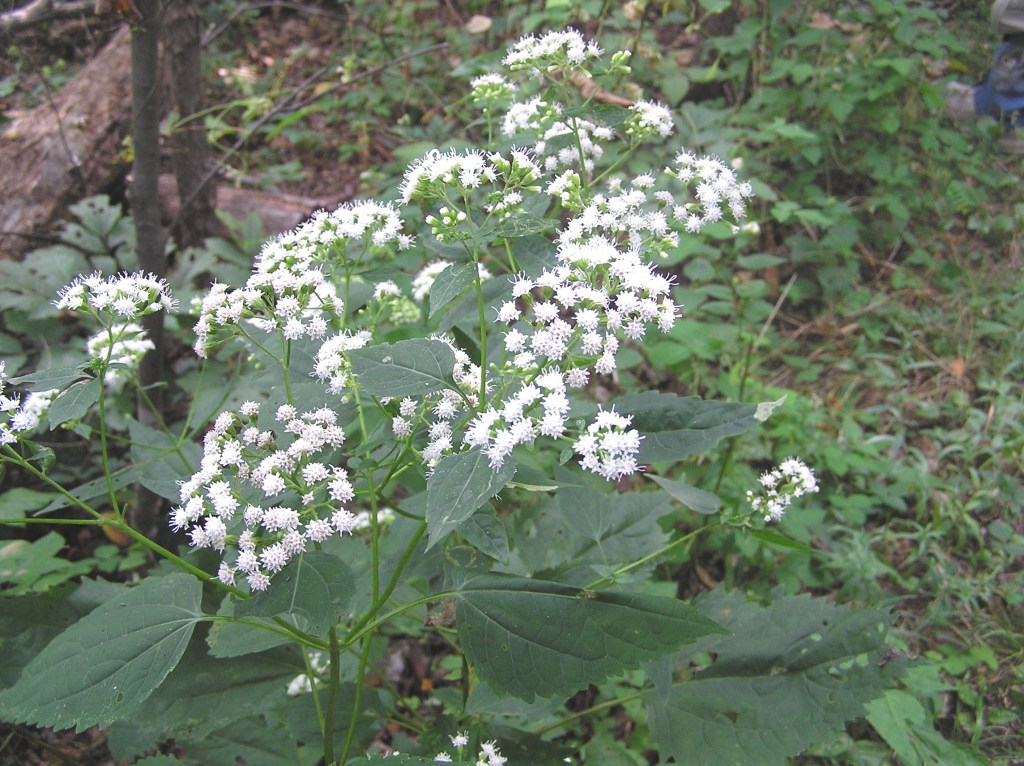
Common Name: White Snakeroot, Indian or White Sanicle, Richweed – Snakeroot is used as a common name for several plants without clear attribution. It is generally asserted that this would mean that the plant was used to treat snake bites, that it was found in common snake habitats, or perhaps had snake-like roots. The white flowers are distinctly profuse and therefore descriptive.
Scientific Name: Ageratina altissima – The Latin ageraton is taken directly from the Greek word ageratos, meaning ageless. [1] This presumably refers to the persistence of the flowers well into autumn. The species name is, like altitude, derived from the Latin root indicating tallness; white snakeroot is frequently a meter in height. Formerly known as and frequently listed as Eupatorium rugosum. [2]The genus Eupatorium is from Mithridates Eupator [132-62 BCE], who was the governor of Pontus who was accredited with discovering a universal antidote for all poison; several plants of the genus (like boneset) have medicinal properties.
Potpourri: White Snakeroot is unremarkable. While it is attractively festooned with bouquets of small white flowers that extend from the ends of an array of its many branches and reaches heights of five feet, it attracts only small flying pollinators but not people. This is in part because it is one of several plants that are noted for clusters of small white flowers, including Queen Anne’s lace, yarrow, and boneset. But historically, it is a very important weed indeed. It is responsible for one of the most severe and mysterious maladies of the early colonists as they moved west and homesteaded. Many died of what was called the milk sickness. Among its victims was Nancy Hanks Lincoln.
Samuel Lincoln was one of the many thousands of Puritans who sailed from England to the Massachusetts Bay Colony through the Boston port of entry, arriving in 1637, his progeny a microcosm for the westward dispersal of the colonists. Three generations later, his great grandson John Lincoln settled in Virginia, providing 210 acres of his land to his first son, Abraham, who served as a captain of militia in the Revolutionary War. One consequence of the successful war for independence from Great Britain that culminated in the Treaty of Paris in 1783 was the free movement of settlers westward over the Appalachian Mountains into the Ohio River Valley. The pioneering spirit drew Lincoln westward, settling with his wife and five children in a remote farmstead of over 5,000 acres on the Ohio River in what is now Kentucky in 1781. Five years later, he was shot and killed by an Indian, his youngest son Thomas now fatherless and without inheritance or prospect continued west. Consistent with the landless younger sons of his generation, he worked to earn enough money to buy land, where he built a cabin, married Nancy Hanks, and started a family; he named his first son Abraham. Land disputes in Kentucky drove the Lincoln family west into southern Indiana in 1816. Nancy Hanks Lincoln, the mother of President Abraham Lincoln, died of what was called the milk sickness on October 5, 1818. [3]
Frontier living was harsh and mercurial; pioneers required a combination of iron will, good fortune, and ingenuity to survive. Absent any knowledge of microbial malevolence, life could be short and brutal; many children died in infancy and mysterious diseases could strike anyone at any time. For the settlers of the Ohio River Valley, one of the most common and frequently fatal ailments was named according to its symptoms as ‘sick stomach,’ puking illness,’ and eventually ‘the slows and the trembles.’ The first indications of abnormality were usually listlessness and loss of appetite progressing to muscle stiffness, vomiting and trembling over the course of several weeks. In many cases, symptoms did not abate leading to jaundice, prostration and death. Not infrequently, the farm animals of the stricken were observed to succumb with markedly similar symptoms. Cows, sheep and especially horses were all affected, the latter felled with extreme virulence in three days. With little communication among isolated settlements, the similarity of symptoms of those who died was not immediately evident.
In piecemeal sharing of individual experience anecdotes, it eventually emerged that the proximate cause for humans was the consumption of milk from poisoned cows leading to the assignation milk sickness, the name that has persisted. According to an Indiana historian “milk sickness killed many, frightened more, and caused local economic distress. Villages and farms were abandoned, livestock died, entire families were killed.” Discovering the root cause was a matter of some serendipity; many logically concluded that it must have something to do with what the farm animals were eating and where they ranged to get it. As early as 1809, a doctor named Barbee came to the Ohio River Valley from Virginia and described what he observed among those entrusted to his care, noting the similarity of the human symptoms to those of proximate farm animal stock. An 1811 article in a Cincinnati newspaper reported the observation that the problem seemed to originate from cows allowed to wander outside established pastures into oak woods and valleys. [4]
While lore and legend inevitably augment the historical record. (John Chapman cum Johnny Appleseed a case in point), it is plausible that the hypothesis that milk sickness was caused by a specific plant originated with Doctor Anna Pierce Hobbs Bixby (1812 – 1873), probably the first female physician in Illinois. Her life story is a compelling saga of pioneer spirit. Anna Pierce came to Illinois from Philadelphia as a youth and became a teacher, returning to her city of origin to train in midwifery and other medical practices to return as a frontier doctor, where she met and married Isaac Hobbs. In the heart of milk sickness country, she was immediately involved both professionally and personally as her mother and sister were felled by the malady. When the proximity of sick cows and sick people became a matter of observation, it is alleged that while she was searching the fields where the cows grazed looking for a plausible cause, she encountered a Shawnee woman who pointed out a tall weedy plant with small white flowers as one known to her people as poisonous. We don’t know what they called it at that encounter but probably the Algonquin name for the plant; it is now known as white snakeroot.
The etymology of snakeroot is unclear, as is the case with many plants and animals of the New World that were first named by its original denizens; colonists frequently translated the Indian name into its Anglicized form (e. g. woodchuck comes from the Cree wuchak) It may then have originally been an Algonquian word that sounded like snake or a translation of the Algonquian word for snake. It is also feasible that snake was used as something of a metaphor – some snakes are poisonous so plants that poison are like snakes. There are several plants also commonly called snakeroot. Whatever white snakeroot was originally called, Dr. Pierce initiated a local program to eradicate the weed and to warn those within the range of her practice of its consequence. However, due to the remoteness of settlement and the lack of communication technology, the correct identification of white snakeroot as the cause of milk sickness did not transcend throughout the midwestern region. When Isaac Hobbs died of pneumonia, Anna married a man named Eson Bixby who turned out to be a horse thief intent on stealing her money. Legend has it that he tied her up and threw her off a cliff and then set fire to the surrounding woods. She survived. Milk sickness continued to be a major problem; an Indiana doctor named Bunnel reported that he typically had five patients with milk sickness continuously through the 1830’s and one county reported that fully half of all deaths during this period were due to milk sickness. [5]
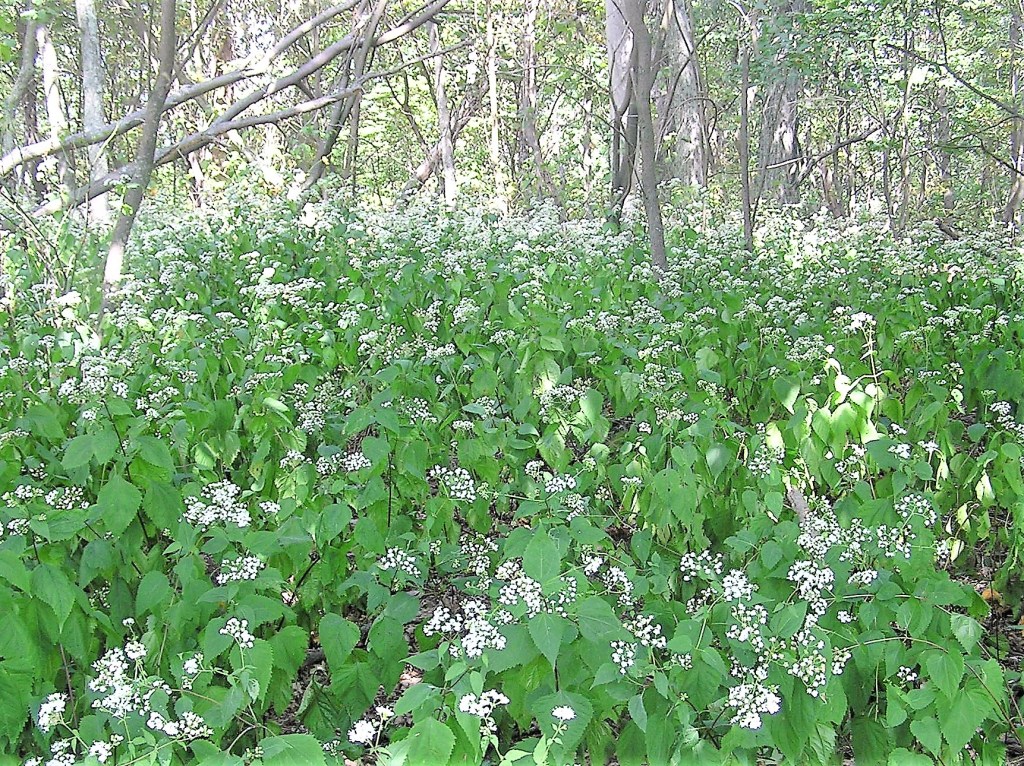
Native American had a substantive knowledge of plants that poisoned, plants that healed, and plants that could be eaten. The Eurasians that migrated to the Americas thousands of years ago survived according to tribal oral tradition of accrued lore; the western civilization that unsettled their lives is only about two thousand years old. While the lack of a written record detracts from historical surety, documented testimonials of tribal practices report that white snakeroot was used by many tribes, notably the Cherokee and the Iroquois for a variety of purposes ranging from antidiarrheal to warming tonic; there is no recorded use of the plant to treat snakebite although it may have been [6]. In general, Indian plant remedies are not tested to modern standards of controlled drug assessment as it is too expensive relative to any gains that might accrue; it is known that it was used but not that it worked The Algonquin Shawnee people of the Ohio River Valley left no oral tradition of snakeroot use, but this is surely a matter of omission and not commission; they frequently crossed paths with their Iroquoian neighbors to the east. It is certainly more plausible that Shawnee pointed out the plant to Dr. Pierce, as it would have been most unlikely that she would have picked it from the bouquet of diverse wildflowers that grow in scattered patches throughout the forest.
White snakeroot qualifies as a weed which is defined as an uncultivated pioneer plant that is undesirable, an anthropocentric notion that ignores the role of nature as the true arbiter of what grows and what doesn’t. As the cynosure of the milk sickness epidemic, it is surely an evil weed – the pejorative sobriquet of smoking tobacco – if ever there was one. The scenario for ‘man meets plant’ is clearly (pun intended) evident. As migrating farmers cleared new land from the forest for their fields, the copious wind driven snakeroot seeds ringed the open areas where shade prevailed to establish dense patches interconnected by underground rhizomes. The plant is about two feet tall with large, toothed green leaves topped with terminal clusters of small white flowers. As the hardscrabble frontier farm progressed, livestock were introduced to augment dietary protein. The stage was thus set for the milk sickness drama to unfold, as grazing cows browsed around the edges of clearings where the lush green plants flourished at a convenient muzzle high elevation. The cows ate the snakeroot, the farmers milked the cows, and their families perished from the milk sickness. Case closed? Not quite’
It took over a half century to determine the proximate cause of milk sickness and another half century to understand its physiological effects. While local remedies had reduced the pernicious effects of snakeroot in some areas (in addition to Dr. Pierce, there had been some successes achieved by keeping their cows behind fences), the syllogistic relationship between snakeroot and sickness remained a mystery. By the middle of the 19th century, it was widely accepted that some type of plant was involved but there were numerous candidates including poison oak, wild parsnip, and white snakeroot. In 1841, the Kentucky legislature offered two thousand dollars to anyone who discovered the true cause of the milk sickness; it was never collected. In the 1850’s both Indiana and Ohio initiated statewide medical and agricultural surveys to gather information from which regulatory policy could be based. Based on these surveys, which included instances of feeding trials conducted with animals that developed the characteristic symptoms of trembles, it was generally concluded by 1850 that milk sickness was caused by cows eating white snakeroot. It appeared in the 5th edition of George P. Woods medical textbook in 1858, affording the hypothesis official medical certification as fact. [7]
The prevalence of milk sickness as one of the most malevolent of frontier maladies faded during the second half of the 19th century until it had almost disappeared by 1900. This is attributed to an increasing public knowledge of the problem but also and probably more importantly due to the simple fact that the frontier had largely disappeared as fences around established pastureland predominated. A 1909 National Institutes of Health report stated, “with the advance of civilization, as forests were cleared, and pastures fenced the disease became less frequent.” [8] The last documented case of milk sickness was in 1963 when two infants were admitted to a Saint Louis, Missouri hospital and determined by blood testing to have a severe condition known as metabolic acidosis, which was remediated with intravenous infusion of bicarbonate to lower the PH to the normal neutral range. One of the older staff physicians suggested a diagnosis of milk sickness based on dim memories of his early practice. Subsequent inquiry proved that the infants had been given milk from cows who had been allowed to wander into infested areas, the theory presumably being that this was more natural and therefore more wholesome. [9] Those who forget or ignore history are doomed to repeat it, and, according to Ecclesiastes, “whatever is has already been and what will be has been before.”
The physiological nature of milk sickness and the mechanisms by which it was induced by white snakeroot could not be fully explained without the knowledge and laboratory acumen of chemistry that began in earnest in the early 20th Century. A researcher named Couch first isolated a straw-colored oil from white snakeroot in 1929; he named it tremetol in recognition of the ‘trembles’ that it caused. The toxic dose for animal ingestion was estimated at ten percent of body weight. While this seems to be more than a grazing animal might possibly eat, the amount is cumulative with tremetol building up over time. White snakeroot is still a problem for grazing animals; In 1983, four horses in Ohio died with symptoms of trembles. Investigation by Ohio State University veterinarians confirmed that their pasture was filled with white snakeroot. There is no antidote for tremetol poisoning in animals, supportive care is prescribed but death is frequent and permanent disability likely. [10] The chemical nature of white snakeroot poisoning was not established until 1971. It disrupts the very essence of life.
Everything animals do requires energy which comes from what they eat. Carbohydrates, protein and fats are broken down into their constituent molecules by digestion and absorption. The chemically complex process of metabolism is to animals what photosynthesis is to plants, oxidation of carbohydrates forming the carbon dioxide that keeps the cycle in balance. What tremetol from white snakeroot does is to interfere with the citric acid enzyme in the liver to disrupt the operation of the Krebs cycle. [11] In somewhat simplistic terms, glucose derived from food digested in the stomach and absorbed in the small intestine is transported to the hepatic portal vein and thus to the liver. The breakdown of glucose that ultimately releases energy in the form of adenosine triphosphate (ATP) formation in cell mitochondria by the Krebs cycle is facilitated or catalyzed by the citric acid enzyme. The action of tremetol thus disrupts the basic operation of glucose metabolism; the body then reverts to the ketosis backup mode, using ketones produced by the liver from fatty acids. The trembling symptoms are due to energy disruption. As the amount of tremetol accumulates, probably in the liver, the metabolic engine gradually shuts down, and the acidity of ketones results in ketoacidosis, which is life threatening.[12] One of the ketones is acetone which has a distinctive smell, reported to be quite evident in the respiration of milk sickness victims. And that is how white snakeroot became the plant that killed Abraham Lincoln’s mother.
And that is how white snakeroot became the weed that killed Abraham Lincoln’s mother. One year later, Thomas Lincoln married Sarah Bush Johnston, a widow with three small children. Her strength of character and shared affection were the silver lining of the ominous clouds of the slough of despond; her nurture restored the sanctity of hearth and home. Abraham Lincoln was quoted by a relative as having said “She had been the best friend in the world …and no man could love a mother more than he loved her.” [13]
References:
1. Webster’s Third New International Dictionary of the English Language, Unabridged, Volume 1 Encyclopedia Brittanica, Inc. Helen Benton Publisher, Chicago, 1971 p. 41.
2. Niering, W. and Olmstead, N. National Audubon Society Field Guide to North American Wildflowers, Alfred A. Knopf, New York, 1998, p. 379.
3. Donald, D. Lincoln, Simon and Schuster, New York, NY, 1995. Even though the Lincoln family got off to an auspicious start, Abraham did not get along all that well with his father Thomas and worked at odd jobs along the Ohio River until he was of age and could make his own way.
4. Daly, W. J. “The Slows: The Torment of Milk Sickness on the Midwest Frontier” Indiana Magazine of History Vol 102 No.1 March 2006 pp 29-40. A thorough historical review of the milk sickness problem in the Ohio River Valley.
5. Allen, John W, “It Happened in Southern Illinois”, Southern Illinois University Press 23 February 1968. The section of interest is entitled: The Legend of Dr. Anna Bixby.
6. http://naeb.brit.org/ An excellent ethnobotany database is available at It is searchable by tribe, by common name and by scientific name with full reference attribution.
7. Daly Op. cit.
8. Tabler, D. “The Curse of the Milk Sickness” Appalachian History, 16 June 2011
9. Daly Op. cit.
10. Daly Op. cit.
11. Wu, C. H. “Metabolic disturbances induced by Eupatorium urticaefolium,” PhD Thesis University of Miami 1971. This was the first evaluation of the physiology of milk sickness in interrupting the normal metabolic process.
12. Starr, C. and Taggart, R. Biology, The Unity and Diversity of Life 5th ed. Wadsworth Publishing Company, Belmont, California 1989.
13. Donald Op. cit.