Many-Headed Slime

Many-headed slime in search of food, mostly bacteria

Common Name: Many-headed slime, Grape cluster slime, Slime mold – The many branches that radiate outward from the site of initial growth form clusters at food sources consumed as sustenance. The overall appearance is one of many small nodes that are metaphorically compared to heads.

Scientific Name: Physarum polycephalum – The genus name is from the Greek physarion, meaning small bellows, which may refer to the characteristic pulsating growth which appears to surge as if wind-driven. The species name from Greek poly meaning many and kephalikos (Latin cephalicus) meaning head.[1] The translation literally means many-headed.

Potpourri: Slime molds were saddled with one of the most pejorative names in biology. The Animal Kingdom’s most despicable attribute of slime is sometimes applied to humans as the penultimate insult. The Fungi Kingdom’s worst form is mold, destroyer of agricultural crops and promoter of human respiratory disease. Even so, slime mold is an apt name in describing an unusual form of life. Slime molds bridge the gap between animals and fungi in transitioning from a mold-like spore that then germanites into an amoeba-like animalcule that moves like Lewis Carrol’s “slithy toves”.  The onerous task of organizing living things into a comprehensible structure has been a work in progress for centuries. With DNA replacing appearance as its organizing principle, phylogenetics has upended the historical hierarchical taxonomy of Carolinas Linnaeus. This transition is just beginning. Placing slime mold into its proper niche in the web of living things on the TBD list. For now, it is classified as a protist.

Numerous attempts have been made by intellectually curious, sapient humans to impose order on the entangled complexity of their surroundings. Schemes based on geographical locale, patterns of fruits and seeds, and gross morphology were all found to be impractical for field application. Linnaeus had the insightful idea of using sex as the organizational principal for plants, forming 26 categories based on the numbers and arrangement of the (all important) male stamens. Calling them vegetable letters he correlated stamen arrangements to the alphabet as a mnemonic. Praeludia Sponsaliorum Plantarum (Prelude to the Betrothal of Plants) was published in 1730, which garnered international interest that was both supportive and dismissive. Linnaeus forged ahead, and, based on the premise that “Minerals grow; Plants grow and live; Animals grow, live, and have feeling” settled on three kingdoms as his foundation. [2] The inclusion of inanimate rocks as an integral part of the tree of life is testimony to the ignorance of the times.

On December 13, 1735, the first edition of Linnaeus’s Systema Naturae (System of Nature) went on sale in Leyden, Netherlands with a section on the Mineral Kingdom and the Animal Kingdom to supplement the extant alphabetic Plant Kingdom. Minerals were dived into three categories named Petrae for simple stones, Minerae for simple stone mixtures, and Fossilia for aggregate rocky particles (that may or may not have an impression of an animal or plant); the system never made it into the work of Charles Lyell, who correctly classified sedimentary, metamorphic and igneous as the three types of rocks. [3] The Animal Kingdom was to have far reaching impact on the future of biology. Linnaeus devised the canonical format Kingdom, Class, Order, Genus, and Species to establish the first enduring method to catalogue living things into what became known as taxonomy.  He identified six classes of animals with 549 species: Quadrupeds (which included the Order Anthropomorpha and thus two-legged humans); Birds; Amphibians; Fish; Insects; and a final class as catchall named Vermes that included everything from reptiles to squid. A seventh group was tacked on at the end named Paradoxa for those animals that were missing from the rankings, as the semi-animal slime mold would have been.

Some twenty kilometers south of Leyden lay Delft, the home of Antonie van Leeuwenhoek, the unlikely father of microbiology.  As the owner of a fabric shop, the need for an improved method of magnification to inspect thread quality essential to the drapery business led him to the field of lens grinding, at which he excelled. In fabricating the first practical microscope, he was able to penetrate the heretofore unseen and unknown domain of the minuscule. An investigation of pond water yielded the presence of moving objects which he (correctly) interpreted to be animalcules. Over the course of the next century, as Leeuwenhoek’s hypothesis gained credence, the idea that these ubiquitous simple organisms must represent the origins of life gave rise to the term Protozoa, literally “fist life”. In the modern era, biology has yielded its operating system in the form of DNA coding for protein synthesis. Fungi were added to the kingdom count in the late 20th century (long after rocks had been expelled) but there were still outliers. This gave rise to Kingdom Protista, implying the same notion of first-ness for those living things that were neither animals, nor plants, nor fungi.  In addition to the slime molds, protists are inclusive of the animal/plant Euglenoids which are mobile photosynthesis factories, and brown algae aquatic Chrysophytes like kelp. [4]

It is tempting to think of slime mold as an evolutionary alternative that was successful enough to survive but not sufficient for mutation and expansion to higher levels of organization. Slime molds have been referred to as Dr. Jeckel and Mr. Hyde due to similar extremes of form and behavior that a single individual might manifest. [5] The slime mold life cycle starts with a wind-blown spore that germinates under appropriate environmental conditions of temperature, water, and nutrients. Slime mold spores form one of two structures: a blob called a myxamoeba that can divide making multiple copies; or a body called a swarm cell that has a flagellum at one end for locomotion. The sexual union of two compatible myxamoebas or two compatible swarm cells yields a fertilized egg cell or zygote. Individual zygotes fuse into a multi-nucleus structure called a plasmodium that surges back and forth in search of food, the mysterious surging mass occasionally seen on woodland jaunts. When the food runs out or if conditions otherwise deteriorate, fruiting bodies are erected and new spores are ejected to comprise the next generation.[6] Thus, a slime mold can be considered as fungus, plant, or animal according to what stage is considered central. Like the ancient parable of the blind men and the elephant, which is like a snake if one first encounters the trunk but like a spear if one encounters the tusk, slime molds are different things to different people.

Scrambled egg slime, aptly named.

Slime molds have traditionally been categorized as myxomycetes from the Greek myxa meaning nasal slime and mykes meaning fungus, a name first applied in 1654. For the next 300 years, fungi were part of the Kingdom Plantae in the Phylum Thallophyta, a collective for primitive plants which also included lichens and algae. Even with sequestration of fungi as the separate kingdom Eumycota, slime molds were considered an integral member. Only recently were they relegated to Kingdom Protista. There are currently about 1,000 species of slime mold taxonomically categorized in 5 orders, 14 families, and 62 genera. [7] Fuligo septica is the best. known of the slime molds. Commonly called either scrambled egg or dog vomit slime (according to age and color) it often grows on garden mulch and can get quite large; a world record F. septica was recorded in Texas in 2016 that was 30 inches long and 22 inches wide. [8] Physarum polycephalum has recently gained the reputation as the slime mold of science due to its demonstrated ability to make what seem to be intelligent choices about the location of food sources and the best way to access them. This is of some interest to developing a better understanding the evolution of cooperation among individual organisms, such as that of social insects like ants and bees.

A scientific experiment conducted at Japan’s Hokkaido University in 2000 found that P. polycephalum was capable of determining the shortest path through a maze that connected two caches of oat flakes, a slime mold favorite.[9] The award of an Ig Nobel prize recognizing this unusual and thought-provoking experiment garnered international slime mold stardom.  Ten years later, researchers followed up on the maze trial with a map simulating Tokyo and its many train terminals marked by oat flakes. The objective was to determine if many-headed slime could find the best network route between them. The result, after only 26 hours of probing growth, was nearly identical to the extant Tokyo rail system, which presumably was the most efficient in practice and took decades to build. [10] The notion that slime molds could apparently make intelligent decisions led inevitably to media hype before settling down to the scientific underpinnings in recent years.

Slime mold replicating the train system of Tokyo (Reference 10)

 The New York Times proclaimed the wisdom of slime in 2012, noting that it behaved as though it were “extremely intelligent” in creating networks that optimized the transport of nutrients. To promote interest for an American audience, a map of the United States was created with oat flakes marking 20 urban centers with slime mold propagating outward from the simulated location of New York City. The resultant connections nearly replicated the interstate highway system in four separate trials. [11] Broadcast media followed up this somewhat scientific finding with a report that slime mold could “solve problems even though it doesn’t have a brain” and had 720 sexes instead of only the boring two. [12] (Since slime molds don’t have bathrooms or sports teams, their social issues should be manageable). Research on the mechanisms employed by slime molds to locate and exploit food along the most favorable paths continues. The physical process is thought to be similar to the movement of fluids in the intestines, known as peristalsis, with slime mold tubes containing cytoplasmic fluid that surges and retracts in reaction to food quantity and quality. [13] From the perspective of a neurologist, the selection process is called emergence and is similar to the scouting methods used by ants to locate the best nesting site and bees to locate the best food source. In the case of slime molds, tubes are sent in all directions as “scouts” and retracting the unsuccessful paths to flow fully in the food direction. [14] An experiment to evaluate slime mold food preferences is not unlikely.

References:

1. Webster’s Third New International Dictionary of the English Language Unabridged, G. & C. Merriam Company, Philippines, 1971.

2. Roberts, J. Every Living Thing, Random House, New York 2024, pp 45-95.

3. Cazeau, C, Hatcher, R. and Siemankowski, F. Physical Geology, Principles, Processes and Problems, Harper and Row New York 1976, pp 6-11.

4. Starr. C. and Taggart, R. Biology, Wadsworth Publishing Company, Belmont, California, 1989, pp 62, 600-609.

5.Lincoff, G. The Audubon Field Guide to North American Mushrooms, Alfred A. Knopf, New York, 1981, pp 843-854.     

6. Kendrick, B. The Fifth Kingdom, Focus Publishing, Newburyport, Massachusetts, 2000. P 10.

7. Keller, H. Everhart, S. and Kilgore, C.  “The Myxomycetes: Nature’s Quick-Chage Artists” American Scientist, Volume 112, September-October 2024 pp 352-359.

8. Keller, H, “World Record Myxomycete Fuligo septica Fruiting Body (Aethalium)” Fungi Volume 9 Number 2, September 2016 pp 6-11.

9. Nakagaki, T. et al. “Intelligence: Maze-solving by an amoeboid organism”. Nature. 28 September 2000 Volume 407 Number 6803 page 470.

10. Wogan T. “Ride the Slime Mold Express” Science 21 January 2010.

11. Adamatzky, A and Ilachinski, A, “The Wisdom of Slime” New York Times, 12 May 2012.

12. Zaugg J. “The ‘blob’: Paris zoo unveils unusual organism which can heal itself and has 720 sexes”. CNN. 17 October 2019.

13. Alim, K et al. “Random network peristalsis in Physarum polycephalum organizes fluid flows across an individual”. Proceedings of the National Academy of Science USA. 29 July 2013 Volume 110 Number 33. pp 13306–11.

14. Sapolsky, R. Determined, A Science of Life without Free Will, Penguin Press, New York, 2023, pp 154-166.

Corn Snake

Corn Snakes are well camouflaged in the brown and tan leaf litter of forest soil.

Common Name: Corn Snake, Red rat snake, Red corn snake, Pine snake, Chicken snake – Corn may refer to habitat, as they frequent corn fields in search of rodents. Corn may also refer to appearance, as the alternating light and dark scales on the bottom, belly, or ventral side, resemble Indian corn with its similar contrast of light and dark kernels.

Scientific Name: Pantherophis guttata – The generic name means panther-snake (ophis) in Greek. The etymology of panther is not well established. Panthera is the genus of large cats (tigers, lions, leopards, and jaguars) that probably is from the Sanskrit word for tiger, pundarika. Panther widely applied to large cats that have a black coat for night stealth (i.e. black panther).[1] Its use in this case is likely due to the more common and prevalent black rat snake, also a member of the genus. The Latin word guttatim means “drop by drop” and may suggest a dappled pattern. [2] Formerly known as Elaphe guttata, the genus Elaphe has been reorganized in recent years due to DNA inconsistency but is still in wide usage in field guides. [3] Elaphe is Greek for deerskin, which may be due to tan color similarities.

Potpourri: Corn snakes are closely related to the more common black rat snakes and share many behavioral characteristics, especially a preference for rodents as repast. The alternative common name red rat snake is a measure of close association. Geographically, corn snakes inhabit only the warmer, southern regions of eastern North America, suggesting a preference for agricultural meadowlands where corn is common whereas their black cousins venture northward into New England. As with most snakes, the color and arrangement of scales are the main distinguishing feature. Corn snakes, though quite variable in hue with angular blotches that can range from red to brown to dark gray, are nonetheless distinct from the uniformly black scales of the black rat snake. [4] Since every aspect of an animals appearance and behavior must have arisen according to environmental factors as a matter of survival as a species, there must be a causal explanation for the color scheme.

Snakes comprise a physiologically consistent group of the class Reptilia in the suborder appropriately named Serpentes. Three lineages of reptiles emerged from the Permian extinction about 250 million years ago, when approximately 90 percent of all species were wiped out, most likely due to massive lava outflows incident to the formation of the supercontinent Pangaea. Two lineages survived through the succeeding Mesozoic era; the dominant dinosaurs of which birds are the only vestige; and the scaled reptiles which gave rise to lizards and then snakes. While the current, Cenozoic (post Pangaea) era is widely known as the age of mammals, it could equally be considered the age of birds, if numbers are more important, or the age of snakes if rapid adaptive radiation was the key criterion.  More than 90 percent of all reptiles living today are lizards or snakes, of which snakes are the vast majority with 2700 species on all continents except Antarctica. [5] Recent phylogenetic research has revealed through DNA associations that the ancestral rat snake arose in tropical Asia in the Eocene Epoch and crossed over the Beringian Land Bridge to North America in the Miocene about 25 million years ago, following the rodents that became their defining source of sustenance.[6]

The adaptive radiation of snakes to occupy new habitat niches precipitated changes in diet, behavior, and appearance as a matter of evolutionary mutations for survival. It is clear from the fossil record and from the presence of vestigial pelvic girdle and hind limb bones in some snakes that they evolved from four legged lizards. Legless reptiles are testimony to the irrefutable progression of Darwin’s evolution. Amphibians that first emerged from the oceans with fins needed legs for locomotion and scaly skin to maintain body fluids to continue as terrestrial reptiles. The success of snakes was necessarily advanced by the loss of quadrupedal capability. The most compelling rationale for this extreme retrogression is rodent burrows. Legs and feet get in the way when slithering down a rabbit hole to access its inhabitants. There was never going to be a case where a cold-blooded snake would chase down a warm-blooded mouse in the open, regardless of the ultimate outcome of Aesop’s tortoise and hare. Cornering rodents in their dens was the impetus and proto snakes with smaller legs were successful in survival, passing their genes down to their eventually legless progeny.[7]

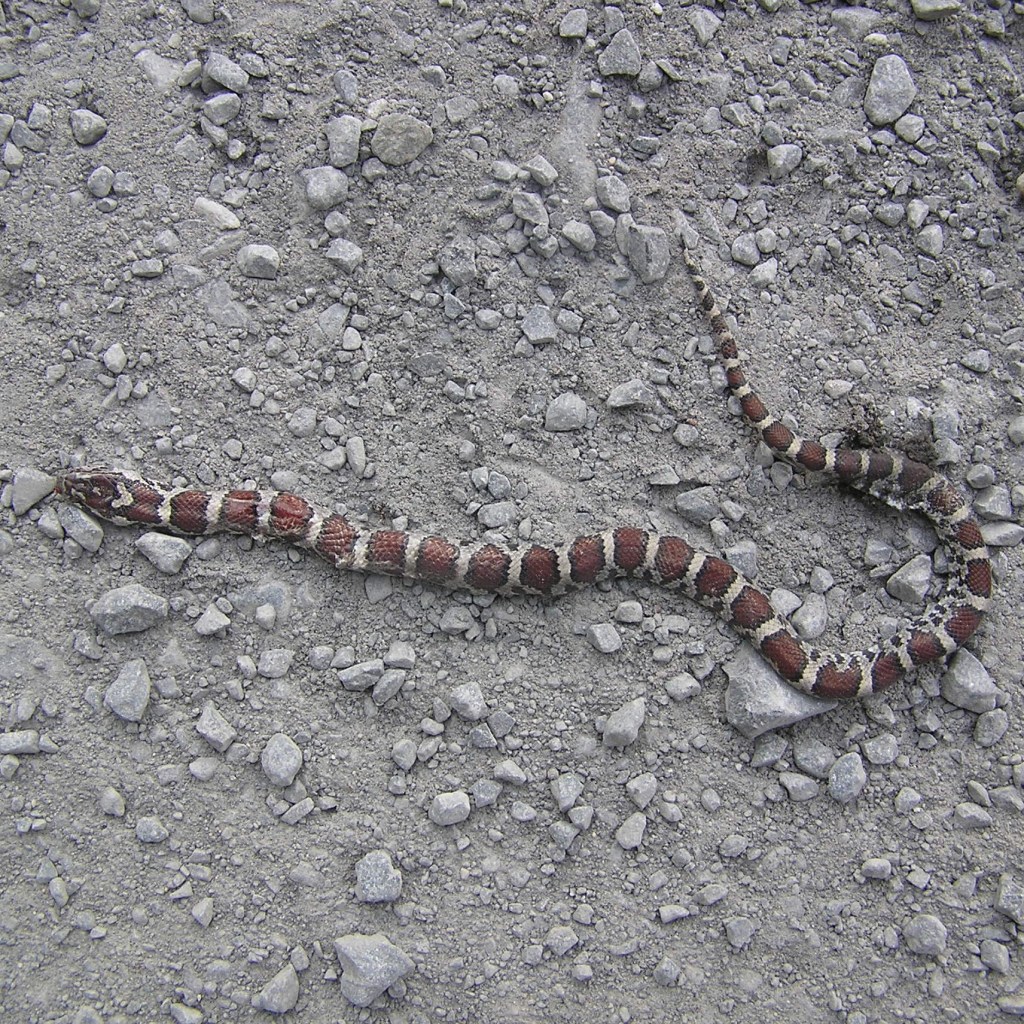
Corn Snakes are often confused with milk snakes

The color scheme of corn rat snakes is also with purpose. For some animals, notably birds, colors are in many cases a matter of mate choice. This cannot be the case with reptiles with no visible distinction between the sexes save perhaps size. What is important is blending into the surrounding environment. If an animal is subject to predation, and most are, then being difficult to find is a survival asset. Snakes are subject to predation by carnivores like foxes, bobcats, and raccoons in addition to birds of prey like hawks. However, an equal and opposite reason for rat snake camouflage is stealth for predation. The black rat snake stands out, literally. Among the greens and dappled hues of the forest floor, jet black is hardly stealthy. Arguably, black confers stealth at night and this surely plays a role as black snakes hunt at night in summer and frequently climb trees in search of songbirds and squirrels. Corn snakes not so much, mostly lurking in underbrush like cornstalks in search of prey. While a limited data point, two corn snakes were eviscerated in Virginia in 1939 to reveal the remains of a field mouse, a skink lizard, and a wood-boring beetle. [8] The variable colors of corn snakes in darker blotches on a lighter background are not unlike those of other snakes like copperheads and timber rattlesnakes in addition to the nearly identical milk snake. It must be concluded that snake color pattern is not all that important as a survival attribute and color variability is therefore not constrained by it.

Detecting, localizing, overpowering, and killing prey for food is a matter of snake survival.  Sensory perception is therefore central to snake hunting success. Vision, hearing, and smell all play a role. Taste does not play a role, as snakes need no sensors to sample food swallowed whole and headfirst. The unblinking, lidless eyes of snakes are sinister and effective. Short range vision of corn rat snakes is good even under the low light conditions of darkness. Since snakes lack mammalian middle ears, connective eustachian tubes, and eardrums (tympana), they are relatively insensitive to airborne noise. However, sound induced ground vibrations are detected by conduction through the solid bones of the skeleton, allowing for initial detection of activity but lacking any directional specificity. Smell is the most important corn rat snake sense [9], enhanced by employing the tongue as an air sampling appendage. The twisting, forked tongue is an equally sinister snake attribute. Chemical molecules in the air that convey smell are sampled by the flickering tongue and deposited into two small ducts in the top of the mouth cavity. This repository is the vomeronasal, or Jacobson’s organ, which sends scent data to the brain for interpretation as food, foe, or friendly mate.[10] When a corn rat snake is encountered on the trail, it will first feel footsteps, localize with beady-eyed vision, and conduct a full evaluation with smells sampled lingually. It will respond according to instincts tempered by experience.

A corn rat snake’s reaction to its encounters with other animals depends on how its brain interprets what its sensory suite detects. According to the analogous mammalian amygdala, sometimes referred to as the reptilian brain, reactions include fight, flight, fear, and, if you happen to be a corn snake of the opposite gender, sex. The mnemonic used by neuroscientist students for these functions is “the 4 F’s” of the amygdala, substituting carnal knowledge fornication. If a threat is perceived and an escape route is open, corn snakes take flight and slither to safety. Laboratory testing has demonstrated that corn snakes are adept at finding an escape route based on spatial awareness and learning when confronted with multiple options. Fleeing to leaf litter bowers is a practiced strategy. [11] If cornered, corn rat snakes will fight, taking up a defensive, coiled, readiness to strike posture, bobbing and weaving to confront the threat. Corn rat snakes also vigorously shake their tails like rattlesnakes when threatened, lacking only the noise-making rattle. While the reason for this evolutionary trait is unknown, it is speculated that it is defensive, presenting a confusing tableau of a double-ended body to a potential predator. It is a relatively common trait among members of the Colubrid snake family.  However, if fear is not a factor according to the sensory profile and there are prospects for a meal or a mate, escape changes to engage.

The adaptations necessary and sufficient for snakes, obligate carnivores, to subdue their quarry without the benefit of arms and legs to hold and pummel or teeth to impale and tear is testimony to the consequential driving force of evolution.  Poisonous snakes engage in chemical warfare, injecting toxins with fangs to immobilize prey. The constrictors, like corn rat snakes, employ brute force. The widespread use of constriction among snakes suggests that it probably was an early adaptation, arising in the Paleocene Epoch, contributing to the rapid radiation of constrictor snakes to new habits. [12] An evaluation of prey handling complexity comparing constrictors with jaw holding and body pinning practiced by other species revealed the simplicity and effectiveness of the former. It is surmised that the constriction method evolved to subdue “vigorously struggling prey” which may have been necessitated to successfully catch and kill rodents. Constrictors mastered the physics of muscular compression. [13]

And then there is the matter of mating, which begins with sensory perception of a potential partner of the same species. Since snakes are solitary and mostly hidden from view over wide-ranging habitats, the importance of pheromones in mate localization cannot be understated. The search for a mate begins in early spring, and, if successful, results in the deposition by the female of up to 30 eggs in a secluded location chosen with enough heat (82 °F is ideal) and humidity to promote incubation. As with almost all reptiles, there is no parental support and protection. The eggs must remain undiscovered by predators for over 60 days when they hatch out as foot-long juveniles. In the three years that it takes to reach full size; many are lost to the gene pool due mostly to either becoming prey or due to the inability to find prey. [14] For corn rat snake population stability, one male and one female must, on average, survive, meet, and mate from each clutch of eggs. In the native habitat in the southeastern United States, corn rat snakes hold their own, in spite of being killed by humans, many of whom wrongfully fear all snakes. For those who like snakes, corn rat snakes make good pets, as they are docile and do not object to being handled. This has led to corn rat snakes becoming an invasive species in many of the islands of the Caribbean as they have been imported and escaped to a predator free habitat. [15]

References:

1. Webster’s Third New International Dictionary of the English Language, Unabridged, G. C. Merriam Company, Chicago, 1971, p 1632

2. Simpson, D. Cassell’s Latin Dictionary, Wiley Publishing, New York, 1968, p 211.

3. Crother, B.  “Scientific and standard English names of amphibians and reptiles of North America north of Mexico, with comments regarding confidence in our understanding” Society for the Study of Amphibians and Reptiles Herpetological Circular. 2012 Volume 39: pp 1–68

4. Behler, J. and King, F. National Audubon Society Field Guide to North American Reptiles and Amphibians, Alfred A Knopf, New York, 1979, pp 604-607

5. Starr, C. and Taggart, R. Biology 5th Edition, Wadsworth Publishing Company, Belmont, California, 1989, pp 580-585.

6. Burbrink F. and Lawson, R “How and when did Old World rat snakes disperse into the New World?”. Molecular Phylogenetics and Evolution. 27 September 2006 Volume 43 Number 1pp 173–189.

7. Title, O. et al “The macroevolutionary singularity of snakes” Science, 22 February 2024, Volume 383 Number 6685. pp 918-923.

8. Linzey, D. and Clifford, M. Snakes of Virginia, University of Virginia Press, Charlottesville, Virginia, 1981, pp 96-102

9. Saviola, A et al “Chemosensory responses to chemical and visual stimuli in five species of colubrid snakes”. Acta Herpetologica. 19 April 2012 Volume 7 Number 1 pp 91–103

10. Dowling, H. “Reptilia” Encyclopedia Brittanica, Macropedia, University of Chicago, Illinois, 1974. Volume 15 pp 725-739.

11. Holtzman, D. et al “Spatial learning of an escape task by young corn snakes, Elaphe guttata guttata“. Animal Behavior. January 1999 Volume 57 Number 1 pp 51–60.

12. Greene, H. and Burghardt, G.  “Behavior and Phylogeny: Constriction in Ancient and Modern Snakes”, Science 7 April 1978. Volume 200 Number 4337.

13. Saviola, A. and Bealor, M. “Behavioral complexity and prey-handling ability in snakes: gauging the benefits of constriction”. Behavior. 30 May 2007 Volume 144 Number 8 pp 907–929.

14. Smithsonian Zoo. Eastern corn snake | Smithsonian’s National Zoo and Conservation Biology Institute   

15. Commonwealth Agricultural Bureaux International. (CABI) database https://www.cabidigitallibrary.org/doi/10.1079/cabicompendium.84655

Mallard Duck

The brightly colored male drake is chosen by the camouflaged hen as her mate.

Common Name: Mallard – From the Old French mallart and Latin mallardus, a combination form derived from the word male. The etymology is not well defined, but it is likely that the distinctive plumage of the male duck is the basis for distinguishing the species with a name derived from “male of the wild duck.” In France, the mallard is known as le canard colvert, roughly translated as duck with the green feathers on the side of the head. Duck is derived from Middle Dutch as düken, to dive underwater. Mallard ducks duck but don’t dive.

Scientific Name: Anas platyrhynchos – The generic name is the Latin word for duck which is ascribed to the Sanskrit ati meaning aquatic bird.  The species name is from the Greek platy meaning flat and rhynchos meaning snout, bill, or beak. Taken together the scientific name literally means flat-billed duck. [1]

Potpourri: The contrast between male drake and female hen mallard, known as sexual dimorphism, is among the most extreme of all vertebrates, affording an unmistakable visual key for identification. Carl von Linné originally listed the male and female as different species in the Linnean taxonomy classification system, believing that they could not possibly be the same.  The male drake’s iridescent dark green head, white neck ring, chestnut brown breast, brownish gray back and white flanks stand in stark contrast to the female’s maculation of buff, ecru, and dark brown. Mallards are prolific, having spread across the northern hemisphere as a global species. The North American contingent of mallards can even be considered a single population. [2] The evident evolutionary success of mallards, even though they are preyed on by human duck hunters, is due to several factors. Drakes are aggressive sexual predators, even though those that succeed settle on a single partner. Hens are selective in choosing mates that meet their criteria, which must impart qualities in their combined offspring that advance favorable adaptability and survival traits. Mallards are masters of ponds and lakes, which provide a measure of protection from terrestrial predators, and furnish an ample supply of water plants, their primary food source. Mallards are a duck dynasty.

Mallards are members of the Anatidae family, named for its characteristic “type” species, the duck genus Anas. It is comprised of ducks, geese, and swans, consisting of 49 genera and 158 species that range across the globe on every continent except Antarctica, a cosmopolitan distribution. Anatids are adapted for aquatic habitats, employing open water as a means of transport. For the most part, they have webbed feet for paddling locomotion and large, round bodies due to the physics of floatation. [3] The buoyancy that provides an upward force to float a duck is equal (and opposite) to the gravitational weight of water displaced by its semi-submerged body. This is important for ship hull construction and duck anatomy, both of which are elongated, rounded cylinders. Waterfowl are also unusual in that they are one of only a few types of birds (3 percent) that have a penis, necessary to ensure successful sperm transfer in an aqueous environment. It is a given that the ancestral bird cum dinosaur had a penis as it was reptilian in origin. The reduction and eventual elimination of the male sexual appendage in most birds is attributed to social behavior. Mating is based on mutual choice with the female usually having the greater say in the matter; many partnerships are lifelong. Since penetration is not forced, the act of intercourse amounts to what is euphemistically called the cloacal kiss. The cloaca (Latin for sewer) is the channel that serves as the passage for excrement and, in some cases like most birds, reproduction. Geese and swans follow the normal bird arrangement of mutual, lifelong partnerships in spite of the retention of a shortened penis for aquatic penetration. In Greek Mythology, Zeus took the form of a swan to impregnate Leda, who gave birth to Helen of Troy. Mallard sex is altogether different.

The iridescent green head of the drake is limned by a white neck ring.

The sexual overdrive of mallards in particular and ducks in general can take extreme forms. In June 1995 a flying mallard collided with the glass front wall of the Rotterdam Natural History Museum in Holland and fell, limp and thoroughly dead at its base. A curator from the museum went to investigate and found not only the dead duck but also a live mallard actively engaged in intercourse that persisted for over an hour. The paper written on the subject, entitled “The First Case of Homosexual Necrophilia in the Mallard” won Harvard’s Ig Nobel prize in biology in 2003. The museum continues to celebrate “dead duck day”. While this particular observation may be an aberration, it is similar in sexuality if not in degree to other mallard drake behaviors such as gang rape. Groups of males are wont to chase after single hen females with repeated sexual assaults that sometimes results in fatal injuries. The cuckold whose mated hen was the object of the chase usually responds with aggressive assault to try to dissuade the rapists, manifesting male fitness evolution. [4] In the absence of available females, drakes have been observed attempting copulation with other (live) males. The evolution of mallard drake’s super libido is matched by the physical size and complexity of the penis. While the record goes to the Argentine lake duck with a 17-inch penis, the mallard is amply endowed with a spined member one third as long. It operates like a coiled party blowout noisemaker, unrolling and everting with lymphatic system pressure as it extends into the vagina of a willing or unwilling hen. In less than a second, it coils counterclockwise inward and upward as a flattened tape with a groove (the sulcus) on one side serving as sperm conduit.[5] However, male sexual dominance is not the whole duck story.

The only notable color of the hen mallard is the blue speculum on the trailing edge of the wing.

Female mallards exercise mate choice, just like most of their avian counterparts. It is not, however, a simple yes or no. The complex nature of duck sexual behavior became a matter of scientific interest early in the century. The explosive, almost instantaneous erection of the penis of mallards and several other ducks must have had some evolutionary origin and was a matter of some interest to the biological sciences. The first area of investigation led to the study of the vaginal structure of duck hens. A series of dissections of different species revealed considerable anatomical differences. While most ducks had simple, tubular passages as would be expected, mallard hens had convoluted structures with a number of side openings that led to dead ends. And, most surprisingly, the vagina was coiled clockwise, in the opposite direction of the counterclockwise drake penis. This led to the hypothesis that species of female ducks partnered males with intimidating sexuality had evolved a coping mechanism, coital sidetracking. To test the hypothesis, an ingenious experiment was devised in which male ducks were encouraged (using a hen as stimulation) to ejaculate into purpose-built glass vesicles that simulated either a corkscrew vagina with cul-de-sac outlets or a simple tubular design with no twists or turns. The data showed that the ducks using the straight, normal tubes were successful in full erections 80 percent of the time while those using the actual hen twisted coil arrangement were only 20 percent successful. This was supported by DNA testing of drakes, hens, and the resultant chicks showing that even though 40 percent of all mallard copulations are forced, no more than 5 percent of the chicks genetically matched to rogue drakes. In other words, the female was able to employ mate selection 95 percent of the time. [6

Scientific research conducted to unravel the complex sexuality of ducks contributes to a better understanding of birds in general and of biology more broadly. Mallards are particularly important for a number of reasons. One is population size. It is estimated that the 23 million individual mallards that make up the global population range over about 10 million square kilometers (one tenth) of the earth’s land surface. In some areas like the Chesapeake Bay, mallards are considered invasive. [7] A second is sexuality, for, in addition to assaulting hens and even dead males, mallard drakes are insatiable paramours. Introduced mallards interbreed with native duck populations to the extent that hybridization threatens to extirpate other duck species; it is estimated that 95 percent of New Zealand’s native gray ducks have been hybridized and that the Hawaiian duck has become completely hybridized on the island of Oahu. [8] Last but not least is human health and nutrition.  Ducks are the principal reservoir on Influenza A viruses, including the H5N1 variant, which, as recently as 2013, resulted in outbreaks in poultry in over 60 countries resulting in 622 human infections. [9] However, studying duck sex, when taken out of context, can sound ludicrous, not unlike many other scientific studies. As part of the political news cycle, the study was dubiously called Duckpenisgate and newscasters asked whether the public was aware that $385,000 of their tax dollars had been spent to study duck dicks. The war on science was just getting started.

Mallard behavior is hard-wired by genetic heritage, focused on reproduction. The annual cycle starts with the initiation of pair bonding in late fall that continues through to spring, migrating in most cases to breeding grounds for the mating season. [10] The sexual hormones ramp up from minimal during winter to what can only be described as overdrive as gonads grow thousands of times larger in only a few months.  Problems arise because the ratio of drakes to hens is skewed with the former outnumbering the latter, as is the case with most duck species. The problem is exacerbated by the concentration of ducks in their habitat. Ponds are limited in size and have an abundant food supply of aquatic plants. Since it would not be possible for any drake-hen couple to defend a pond, ducks are not territorial. [6] The combination of too many males in a restricted area with a large number of paired couples committed to copulation and reproduction is a recipe for mayhem. Males struggle to defend their mates from the testosterone driven bachelor drakes in search of fulfillment. After successful mating, controlled in part by hen selectivity, the favored drake continues to guard his mate during selection of a ground nest near the water and the laying of 9-13 eggs. The burden of sitting on the nest for a month and leading the hatched chicks to water rests entirely with the hen. The drake departs, molts and regrows flight feathers needed for the reverse migration to find a new mate for the next season. [11]

The love it and leave it behavior of male ducks is blighted according to human morality. Anthropomorphism, however, has no place in nature other than amongst us. The mallard drake dynasty is a product of time, space, and survival, as is the evolution of every other living thing. The evolution of the mallard is fairly recent, the genus Anas is thought to have originated sometime in the late Pliocene or early Pleistocene epoch, about two million years ago, probably in Siberia.[12] During the relatively brief geologic time scale period since then, the combination of aggressive males preying on females and the selectivity of females in their choice of males (presumably preferring those with coruscating green heads) has been a resounding success. The loss of hens sitting on ground nests to predators like foxes contributes to their numerical imbalance. The high demands on chick survival according to the same constraints would also result in survival of the strongest, usually male, of the species. There are therefore more males for the females to choose from to ensure that those with the “right stuff” get the reward of progeny. Drakes are aggressive because they have to be. Disney’s irascible Donald Duck character as foil to the benign Mickey Mouse is well cast.

References:

1.  Webster’s Third New International Dictionary of the English Language, Unabridged Meriam Webster Company, New York, 1971, pp 78, 698, 1267

2. Starr, C. and Taggart, R. Biology, The Unity and Diversity of Life, Fifth Edition, Wadsworth Publishing Company, Belmont, California, 1989, p 539, 543.

3. Alderfer, J. ed Complete Birds of North America, National Geographic Society, Washington, DC, 2006, pp 2-42.

4. Barash, D. “Sociobiology of Rape in Mallards (Anas platyrhynchos): Responses of the Mated Male” Science, Volume 197 Issue 4305, 19 August 1977, pp 788-789

5. Schilthuizen, M. Nature’s Nether Regions, Penguin Group, New York, 2014, pp 125-129.

6. Prum. R. The Evolution of Beauty, Doubleday, New York, 2017, pp 149-181. The relevant chapter is entitled “Make Way for Duck Sex”

7. Smithsonian Institution Invasive Species https://invasions.si.edu/nemesis/chesreport/species_summary/anas%20platyrhynchos

8. Levin D. Hybridization and Extinction” American Scientist, Volume 90 Number 3, May-Jun 2002, p. 254.

9. Huang, Y. et al. (2013). “The duck genome and transcriptome provide insight into an avian influenza virus reservoir species”. Nature Genetics. April 29, 2014, Volume 45 Number 7 pp 776–783.

10. Cornell University Ornithology Laboratory https://www.allaboutbirds.org/guide/Mallard/id

11. Rogers, D.  University of Michigan Ann Arbor Michigan, “ Anas platyrhynchoshttps://animaldiversity.org/accounts/Anas_platyrhynchos/

12. Johnsgard, P. “Anas platyrhynchos Linnaeus – Evolutionary relationships among the North American mallards”. The Auk.1961 Volume 78 Issue 1 pp 3–43

Cut-leaved Toothwort

The deeply lobed leaves are the most reliable feature for field identification.

Common Name: Cut-leaved toothwort, Pepperwort, Pepper-root, Spring blossom, Lady’s smock, Milkmaid, Large toothwort – The deeply indented leaves are an unmistakable key to the identification of this spring ephemeral. The root is a thick, white rhizome that is divided into segments having the appearance of a jawbone with teeth. Wort is from the Old English word wyrt meaning herb, plant, or root and is usually used in combination for an herbaceous plant. [1] It does convey a sense of medicinal use, as the word herb is sometimes construed.

Scientific Name: Cardamine concatenata – The genus name is from the Greek kardamine, a word meaning water cress. The species name is taken directly from the Latin concatenatus meaning linked together like a chain, recognizable in English as concatenate. This refers to the jointed “tooth” rhizome. Dentaria laciniata appears in many older texts with the genus having clear reference to teeth, the dent prefix in Latin. Laciniate means cut into deep and irregular lobes, also directly from Latin translation. The former scientific name translates to “tooth-like with deep lobes,”  the antithesis of cut-leaved toothwort. [2]

Potpourri: Spring ephemerals are the first harbingers of winter’s end and the start of the growing season powered by radiation from the sun and nurtured by water now unfrozen. The name is apropos, deriving from the Greek word ephemeros, lasting for one day. It is generally used for anything fleeting, including ideas, maladies, data, and especially cultural arts (out, out brief candle, life is but a walking shadow that struts and frets his hour upon the stage and then is heard no more).  Flowers that proliferate along the trail are the epitome of ephemeral in their brevity of growth, maturity of florescence, and the decay of death over the course of just a few days. In addition to the cut-leaved toothwort, the other notable ephemerals are bloodroot, hepatica, trout lily, spring beauty, and trilliums. As a trait shared among a number of unrelated species, ephemerality is the end result of a successful evolutionary response to environmental constraints that favors transience. Such traits are called convergent evolution as plants (and animals) converge to the same form and function independently.

The reason flowers trend toward the frenetic pace necessary to become ephemeral is neither recondite nor one of nature’s innumerable oddities. It results from the logical and successful strategy to take advantage of the short window of time during which there is little competition, other than from other ephemerals doing the same thing. Plants need the sun’s energy to make hydrocarbons and (most) flowering plants need pollinators to satisfy sexual needs (but not desires). Sunlight at ground level is abundant in early spring as the canopy trees have not yet foliated to absorb its energy for their own photosynthetic purpose (which is why trees grow ever upward in branches of leafy arrays). As insect pollinators first emerge in the cold blush of early spring in search of nutritive nectar, ephemeral flowers are abundant with showy blossoms offering the promise of a meal. There is little else to choose from.

Ephemerals make insect propagation easier by being generalists, meaning that any roving insect will do (many flowers – notably the orchids – are “designed” to attract a specific insect pollinator), and by being self-compatible, meaning that the pollen from the stamens in a flower will fertilize the ovaries in the pistil of the same flower. Bumblebees are the most adapted to pollinating ephemerals as they emerge early and feed abundantly to get a jump start on establishing a colony, a prodigious feat that must be completed by fall, a scant six months away. Their furry bodies shield them from cold and their continuous buzzing vibrations generate heat.  [3] While self-pollination is not a strategy conducive to long term survival in that it suppresses the genetic diversity of mixing genes, the raison d’être for sexuality, it suffices for ephemerals. Most plants reproduce by combining self pollination with sexual cross pollination to promote propagation with enough diversity to prevent extinction. [4] Whatever the mechanism, the evolutionary success of ephemerals is undeniable, as they are ubiquitous along forested pathways in the springtime to the extent that they define it as a time of resurgent life.

Cut-leaved toothworts employ a supplemental growth feature in the form of a root structure called a rhizome that extends horizontally from each plant to enable vegetative growth. The name toothwort is due to the resemblance of the rhizome to a jawbone with bumps that suggest teeth along its length. The bumps-cum-teeth are the origination points for individual flower stems that grew upward over the course of previous spring emergence. [5] This is a feature of a perennial plant, taking advantage of a well established root structure from which to grow and spread. While the four-petaled white to pink flower is what attracts ambling hikers for its beauty and itinerant insects for its pollen and nectar, it is the root for which it is named that  establishes a niche in the ethnobotanical catalogues as both a food and as a medicinal. While cut-leaved toothwort flowers each produce about ten seeds, amounting to as many as 100 seeds per plant, their fertilization and growth is infrequent, relying mostly on the anastomosis of spreading rhizomes for extension into new frontiers. [6]

The rhizome or root has the appearance of a jawbone with emergent teeth.

The most obvious, if least effective, human use of tooth-like roots was as a treatment for toothache and related oral maladies. [7] Prior to the modern era, disease was more fearsome as there was little knowledge of cause and remedies amounted to patent quackery like blood-letting and bat wing potions. In Western civilization, Christianity offered the only solace against the scourges of nature and a loving God was thought to have intervened to help believers survive (and prosper and, of course, propagate the faith and faithful). This was the origin of The Doctrine of Signatures in the 17th century, a theory that God left his mark/signature on plants to signify their use. It was only necessary to determine the divine purpose through enlightened human inspection. Heal-all would soothe sore throats because it looked like an open mouth and sassafras cured syphilis because the leaves are shaped like a penis (stretching credulity). [8] The use of a plant that had roots that looked like teeth was much more obvious. It could only have had an ameliorative placebo effect among the early colonists, many of whom came to the alien shores of North America aided and abetted by their profound faith.

The Native Americans knew better, having survived for thousands of years by applying the tried and true practices of trial and error to develop an herbal pharmacopeia passed down through generations by word of mouth. They did not use toothwort for toothache. But they used it for many other purposes ranging from aphrodisiac to food. The six tribes of the Iroquois Confederation of the Northeast are treated as a singular group even as their cultural traditions are diverse as reflected in their toothwort use. It was used not only as a medicine to treat specific conditions like headache and heart palpitations but as a kind of panacea to treat any injury, known as “little water medicine.” More imaginatively, the toothwort plant was rubbed over things like traps and fishing lines as a “hunting medicine.” The root was placed inside the mouth which produced an aura thought to attract the opposite sex as a “love medicine.” There is no evidence that any of these treatments were effective in improving love, hunting, or health.    

The one use of cut-leaved toothwort that transcends Native American practices and colonist adaptation to the current era is as wild food. The different applications imply some significant diversity in American Indian cuisine. The Cherokee of the Carolinas cooked the plant and roots with other greens as a vegetable medley. Further west, the Ojibwa made something of a stew with potatoes, deer meat, and corn flavored with the peppery taste of the roots. [9] The pungency of phytochemicals is one of the characteristics of the Mustard Family (Brassicaceae or Cruciferae) to which toothwort belongs. According to current tastes, the pungent roots can be added to a sandwich or to a salad for piquancy with a specific recipe to “scrape or grate several of these sharply flavored root stocks, mix with vinegar, and set on the table in a little covered pot.” [10] However, harvesting ephemeral flowers to eat their roots is neither an appropriate nor necessary way to interact with the natural world. Better to admire them as you walk through the woods in spring.

References

1. Webster’s Third New International Dictionary of the English Language, Unabridged. Encyclopedia Brittanica, Inc. Helen Benton Publisher Chicago, Illinois, 1971, p. 2637.

2. Simpson, D. Cassell’s Latin Dictionary, Wiley Publishing, New York 1968, pp 179,333.

3. Kricher, J. and Morrison, G. A Field Guide to Eastern Forests, Houghton Mifflin, Boston, 1988, pp.163-169.

4. Wilson, C. and Loomis, W. Botany, 4th Edition, Holt, Rinehart and Winston, New York, pp 347-362.

5. Niering, W. and Olmstead, N. National Audubon Society Field Guide to North American Wildflowers, Alfred A. Knopf, New York, 1998, pp 428-429.

6. Mahr, S. University of Wisconsin – Madison Horticultural Extension https://hort.extension.wisc.edu/articles/cutleaf-toothwort-cardamine-concatenata/ 

7. Foster, S and Duke, A. Medicinal Plants and Herbs of Eastern and Central North America, Houghton Mifflin, Boston, 2000, pp 38-39.

8. Needham, W. The Compleat Ambler, Outskirts Press, Denver, Colorado, 2020, pp 28-30.

9. Native American Ethnobotany Database. http://naeb.brit.org/uses/search/?string=toothwort

10. Angier, B, Field Guide to Edible Wild Plants, 2nd edition, Stackpole Books, Mechanicsburg, Pennsylvania, 2008, pp 234-235.

Groundhog/Woodchuck

Groundhog foraging for food along the edge of a field not far from one of the entrances to its den refuge.

Common Name: Groundhog, woodchuck, forest marmot, whistle pig, marmotte commune (French), waldmurmeltier (German), Marmota canadiense (Spanish) – Groundhog is thought to derive from a translation of the Afrikaans aardvark; aarde means “earth” and vark means “pig”. This may have come to North America with the Dutch settlers of New Amsterdam. Earth pig and ground hog are synonymous.

Scientific Name: Marmota monax – The generic name comes from the French marmotte which is a shortened form of the Old French marmontaine which is from the Latin mures monti, which means “mountain mouse,” which is metaphorically similar to ground hog.  The specific name is from the Greek monos, which means single or alone, referring to characteristic solitary and  asocial behavior.

Potpourri: The groundhog is also known colloquially as woodchuck from a disparate Native American etymology. The various tribes of the Northeast were  familiar with the indigenous mammal, as it ventures abroad openly yet furtively in search of food during daylight hours. On being startled by a relatively large, and surprisingly fast woodchuck inadvertently encountered alongside a hiking trail, “big – brown – fluffy” was the descriptive name blurted out by one hiker. Perhaps due to similar and more frequent run-ins with different members of different tribes with different  languages, a variety of names were adapted over thousands of years of encounters: ockqutchaun in Narragansett; otchig in Ojibwa; otcheck or wuchak in Cree. [1] It is not clear that this was the name given to the groundhog, as one translation of the Cree name is “he who fishes” which  was given to  any of various fishing animals and groundhogs are not noted for catching or eating aquatic animals. Regardless of the precise etymology, which is rarely a matter of certainty, the  name wuchak was adopted by colonists. Many plants and animals of the New World had no European equivalents and were similarly christened. When words are taken from one language and used in another, modifications to suit familiarity are the norm. Thus, wu became “wood” to account for the animal’s habitat and chak became “chuck” perhaps as an onomatopoeia for the clucking noises that it made. The calque word woodchuck was the result. The palindrome that results from the reversal of the words led to the language exercise (tongue twister) phrase” how much wood could a wood chuck chuck if a woodchuck could chuck wood.” It was never clear what chuck wood was supposed to mean, but it suggests gnawing.

Groundhogs/woodchucks are in the Order Rodentia in the Family Sciuridae and are therefore closely related to squirrels and chipmunks, collectively the sciurids. The rodents are the largest group of mammals, comprising roughly 50 percent of all species, closer to 70 percent if based on the number of individual animals due to their geometric population growth and proliferation. Like all rodents, groundhog incisors grow at a rate of several millimeters a week throughout their lives (less during hibernation), which promotes and necessitates gnawing hard objects frequently. [2] While woodchucks may not chuck wood the way beavers do, it is not unlikely that they do. If there is nothing available to grind the teeth, malocclusion can proceed with potentially fatal result. Woodchucks are herbivores as are all rodents; foraging for food is the primary daily activity. While they favor grasses and herbs, they also regularly eat the leaves and twigs of dogwood, black cherry, and sassafras trees. Groundhogs are  synanthropes, thriving  in habitats planted and maintained in support of human enterprise. They are notorious for damaging consumption of farm crops such as corn, vegetables and fruit trees,  eating over a pound a day on average to maintain a body weight of 10 pounds. [3]

Groundhogs have strong, clawed forelimbs to dig elaborate dens that consist of an underground tunnel system with over 45 feet of tunnels extending to a depth of 5 feet underground.  The amount of effort necessary to excavate a maze of interconnected tunnels is near herculean, transporting about 100 cubic feet of soil weighing more than three tons. The tunnelling process would almost always include cutting through plant and tree roots, providing the tooth grinding necessary for survival. The den is accessed by a number of entrances, one of which is a plunge hole that extends vertically to the main tunnel for rapid ingress to escape predation. Occupied dens have a characteristic pile of fresh dirt at the entrances as a result of frequent cleaning. The den is arranged with a special chamber for excrement and a chamber for sleeping/hibernation that is a cozy 15 inch diameter padded nest.  The dens are both a boon and a bane as far ashumans are concerned. Their aeration and fecal fertilization of  the subsoil transforms it into topsoil, estimated by the state of New York to amount to 1.6 million tons per year. On the other hand, the burrows can damage building foundations and are a hazard to horses, who have been known to break a leg  on penetrating a hidden tunnel. [4]

Groundhogs have been traditionally characterized as solitary, agonistic animals, meeting only for the conjugal act necessary for survival of the species. Mating occurs soon after emergence from hibernation in early spring, the males on occasion fighting for the rights to reproductive activities with local females where geographic ranges overlap. The pugilistic ritual brings out the range of noises that make up the vocabulary of the animal which consists of  barking, squealing, chattering, and whistling; the name whistle pig is attributable to the cacophony. Female woodchucks have about three to five young called kits, that they raise for the most part on their own. The kits are naked, blind, and helpless and don’t even open their eyes until the fourth week. At six weeks, they are expelled from the den and forced to disperse. Not too many survive the first summer. The widely held belief that groundhogs are loners has been challenged by field studies. Recent research with modern radio tracking equipment has established that some if not most groundhogs belong to small groups consisting of one male and two or more kin groups of females consisting of an adult and a juvenile from the previous mating. “Interactions within the kin group and with the adult male were relatively frequent and generally amicable.” [5] Or maybe groundhogs are evolving so that the genetic traits that foster cooperation in raising kits results in increased survival of those who practice it.

Groundhogs are true hibernators in that they enter a state of torpor over extended periods during the colder months of winter. Hibernation is an evolutionary trait necessary and sufficient for survival (of the fitter) during periods when there is limited food available. It was most likely an adaptative genetic mutation that occurred soon after animals emerged from the oceans, where food is floating or swimming around at all times, to the challenges of seasonal terrestrial food availability. According to this theory, hibernation emerged during the transition from amphibians to reptiles and was retained in the mammalian diaspora during the Eocene Epoch. Human mammals would then have retained its genes, making the study of groundhog hibernation relevant to human treatments involving methods to slow metabolism   During sleep torpor, groundhog body temperature drops almost fifty degrees from 95 °F to 46 °F and heart rate slows form 100 to 15 beats per minute. In the mid-Atlantic groundhog hibernation begins in October and does not end until March or early April, lasting about 100 days. Research over the last twenty years has revealed that groundhogs do not stay in the lower metabolic, energy preserving state continuously, but rather reheat periodically to arouse and move about. It is hypothesized that arousal cycles may be needed to limit the physiological harm caused by long term shutdowns and contribute to readiness for spring mating. Arousals occur throughout winter becoming more extensive toward spring, which may then include short forays above ground, where they can be spotted by superstitious humans and named Punxsutawney Phil.[6]

Groundhog Day (February 2) is based on sound practical science even if its modern interpretation is fraught with the holiday hype of the social media age. When growing food became the norm during the Neolithic Age, knowing when to plant in spring for the fall harvest was a matter of life and death. The decision is essentially the same as that made by a hibernating animal that must decide based on environmental clues that it is safe to wake up and expend energy in search of food (and a mate).So looking for a hibernating animal out and about would provide a reliable prediction of the last frost and signal the start of preparatory measures to plow the fallow fields to sew the seeds of spring. Where and how this started is not known, but Romans purportedly celebrated hedgehog day in a similar manner, the indigenous hedgehog providing the shadowy omen. This practice spread across and was retained in medieval Europe. Since there are no hedgehogs in the New World, the majority of colonists who followed the Old World predictive prescription  eventually settled on groundhogs. While there are other animals that hibernate, including bears, skunks and snakes, the groundhog was common, easy to spot, and benign.

February 2 has a celestial significance that was important to early humans governed by the seasons as measured by the movement of the sun, the moon, and the visible stars. The Celtic tradition, which was incorporated into cultures that succeeded it in Britain and Ireland, is notable. The winter and summer solstices when the sun stood still and the spring and fall equinoxes with equal night and day were evident by careful observation. To provide for some transition between the four “quarter points,” the day that was midway between the two was known as a “cross-quarter” day. February 2, Groundhog Day, is  the quarter point between the winter solstice and the spring equinox. According to the Celtic tradition, it was called Imbolc, meaning lamb’s milk. A cloudy day was considered a harbinger of warm spring rains to prepare the ground for planting. Imbolc was symbolized by Brigantia, the goddess of light. When the Christian faith penetrated the Celtic lands, the holiday became Candlemas, when the candles of the church were blessed in celebration of the presentation of the Christ Child at the temple in Jerusalem. The other three cross quarter points are May 1, Beltane, generally the rite of spring now May Day, August 1,  Lammas, from “loaf mass” to celebrate the wheat harvest, and October 31, Samhain meaning “summer’s end” and the end of the old year, a time of the spirits of the dead. This became All Hallow’s Eve, now Halloween, returning to religiosity on All Saint’s Day on November 1. [7]

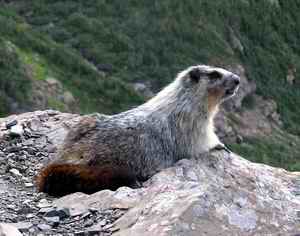
Hoary Marmot on Highline Trail in Glacier Park

The groundhog is the most solitary of the marmots, which are large ground squirrels that live in burrows and subsist on vegetative matter that can include grasses, berries, lichens, mosses, roots and flowers. The marmot appellation is more commonly applied to the species that live in mountainous areas, such as the Hoary Marmot (M. caligata) of the North American northwest and Siberia (right).  The Yellow-bellied Marmot (M. flaviventris) is also indigenous to the northwest and is noted for being the host for the tick that carries Rocky Mountain spotted fever. The Alpine Marmot (M. marmota) of Europe is thought by some historians to be the primary carrier of the Bubonic Plague, otherwise attributed to rats, which are also rodents. [8] It is not all bad. Groundhogs are the best non-human models for studying Hepatitis B since they suffer from a similar ailment and are also useful in studies of obesity, metabolism, and endocrinology. [9]

References:

1. Bento, H, publisher, Webster’s Third New International Dictionary of the English Language Unabridged, Encyclopedia Brittanica, Inc. Chicago, Illinois. 1971, p 2630

2. Wood, A. “Rodentia” Encyclopedia Brittanica, Macropedia William and Helen Benton Publishers, University of Chicago. 1974, Volume 15 pp 969-980.

3. Light, J. University of Michigan Museum of Zoology Animal Diversity Web. https://animaldiversity.org/accounts/Marmota_monax/

4. Kerwin, K. and Maslo, B. Ecology and Management of the Groundhog (Marmota monax)  Rutgers School of Environmental and Biological Sciences    https://njaes.rutgers.edu/e361/ 

5. Meier, P.  “Social organization of woodchucks (Marmota monax)”. Behavioral Ecology and Sociobiology Volume. 31 Number 6,  December 1, 1992, pp 393–400

6. Zervanos, S, “Professor sheds light on groundhog’s shadowy behavior” Penn State University Newsletter, January 2014

https://berks.psu.edu/story/2398/2014/01/23/professor-sheds-light-groundhogs-shadowy-behavior

7. Rothovius, A. “Ancient Celtic Calendar: Quarter Days and Cross-Quarter Days”            https://www.almanac.com/quarter-days-and-cross-quarter-days       

8. Whitaker, J. National Audubon Society Field Guide to North American Mammals, Alfred A. Knopf, New York, 1996, pp 438-445.

9. Kerwin and Maslo, op. cit.

Needle Ice

Needle ice extends upward into the frigid air at night at the rate of about a centimeter a day.

Common Name: Needle Ice, Ice flowers, Frost flowers, Ice fringes, Ice filaments, Rabbit ice, Ice castles, Ice leaf – The various descriptive terms are applied to an ice formation depending on the configuration of its components that can range from narrow needles to blocky castles.

Scientific Name: Segregated Periglacial Ice – Characterized by an area that is subject to intense freeze-thaw conditions (periglacial) that extends (segregates) from a frozen substrate, which may be ground soil or a plant stem. The name Crystallofolia has been proposed as a Latinized version of ice flower.

Potpourri: Hiking in winter is a challenge as air temperature often drops below the freezing point of water. Water is wet and sometimes slick but ice is slipperier and potentially dangerous. Mountainous regions are particularly susceptible to icy conditions for two reasons. The first is that ground water accumulates in the high volume terrain much more than level areas. It is drawn by gravity downslope, forming rivulets in ravines that combine to become the headwaters of rivers flowing eventually to the sea. Freezing is also a matter of height since temperature decreases between 3 and 5 degrees Fahrenheit (depending on how dry the air is) with every 1000 feet of elevation gain (6-10 degrees Celsius per kilometer). Sometimes physics is not intuitive. Lower temperatures occur when hiking upward in elevation because there is less atmosphere above and therefore less pressure, making  the molecules of air (mostly nitrogen and oxygen) move further apart. Temperature is a measure of molecular movement which is therefore lower when going higher. More elevation, more ice.  Because of this effect, a gently meandering downward trail can turn into an icy toboggan run without a sled. Ice can be beautiful just as it is oftentimes treacherous. Under certain conditions, it forms ice sculptures with variety of shapes and sizes. The most common form is needle ice.

The formation of needle ice structures is a well-recognized phenomenon in areas with the necessary and sufficient environmental conditions; it is called kammeis in Germany, pipkrake in Sweden and shimobashira in Japan. The German name kammeis translates to “comb ice” as the structure suggests the teeth of a hair comb. It occurs on sloped regions to the extent that a special name, kammeissolifluktion, is given to the process of movement of soil down the face of a slope due to comb ice. The Swedish name pipkrake is used largely in reference to sub-arctic needle ice. Pipkrake formation results in frost creep,  one of the primary geomorphologic processes associated with the shift of temperature across the freezing point of water. Frost creep occurs in permafrost regions due to the action of the individual pipkraken (needles) that rise beneath individual sediment particles. The net movement of soil due to needle ice/pipkrake is up to one meter per year; laboratory demonstrations have shown that pipkrake can lift ten pound rocks. The Japanese word for needle ice, shimobashira, translates as “columns of frost.”

Needle ice can be defined as “the accumulation of ice crystal growths in the direction of heat loss at, or directly beneath, the ground surface.” There are some complexities in this definition that relate to thermodynamics, the branch of physics that deals with the relationship between heat and energy.  [1] However, the mechanism of extending ice can be understood from observing the conditions under which it occurs. The fundamental requirement is a diurnal freeze-thaw cycle, which is nothing more than a 24 hour period during which freezing occurs at night followed by thawing with the radiant heat of the sun starting a dawn’s early light. In mountains, the area where this will occur depends on the height above ground due to the effect of elevation on temperature and the degree to which the sun is shaded by adjacent slopes. [2] Soil composition is also important in channeling the extending ice crystals in parallel columns. Soil is classified according to the relative amounts of three basic forms/sizes that arise depending on the degree of the erosion of weathered rocks. The largest particles are sand ranging in diameter from 0.05 mm to 2 mm. Silt is smaller, starting at 0.01mm. Clay particles are one order of magnitude lower, in the micron range, imparting a slippery feel to soil. A soil that has an even mix of sand, silt, and clay is called loam. Needle ice is most prevalent in soils that are made up of small sand particles with about 10 percent silt or clay. [3] It may be concluded that needle ice forms in columns separated by soil particles as water is pushed upward into the frozen air.

The thermodynamics of water is the essence of meteorology and oceanography (and therefore weather and climate) at the macro scale  just as it is of needle ice at the micro scale. Radiant heat from the sun in the form of photons is the font of all energy. Plants use sunlight energy to produce hydrocarbons and exhale oxygen. Oxidation of hydrocarbons in the mitochondria of all cells is the energy of growth and movement. With a higher intensity along equatorial latitudes, the sun’s radiant photons interact with either solid ground, causing concrete hot spots in cities, or water, mostly ocean, causing evaporation. Water molecules thus vaporized rise from the oceans and cool as they travel skywards to condense as clouds. The energy of evaporation, called the latent heat of evaporation, is returned when water vapor becomes liquid, falling as rain, snow, and sleet. This returned energy is what powers the weather, manifest in the extremes with thunderbolts of lightning and tornado whirlwinds. The rotation of the earth swirls the rising tropical vaporous clouds as they move away from the equator toward the poles to create weather. At the other end of the temperature spectrum is the latent heat of fusion, that amount of energy needed to melt solid ice to yield liquid water. Since it takes energy to melt ice, then energy must be released when ice forms. This is what is meant by the definitive statement that needle ice grows in the direction of heat loss. Energy from liquid water freezing is what forms the vertical needle column and moves it upward. [4]

Each water molecule is attracted to four adjacent water molecules with hydrogen or polar bonds.

The growth of needle ice is also affected by an increase in volume that occurs when liquid water solidifies. Solid water ice is 9 percent larger in volume that the liquid water from which it arose. This very unusual behavior for a substance occurs due to the nature of the bonding between the two hydrogen atoms and one oxygen atom that make up the water molecule, the familiar H2O.  The water molecular attractive bond called a hydrogen bond acts between two molecules that results from polarity, the familiar positive (+)  or negative (-)  of electric battery terminals. Hydrogen bond sites occur due to the way water molecules are put together.  Chemical compounds between atoms occur by sharing electrons so as to achieve a stable number of electrons which is the same as those in the inert gases at the far right side of the periodic table, which don’t react with anything (inert is the adjective form of inertia, to remain at rest). Oxygen needs two extra electrons which it shares with two hydrogens each with a single electron. Oxygen bonded to hydrogen in water is like the inert gas neon in stability. The result of the covalent water bonds is the creation of a positive charge on region on the hydrogen atom side of the water molecule  and a  negative charge on the oxygen atom side. These are called dipoles due to having two poles, one positive and one negative. The hydrogen or dipole to dipole bond occurs because opposite charges attract each other with an electrostatic force. Each water molecule is hydrogen bonded to four adjacent water molecules. [5]    

The weak electrostatic attraction of hydrogen bonds is what makes water fluid. It is also what makes liquid water more dense than frozen water. The freedom of liquid hydrogen bonds to attach to alternative and closer molecules draws them more tightly together. When crystallized as ice, molecules are rigidly set in space further apart, which is why ice occupies a larger volume than the liquid it formed from. Since ice is less dense than water, icebergs float and ponds freeze from the top down and not the bottom up.  This fact is enormously important to life on earth. If ice sank, the oceans would fill with ice and only a thin surface layer would be melted by the sun. Earth would essentially be an ice-covered ball. Further, since life (apparently) arose in aqueous (watery) saline (salty) conditions that we call oceans, there would almost certainly be no life on a frozen earth. When organisms eventually ventured out of the oceans onto dry land, they could continue to operate only by taking the ocean with them. Which is why humans and all other mammals are about 60 percent salt water. The hydrogen bond of water molecules in an aqueous environment is what makes life work. “The structures of the molecules on which life is based, proteins, nucleic acids, lipid membranes, and complex carbohydrates result directly from their interactions with their aqueous environment The combination of solvent properties responsible for the intramolecular and intermolecular associations of these substances is peculiar to water (italics in original).” [6]  Something to think about when you look down at the needle ice on the trail.  

Needle ice causes damage to plants by pushing up the soil around the roots.

Aside from aesthetics, needle ice formation is of scientific interest due to plant damage that is often its result. In order to establish the key variables in the formation and growth of needle ice, a montane area near Vancouver, British Columbia was instrumented and monitored in the late 1960’s. Weather conditions consisted of a prolonged anticyclonic period with clear, cold, and dry air. An anticyclone is the clockwise  (CW) circulation (in the northern hemisphere) of air around an area of high (H) pressure noted for cloudless blue brilliance. Cyclones are the opposite, turning counter-clockwise (CCW) around low (L) pressure areas which, under extreme conditions, result in hurricanes. Over the course of eleven sequential 24-hour noon to noon periods, parametric data were collected to evaluate the effects of temperature and time on needle formation and mean values calculated from the eleven data sets. Starting with the nucleation of ice at the bottom of the needle that started 9.9 hours after noon (about 2200), the nominal ice needle grew for 7.3 hours with an elongation of 9 millimeters (about 1 centimeter or 1/3 inch). As the sun rose the next day, the maximum surface temperature reached 12.8 °C (55 °F) at about 1330, resulting in some melting, and, more importantly, evaporation of the soil water into the desiccated air. Depending on the balance between freezing at night and melting during the day, needle ice formation is either homogenous (top photo), with continuous upward growth, or heterogeneous (right photo), with repetitive cycles of soil upheaval and subsidence, the latter resulting in greater damage. [7]

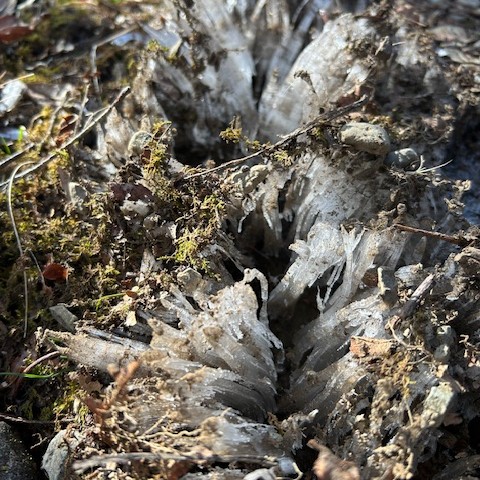
Ice flowers result from longitudinal splits on the stem of some plants.

The formation of ice structures that resemble flowers or ribbons is due to a freezing phenomenon that is closely related to that which causes needle ice. The fundamental difference is that ice flowers exude from the stems of certain plants whereas needle ice exudes from ground water without any botanical conduit. The geometry of certain plants and rotting wood is such that a passage for supercooled water is created. When the temperature drops, longitudinal cracks form along the axis of the stem and allow the liquid to ooze out into sub-zero air to be almost instantaneously frozen into a ribbon-like crispation. The overpressure that pushes the extruded ribbon out is thought to be the result of the gradual freezing of the water in the stem.[8] Ice flower formation is often erroneously attributed to frozen sap, which may contribute to the cracking of the stem wall.  However, there is not enough sap in the plant to create the “remarkable accumulations of voluminous friable masses of semi-pellucid ice around the footstalks of the Pluchea (fleabane) which grow along the road-side ditches”  as described by Dr LeConte of the University of Georgia in 1850. The plants that exhibit ice flower formation have been identified by observation, as the relevant dimensions of the plants’ structures that result in the phenomenon have not yet been determined. The list, largely anecdotal includes: dittany (Cunila origanoides), frostweed (Helianthemum canadense), yellow ironweed (Verbesina alternifolia) and white crownbeard (Verbesina virginica). [9]

Ice portal on AT in Shenandoah National Park near Matthews Arm

Spring is for flowers, summer is for fauna, fall is for fruit and fungi. Winter is for ice. Solid water frozen into structures sculpted by the physical properties of soil and air are quest-worthy. While ice needles may be admired for incongruous symmetry and ice flowers marveled for their mobius strip curvature, wind and water in frigid air works equal wonder. The trinity of water as vapor, liquid, and ice is as profound and deeply rooted in relevance to humans as the spiritual trinity that guides the lives of many. Cathedral portals through the iced boughs and branches offer solitude and purpose just as those of churches. Here one may find  the animist gods of the aborigine, the lares and penates of the wooded home, and the solitude of the soul, reduced to the raw elements that are ultimately its origin.

References:

1. Grab, S. “Needle-Ice”. In Goudie, Andrew (ed.). Encyclopedia of Geomorphology. Routledge. p. 709.

2. Pidwirny, M.: Fundamentals of Physical Geography, 2nd ed., section 10(ag), Periglacial Processes and Landforms

3. Nardi, J. Life in the Soil, University of Chicago Press, Chicago, 2007, pp 1-6.

4. Petrucci, R. General Chemistry, 4th Edition, Macmillan Publishing Company, New York, 1985, pp 140-151, 285-298.

5. Ibid. pp 305-307.

6. Voet, D. and Voet, J. Biochemistry, John Wiley and Sons, New York, 1990, pp 29-34.

7. Outcalt, S. “A Study of Time Dependence During Serial Needle Ice Events” Department of Environmental Sciences  University of Virginia, Charlottesville, Virginia, U. S. A. 23 April 1970. Water Resources Journal , Volume 7,  pp 394-400.

8. Carter, J. “Flowers and Ribbons of Ice” American Scientist. Sep-Oct 2013, Volume 101, Number 5. p. 360.

9. Carter, J.  “Needle Ice” Geography-Geology Department Illinois State University, Normal IL https://www.jrcarter.net/ice/needle/

Deer Truffle

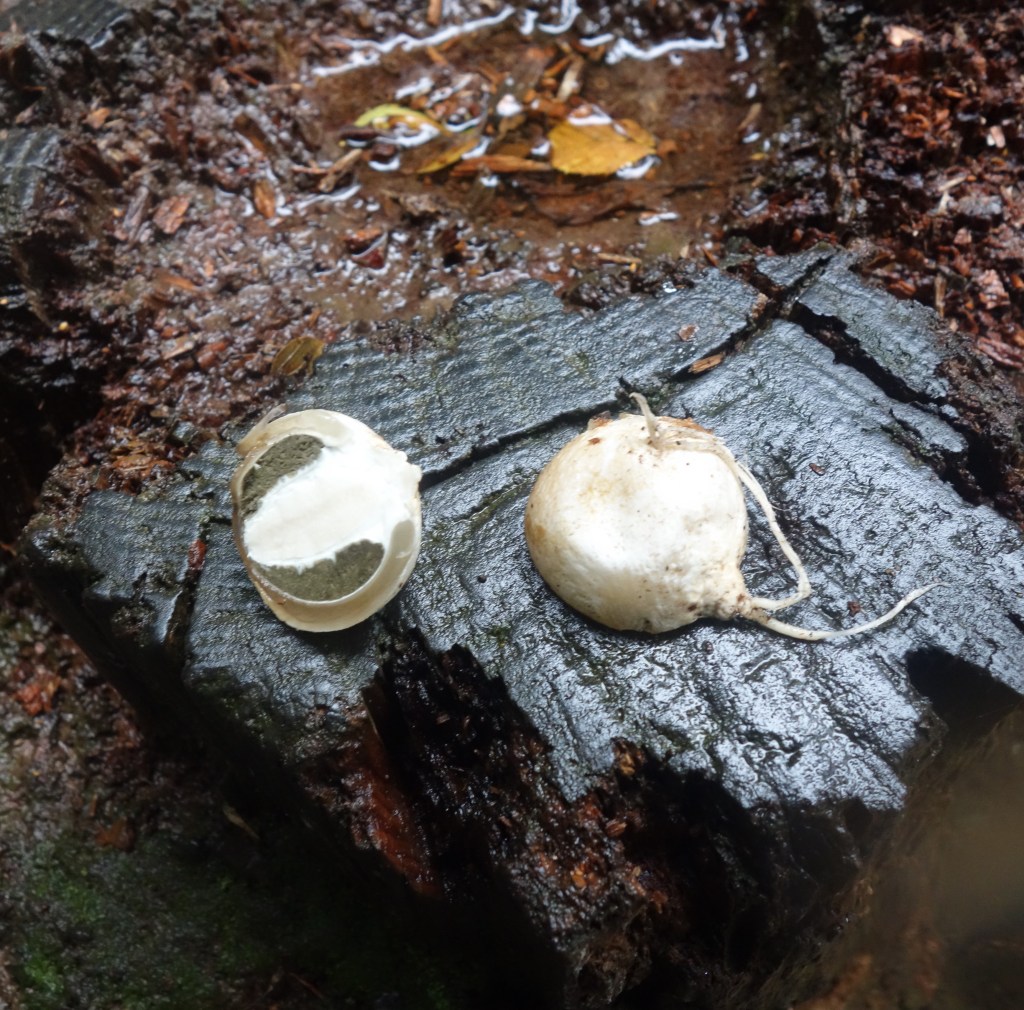
Deer truffles look like small clods of dirt; sectioning reveals spores. Note acorns for size.

Common Name: Deer Truffle, Deer balls, Hart’s balls, Warty deer truffle, Fungus cervinus (cervus is Latin for deer), Lycoperdon nuts (Lycoperdon is a genus of puffball fungi) –  Truffle is a French variant of the Latin word tuber meaning lump or knob. Both truffles and tubers (like potatoes) are generally globular in shape. The association with deer is attributed to finding them in locations frequented by stags during mating season. This gave rise to the belief that truffles are aphrodisiacs.

Scientific Name: Elaphomyces granulata – The generic name is a literal translation of Greek,  deer (elaphos) fungus (mykes). The Latin granulum is used directly in English as granule, referring here to the protuberances on an otherwise smooth surface. A loose translation of the scientific name would be “warty deer fungus,” one of the common names.

Potpourri: The deer truffle genus Elaphomyces is one of the most important mycorrhizal genera in temperate and subarctic forests, establishing and maintaining the ecosystem balance between plants and fungi. They are also an important source of food for small mammals like mice and voles on every continent except Antarctica. Deer truffles are equally favored by their namesake, notably the red, roe, and fallow deer species of Europe. Of the 49 species of deer truffle so far recognized worldwide, 20 are European. E. granulatus is one of the  most important North American species. A related species, E. muricatus, has been used in Mexico, both as “a stimulant, for remaining young and treating serious wounds” and “in shamanic practices in association with psychoactive Psilocybe species.” [1] Limited research in the 21st century has revealed that E. granulatus has enzymes that are known to reduce inflammation in addition to a variety of anti-oxidants with potential medicinal applications for humans.

Deer truffes are among the most common of underground fungi globally, and equally one of the least documented. The lack of scientific research on deer truffles is due partly to their sub rosa, subterranean obscurity and ignorance about their ecological importance. Even when uncovered, they look like lumpy balls of dirt. However, unlike the more famous black and white truffles of Europe, they are neither redolent with beguiling aromas nor palatable. Taste testers report that the main body is like “thick cream that tastes like nothing,” a rind that is “rubbery but can be chewed quickly,” and “a taste that goes in the direction of earthy forest floor.” They are, nonetheless, relished by rodents. [2]

Truffle is defined as “any of an order (Tuberales) of fleshy, edible, potato-shaped ascomycetous fungi that grow underground.” However, truffle is broadly applied to any hypogenous (below ground) fungus that is shaped like a tuber, which is the thickened part of an underground plant stem like those of the yam, cassava, and potato. According to historical etymology, any roundish shaped globule dug out of the ground was a tuber and/or truffle. [3] The distinction between plant and fungi kingdoms was not established until the 20th century so it would have made no difference whether the earthen globule was a plant tuber or a fungal truffle. The lumpiness meaning is inherent in chocolate truffle, a confection shaped like a truffle having no fungal ingredients. The terms edible and ascomycetous in the definition require some elucidation.

Edible does not necessarily mean by humans, but merely that it is or can be eaten for nutrition by an animal. Being edible is also a matter of importance, as fungal truffles reproduce by spores that must be transported for propagation. Above ground or epigenous fungi/mushrooms accomplish this with airborne wind dispersion, a mechanism not available to truffles buried several centimeters deep. Truffles must usually be consumed by an animal to transport the spores to new fertile ground and must thus be at least palatable. The need to attract animals is key to the inimitable smell and taste of certain species of truffles. It is probable that some truffles are unearthed and broken open without being eaten to release spores, so consumption is not absolutely mandatory although certainly the norm. Insects and worms that tend to feed on fungi may also play a role. Edible is a broad term in this context.

The term ascomycetous is a bit more complicated. The vast majority of fungi typically called mushrooms are in the subkingdom Dikarya which means “two nuclei” in Greek. Dikaryotic cells replicate with cell division of one nucleus from one “parent” and one from the other as they grow so that each new cell has two nuclei until the creation of reproductive spores through meiosis to pass the combined DNA to future generations. The way in which spores are produced divides Dikarya into two phyla, Basidiomycota and Ascomycota. Basidiomycetes produce four spores at the end of a club-shaped structure called a basidium. Most of the fungi that look like a mushroom with a cap or pileus at the top of a stem or stipe in addition to the various bracket fungi, puffballs, and stinkhorns fall into this category. Ascomycetes produce eight spores inside a sac-like structure called an ascus, Greek for wineskin or bladder. The asci are typically arrayed on a concave surface giving rise to the more common name “cup fungi” for ascomycetes. Most fungi, including yeasts, rusts, smuts, lichens, and, notably, truffles are ascomycetes. [4]  False truffles are basidiomycetes that look like truffles―ball-shaped structures that grow below ground.

Both truffles and false truffles followed different ancestral trajectories to become nearly identical in size, shape, and disposition due to similar environmental factors, a process called convergent evolution. Richard Dawkins offers that this is because “however many ways there may be of being alive, it is certain that there are vastly more ways of being dead.” Organisms tend to come up with similar ways to survive in the unforgiving environments of nature. Life above ground can be dangerous due to predatory and environmental challenges making it  advantageous to seek refuge in the soil. Many animals also do this. It is hypothesized that truffles evolved from cup fungi and false truffles evolved from mushrooms like agarics and boletes as a matter of random mutation resulting in improved survival. However, it could equally be the other way around, i.e. fungi may have originally been underground ”truffles” and evolved mushroom stems and gills for spore wind dispersion. DNA sequencing of the world-renowned Périgord black truffle corroborated the estimate that Pezizomycetes, the largest group of Ascomycota that includes truffles, separated from other fungal lineages 450 million years ago, just as the first plants advanced onto land from the sea. [5]

Deer truffles from Germany. Note root-like attachment to the mycelium.

Most fungi start as a root-like structure called a hypha emanating from one spore joining up with another hypha from another spore to  form a mycelium, the tangled mass of hyphae that defines the fungus. Since no species can survive without reproducing at some point, the mycelium must somehow send spores somewhere to start anew. Just as plants have devised ingenious ways to spread seeds, so have fungi to spread spores. Mushrooms start as underground bodies called primordia that are formed by the mycelium. They erupt upward on a stem into open air when the time is right to expose the spore bearing gill or pore surface to transporting winds. In the case of truffles and false truffles, the spores are contained in the tuber-like body that is attached to and grows from the mycelium but remains underground. The evolutionary pathway for the truffles and false truffles was to attract animals with enticing smells, not all that different from plants producing flowers with complex chemical scents to attract pollinators. Note that it is important for truffle smell signaling to start only when the spores are fully mature and ready to transport. Animals drawn by the smell to eat them transport truffle spores unwittingly wherever and whenever they “go.” [6]

Animals attracted to truffles and false truffles are globally diverse, inclusive of  deer, bears, and rabbits in the Northern Hemisphere and armadillos, baboons, and wallabies in the Southern Hemisphere. [7]  Underground fungi offer a food source that is relatively independent of surface conditions making them especially important to cohabitating animals. While most if not all forest dwelling mammals consume truffles on occasion, it is the burrowing squirrels and voles that are best equipped to use them as a major food source. With a keen sense of smell and claws to dig up buried acorns, there can be no doubt that squirrels are truffle aficionados. One well studied example is the California red-backed vole of the Pacific Northwest which subsists almost entirely on truffles. A study in the Oregon Coast Range involving vole capture and evisceration found that truffles made up 85 percent of consumed food, the balance was mostly lichens, also predominantly fungal. The northern flying squirrel, with a range from Alaska to North Carolina, is a nationwide spreader of truffle spores. [8] The extent of the role that truffles play in forest ecology as both providers of key soil nutrients like phosphorous and nitrogen to trees and as food for foragers is not well studied and therefore mostly unknown. This relationship is called mycorrhizal (meaning fungus root in Greek) and was first discovered by a biologist named Albert Frank in 1885 while employed by the King of Prussia to attempt to cultivate truffles. [9] Since there is no above ground evidence and animals need to be literally caught in the act, data are mostly anecdotal. However, one can gather some insight of the range, diversity, and importance of truffles from the aptly named “desert truffles.”

A desert is a dry, barren place incapable of supporting almost any plant or animal life. And yet, truffles thrive across North Africa and the Middle East all the way to China. Eking out a tenuous existence with shrubby plants with which they are mycorrhizal, they are surprisingly ubiquitous. They are sold in many local markets and consumed as an important food source over a vast region, noted for having a taste characterized as “delicate, not pungent.” They are reportedly relatively easy to find as they grow close to the surface and make the ground harder, a property that can be discerned with experience by rubbing a bare toe over the area. [10]  As Mesopotamia was the cradle of western civilization, the long history of truffles as both food and medicine there is telling. Truffles have historically been a substitute for meat throughout the Arabian peninsula. Truffles (kama’ah in Arabic) appear in the Koran as preventive medicine, used as promoters of longevity and good health much as many other fungi are in Asia. This a measure of their reputed anti-oxidant, anti-inflammatory, and immune modulating activity. 11] The cultural importance and extensive range of desert truffles across a broad swath of Eurasia is a strong indicator that they are key components of the plant-fungi global ecological partnership. While truffles are surely common and keystone in many regions, almost  all of what is known and studied about the nature and nurture  of truffles derives almost in entirety from detailed study of a few species that are among those granted the rubric “true truffles.”

True truffles are the epitome of European gastronomy. The black truffle of the Périgord region in southern France (Tuber melanosporum) is surpassed only by the white truffle of the Piedmont region of northern Italy (Tuber magnatum) in desirability and exorbitant cost. The reason for the difference is supply and demand, the universal economic law. White truffles are rarer because, unlike their cultivated French cousins, they grow only under naturally appropriate conditions and require specialized skills to locate. Consequently, in local Italian trattoria, one can purchase risotto with black truffles for about 20 euros, but risotto with white truffles will run over five times as much. [12] The reason for truffle demand is the redolence they impart to food, beguiling gourmands in their search for epicurean nirvana. It is telling that truffles were originally hunted with domesticated female pigs attracted by their aroma which includes the steroid alpha-androstenol, also found in the saliva (and breath) of rutting boars. The same chemical is found in the underarm emanations of men and in the urine of women, and, while the sexual role of the steroid in human sexuality has not been proven, it has been demonstrated. Men rating photographs of (clothed) women for sexual attractiveness gave higher marks when smelling alpha-androstenol.  [13] In that smell is intertwined with taste according to the neural-networked brain, the irresistible allure of  truffles to humans probably has deeper meaning and possibly including subliminal sexual arousal. It is no wonder that they are considered to be aphrodisiacs. Perhaps at least mentally they are.

It is almost certain that boars that have roamed wild across Europe for millennia were the coevolutionary partners of white and black truffles, spreading their spores far and wide. It is probable that humans first became aware of truffles in association with hunting wild boars. Thus began the long partnership between domesticated pigs and people in the pursuit of pleasure. Dogs have mostly replaced pigs as the truffle hunter’s sensory companion. Heavy, sedentary pigs required carting to truffle forest habitats and had to be forcibly prevented from eating their quarry; many a truffle hunter lost a finger to an overzealous pig. Dogs are not sexually attracted to truffles and must therefore receive olfactory training, much like drug-sniffing dogs of the DEA. This takes a great deal of time and effort, which must of necessity include the use of valuable, short-lived truffles. Trained truffle dogs are dear, commanding prices of over 15,000 euros but rarely sold. They can transit and search woodlands with ease and are not overwhelmed by lust for consumption. In fact, most truffle dogs don’t even like them, though apparently some do. Dogs have different taste preferences, as do their best friends. But not pigs, apparently. [14] The wild boar fungus story has a recently discovered twist. Of 48 boars killed in hunts in Bavaria, Germany, 88 percent had radioactive cesium levels (from Chernobyl) exceeding safety standards. It is considered likely that eating fungi that tend to bioaccumulate heavy metals were the source, especially truffles. [15]

References:

1. Paz, A. et al . “The genus Elaphomyces (Ascomycota, Eurotiales): a ribosomal DNA-based phylogeny and revised systematics of European ‘deer truffles'”. Persoonia. 30 June 2017. Volume 38 Number 1 pp 197–239.

2. “Deer Truffles – biology, ecology, distribution and occurrence of Elaphomyces or False truffle” https://www.umweltanalysen.com/en/elaphomyces-deer-truffles/  

3. Neufeldt. V. ed Webster’s New World Dictionary of American English, Third College Edition, Simon and Schuster, New York, 1988, p 1435, 1438.

4. Lincoff, G. National Audubon Society Field Guide to North American Mushrooms, Alfred A. Knopf, New York, 1981, pp 323, 377.

5. Martin, F. et al “Périgord black truffle genome uncovers evolutionary origins and mechanisms of symbiosis” Nature, 28 March 2010, Volume 464 pp 1033-1038.  https://www.nature.com/articles/nature08867 

6. Arora, D. Mushrooms Demystified, Second Edition, Ten Speed Press, Berkeley, California, 1986 pp 739-741, 841-865.

7. Trappe J. and Claridge A.” The Hidden Life of Truffles” Scientific American April 2010.

8. Stephenson, S. The Kingdom Fungi, Timber Press, Portland, Oregon, 2010 pp 200-205.

9. Frank, A.B. “Über die auf Wurzelsymbiose beruhende Ernährung gewisser Bäume durch unterirdische Pilze” [On the nourishing, via root symbiosis, of certain trees by underground fungi]. Berichte der Deutschen Botanischen Gesellschaft. 1885 Volume 3: pp 128–145.

10. Schaechter. E. In the Company of Mushrooms, Harvard University Press, Cambridge, Massachusetts, 1997, pp 161-167.

11. Khalifa, S. et al “Truffles: From Islamic culture to chemistry, pharmacology, and food trends in recent times”  Trends in Science and Food Technology, Volume 91, September 2019, pp 193-218. https://www.sciencedirect.com/science/article/abs/pii/S0924224418303406 

12. Goldhor, S. “Hunting the White Truffle” Fungi. Volume 8 Number 3, Fall 2015, pp 18-23.

13. Kendrick, B. The Fifth Kingdom, Third Edition, Focus Publishing, Newburyport, Massachusetts, 2000 pp 281-283.

14. Campbell, D. “Sketches from the Italian Truffle Hunt.” Fungi, Volume 11 Number 1, Spring 2018, pp 20-25.

15. Rains, M. “Germany’s radioactive boars are a bristly reminder of nuclear fallout” Science, 30 August 2023.

Horsenettle

Horsenettle flowers range from light purple to white, all with tubular yellow stamens to attract pollinators

Common Name:  Horsenettle, Bull nettle, Carolina horse nettle, Apple of Sodom, Devil’s potato, Thorn apple, Wild tomato, Poisonous potato – A nettle is a plant of the genus Urtica noted for stinging hairs. The name has been widely applied to other plants that have prickles like the horsenettle. The horse association is likely due to the fact that horsenettle plants are commonly found in pastures, like those fenced off for horses.

Scientific Name: Solanum carolinense – Solanum is Latin for nightshade. The genus name is attributed to Pliny the Elder (Gaius Plinius Secundus), a Roman military commander and naturalist in the first century AD. The origins of Solanum are unclear, but sol is Latin for sun; there is a sunberry flower in the nightshade family. The similarity in spelling to the Latin word solamen which means comfort is another possible etymology. [1] Plants of the Solanum genus have historically been widely used as medicine for a variety of ailments and conditions.  The species name is reference to the North American colony Carolina where it was first noted, probably before its division between north and south.

Potpourri: The horsenettle is a weed according to the standard definition as it grows where humans don’t want it to grow and crowds out preferred plants. If weediness is a matter of garden aesthetics, however, an argument can be made that the five-petalled white or purplish star with five yellow elongated stamens projecting from the center has some appeal. If weediness is detrimental to food crops like soybeans and wheat awaiting harvest from farm fields, then eradication with herbicides may be justified. Horsenettle is also poisonous to the extent that it is included in edible wild plant field guides as a cautionary measure to prevent gathering the wrong things when edible plants are sought. [2] But it is also medicinal, having been used by Native Americans and subsequently by colonizing Europeans for centuries. This, too, is not unusual, as horsenettle is a member of the Nightshade family, a rogue’s gallery of deadly plants that also includes potatoes, tomatoes, peppers, and eggplants, mainstay edibles of western cuisines. Horsenettle is bad weed, good medicine, and has ugly prickles.

Another thing that can be said about weeds like horsenettle is that they are successful plants, able to flourish in marginal soils and spread outward in profusion. That is what all living things aspire to do, perpetuating their own kind following the recipe for survival by being fittest. Darwin came to recognize that competition among plants was equal to if not more than that among animals, even as Galapagos finch beaks became his focus. As a backyard scientist with inimitable curiosity, he conducted an field test in his backyard by clearing six square feet down to bare soil to observe the emergence of native weeds. He noted that “out of 357 no less than 295 were destroyed, chiefly by slugs and insects,” the detail testimony to thoroughness. As confirmation, he repeated the experiment on a second area of established turf, noting that “out of twenty species … nine species perished” because the “more vigorous plants gradually kill the less vigorous.” [3] It is evident that becoming a successful weed is an evolutionary feat rather than a routine event. It is also apparent that the weeds that persist and become human problems are the cream of the weed crop, exceptionally evolved with propagative efficiency.

Horsenettles are poisonous because they produce an alkaloid chemical named solanine, the name derived from Solanaceae, the Nightshade family of almost 4,000 plant species in nearly 100 genera. Alkaloids are complex organic chemical compounds that can in many cases have physiological effects on animals ranging from medicinal like morphine, hallucinogenic like mescaline, and stimulants like nicotine (the “ine” suffix is prescribed). The root alkali is derived from the Arabic word for the calcined ashes of the saltwort plant, and refers to molecules that are basic (pH > 7), the opposite of acidic. Alkaloids are mostly bitter, which is undoubtedly the reason why bitter is one of the five tastebud types also including sweet for sugars, salt for minerals, sour for ripeness, and savory for proteins. Bitterness warns of  poison and most animals avoid bitter plants like horsenettle. The genetic code for bitterness taste sensors was retained by the survivors; individuals that lacked sensitivity learned about bitter poisons the hard way. Up until the nineteenth century, plant compounds were only known through trial and error. The alkaloid associated with the poison hemlock (coniine) was the first to be synthesized in 1886. [4]

The taxonomy of plants is based on familial similarities. The production of a specific alkaloid is typically a shared characteristic. This is true of the nightshades (Solanaceae) just as it is of buttercups (Ranunculaceae), poppies (Papaveraceae) and barberries (Berberidaceae). Alkaloid concentrations vary among the different species of a plant from plentiful to nearly nonexistent. The nightshades range from almost no alkaloid in tomatoes, potatoes, and eggplant to substantial amounts in horsenettle and tobacco. Why plants produce alkaloids is uncertain. Experiments have shown that tomatoes grafted onto tobacco stems produce no solanine.  Conversely, tobacco grafted onto tomato stocks does. This would indicate that solanine isn’t involved in growth or metabolism. However, that is not to say that there is not a purpose for a plant to make a complex chemical compound, which takes energy and raw materials. There is more to life than growth and there is more to genetics than the here and now. Alkaloids may be vestigial remnants that once had a purpose in the evolutionary past but which is no longer relevant.

Horsenettle fruits look like small tomatoes

Alkaloids may also have a role in reproduction, as some plants produce high levels during seed and fruit formation which become depleted when the seed is ripe. Horsenettle fruits look like miniature tomatoes. Whether they are toxic or not is an open question. One source says “the berries are the most toxic when they are mature” [5] and another says “all parts of the plants, except the mature fruit, are capable of poisoning livestock” [6] Since poisoning experiments on humans and livestock are not ethically acceptable, almost all reports of poisoning are anecdotal. It is probable that immature fruits are poisonous and mature, ripe fruits are not. This makes sense, as plants produce fruit to be eaten by animals so that the seeds are distributed in a dollop of fertilizing manure. For example, all parts of the mayapple are poisonous except the ripe fruit. Experiments with livestock that consumed ripe horsenettle fruits have shown that the seeds pass through the gut unharmed, exactly as would be intended and predicted. [7]

The relationships between animals and plants are complex. This is particularly true when it comes to alkaloids. Ostensibly, plants produce the bitter compounds through random genetic mutation and eventually a formulation occurs that keeps animal predation in check. However, in the niche-centric ecology of survival, the opposite must also occur. That is, animals that evolve some form of immunity to certain alkaloids in certain plants gain the advantage of abundant food avoided by competitive herbivores. The example of the monarch butterfly caterpillars eating milkweed that is poisonous to nearly all other animals is well known. Experimentation has shown that this is more the rule than the exception. When the Panama Canal was built in the early twentieth century, the flooding of Gatun lake created Barro Colorado Island where a Smithsonian Field Station was opened in 1924 to conduct long term experiments of evolution in an isolated biosphere. A recent study of the 174 caterpillars found on the island found that they were “picky eaters” is choosing which types of over 200 toxic compounds they would consume. This “encourages diversification, as new species with new, temporarily insect-proof toxin profiles emerge.” [8] It is not therefore surprising that a fair number of insects, and some animals, eat horsenettle leaves, stems, and fruit.

The vast majority of twenty first century humans have plenty to eat―in many cases too much. There is no cornucopia in the wild where life is “nasty, brutish, and short” according to Thomas Hobbes. Many insects and a few animals consume not only the horsenettle fruit, but also the bitter, normally poisonous leaves and stems as well.  A study conducted in Virginia over a period of six years (1996-2002) revealed that 31 insects from six different orders ate horsenettle voraciously. In fact, a detailed survey of 960 horsenettle plants found that the plants were severely damaged. And it wasn’t just bugs, as meadow voles also consumed horsenettle with no apparent ill effects. The most damaging insect species were those that also fed on other Nightshade family plants including the eggplant flea beetle and the false potato beetle in keeping with the evolutionary pathway of alkaloid tolerance.  Fruits were assessed separately due to their importance in propagation as the seed bearing component of the plant. The three species accounted for 75 percent of fruit damage were false potato beetles, pepper maggots, and meadow voles. [9] This also provides some validity to the overall scheme of life with plants producing sweet, tasty fruit to attract animals for seed dissemination.  

As is the case with many plants that are listed as poisonous to animals in general and humans in particular, horsenettle has historically been used for medicinal purpose. In the eons that preceded the Renaissance in the arts and sciences, treatment of human and livestock ailments was a matter of local lore and tradition using naturally occurring substances, mostly plants. Essentially, the chemicals created by a plant for its own use and protection provided similar benefits when consumed by an animal. In the case of horsenettle, the Cherokee who were indigenous to Virginia and the Carolinas where it originated were its most inventive purveyors. The leaves were used internally to dispel worms (apparently worms don’t like it either) and externally to treat poison ivy (although one would think that Cherokee had figured out the “leaves of three let it be” rule). Fruits were boiled in grease to treat dogs with mange and the seeds of the fruit were made into a sore throat gargle. [10] The Native American uses of native plants were in many cases adopted by early colonists so that these “natural remedies” appeared in the early listings of drugs. Horsenettle was listed in the United States Pharmacopeia  from 1916 to 1936 as a treatment for epilepsy, and, in keeping with the “snake oil” practices of unregulated past, both an aphrodisiac and a diuretic. It has long since disappeared from the apothecaries shelves, and is now mostly known for its toxicity. A modern medicinal plant guide concludes with “fatalities reported in children from eating berries.” [11]

References:

1. Simpson, D. Cassell’s Latin Dictionary, Wiley Publishing New York, 1968, pp 560, 772.

2.  Elias T. and Dykeman, P. Edible Wild Plants, Sterling Publication Co. New York, 1990, p 265.

3. Darwin, C. On the Origin of Species, Easton Press, Norwalk, Connecticut, 1976, p.50.

4. Manske, R, “Alkaloids” Encyclopedia Britannica, Micropedia, William Benton Publisher University of Chicago, 1974, Volume 1 pp 595-608.

5. North Carolina State University Agricultural Extension https://plants.ces.ncsu.edu/plants/solanum-carolinense/   

6. Bradley, K. and Hagood, E.  “ Identification and Control of Horsenettle (Solanum carolinense) in Virginia” http://www.ppws.vt.edu/scott/weed_id/horsenettle.PDF           

7.  https://www.illinoiswildflowers.info/prairie/plantx/hrs_nettlex.htm

8. “One hundred years of plenitude” The Economist, Science and Technology, 6 July 2024. p 64.

9. Wise, M. “The Herbivores of Solanum carolinense (Horsenettle) in Northern Virginia: Natural History and Damage Assessment” Southeastern Naturalist,  1  September 2007,  Volume 6,  Number 3, pp 505-522.

10. Native American Ethnobotany Data Base http://naeb.brit.org/  

11. Duke, J. and Foster, F. Medicinal Plants and Herbs, Peterson Field Guide Series 2nd edition, Houghton Mifflin Company, Boston, 2000, p 206.

Destroying Angel – Amanita bisporigera

The key features of the Destroying Angel are the cup-like volva at the base of the stem, the stark whiteness of the stem, cap, and gills, and the partial veil hanging from the top of the stem just below the gills under the cap.

Common Name: Destroying Angel, Fool’s Mushroom, Death Angel, White Death Cap – The virginal whiteness of all parts of the mushroom are aptly described as angelic – beautiful, good, and innocent. The fact that it is anything but is conveyed by the addition of destroying with death-dealing toxicity.

Scientific Name: Amanita bisporigera – The generic name is taken directly from the Greek word amanitai, probably from the Amanus Mountains of southern Turkey where the noted Greek physician Galen may first have been identified the archetype, Amanita. [1] The specific name indicates that there are only two spores on each of its basidia in contrast to the four spores of other basidiomycete fungi. Virtually indistinguishable from Amanita virosa and Amanita verna which both frequently appear as synonyms in mushroom field guides.

Potpourri:  The destroying angel is a toadstool nonpareil. While the origin of the term toadstool is obscure, it cannot be a coincidence that tode stuhl means death chair in German, the language of the Saxons who emigrated to England. Its notoriety is not only because it is one of several mushrooms that contain deadly poisons called amatoxins, but also due to its close resemblance to Agaricus campestris, the edible field mushroom which is the cousin of the cultivated white button mushroom of supermarkets and salad bars. Both are white, similar in size and shape, and grow in the same habitat, primarily grass under or near trees. The destroying angel is the most dangerous of the numerous doppelgänger mushrooms as the deadly twin of a well-known and often consumed edible.  Misidentification absent knowledge of the subtle physical differences between the two can result in discovering the profound physiological differences with sometimes deadly result. The field white mushroom is nourishing. The angelic white mushroom is Shiva.

The cup at the bottom of the stem is the volva, the bottom half of the universal veil.

The key features that distinguish the destroying angel from similar mushrooms are straightforward if you know what to look for. First and foremost is the volva, (Latin for a covering like a husk or shell) which is the cuplike structure at the base of and surrounding the stem or stipe. The volva is frequently hypogeal, i. e. underground and out of sight. This means that it can only be positively identified by digging up the soil around the base of the mushroom. [2] However, it is the standard and preferred practice among mushroom gatherers to use a knife to cut through the stem cleanly at the base. This is done so the mycelium of the fungus from which the fruiting body mushroom grows is not seriously disturbed. The procedure is analogous to gathering apples from an apple tree. The fungal mycelium and the apple tree survive to produce new mushroom spores and fruit seeds for future generations. Using the standard harvesting technique, it is easy to see how the below the cut volva would not be noted.  White mushrooms must be dug out to the roots to avoid the dilemma of the death mushroom.

The only way to be certain that you have a puffball and not a Destroying Angel is to cut it in half.

The volva is the bottom part of what is known as a universal veil, a thin membrane that envelops the mushroom during the subterranean growth phase to protect the gills and the spores they hold from damage. The universal veil is a characteristic of all mushrooms in the Amanita Family. While there are a few other mushrooms that have a universal veil and its volva (such as the genus Volvariella named for this characteristic feature), it is a reliable identification feature for the destroying angel. All spore-bearing mushrooms are produced by the fungal mycelium underground as an ovoid called a primordium. Once they mature and environmental conditions are promising (like after rain) the extension of the stem causes the universal veil to tear around its circumference to expose the cap and gills of the fruiting body for spore dispersal. The volva is the lower part of the “eggshell” that remains attached to the bottom of the stem. Prior to upward extension, the destroying angel looks like a white egg, similar in appearance to a puffball, another type of edible fungus with which the destroying angel can be confused.  Some field guides include a picture of it in the puffball section to emphasize the danger of mistaken identity. [3] The only way to be absolutely sure is to cut the fungus lengthwise to reveal a cap and gills within.

Many mushrooms have what is known as a partial veil which also helps prevent damage to the reproductive gill surface. It is partial in that it only covers the underside of the cap, extending from the edges of the cap to the stem. When the mushroom cap expands fully, the partial veil also tears, in many cases leaving some remnants around the edges and a ring called an annulus attached to the stem just below the cap. In some cases, the partial veil remnant can be seen hanging like a draped clerical mozetta at the top of the stem. However, this annular ring is not well connected, and in many mushrooms with partial veils, there is no remnant. Most Amanita family mushrooms have both universal veils and partial veils with both a volva at the bottom and a ring around the stem as is the case with the destroying angel. The double protection afforded to the gills must have evolved due to the success of the species in propagation. Amanitas are one of the most prolific of all mushroom families. Partial veils and the remnant annulus are also a characteristic of the Agaricus family, which includes the edible field mushroom Agaricus campestris. They do not have universal veils with the tell tale volva.

The second prominent feature of the destroying angel is the stark whiteness of the cap, stem, and gills that has been described as having a “strange luminous aura that draws the eye” that is “easily visible from one hundred feet away with its serene, sinister, angelic radiance.” [4] The cap is smooth and usually described as viscid or tacky when wet.  This is to distinguish it from most of the other species in the Amanita genus that have warty patches on the cap from the dried out and cracking universal veil like the white dot warts on the bright red cap of the iconic fly agaric (Amanita muscaria).  The glowing purity of the whiteness is a reliable feature for initial field identification. Confirmation by looking for a picture or drawing of a white mushroom with a volva and annular stem ring using a field guide is another matter. One provides only Amanita verna or fool’s mushroom, prevalent only in spring (vernus in Latin). The common name implies that it fools the observer with its deception. [5] A second field guide provides both A. verna as the spring destroying angel, and Amanita virosa (virosus is poisonous in Latin) for mushrooms that appear in the fall with only a passing reference to A. bisporigera. [6] DNA sequencing of fungi has had a profound impact on the eighteenth-century Linnaean system basing taxonomy on physical similarity. It has been shown that all destroying angels of North America are A. bisporigera (with one additional species A. ocreata in California) and that A. verna and A. virosa are only found in Eurasia. Destroying angel is a universal common name for all species for the white mushrooms with volva.

The destroying angel is one of the deadliest mushrooms known. According to one account “misused as a cooking ingredient, its alabaster flesh has wiped out whole families.” [7] The toxic chemicals are called amatoxins (from the generic name Amanita), which are protein molecules made up of eight amino acids in a ring called a cyclopeptide with a molecular weight of about 900. The death dealing amatoxin variant is alpha-amanitin, which destroys RNA polymerase, a crucial metabolic enzyme. RNA polymerase transcribes the DNA blueprint, creating  messenger RNA that transport the codon amino acid recipe used  to make proteins on which all life depends. The ultimate result is rapid cell death. The gastrointestinal mucosa cells of the stomach, the hepatocytes of the liver, and the renal tubular cells of the kidneys are the most severely affected cells because they have the highest turnover rate and are rapidly depleted. The liver is most at risk because the hepatocytes that absorb alpha-amanitins are excreted with the bile and then reabsorbed. The initial stages of amatoxin poisoning start about ten hours after ingestion; the gastrointestinal mucosa cells are the first to be affected resulting in forcible eviction (aka vomiting) of the intruding poisons.  There follows a period of several days of calm as the stomach cells recover somewhat before the storm of  hepatic and renal debilitation. The third and final stage can in severe cases lead to the crescendo of convulsions, coma and death. The lethal dose for 50 percent of the population or LD50 is used by toxicologists as a benchmark for relative virulence. The LD50 for alpha-amanitin is 0.1 mg/kg.  A 70 kg adult will have a 50-50 chance of survival with a dose of 7 milligrams, the amount of alpha-amanitin in one small destroying angel. [8]

The North American Mycological Association (NAMA) received a total of 126 reports of amatoxin poisoning over a period of thirty years, about four annually. The fatality rate has historically been on the order of thirty percent attributed to liver and/or kidney failure; this number has improved over the last several decades to about five percent due to a better understanding of amatoxin physiology effects combined with aggressive therapy. The basic tenet of the treatment is to reduce the toxic concentration in the blood serum as rapidly as possible. Gastric lavation is used if the ingestion was recent enough followed by a thorough purging using emetics to induce vomiting and cathartics to induce evacuation of the bowels (essentially the same effect on the gastrointestinal mucosa cells to expel the poison).  Perhaps the most important therapy is the use of activated charcoal, as amatoxins have a high affinity for adsorption on its surface. Although there is no proven antidote, intravenous injections of penicillin have been used with some apparent benefit. A French physician named Bastien developed a three part procedure using intravenous injections of vitamin C and two types of  antibacterial drugs supplemented with penicillin to successfully treat 15 cases. To unequivocally prove its efficacy, he conducted the ultimate experiment by eating 70 grams of Amanita phalloides, the death cap cousin of the destroying angel and using the protocol on himself. [9] The most promising new treatment is silibinin, an extract of the blessed milk thistle (Silybum marianum), which is sold commercially as Legalon by a German pharmaceutical company. Liver transplant was once considered the last resort for amatoxin poisoning, but that may no longer be necessary. [10]

The destroying angel is not the only mushroom that produces amatoxin, nor is amatoxin the only substance produced by fungi that is inimical to humans. The identification of fungal toxins and the characterization of their imputed symptoms are among the most empirical of forensic science. The facts are based almost entirely on the anecdote. The identification of the mushroom that caused the condition under evaluation is usually a matter of conjecture since the victim has eaten the evidence. To add to the confusion, the alleged offending mushroom may have been consumed with a mixture of other wild foods and fungi gathered over a wide area in obscure nooks.  The dearth of fungal knowledge in the medical community contributes to uncertainly. Poison Control Centers (PCC) were established after World War II to deal with the proliferation of chemicals as clearing houses for information about poisons and their antidotes and treatment protocols. [11] Over the ensuing years, mushroom poisonings accounted for only one half of one percent of all PCC reports (1 in 200). Of those reported, only 10 percent included any information about the mushroom. Based on limited data, NAMA established a toxicology committee in 1985 and began to supplement the PCC data with a separate data base using the input from experienced mycologists and mushroom aficionados. The result to date is a more comprehensive accounting with fairly reliable identification of 80 percent of the mushrooms involved in poisoning. [12] This is a good start but has done little to assuage the beliefs of the general public that most if not all mushrooms are toadstools and that eating wild mushrooms is a fool’s errand, sometimes literally.

One example suffices to point out the irrational fear of amanita mushroom poisoning and the broader category of mycophobia. In 1991, the venerable French reference Petit Larousse Encyclopédie was recalled because the deadly amanita article lacked the appropriate symbol for poison. But this was not enough, since almost 200,000 copies had already been sold.  Several hundred students were hired to visit 6,000 stores throughout Europe and Canada to affix stickers with the appropriate symbol for poison on the pages and append a notice on the cover of the book that it was a new edition. [13]  History has impugned the mushroom as the source of the poison that has dispatched any number of notables, among them Claudius, the fourth Roman Emperor. The perpetrator is alleged to have been his fourth wife Agrippina who wanted her son Nero to succeed to the throne. The death is recounted by the philosopher Seneca the Younger in December 54 CE, only two months after the event occurred. According to his account, it happened quite quickly, the onset of illness and death being separated only by about an hour. [14] The mushroom assassination of Claudius is almost certainly apocryphal, as deadly mushrooms are relatively slow to act; those that act rapidly generally cause gastrointestinal distress that is rarely fatal. Hyperbole is not out of the question. One recent account attributes the disappearance of the Lost Colony of Roanoke to the relocation of the starving colonists to the island of Croatoan. Gorging themselves on the mushroom bounty that they found there, they died a horrible death of grotesque contortions. [15]

References:

1. McIlvaine, C. One Thousand American Fungi, Dover Publications, New York, 1973 pp 2-5

2. Roody. W. Mushrooms of West Virginia and the Central Appalachians, The University Press of Kentucky, Lexington, Kentucky, 2003, pp 62-63.

3. Lincoff, G. National Audubon Society Field Guide to North American Mushrooms, Alfred A. Knopf, New York, 1981. pp 551-552.

4. Russel, B. Field Guide to Wild Mushrooms of Pennsylvania and the Mid-Atlantic, The Penn State University Press, University Park, Pennsylvania, 1935, pp 67-69.

5. McKnight, K and McKnight, V.  Peterson Field Guide to Mushrooms of North America, Houghton Mifflin Company, Boston, 1987, pp 238-239, Plate 27.

6. Pacioni, G. (Lincoff, G, US editor) Guide to Mushrooms, Simon and Schuster, New York, 1981, pp 76-77.

7. Money, N. Mr. Bloomfield’s Orchard, Oxford University Press, Oxford. 2002 p 151

8. Hallen, H. et al. “Gene family encoding the major toxins of lethal Amanita mushrooms”. Proceedings of the National Academy of Sciences. 27 November 2007 Volume  104  Number 48  pp 19097–19101

9. Kendrick, B. The Fifth Kingdom, Focus Publishing, Newburyport, Massachusetts, 2000, pp 319-321.

10. Beug, M. in Fungi Magazine Volume 1 Number 2 Spring 2008. Beug is a Professor Emeritus at Evergreen State College and a member of the NAMA toxicology committee.

11. Wyckoff, A. “AAP Had First Hand in Poison Control Center” AAP News Sept. 2013 http://www.aappublications.org/content/34/10/45

12. Beug, M, et al “Thirty-Plus Years of Mushroom Poisoning: Summary of the Approximately 2,000 Reports in the NAMA Case Registry” Mcllvanea Volume 16 number 2 Fall 2006 pp 47-68.

13, Schaechter, E. In the Company of Mushrooms,  Harvard University Press, Cambridge, Massachusetts, 1997, pp 210-211.

14. Marmon, V. and Wiedemann, T. “The Death of Claudius” Journal of the Royal Society of Medicine, Volume 95, May 2002 pp. 260-261.

15. Spenser, S. “The First Case of Mass Mushroom Poisoning in the New World” Fungi Magazine, Volume 11, Number 4, Fall 2018, pp 30-33.